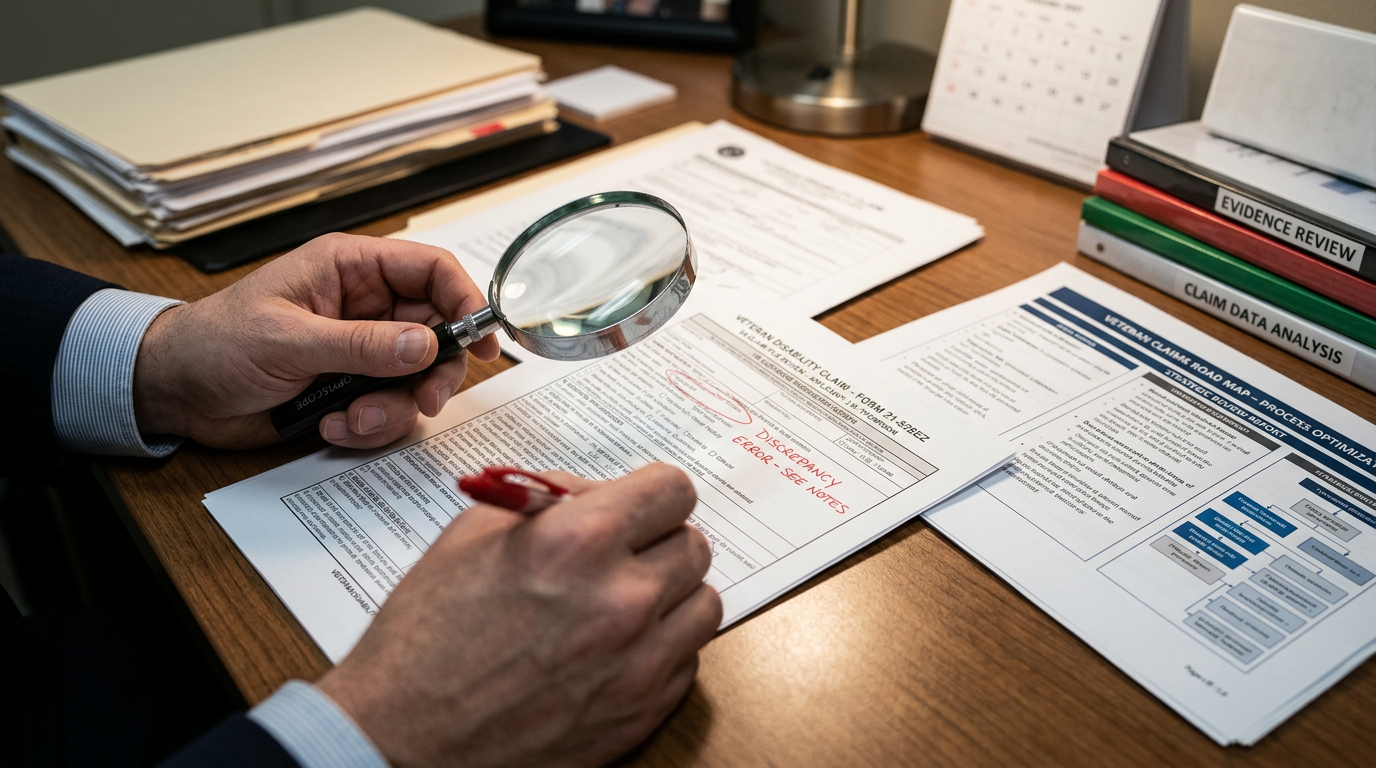

Appeal Options: Which Lane Is Right for Your Claim?
The VA gives you three decision-review options to challenge a denial or a low rating, Supplemental Claim, Higher-Level Review, and a Board appeal, plus a separate CUE motion for an undebatable past error. Each has different rules, timelines, and evidence requirements. Picking the wrong one wastes months. This page helps you pick the right one.
Quick Decision Guide
Work through these questions in order. The first “yes” answer points you to the strongest starting lane.

Do you have new evidence the VA has never seen?

Was the evidence already strong but the decision was wrong?

Is your case legally complex, or has the RO denied you multiple times?

Did a prior decision (even years ago) contain an obvious, undebatable legal or factual error?

The Three Decision-Review Options, Side by Side (Plus CUE)
Under the Appeals Modernization Act (AMA) you have three decision-review options, Supplemental Claim, Higher-Level Review, and a Board appeal. CUE is a separate motion, not a fourth option, shown here so you can see how it differs. You can use different options for different issues from the same decision simultaneously.
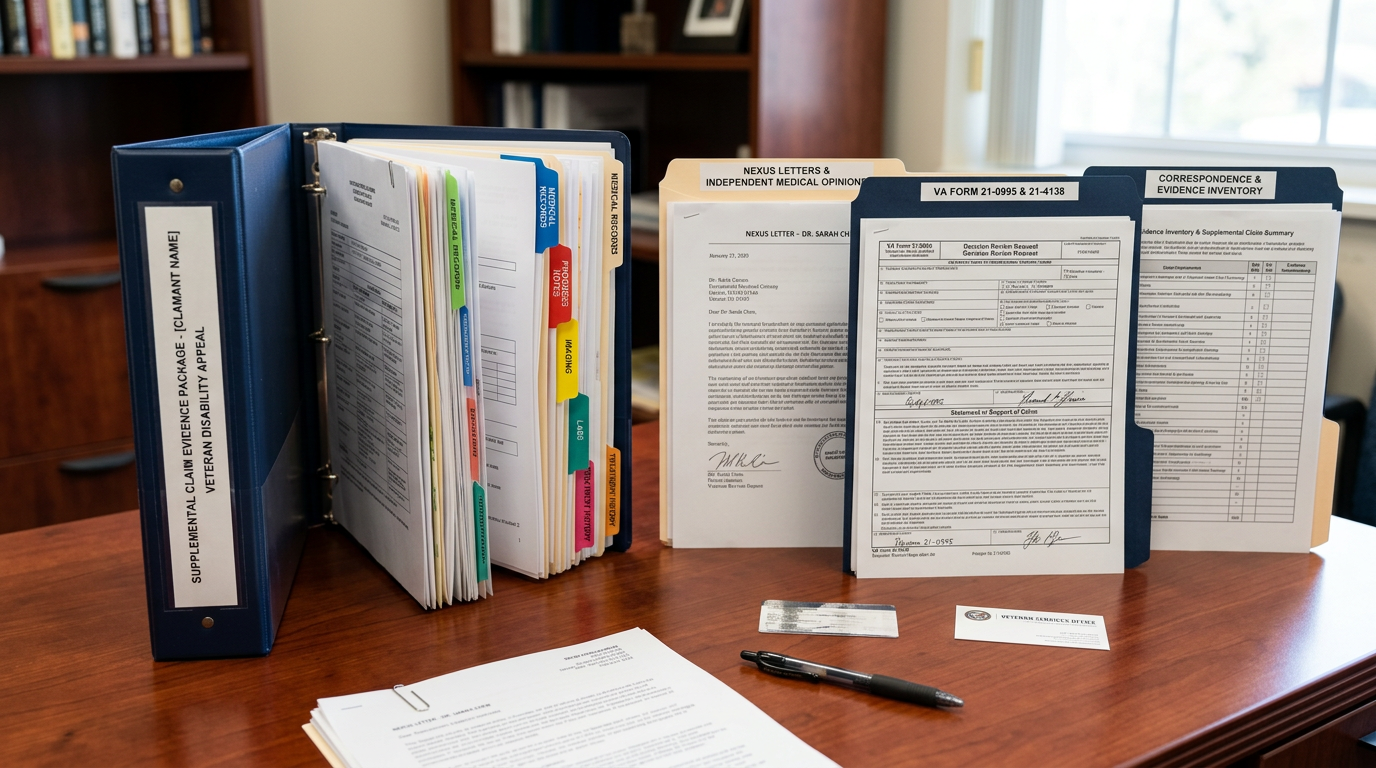
Supplemental Claim
Best when:
You have NEW evidence the VA never saw, a nexus letter, a private DBQ, updated medical records, or a newly applicable law like the PACT Act.

Higher-Level Review
Best when:
The evidence was already strong but the VA decision got it WRONG, wrong diagnostic code, ignored evidence in the file, or failed to apply benefit of the doubt.

Board of Veterans’ Appeals
Best when:
The legal argument is complex, credibility testimony is needed, or the regional office has denied you multiple times and a Veterans Law Judge is the strongest path forward.

Clear & Unmistakable Error (CUE)
Best when:
A prior VA decision, even decades old, contained an undebatable error: wrong law applied, evidence clearly in the file was ignored, or a mathematical error in the combined rating.
At a Glance
This table puts all four options side by side so you can see what each one allows, what it costs you in time, and whether you can add evidence. The VA will not tell you which lane fits your file. That decision is yours, and the clock is running from the date on your decision letter. Your part is to find the row that matters most for your case, usually new evidence or a hearing, and choose the lane that gives it to you.
| Feature | Supplemental | HLR | Board | CUE |
|---|---|---|---|---|
| New evidence accepted? | Yes, required | No | Yes (Evidence docket) | N/A |
| Timeline | Faster | Faster | Often a year or more | Varies |
| Who reviews? | Rating official | Senior adjudicator | Veterans Law Judge | RO or Board |
| Hearing available? | No | Informal conference | Yes | No |
| Preserves effective date? | Yes (within 1 yr) | Yes (within 1 yr) | Yes (within 1 yr) | Reaches original date |
| Can be re-filed? | Yes, with new evidence | No (same issue) | No (same issue) | Yes, different error |
Match the Sentence in Your Denial to the Lane That Fixes It
The reason your claim failed is usually one sentence buried in the reasons for decision. Find it before you pick anything, because the lanes split on one question: can new evidence come in, or not? These are the sentences I see over and over in exposure denials. Find the one closest to yours. Here is the trap: the same sentence can point two directions depending on what is already in your file, so treat this as a starting point, not a substitute for somebody reading the whole decision.

The decision said
“Your condition is not on the presumptive list for that location.”
Lane: Supplemental Claim
A presumption is one road, not the only road. Direct service connection under 38 CFR 3.303 is still open. Build the exposure record and get a medical opinion that ties the disease to it. Here is the trap: arguing the list in a Higher-Level Review, when the list was never going to move.

The decision said
“There is no evidence you were exposed to a hazard.”
Lane: Supplemental Claim
That is a records problem, and records are exactly what this lane is for: unit records, base histories, the duty you actually pulled, and buddy statements. Name the records and VA's duty to assist under 38 CFR 3.159 applies.

The decision said
“The examiner said any connection would be speculative.”
Lane: Read the opinion first
If the opinion never answered the question it was asked, or gave no reasons, that is an inadequate exam sitting on the existing record, and it belongs in a Higher-Level Review. If what you truly need is a better opinion, a private nexus letter goes in a Supplemental Claim.

The decision said
“Your condition became presumptive after your denial.”
Lane: Supplemental Claim
A change in the law is a recognized basis for this lane. The PACT Act moved a long list of conditions after the denials were already mailed. Here is the trap: assuming VA will reopen your old denial on its own. File it.

The decision said
“The presumption plainly applied to you, and the decision ignored it.”
Lane: Higher-Level Review
The dates, the place, and the diagnosis are already in the file. Do not rebuild what is already proven. Put it in front of a senior reviewer whose job is to correct the law on the record that exists.

The decision said
“A record you sent is missing from the evidence list.”
Lane: Higher-Level Review
Evidence that was in the file and never considered is an error on the existing record. A reviewer who finds a duty-to-assist error sends the claim back for the development that should have happened (38 CFR 3.2601). Here is the trap: re-sending the same record as if VA's mistake were your missing evidence.

The decision said
“The regional office repeated the same error after your Higher-Level Review.”
Lane: Board of Veterans’ Appeals
You have given that office two chances, and you cannot ask for a Higher-Level Review of a Higher-Level Review. A Veterans Law Judge is not bound by what the regional office concluded and can remand with instructions it has to follow.

The decision said
“The Board applied the wrong law to your case.”
Lane: Court of Appeals for Veterans Claims
Legal error at the Board is that court's entire job. The Notice of Appeal is due 120 days from the date the Board mailed its decision. It is the one deadline in this system with no cushion in it.
Your part: highlight the one sentence in your reasons for decision that explains the denial, then find its card above before you touch a form.
Where the Three Lanes Stop: The Court, the Old System, and the Lapsed Year
No case is served by a page that pretends every decision drops neatly into three boxes. Four situations sit at the edges, and each one runs on a date printed on a document, not on when you found out, felt well enough, or finally got someone to help.

The Court: 120 Days, and It Does Not Bend
The Court of Appeals for Veterans Claims is a federal court, independent of VA, and it reviews Board decisions for legal error. The Notice of Appeal must be filed within 120 days after the date the Board mailed its decision (38 U.S.C. 7266). The record closed at the Board, so no new evidence comes in. The court can affirm, reverse, or remand, and a remand back to the Board is a common result. Beyond it sits the U.S. Court of Appeals for the Federal Circuit. Here is the trap: treating the court as one more chance to add evidence. If you are missing a record or an opinion, that is a Supplemental Claim, not a federal case.

The Board’s Three Dockets and Their 90-Day Windows
On VA Form 10182 you pick one docket, and that pick is the strategy. Direct Review: no new evidence, no hearing, the judge decides the record as it stands. Evidence Submission: you may send evidence within 90 days after the Board receives your form (38 CFR 20.303). Hearing: you testify before a Veterans Law Judge and get 90 days after the hearing to send evidence (38 CFR 20.302), and it is the slowest of the three. Here is the trap: choosing Direct Review while you are still holding evidence you meant to send. You can switch dockets only within the narrow window in 38 CFR 20.202, and only if you have not already submitted evidence or testimony.

If Your Decision Is Older Than February 19, 2019
February 19, 2019 is the day the current system took effect. Older decisions that were never moved into it run on the legacy appeal process: a Notice of Disagreement, then a Statement of the Case, then a VA Form 9 to the Board. If those are the words on your paperwork, you are in the old system, and the three lanes on this page do not map cleanly onto it. Here is the trap: filing a current-system form on a legacy appeal and assuming it did what you meant. Have someone read the letter before you file anything.

If the Year Is Already Gone
You have two options, and neither is a new lane. File a Supplemental Claim and accept a later effective date, because the door never locks but the date moves. Or, on a final decision, raise clear and unmistakable error under 38 CFR 3.105(a), the narrow argument that the decision was undebatably wrong on the law or the facts that were in front of VA at the time. Narrow is the operative word. Here is the trap: dressing up a disagreement with how the evidence was weighed as CUE. VA will deny it, and it will be right to.
One more honest point, about me. My VA accreditation covers representation inside VA: the regional office, a Higher-Level Review, and the Board. The Court of Appeals for Veterans Claims admits its own practitioners under its own rules. If your case belongs in that court, I will tell you so plainly and point you toward someone admitted there. Your part: write the date on your decision, the Board's mailing date if you have one, and the deadline that applies to each, on the front of the envelope the day it arrives.
Inside the VA's Procedural Manual
The AMA decision-review options are created by statute, 38 U.S.C. §5104C, and set out in 38 CFR §3.2500. The M21-1 is the VA's internal processing manual; it interprets these rules and never overrides them. The Supplemental Claim requires new and relevant evidence under 38 CFR §3.2501. The Higher-Level Review provides de novo review of the existing record. The Board offers three dockets: Direct Review, Evidence Submission, and Hearing Request under 38 CFR Part 20.
Under 38 U.S.C. §5104C(a)(2), each option is independent, a veteran can pursue different options for different issues simultaneously, and the outcome in one does not preclude action in another for a different issue from the same decision.
Critical timing rule: filing in any AMA option within one year of the decision preserves the original effective date under 38 CFR §3.2500(h), the continuous pursuit rule. Missing the one-year window in every option resets your effective date, and every month lost is a month of back pay you cannot recover.
The Advocate's Take
Most veterans pick the wrong lane because they do not understand the difference between an evidence problem and a decision-making error. If the VA never saw your nexus letter, a Supplemental Claim fixes it. If the VA ignored a nexus letter that was already in the file, that is an HLR or a CUE.
Here is how the VA looks at it. Under the Appeals Modernization Act, every decision gives you one year to pick a lane and keep your effective date protected under 38 CFR §3.2500. A Supplemental Claim on VA Form 20-0995 needs new and relevant evidence, and the Duty to Assist under 38 CFR §3.159 applies, so the VA must help you get records and may order a new exam. A Higher-Level Review on VA Form 20-0996 is a fresh look by a more senior reviewer at the exact same record, with no new evidence allowed, and you can ask for an informal conference to point out the error. The Board of Veterans' Appeals on VA Form 10182 puts your case in front of a Veterans Law Judge on one of three dockets: direct review, evidence submission, or hearing. After a Board denial, you have 120 days to go to the Court of Appeals for Veterans Claims. And a CUE motion under 38 CFR §3.105(a) attacks an old final decision for an undebatable error that changed the outcome.
What you need. The full decision letter and code sheet, the C&P exam report, and a list of every piece of evidence you have that the VA did not see. With those three things on the table, the lane usually picks itself.
We do not guess. We read the denial letter line by line, audit the evidence of record, and pick the lane that matches the specific deficiency. Sometimes it is one lane. Sometimes we split issues across two lanes simultaneously, Supplemental for the evidence gap, HLR for the legal error.
The pitfalls: filing an HLR when the real problem is a missing nexus, because the reviewer cannot look at anything new; choosing the Board hearing docket for an issue that one good medical opinion would win in a Supplemental Claim; letting the one-year window close and starting over with a later effective date; and stacking lanes on the same issue, which the rules do not allow. Your part: keep every letter, mark the one-year date on your calendar the day the decision arrives, and gather what you have before we choose. We work WITH you, not FOR you.
If you are not sure which lane applies, start with a Mission 5 Intelligence Brief. We will tell you exactly which pathway gives your claim the best chance, and build the evidence package to win it.
The Nine Questions Every Veteran Should Be Able to Answer
This is the standard I hold every page on this site to. Before you file anything on choosing your appeal path, you should be able to answer these nine questions. If you cannot answer them yet, you are not ready, and that is exactly what my review is for. This is education first, representation second.

What is this?
Appeal options are the routes for challenging a VA decision you disagree with, the three decision-review options, a Supplemental Claim, a Higher-Level Review, and a Board appeal, plus CUE as a separate route. Choosing correctly is a strategy decision, not a form-picking exercise.

What must the VA decide?
On whichever route you choose, whether the earlier decision was correct, either on the existing record or in light of new and relevant evidence.

What must the evidence prove?
It depends on the route. A Supplemental Claim needs new and relevant evidence; a Higher-Level Review argues the record already proves your case; a Board appeal puts the issue before a Veterans Law Judge. The problem dictates the route.

What is the VA responsible for?
Giving you a decision that states your review options and deadlines, and, on the route you choose, reviewing the issue under the correct standard and stating its reasons.

What are you responsible for?
Filing the correct review within the deadline, choosing the route that matches your specific problem, and preserving your effective date through continuous pursuit.

What can go wrong?
Picking the wrong lane, filing a Supplemental with no new evidence, or letting the one-year window lapse and losing your original effective date.

What you should not do
Do not refile blindly or default to the same lane every time. First decide whether you have an evidence problem or a decision problem.

What I review as your accredited agent
I read the denial line by line, decide whether it is an evidence problem or a decision problem, and match each issue to the route built to fix it, sometimes splitting issues across lanes at once.

What happens next
We file the correct review within the deadline that protects your date, and if one route is exhausted, we move to the next appropriate one.
Representation Means Telling You the Truth
Do Not File Yet If…
Before you take action on choosing your next review path, check whether any of these apply. Filing at the wrong time can weaken your claim, waste a deadline, or put you on a longer path than necessary. I would rather tell you to wait than watch you lose an effective date or hand the VA a thin file it can deny in a week. A denial is not the end, but it costs you months. Read each item below honestly. If one fits your situation, call us first and we will tell you what to fix before anything gets filed.




Continuous Pursuit: Why Deadlines Protect Your Money
If you timely use available review options, the effective-date rules can preserve the earlier claim date.
THE RULE
When a claimant continuously pursues a claim by timely requesting review within the applicable period, the effective date can remain tied to the original filing date. A Supplemental Claim filed more than one year after notice of a decision generally cannot receive an effective date earlier than the date of the later filing, subject to applicable exceptions.
✓ CONTINUOUS PURSUIT
Decision issued → Review filed within one year
Second decision → Review filed within one year
Result: Original effective date preserved
✗ BROKEN PURSUIT
Decision issued → More than one year passes
New Supplemental Claim filed
Result: Effective date resets to the new filing date
WHAT THIS MEANS FOR YOU
At a 70% rating, every year of back pay is roughly $19,000 to $20,000 in tax-free compensation (estimate based on current VA rates; exact amount depends on dependents and other factors). Letting one year lapse without filing a review can mean losing that entire year of back pay. Deadlines protect your money, I track every one of them.
Appeal Options, Questions Veterans Ask
These are the questions veterans ask me when they are choosing between a Supplemental Claim, a Higher-Level Review, and a Board appeal. The right lane depends on why you lost, not on which one sounds fastest. Your part is to match the reason for your denial to the lane built to fix it, and act inside the one-year window.