

VA Math · 38 CFR §4.25
Combined Ratings Formula
38 CFR §4.25, why 50% + 30% does not equal 80%, and what that means for your compensation
The VA does not add your disability percentages together. Under 38 CFR §4.25, it uses a combined ratings formula built on whole-person impairment theory, and understanding it is the difference between expecting a check and knowing exactly what the VA owes you. On this page I break the formula down in plain English, work through real examples, explain the bilateral factor, and show you exactly where the VA gets the math wrong.
The Combined Rating Formula, Plain English
The VA does not add your disability percentages together. Under 38 CFR §4.25, the VA uses a combined ratings formula based on whole-person impairment theory. Each disability is applied to the percentage of health you have remaining, not to the original 100%.
This is the single most misunderstood concept in VA disability compensation. Veterans routinely expect that a 50% rating plus a 30% rating should equal 80%. It does not. The math produces 65%, which rounds to 70%. Understanding this formula is the difference between expecting a check and knowing exactly what the VA owes you.
The formula works like this: start with your highest-rated disability. The next disability is applied to the remaining percentage of health. Then the next disability is applied to whatever remains after that. Continue until all conditions are combined, then round to the nearest 10%.

Step-by-Step Examples

Here is how the formula plays out across the most common combinations. Start with the highest-rated disability, apply each additional condition to the health that remains, and round the final value to the nearest 10 percent.
50% + 30%: 50 + (30% of remaining 50) = 50 + 15 = 65, which rounds to 70%.
70% + 40%: 70 + (40% of remaining 30) = 70 + 12 = 82, which rounds to 80%.
40% + 20% + 10%: 40 + (20% of 60) = 52, then 52 + (10% of 48) = 56.8, which rounds to 60%.
50% + 50%: 50 + (50% of remaining 50) = 50 + 25 = 75, which rounds to 80%.
30% + 20% + 10% + 10%: sequential, 30 to 44 to 49.6 to 54.64, which rounds to 50%.
The Bilateral Factor, 38 CFR §4.26
When disabilities affect paired extremities (both arms, both legs, or one arm and one leg on the same or opposite sides), the VA applies a 10% bonus to the combined value of those bilateral conditions before merging them into the overall rating.
Example: a veteran with 30% left knee and 20% right knee has a bilateral combined value of 44%. The 10% bilateral factor adds 4.4%, bringing it to 48.4% before combining with non-bilateral disabilities. This small factor can push a rounding threshold and increase monthly compensation by hundreds of dollars.

Common Mistakes That Cost Veterans Money

Not claiming bilateral conditions separately, missing the §4.26 bilateral factor bonus

Assuming the VA will automatically identify secondary conditions that raise the combined rating

Not filing for conditions that would push the combined value past a rounding threshold (e.g., from 64% to 65% = the difference between 60% and 70%)

Ignoring the order of operations, the VA should start with the highest-rated condition, and errors here change the final number

Not understanding that a 0% service-connected rating still has value, it establishes the condition as service-connected for future increases and secondary claims
Why the Combined Rating Matters for TDIU
Under 38 CFR §4.16(a), you need a combined rating of 70% or higher (with at least one condition at 40%) to qualify for schedular TDIU, Total Disability based on Individual Unemployability. TDIU pays at the 100% rate even if your combined schedular rating is below 100%.
This means the difference between a combined 60% and 70% is not just the monthly payment difference, it is potentially the difference between qualifying for TDIU (100% rate) and not. Every rating point matters.

Where the VA Gets This Wrong

Applying the combined rating formula in the wrong order, the VA should start with the highest-rated disability and work down, and a math error here changes the final combined value

Missing the bilateral factor under §4.26 entirely, if paired extremities are affected (both knees, both shoulders), the 10% bilateral bonus must be applied before merging into the overall combined rating
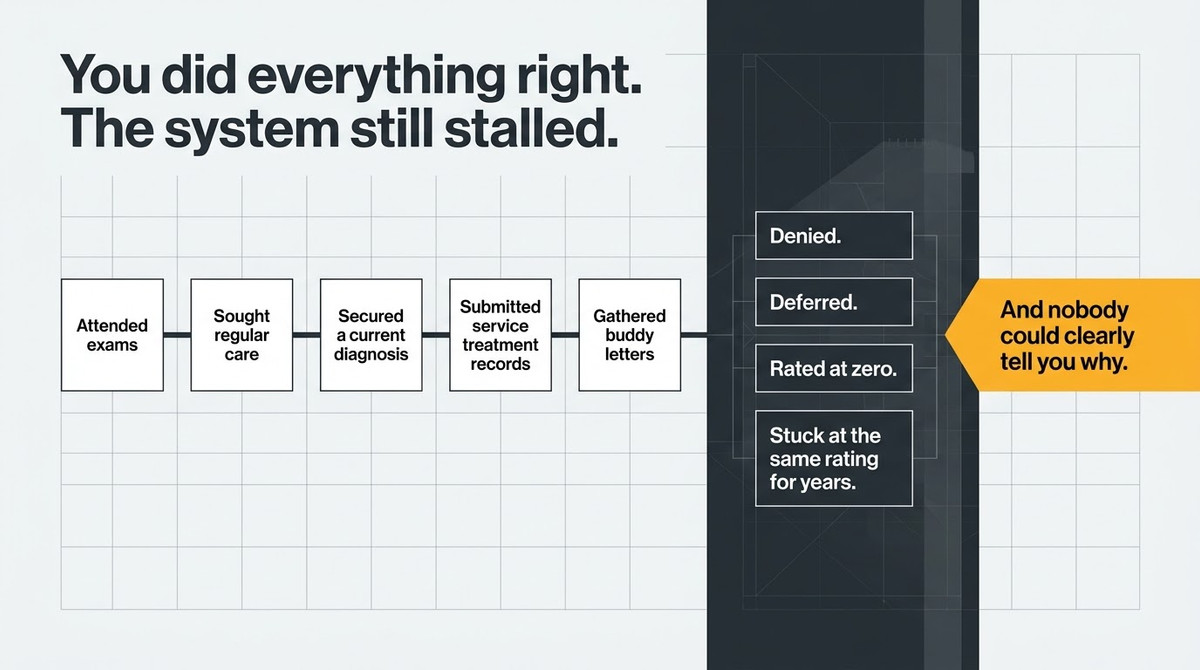
Not rounding the final combined value correctly, values ending in 5 or higher round up, and the difference between 64% (rounds to 60%) and 65% (rounds to 70%) is hundreds of dollars per month

Failing to recognize that conditions of common etiology can be combined as a single disability for TDIU threshold purposes, missing this means a veteran who qualifies for schedular TDIU is incorrectly denied

Ignoring 0% service-connected ratings, a 0% rating has no immediate compensation value but establishes the condition for future increases and secondary claims, and the VA sometimes fails to assign it

Not flagging when one more claim could push the combined value past a rounding threshold, the VA has no obligation to tell you that a 10% secondary claim would jump you from 60% to 70%
See the Combined Rating Math in Action
This interactive diagram shows exactly how the VA applies whole-person impairment theory to combine multiple ratings. Watch how each new condition is applied to the remaining healthy percentage. The VA starts with your highest rating, applies the next one to what is left, and keeps going until every rating is counted. Only then does it round to the nearest 10 under 38 CFR 4.25. Enter the ratings from your own decision letter and check whether the VA got the same answer.
Why 50% + 30% Does NOT Equal 80%
The VA uses “whole-person” math, not simple addition. This is how ratings really stack.
The VA always begins from a whole, healthy person (100%).
50% of 100 is subtracted. You have 50% “efficiency” left.
30% is taken from the REMAINING 50 (0.30 × 50 = 15). 50 − 15 = 35 left.
100 − 35 = 65, then rounded to the nearest 10 → 70%.
Bottom line: 50% and 30% combine to 65% → rounded to 70%, not 80%. The same math turns two 50% ratings into 75% → rounded to 80%, not 100%. Every rating you add is worth less than the last. That is why which conditions you claim, and in what order, matters as much as how many.
The Advocate's Take
Veterans lose money every single month because nobody ever explained this formula to them. You add up 50, 30, 20 and 10 on a napkin, get 110, and then the VA tells you that you are at 70%. It feels like a trick. It is not a trick, it is math, but it is math the VA will never sit down and walk you through. I have been there, staring at a rating decision and wondering where the other 40 percent went.
Here is how the VA looks at it. Under 38 CFR §4.25, ratings are not added. They are combined using the "whole person" method. You start at 100% healthy. Your highest rating comes off first. If you are rated 50%, you are treated as 50% efficient. The next rating, say 30%, is applied only to what is left: 30% of the remaining 50 is 15, so you are now 65% disabled. The VA then rounds to the nearest 10, and 65 rounds up to 70%. Every additional condition shrinks by the same logic, which is why a 10% rating on top of a high combined value sometimes moves nothing and sometimes pushes you over a threshold worth hundreds of dollars a month. If you have disabilities affecting both arms, both legs, or paired skeletal muscles, 38 CFR §4.26 adds a bilateral factor: the VA combines those ratings, then adds 10% of that combined value before it goes into the rest of the math. That bonus is mandatory, and I see it missed.
What you need. Your most recent rating decision and the code sheet, which lists every service-connected condition, its diagnostic code, and its percentage. A list of every condition you currently have, service connected or not, and every condition you have been treated for since service. And your treatment records, because the math only helps you if each individual rating is correct to begin with.
Walk through it with me. Step one: we list every rated condition from highest to lowest. Step two: we run the combined math ourselves, including any bilateral factor, and compare our number to what the VA assigned. Step three: we check each individual rating against the rating schedule for the body system, because one underrated condition throws off the whole stack. Step four: we look for unclaimed conditions, especially secondaries under 38 CFR §3.310, that are supported by your records. Step five: we decide which single claim, filed in which lane, gives you the best realistic chance of reaching the next threshold. One condition at a time, done right.
The pitfalls: filing six weak claims hoping one sticks, which invites a reduction review of what you already have; chasing a 10% claim that cannot move your combined value while ignoring the one that can; and assuming the VA got the arithmetic right. It does not always. A math error on a code sheet is a clear and unmistakable error, and it can be fixed.
Your part: keep a current list of every condition and every provider, and bring me your full code sheet, not a screenshot of the total. I run the numbers, I find the gaps, and I build the strategy that targets the highest defensible combined rating. We work WITH you, not FOR you.

The VA does not add your ratings together, it combines them, and the result almost always feels lower than it should. I want you to see that math the way the VA does it. Watch the official VA video below, then use the formula on this page to check whether your combined rating was calculated correctly.
How the Combined Rating Is Actually Calculated
VA math is not simple addition. This official VA explainer walks through the combined-rating formula step by step, alongside how compensation is built from it.
How Your Combined Rating Is Calculated
How VA Disability Compensation Works
Building a Combined Ratings Formula Claim That Wins
Every claim stands on three legs. Knock one out and the claim falls over, no matter how bad your symptoms are. Before you file, look at your file and find all three. If one is missing, that is the piece to build first. The VA will not build it for you, and filing without it usually just buys you a denial letter and lost time.
 01
01A current diagnosis
A doctor has to say you have it, now, in writing. Not "reports symptoms of", a diagnosis. Without this leg, nothing else in the file matters.
 02
02A link to your service
An event, an injury, an exposure, or an already service-connected condition. Service records, unit records, buddy statements, and your own account all count as evidence.
 03
03A nexus that ties the two together
A medical opinion stating it is at least as likely as not that your service caused or aggravated the condition. That phrase is a legal standard: 50 percent or better. It is the leg most denials break.
Document the problem before you file
• Keep a dated symptom log for at least 30 days. Frequency, severity, and what it stopped you from doing.
• Get statements from people who see it, a spouse, a coworker, a battle buddy. Lay evidence is legal evidence.
• Pull your private treatment records. The VA only has to help; it does not have to go find everything.
• Write down what you have stopped doing. Lost work, lost sleep, lost activities. That is what impairment looks like on paper.
Your Rights in This Process
Most veterans walk into this system without knowing the rules the VA itself has to follow. That is how claims get denied for missing evidence the VA was supposed to help you find, and how exams get done by the wrong clinician. These six rights are written into federal regulation. Know them before you file, and make the VA honor every one of them when it decides your claim.

It costs nothing to file
Filing a VA claim is free. Accredited representatives may only charge for work on an appeal after an initial decision, and those fees are capped by 38 CFR §14.636.

The VA has a Duty to Assist you
Under 38 CFR §3.159 the VA must help you get the evidence it needs, and it must tell you what is missing before it denies you for missing it.

You can ask for a different examiner
You may request a trauma-informed clinician, or a clinician of a specific gender, for a C&P examination. Ask before the exam is scheduled.

You can claim every condition you have
There is no limit and no penalty. Primary conditions, secondary conditions, and conditions made worse by service all get filed.

You can appeal and be re-evaluated
A denial is not the end. You may submit new evidence, request a higher-level review, appeal to the Board, and ask for re-evaluation when your condition worsens.

You must be considered for TDIU
If your service-connected conditions keep you from holding substantially gainful employment, you may be paid at the 100 percent rate without a 100 percent rating.
Frequently Asked Questions
Most of the anger I hear about VA math comes from one surprise: 50% plus 30% does not equal 80%. The VA combines ratings against what is left of a whole person, then rounds. The answers below walk through the questions that come up most. Your part is to run your own numbers before you decide the VA made a mistake, or that it did not.
Why does the VA not add ratings together?
What is the bilateral factor and when does it apply?
How does rounding work?
Can I get over 100% combined?
What is the difference between combined rating and TDIU?

When You Are Ready to File
Talk to an accredited representative before you file. It costs nothing to ask, and the order you file in changes what the VA is allowed to award you. Albert L. Thombs Jr. is VA-Accredited Claims Agent #45147. A short conversation now can save you a year spent waiting in the wrong review lane.
Your part starts at the kitchen table. Pull your DD-214, your rating decision if you have one, and the names of every doctor who treats you today. Under 38 CFR 3.159 the VA has to help you gather records, but it can only chase the records you tell it about. Leave a doctor off the 21-4142 and that treatment may never reach your file.

The application itself
This is the form that opens a disability compensation claim. List every condition you are claiming, and name the secondary conditions explicitly.
Release for private records
Authorises the VA to request records from your private doctors. Without it, treatment outside the VA may never reach your file.
Lay or buddy statement
The official form for your own statement and for statements from people who witnessed the event or the change in you.
Keep Reading
One page never tells the whole story of a claim. The VA rates every condition on its own evidence, its own exam and its own diagnostic code, and the pieces connect in ways most veterans never see until a decision letter lands. These are the pages that pick up where this one stops. Read them before you file, not after a denial, because the cheapest fix in this process is the mistake you never make.

Combined Ratings Calculator
Run the exact VA math under 38 CFR §4.25. Free tool, no account required.
Read more
TDIU
Paid at the 100% rate when service-connected disabilities keep you from substantially gainful work.
Read more
Secondary Conditions
Each secondary condition you win is added to your combined rating, often the fastest way up.
Read more
Rating Increases
When a condition worsens, a higher rating can push your combined value past the next threshold.
Read more