
Getting Started
What Is Service Connection?
The four ways to connect a disability to service under 38 CFR Part 3
Service connection is the legal foundation of every VA disability claim. There are four distinct paths to establish it, and most denials happen because only one was ever argued.
The Legal Foundation of Every Claim
Before the VA will rate a disability and pay compensation, it must agree that your condition is connected to your military service. This is service connection, the threshold question that every claim must answer. Without it, the rating percentage is irrelevant because there is nothing to rate.
The law provides four distinct legal theories for establishing this connection. Each is governed by its own regulation, has its own evidentiary requirements, and wins different types of claims. A denial under one theory says nothing about the viability of the others.

The Four Theories of Service Connection

Direct Service Connection, §3.303
The most common path. Requires three elements: (1) a current, diagnosed disability, (2) an in-service event, injury, or exposure, and (3) a medical nexus opinion linking the two. If any one element is missing, the claim fails under this theory, but it may succeed under another.
Secondary Service Connection, §3.310
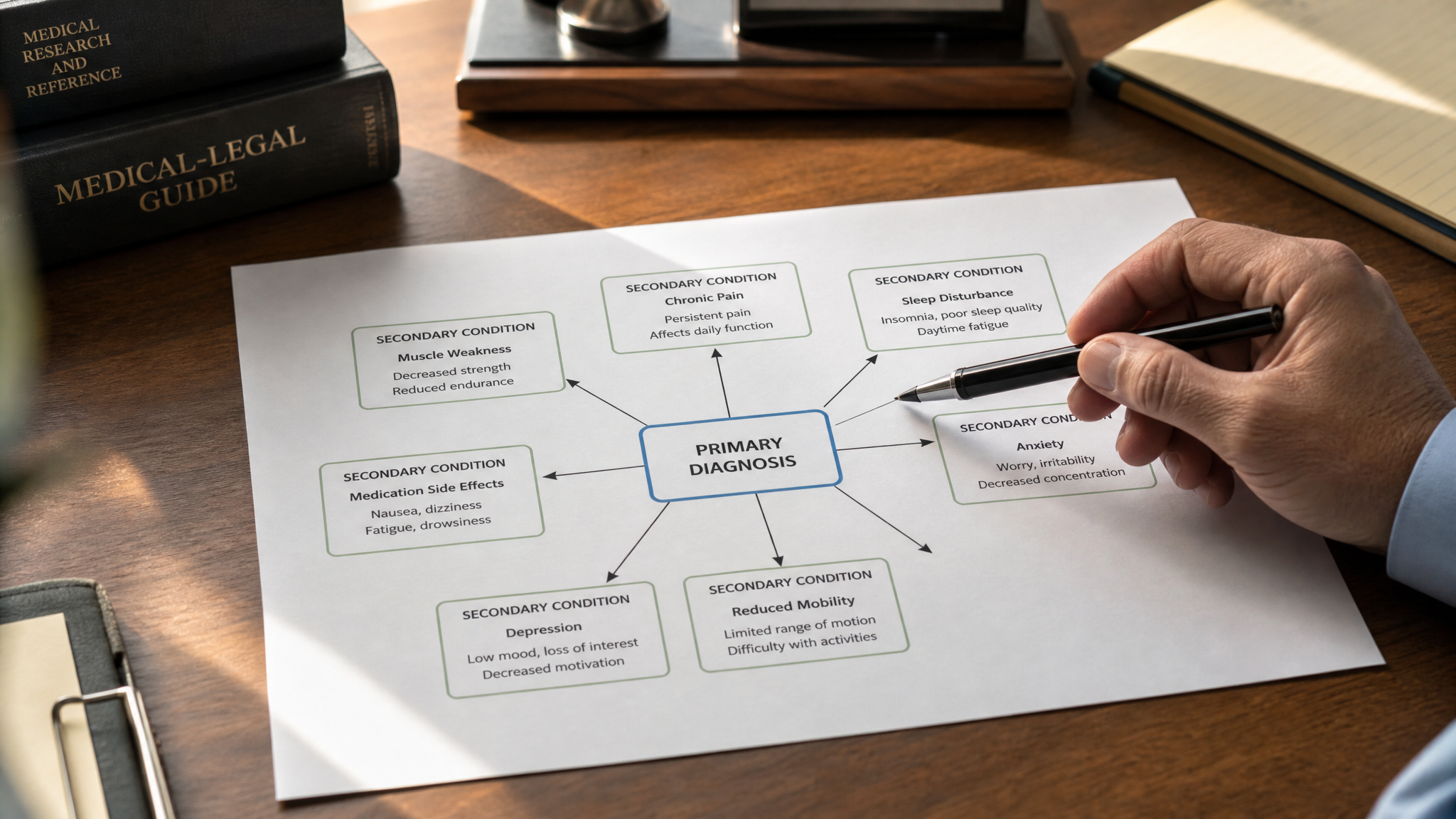
A condition caused or permanently aggravated by an already service-connected disability. Example: service-connected knee injury leads to hip misalignment, or service-connected PTSD causes sleep apnea or hypertension. The nexus must link the secondary condition to the primary, not to service itself.

Presumptive Service Connection, §3.307 / §3.309
For certain conditions associated with specific service (Agent Orange, Gulf War, radiation, PACT Act exposures, POW status), the VA presumes the nexus without requiring an individual medical opinion. If you served in the covered location during the covered period and have the listed condition, service connection is conceded.

Aggravation, §3.306
A pre-existing condition that was permanently worsened beyond its natural progression by military service. The VA applies a presumption of soundness: if you passed the entrance exam, you are presumed sound at entry, and the VA bears the burden of proving a condition pre-existed. If it can prove pre-existence, you must show aggravation.
Pleading in the Alternative
The VA is not required to develop every theory on your behalf, and in practice it usually develops the narrowest one, the one most likely to result in denial. A skilled representative identifies every viable theory and pleads them in the alternative: "This condition is directly connected to service; in the alternative, it is secondary to the veteran's already service-connected PTSD; in the further alternative, it is presumptive under the PACT Act."
This approach forces the VA to address each theory individually. A denial must explain why all of them fail, which is much harder than denying just one.

The Benefit of the Doubt, §3.102
When the evidence for and against service connection is in approximate balance, roughly 50/50, the VA is required to resolve the doubt in the veteran's favor. This is not a technicality; it is a statutory mandate. In practice, the VA routinely applies the standard unevenly, and holding raters to §3.102 is a fundamental part of the appeals process.

The Advocate's Take
Most veterans argue one road and get denied. We map all four before we file, and we plead every viable theory in the alternative so the VA cannot pick the weakest one and pretend the rest do not exist.
Where the VA Gets This Wrong
The most common error is developing only direct connection when a presumptive or secondary theory was clearly available on the record. If the VA denied your claim without addressing an obvious alternative theory, that is a basis for appeal.
Building a What Is Service Connection? Claim That Wins
Every claim stands on three legs. Knock one out and the claim falls over, no matter how bad your symptoms are. Before you file, look at your file and find all three. If one is missing, that is the piece to build first. The VA will not build it for you, and filing without it usually just buys you a denial letter and lost time.
 01
01A current diagnosis
A doctor has to say you have it, now, in writing. Not "reports symptoms of", a diagnosis. Without this leg, nothing else in the file matters.
 02
02A link to your service
An event, an injury, an exposure, or an already service-connected condition. Service records, unit records, buddy statements, and your own account all count as evidence.
 03
03A nexus that ties the two together
A medical opinion stating it is at least as likely as not that your service caused or aggravated the condition. That phrase is a legal standard: 50 percent or better. It is the leg most denials break.
Document the problem before you file
• Keep a dated symptom log for at least 30 days. Frequency, severity, and what it stopped you from doing.
• Get statements from people who see it, a spouse, a coworker, a battle buddy. Lay evidence is legal evidence.
• Pull your private treatment records. The VA only has to help; it does not have to go find everything.
• Write down what you have stopped doing. Lost work, lost sleep, lost activities. That is what impairment looks like on paper.
Your Rights in This Process
Most veterans walk into this system without knowing the rules the VA itself has to follow. That is how claims get denied for missing evidence the VA was supposed to help you find, and how exams get done by the wrong clinician. These six rights are written into federal regulation. Know them before you file, and make the VA honor every one of them when it decides your claim.

It costs nothing to file
Filing a VA claim is free. Accredited representatives may only charge for work on an appeal after an initial decision, and those fees are capped by 38 CFR §14.636.

The VA has a Duty to Assist you
Under 38 CFR §3.159 the VA must help you get the evidence it needs, and it must tell you what is missing before it denies you for missing it.

You can ask for a different examiner
You may request a trauma-informed clinician, or a clinician of a specific gender, for a C&P examination. Ask before the exam is scheduled.

You can claim every condition you have
There is no limit and no penalty. Primary conditions, secondary conditions, and conditions made worse by service all get filed.

You can appeal and be re-evaluated
A denial is not the end. You may submit new evidence, request a higher-level review, appeal to the Board, and ask for re-evaluation when your condition worsens.

You must be considered for TDIU
If your service-connected conditions keep you from holding substantially gainful employment, you may be paid at the 100 percent rate without a 100 percent rating.
When You Are Ready to File
Talk to an accredited representative before you file. It costs nothing to ask, and the order you file in changes what the VA is allowed to award you. Albert L. Thombs Jr. is VA-Accredited Claims Agent #45147. A short conversation now can save you a year spent waiting in the wrong review lane.
Your part starts at the kitchen table. Pull your DD-214, your rating decision if you have one, and the names of every doctor who treats you today. Under 38 CFR 3.159 the VA has to help you gather records, but it can only chase the records you tell it about. Leave a doctor off the 21-4142 and that treatment may never reach your file.

The application itself
This is the form that opens a disability compensation claim. List every condition you are claiming, and name the secondary conditions explicitly.
Release for private records
Authorises the VA to request records from your private doctors. Without it, treatment outside the VA may never reach your file.
Lay or buddy statement
The official form for your own statement and for statements from people who witnessed the event or the change in you.
Keep Reading
One page never tells the whole story of a claim. The VA rates every condition on its own evidence, its own exam and its own diagnostic code, and the pieces connect in ways most veterans never see until a decision letter lands. These are the pages that pick up where this one stops. Read them before you file, not after a denial, because the cheapest fix in this process is the mistake you never make.

The Responsibility to Yourself
Many veterans blame the VA's "deny, deny, deny" culture, and it is real, but a large share of denied claims trace back to the veteran going AWOL on their own case.
Read more
The VA Claim Process, Start to Finish
Understanding each stage of the claim lifecycle lets you spot exactly where your claim stalled or failed, and which review option fixes it.
Read more
DD-214 & Discharge Status
Your DD-214 and character of discharge shape eligibility for VA benefits. A less-than-honorable discharge is not always the end of the road, the rules have doors.
Read more