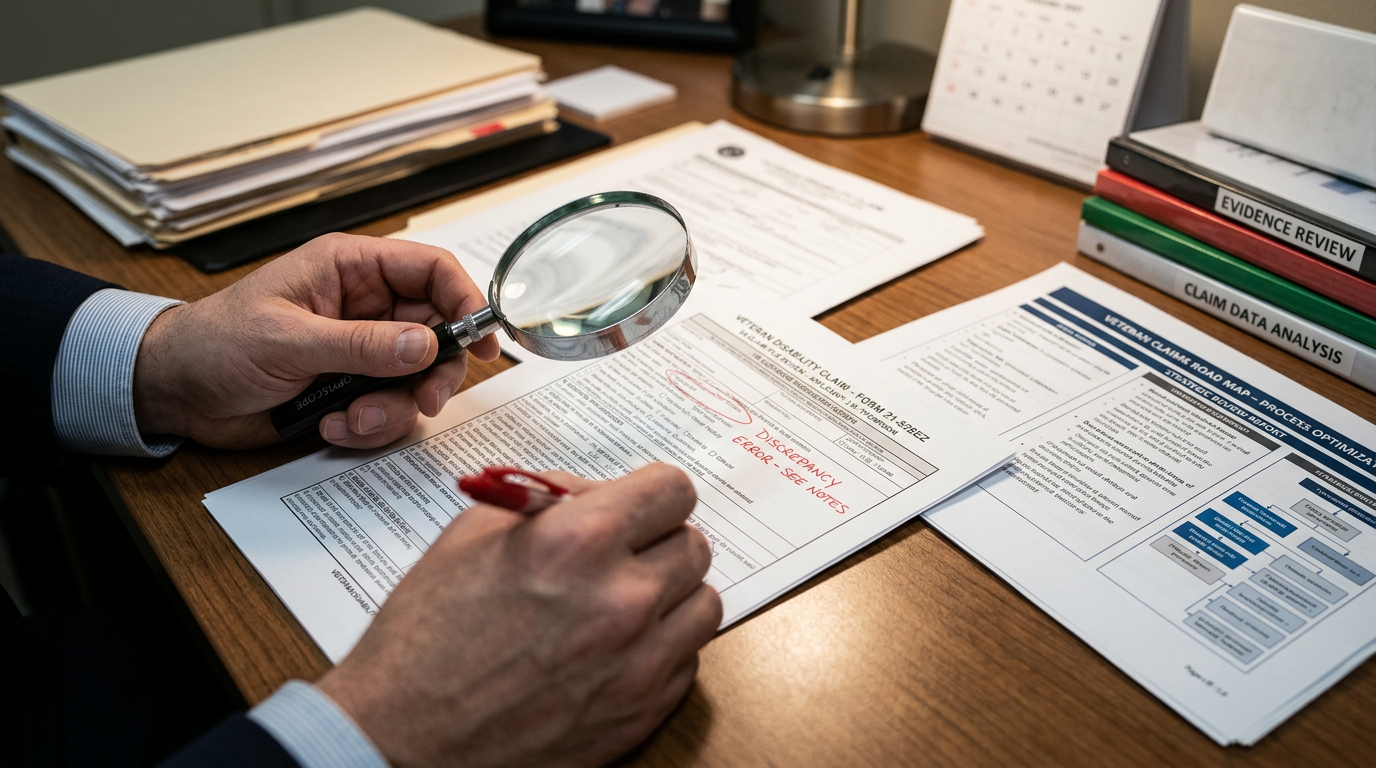

From Sign-Up to Recovery
How It Works: Your Case, Step by Step
From the moment you reach out to the day your benefits land, every step is built to decode the VA’s decision and expose the errors they hope you never find.
We do not file and forget. We audit your file against the regulations, route each condition through the appeal lane that fits the error the VA made, and fight it through every stage, with no upfront cost for representation.
From Sign-Up to Recovery
Every case runs through the same disciplined sequence, no shortcuts, no guesswork. Here is exactly what happens from the moment you reach out to the day we fight your case. Each step says what we do and what you do, because a claim moves only as fast as its slowest piece. Keep your decision letter handy, stay in treatment, and answer our requests quickly, and you will never be the reason your case stalls.
Online Registration
Complete your online registration with your service history, denial details, and current rating. An accredited agent, not a receptionist, not a chatbot, personally reviews every submission within 48 hours. We tell you honestly whether we can help before you sign anything.
You will need two things to start: your most recent VA Decision Letter, and to be in active medical treatment for your conditions. If you cannot locate your decision letter, we can help you obtain it once you are on file.

Sign the VA Authorization Forms
Once we agree to work together, you sign VA Form 21-22a, the federal power-of-attorney form that authorizes us to access your claims file and represent you before the VA. This is filed with the VA Office of General Counsel and is the legal document that puts us on your case.
Nothing happens on your claim until this form is signed and filed. By law (38 U.S.C. §5904), no fee attaches until after the VA issues its first decision and the form is on record. You are never locked in, you can revoke the 21-22a at any time.
Access Your Client Portal & Upload Your Records
You gain access to your secure client portal where you upload every document that matters: medical records, decision letters, buddy statements, service records, and anything else relevant to your case. The more complete your upload, the stronger our forensic review.
This is YOUR part of the process. We cannot fight what we cannot see. Upload everything, treatment records, private medical opinions, photos, journal entries, employment records. The portal is secure, and every document you submit becomes part of your evidence file.

We Gain Access to Your C-File (7–14 Days)
Within 7 to 14 days of the VA processing your 21-22a, we receive full access to your VA claims file (C-File), every decision, every exam, every piece of evidence the VA has on you. This is the raw material for the forensic audit.
The C-File is the single most important document in your case. It contains the VA’s entire record of your claim history, including evidence they used against you, exams they relied on, and decisions they made. Without it, no one can give you real answers.
Forensic Review of Your Complete File
Once we have your uploaded records AND your C-File, we conduct a full forensic review, pulling apart every denial, every rating decision, every C&P exam report, and every piece of evidence in the record. This is not a cursory review. It is a structured evidence audit.
We identify legal errors under 38 CFR §3.105(a), inadequate C&P exams under 38 CFR §3.159(c)(4), missing DeLuca factors for musculoskeletal conditions, overlooked secondary conditions under 38 CFR §3.310, effective date errors under 38 CFR §3.400, and every regulation the VA violated. Every error is documented.

Initial Client Consultation
Before we finalize anything, we schedule your initial consultation to discuss your case in detail. This is where we walk you through what we found, what the VA got wrong, and what the evidence actually supports. You ask questions. We give you straight answers.
This is a real conversation, not a sales pitch. We combine everything: the documents you uploaded, the evidence we gathered from your C-File, and the findings from our forensic review. You leave this meeting knowing exactly where your case stands and what needs to happen next.

Generate & Perfect Your Forensic Report
After the initial consultation, we get to work. We generate your complete forensic report using everything, the records you uploaded, the evidence we gathered from the C-File, and the information from our initial interview. The report is then perfected and finalized.
This report is the backbone of your case. It documents every error the VA made, maps each condition to its optimal appeal lane, identifies the evidence needed to win, and lays out the strategy. For representation clients, this becomes the battle plan we execute. For Mission 5 Brief clients, this is the product you take home.
Choose Your Service & We Send the Agreement
We help you choose the service option that fits your case, Standard Direct-Pay (20%), High-Complexity (30%), or the Mission 5 Intelligence Brief ($750 flat). Once you choose, we send the registration agreement that matches your selection, and the fight begins.
This is not a pressure decision. The forensic review tells us, and you, exactly what your case needs. A clean, recent denial? Option 1. A decade of denials with Board history? Option 2. Want to fight it yourself? The Mission 5 Brief. We want to help you make the right choice so we know exactly which agreement to send.
Compare the Three Services Side by Side
Every service starts from the same forensic review of your file, that is the foundation every client gets. From there the three diverge sharply in who does the fighting, how far it is carried, and how the fee is paid. The green checks and red marks below show, at a glance, exactly where the services are the same and where they are not.

| Feature / Scope | Option 1Standard Direct-Pay20% contingency | Option 2High-Complexity30% contingency | Option 3Mission 5 Brief$750 flat |
|---|---|---|---|
| Primary Purpose | We execute the approved strategy for you | We execute a complex strategy with greater client collaboration | We provide the intelligence, you execute it |
| Formal Ongoing Representation | Included | Included | Limited engagement, closed after the briefing |
| Shared foundationForensic Foundation | Same forensic foundation | Same forensic foundation | The forensic report is the purchased product |
| Who Prepares & Files | Our office | Our office | The veteran |
| Communication Model | Milestone-based | Higher-engagement and collaborative | One 45-minute briefing |
| Client Participation | Treatment, evidence, statements, examinations, and timely responses | All standard responsibilities plus greater participation at major strategy points | Full responsibility after delivery |
| Written Report Delivered to You | Working analysis drives your strategy | Working analysis drives your strategy | Plain-language plan handed to you |
| Best Suited For | A straightforward denial within the past 12 months with clean, available evidence | Multi-year denials, 5-10+ year C-files, prior BVA appeals, CUEs, complex TDIU | Long-term filers who want to execute the claim on their own |
| Fee | 20% contingency of past-due benefits | 30% contingency of past-due benefits | Flat $750, paid once |
| How the Fee Is Paid | VA-directed withholding from past-due benefits, when applicable | You pay the firm directly under the written agreement | Paid by you at the time of engagement |
| End Point | When the agreed representation concludes | When the agreed representation concludes | After report delivery and briefing |
| Future Work | Governed by the representation agreement | Governed by the representation agreement | Requires a new engagement |
| Full details | Option 1 page | Option 2 page | Option 3 page |
Options 2 and 3 serve the same high-complexity veteran and receive the same depth of forensic review, the difference is the scope of the engagement and how the work is delivered, never the quality of the advocacy. Both non-direct arrangements are filed with the VA Office of General Counsel (022D) within 30 days, as the regulations require. Each service has its own page above, open it for the full breakdown.
How VA Actually Reaches a Decision
Every claim, whether it is a first filing or a fourth appeal, runs through the same nine-step path. Understanding it is the difference between reacting to VA and staying ahead of it. Most veterans only see two moments, the day they file and the day the letter arrives. Everything in between, evidence gathering, the exam, the rating decision, is where claims are won or lost, and it is where we focus our review.

How VA Actually Reaches a Decision
A claim is not won because a condition is serious, because another veteran got rated for the same diagnosis, or because someone online called it “automatic.” VA decides from the evidence in your record and the law that applies to it.
- 1Step 1
The Claim Defines the Question
What benefit are you actually asking VA to grant? Service connection, a higher percentage, secondary service connection, TDIU, an earlier effective date, or Special Monthly Compensation? A different question requires different evidence. Before we file anything, we identify the exact question VA will have to decide.
- 2Step 2
The Record Has to Support the Claim
We separate what you believe from what the evidence proves. Your record may include service treatment records, military personnel records, deployment and occupational history, VA and private medical records, C&P examinations, DBQs, medical opinions, lay statements, prior rating decisions, and code sheets. The goal is not the thickest file. The goal is the clearest record.
- 3Step 3
VA Develops the Claim
Depending on the claim, VA may obtain federal records, request the private records you identify, order a medical examination or opinion, or decide on the evidence already there. A C&P examination is not treatment, it is evidence collection. The examiner does not award your claim, the examiner provides the findings and opinions VA uses to decide it.
- 4Step 4
VA Makes Findings
A rating decision should tell you what VA decided, what evidence it considered, which findings were favorable, and why it granted or denied. Read the favorable findings. Read the effective date. Read the diagnostic code. That is where the next decision begins.
- 5Step 5
We Audit the Decision
After VA decides, we ask five separate questions. Facts: did VA understand your history correctly? Medicine: does the evidence actually support the examiner’s conclusions? Law: did VA apply the correct regulation? Math: is the combined rating calculated correctly? Time: was the correct effective date assigned? A decision can be right in four of those areas and wrong in the fifth. That still matters.
- 6Step 6
We Identify the Type of Problem
There is a major difference between an evidence problem and a decision problem. If the necessary evidence never existed or was never submitted, the record needs development. If the evidence was already there but VA misread or misapplied it, the strategy is completely different. Do not choose an appeal form before you identify the problem.
- 7Step 7
We Choose the Review Path
The modern system gives three decision-review options: the Supplemental Claim, when new and relevant evidence is needed, Higher-Level Review, when the argument can be made from the existing record, and the Board Appeal, review by a Veterans Law Judge. Clear and Unmistakable Error is separate and applies only in specific circumstances. The form follows the strategy, not the other way around.
- 8Step 8
We Protect the Date
Deadlines matter because effective dates matter. For most VA decisions, requesting the appropriate review within one year can be critical to continuous pursuit and to preserving your effective-date rights. A Supplemental Claim can often be filed later, but filing outside the continuous-pursuit period can change the date your benefits begin. Never let frustration make the deadline decision for you.
- 9Step 9
We Do It Again After Every Decision
One VA decision does not always end the analysis. If VA grants service connection, we still examine the percentage, the effective date, whether TDIU is raised, whether SMC applies, and whether the rating is protected from reduction. Every decision is a new starting point, not a finish line.
This is education first, representation second. When you understand how VA reaches the decision, you know what is happening in your own claim instead of simply handing it over.
How We Route Your Claim
When we develop your strategy, we route each condition through its optimal decision-review lane. Explore how the lanes differ and when each one applies under the Appeals Modernization Act. One decision letter can hold several conditions, and each one may belong in a different lane. A condition missing evidence goes one way, a condition the VA misjudged goes another, and choosing wrong can cost you months and your effective date.
The Three Decision-Review Options
A denial is not the end, it is a fork in the road. Choosing the WRONG option wastes months. Choosing right protects your back pay.
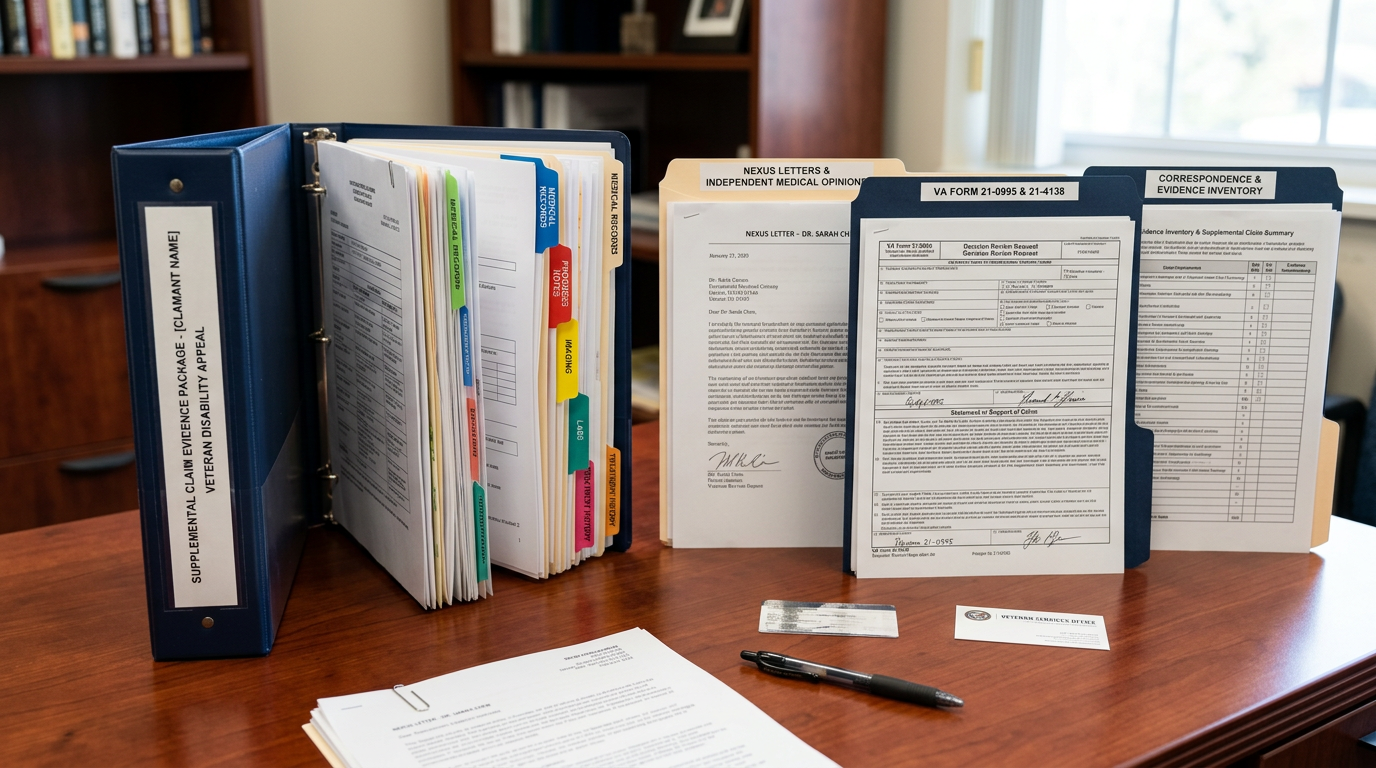
- Requires NEW & RELEVANT evidence
- File within 1 year to protect your effective date
- Reviewed by a claims adjudicator
- NO new evidence allowed
- An experienced adjudicator who did not decide your claim re-examines the same record
- Best when the evidence was there and the decision got it wrong

- Decided by a Veterans Law Judge
- Three dockets: Direct Review, Evidence Submission, or Hearing
- The most thorough review in the VA system

- A Clear and Unmistakable Error (CUE) motion is not one of the three decision-review options, it is a separate legal challenge to a FINAL decision.
- It alleges the earlier decision was undebatably wrong on the facts or the law as they existed at the time.
- When granted, it can reach back years for retroactive pay tied to the original effective date.
Protect your effective date: filing a Supplemental Claim within one year of the decision keeps your original filing date, which can mean thousands in retroactive back pay.
Case Snapshots
Anonymized outcomes from real case types. Individual results depend on the facts and evidence in each veteran’s file, but they show what the forensic process is built to do. In each one the win came from the file itself: an exam that missed something, evidence the VA overlooked, or a regulation that was not applied. None of them came from luck or from filing the same claim again and hoping.

PTSD
VA denied PTSD for lack of a confirmed stressor. We submitted buddy statements, unit records, and a private nexus opinion meeting the “at least as likely as not” standard under 38 CFR §3.304(f). Granted on supplemental.

Lumbar Spine
C&P exam failed to measure painful motion during flare-ups (DeLuca factors). We argued the exam was legally inadequate under 38 CFR §3.159. Senior reviewer ordered a new exam that captured full functional loss.

Sleep Apnea (Secondary)
VA denied secondary connection to PTSD. We submitted peer-reviewed medical literature and a specialist nexus opinion showing the standard was met under 38 CFR §3.310. VLJ granted service connection.
No Fine Print
Here is how we get paid, in plain English. Representation is no win, no fee, at 20% or 30% of past-due benefits depending on the option you choose, and the Mission 5 Brief is a separate $750 flat fee. Every fee agreement is in writing and filed with the VA under 38 CFR §14.636. Read it, keep your copy, and ask about anything you do not understand before you sign.
Zero upfront cost for representation.
You pay nothing to engage us for representation. It begins free.
We are paid only when you are paid.
Our fee comes out of the past-due (back pay) benefits recovered, never from your ongoing monthly compensation.
If we do not win, you do not pay.
No recovery, no fee. Period.
We do not bill by the hour.
No charge for phone calls, emails, or the number of times we talk. We get paid for the recovery we secure.
Governed by 38 CFR §14.636.
Federal law sets the limits for accredited agents’ contingency fees. The exact percentage is confirmed in your fee agreement. There is never a fee on a first-time claim.
The VA pays us directly.
By law the fee is withheld from the back-pay award and paid to the representative, so on Standard Direct-Pay you never write a check.
This alignment is intentional. When we fight for a larger back-pay award and an earlier effective date, we are fighting for both of us. That is how an advocate should be structured, our incentive is your recovery.
How It Works, Your Questions Answered
How It Works, FAQ
These are the questions veterans ask me right before they decide to work with us. Every answer here is plain, because the process should not be a mystery. Your part is to read through them, then ask me anything they do not cover before you sign a single form.
How long does the whole process take?
What do I need to get started?
What does it cost me to start?
Do you handle first-time claims or only appeals?
What happens if the VA orders a new C&P exam?
Will I work with an actual accredited agent?