

Health Care
VA Medical Care & Priority Groups
How service connection affects your access, copays, and priority
Service connection affects where you land in the VA health-care priority groups, which determines your access, enrollment, and whether you owe copays. Your treatment records at the VA also become evidence for your claim, so access matters twice. Your part is to enroll, confirm your priority group after any rating change, and tell every provider about every symptom so it lands in the record the rater will read.
Priority Groups Decide Your Access
The VA assigns every enrolled veteran to one of eight priority groups. The group determines how quickly you enroll, what care you can access, and what you pay. Service-connected veterans, particularly at 50 percent or higher, land in the top groups with copays reduced or eliminated for all care, not just care related to the rated condition.

The Eight Groups, Plainly

Group 1
Veterans rated 50% or more service-connected; veterans determined unemployable due to service-connected conditions (TDIU); Medal of Honor recipients. No copays for care or medications.

Group 2
Veterans rated 30–40% service-connected.

Group 3
Veterans rated 10–20%; former POWs; Purple Heart recipients; veterans discharged for a disability incurred in the line of duty; veterans awarded special eligibility for a disability incurred in treatment (§1151).

Group 4
Veterans receiving aid and attendance or housebound benefits; veterans determined to be catastrophically disabled.

Group 5
Non-service-connected veterans and veterans rated 0% whose income falls below VA national thresholds; veterans receiving VA pension; Medicaid-eligible veterans.

Group 6
Compensable 0% service-connected veterans; veterans exposed to Agent Orange, ionizing radiation, Camp Lejeune water, or covered toxic exposures; Gulf War and post-9/11 combat veterans within their enrollment window.

Groups 7 and 8
Veterans with income above the national threshold who agree to pay copays. Group 8 veterans above both national and geographic thresholds may face enrollment restrictions.
What Your Rating Actually Changes

Care for any service-connected condition is provided without copay regardless of group

At 50% or higher, copays are generally eliminated for all care and medications, service-connected or not

Travel reimbursement (beneficiary travel) is available to veterans rated 30% or more for care-related travel

Higher priority means faster enrollment and fewer restrictions on the medical benefits package

Toxic-exposure eligibility under the PACT Act placed a large population directly into Group 6

Community care eligibility under §17.1500 depends on drive time and wait-time standards, not on your rating
CHAMPVA: Health Coverage for the Family, Not the Veteran
Everything above is about your care. Your spouse and children are a different question, and the answer for many families is CHAMPVA. Under 38 CFR §17.271, CHAMPVA covers the spouse or child of a veteran who is rated permanently and totally disabled from a service-connected condition, the surviving spouse or child of a veteran who died of a service-connected condition or was rated P&T at the time of death, and the survivors of a service member who died in the line of duty.
Two rules trip families up. First, the family member must not be eligible for TRICARE. Second, a surviving spouse who remarries generally loses CHAMPVA, but a remarriage on or after age 55 keeps it, and coverage lost to an earlier remarriage can come back if that marriage ends by death or divorce. The veteran keeps using VA health care; the spouse and children use CHAMPVA. That is the split.
This is why the P&T box on your decision letter matters so much. A 100% rating that is not permanent and total does not open CHAMPVA for your family. If your conditions are static and the VA never marked them permanent, that is worth a hard look.

What CHAMPVA Actually Costs, and How It Works With Medicare
People hear "25 percent" and worry one bad year will wipe them out. It cannot. The outpatient deductible is $50 per person, capped at $100 per family each calendar year, and it is waived for inpatient care, hospice, most preventive care and Meds by Mail. After that CHAMPVA pays 75% of the allowable amount and you pay 25%, with a $3,000 catastrophic cap per family per year. Hit the cap and CHAMPVA pays 100% of allowable charges for the rest of the year.
Once a family member is eligible for Medicare, at 65 or earlier through disability, they generally must keep both Part A and Part B to stay on CHAMPVA. Medicare pays first, CHAMPVA pays second, and for services both cover, CHAMPVA can pick up much of the Medicare deductible and the 20% coinsurance. Dropping Part B to save the premium can cost you CHAMPVA altogether. CHAMPVA does not pay the Part B premium.

Meds by Mail: maintenance prescriptions mailed in 90-day supplies with no copay and no deductible, as long as the family member has no other drug coverage, including Medicare Part D.

Dental: CHAMPVA does not include routine dental, but beneficiaries can buy low-cost coverage through the VA Dental Insurance Program (VADIP), with no open-season window.

Two different cards: the Veteran Health ID Card is the veteran’s check-in card and is not insurance. The CHAMPVA card is what a civilian doctor bills. Hand the clinic the wrong one and the claim will not pay.

How to apply: VA Form 10-10d, with the marriage certificate or the child’s birth certificate and a copy of any Medicare card, front and back.
Enrollment Is Worth Revisiting
If your rating has increased since you enrolled, or you never enrolled at all because someone told you that you would not qualify, your priority group and copay status may have changed substantially in your favor. The VA does not reliably re-sort you or refund copays you should not have owed.
Two specific things to check: whether your group reflects your current combined rating, and whether you were billed copays for periods after an effective date that should have exempted you. Retroactive copay adjustments are a real remedy.

The Advocate’s Take
A rating increase can quietly upgrade your health care and erase copays back to your effective date. Do not assume the VA re-sorted you automatically. It frequently does not. The claims side and the health care side of the VA are two different buildings, and they do not always talk.
Here is how the VA looks at it. VA health care sorts you into priority groups. A rating of 50% or more, or being paid as unemployable, puts you in Priority Group 1, with no copays for care or medications. 30% to 40% is Priority Group 2. 10% to 20% is Priority Group 3, alongside others. Care for any service-connected condition is copay-free at every level. A 100% Permanent and Total rating, or being paid at the 100% rate through TDIU, can also open comprehensive dental care. When your rating is granted retroactively, copays you paid after the effective date for care that now qualifies can be refunded.
What I need from you: your newest decision letter, your Benefit Summary Letter, and any VA medical bills or copay statements from the last few years. If you were billed for treating a condition that is now service-connected, keep those bills.
Walk through it with me. If you are not enrolled, we file VA Form 10-10EZ. If you are, we file 10-10EZR to update your rating and income. We ask the facility's enrollment office to confirm your new priority group. Then we go to the billing office with your decision letter and request a review of copays charged after your effective date. If you are newly P&T, we ask about dental eligibility in the same visit.
The pitfalls: assuming the VA updated you, paying copays out of habit, and never asking for the refund. Shocking, I know, but veterans keep paying bills for care the law says is already covered.
Your part: walk your decision letter into enrollment and billing, and keep every statement you receive. We work WITH you, not FOR you. You earned the care, so make sure the system knows it.
Your priority group for VA health care is driven largely by your service-connected rating, which comes straight out of your claim exam. A higher rating can move you up and cut your costs. Watch the official VA videos below so you understand how that exam works, then make sure your rating reflects your real condition.
Straight From the Source
The rating behind this benefit is set at your claim exam. Watch these official VA walkthroughs to understand what that exam involves and how to prepare.
The official overview of the VA claim exam process, what happens, who conducts it, and why it matters for your rating.
What the VA's own guidance covers, what to bring, how to report your symptoms honestly, and the mistakes that cost veterans rating levels.
The Drive to the VA Is Not Free: Beneficiary Travel Pays You Back
Every trip to a VA clinic costs you gas, parking, and sometimes a toll. For a lot of veterans that is a real bite out of the month, especially older veterans who drive an hour or more each way to a medical center. The VA has a program that pays some of that back, called beneficiary travel, and it lives in 38 CFR Part 70. Most veterans who qualify never file for it. They simply do not know it exists.
The program pays mileage for the shortest reasonable route to and from VA care or VA-authorized community care. Tolls and parking can be covered too. Bus, train, or air fare can be paid when the VA approves it ahead of time, and meals and lodging can be paid when they are medically justified and approved. If the VA decides you medically need an ambulance or wheelchair van, that is a special mode of transportation, with its own rules that generally require approval before the trip unless it is an emergency.
A small deductible comes off each one-way trip, but under 38 CFR §70.31 it stops for the rest of the month once you have paid it on six one-way trips. It does not apply at all to travel for a scheduled C&P exam, and the VA must waive it for severe financial hardship, which includes veterans receiving a VA pension and veterans whose household income falls under the VA health care income threshold. I am not putting the current mileage rate or deductible amount on this page because the VA adjusts them; check the travel office or va.gov for today’s figures.
Here is the trap: the clock. Under 38 CFR §70.20(b), an ordinary travel claim must be filed within 30 calendar days after the trip. Miss it and the claim is denied, and the Board has upheld those denials even when the veteran never knew the deadline existed. Not knowing is not an excuse the regulation accepts.
Your part: set up your account in the VA’s Beneficiary Travel Self-Service System, through VA.gov or the VA Health and Benefits app, before your next appointment. Put direct deposit on it. Then file every trip the same week you make it.

Who Qualifies for Travel Pay, and How to Stop Leaving It on the Table
Eligibility is set out in 38 CFR §70.10, and it is broader than most veterans assume. You do not have to be rated 100 percent. You do not even have to be rated at all in some cases. The four cards below cover who is in, what to keep, and how to beat the 30-day deadline.
Notice how the rating ties in. A veteran rated 30 percent or more is covered for travel to care for any condition, service-connected or not. So the increase from 20 to 30 percent changes more than the monthly check. It can change who pays for every drive to the clinic for the rest of your life. That is one more reason I read every code sheet for missed ratings.
Here is the trap: veterans assume travel pay is only for the severely disabled, never ask, and lose years of reimbursements one 30-day window at a time. There is no back pay for trips you never filed. Each missed claim is gone for good.
Your part: match yourself to the cards below. If you fit any one of them, start filing with your next appointment, and if your rating or income changes, tell the travel office so your eligibility and any deductible waiver are updated.

Who Is In Under §70.10
Veterans rated 30 percent or more, for care of any condition. Veterans traveling for treatment of a service-connected condition, at any rating. Veterans receiving a VA pension, or whose income is at or below the maximum annual pension rate. Some special groups, and a medically necessary attendant who must travel with you, can also be covered.

C&P Exam Travel Counts, With No Deductible
Any veteran traveling to a scheduled C&P exam at a VA or VA-authorized facility is eligible for travel pay, whatever the rating or income. Under §70.31 the deductible does not apply to that trip. Do not skip filing just because the exam was for a claim instead of treatment.

What to Keep for Every Trip
The appointment date and facility, your starting address, and receipts for tolls and parking. For public transportation, meals, or lodging, keep the prior approval and the receipts. If an attendant traveled with you, keep the provider’s note that the attendant was medically needed. A claim with clean records gets paid. A claim with gaps gets questions.

Beating the 30-Day Clock
File within 30 calendar days of the trip, under §70.20(b). The self-service system calculates the distance for you, and a saved recurring trip makes repeat claims fast. If the VA asks for more information, answer within the time the letter gives you. You can also file in person at your medical center’s travel office the day of the visit.
Turning 65 With VA Health Care: Medicare Part B Is a Decision You Only Get to Make Cleanly Once
Turning 65 does not end your VA health care. Your enrollment, your priority group, and your free care for service-connected conditions all stay exactly where they are. What 65 does is hand you a decision about Medicare Part B, and that decision follows you for the rest of your life.
Here is what most veterans are never told. VA health care and Medicare are two separate systems that do not coordinate. The VA does not bill Medicare for the care you get at a VA facility, and Medicare does not pay the VA. VA care covers you inside the VA. Medicare covers you in the community, at any doctor or hospital that takes it. That is the opposite of how CHAMPVA works for a spouse, so advice you heard from a CHAMPVA family is the wrong advice for your own VA care.
You are not required to take Part B to keep your VA health care. But I tell nearly every veteran turning 65 to take it anyway, and so does the VA. Part B is your way to see a doctor close to home without a VA referral, your coverage at a non-VA emergency room, and your safety net if your VA eligibility or priority group ever changes. Part A, the hospital side, is premium-free for almost everyone who worked about ten years, so there is rarely a reason to pass on it.
Here is the trap: VA health care is not creditable coverage for Part B. If you skip Part B at 65 and sign up later, Medicare adds a 10 percent penalty for every full 12 months you could have had it, and that higher premium stays with you for as long as you have Part B. Wait three years and you pay roughly 30 percent more, every month, permanently. The main exception is still working with an employer group health plan, yours or your spouse's, which can open a penalty-free window later. VA care does not open that window.
Your part: about three months before your 65th birthday, sit down with your budget and decide on Part B on purpose, not by default. If you are still covered through current employment, get written proof of that coverage and keep it, because you will need it to enroll later without the penalty.

Telling the VA About Medicare or Other Insurance Can Only Help You
I hear the same fear almost every week. A veteran hides that he has Medicare, Medicaid, or a plan through his wife, certain that saying it out loud will cost him his free VA care or come out of his disability check. None of that is true. Your compensation is paid under the law for your service-connected disabilities. Medicare, Medicaid, and private insurance do not reduce it, tax it, or use it up.
Care for your service-connected conditions is free at the VA, no matter what other coverage you carry. For care of non-service-connected conditions, the VA can bill a private health plan under 38 U.S.C. §1729, and 38 CFR §17.106 controls how that recovery works. You never owe the part your insurer does not pay the VA, and what the insurer does pay can lower or wipe out a copay you would otherwise owe.
Here is the trap: veterans who hide other coverage do not protect anything. They give up the second safety net, and some of them skip Part B out of that same fear and end up carrying the late penalty for life.
Your part: give your VA medical center a complete list of every plan you carry, with a copy of each card, front and back, and update it whenever your coverage changes. The four cards below show how each piece fits.

Two Systems, Two Settings
The VA covers you at VA facilities and through Community Care when the VA sends you out. Medicare covers you at any provider that accepts it, with no VA referral. Your VA rating does not change whether you get Medicare or what it costs. Medicare looks at your age and work record, not your VA file. Holding both means you are covered everywhere.

Your VA Pharmacy Protects You on Part D
VA prescription coverage is creditable coverage for Medicare Part D. You can skip Part D, keep filling prescriptions through the VA, and owe no late penalty. If you ever lose VA drug coverage, you have 63 days to join a Part D plan without a penalty. Many veterans never buy Part D at all.

Private Insurance Can Lower Your Copay
For non-service-connected care, the VA may bill your private plan under §1729. You are never billed for what the plan refuses to pay, and plan payments can reduce your VA copay. For your service-connected conditions there is no copay and nothing to bill. Reporting the plan costs you nothing and can save you money.

Medicaid and the Nursing Home
Medicaid is your state's needs-based program, and a VA rating or VA health care does not disqualify you from it. It can pay for long-term nursing-home care that Medicare will not. One rule to know: a veteran with no spouse and no child whose Medicaid-covered nursing facility care has begun has VA pension limited to a small monthly amount under 38 U.S.C. §5503(d) and 38 CFR §3.551(i). That amount is yours to keep, and Medicaid may not reduce its payment because of it. Disability compensation is not limited by this rule.
Hearing Aids and Glasses: The Exam Is Easy to Get, the Device Has a Rule
If you are turning the television up, asking your wife to repeat herself, or squinting at a menu, I want you to know something before you spend another dollar at a big-box hearing center. Enrolled veterans can get hearing aids, eyeglasses, and the batteries and repairs that go with them at no cost. But there are two separate questions here, and the VA does not explain the difference very well.
The first question is the exam. A hearing evaluation and an eye exam are part of ordinary VA health care. If you are enrolled, you can ask for an audiology appointment, and many VA medical centers will let you schedule audiology directly without going through primary care first.
The second question is the device, and that one is controlled by 38 CFR §17.149. The VA furnishes hearing aids, eyeglasses, and contact lenses to veterans who fit one of its categories: a compensable service-connected disability, a former prisoner of war, a Purple Heart recipient, a veteran receiving benefits under 38 U.S.C. §1151 for harm caused by VA care, a veteran drawing increased pension for being housebound or needing aid and attendance, a veteran whose hearing or vision loss comes from another condition the VA is treating or from that treatment itself, a veteran with significant functional or cognitive impairment shown in the activities of daily living, or a veteran whose loss is so severe the device is needed to take part in his own medical care.
Here is the trap: read that list again and look at what is not on it. Ordinary age-related hearing and vision loss is not a category. That one gap is why so many older veterans walk out of a VA audiology clinic with a diagnosis in hand and no hearing aids, and never understand why. They were eligible for the test. They were never placed inside the device rule.
The widest door into that rule is the smallest rating. Under 38 CFR §17.149(c), a service-connected hearing disability rated at 0 percent qualifies for hearing aids, as long as the audiologist documents an organic conductive, mixed, or sensory impairment with a loss of puretone sensitivity that costs you communication ability. Zero percent pays you nothing each month, and it still puts you inside the device rule for good.
Your part: if you served around gunfire, aircraft, artillery, flight lines, engine rooms, or heavy machinery and you have never filed for your hearing, file for hearing loss and tinnitus together. Then get the audiology appointment on the books, and bring your rating decision with you so the clinic knows which category you fall under.

Keeping the Device Working: Zero Percent Ratings, Supplies, and the Medical Route to Glasses
Getting the hearing aid is only half of it. The other half is keeping it working for the next twenty years without paying for it yourself. Once you are inside 38 CFR §17.149, the batteries, the small supplies, the repairs, and the replacements come with it, and they follow you for as long as you need them.
The same goes beyond hearing. The VA's Prosthetic and Sensory Aids Service is the office behind hearing aids, and it also issues wheelchairs, walkers, canes, scooters, hospital beds, oxygen equipment, braces, and cochlear implants. Every item starts the same way: your VA care team prescribes it, and the VA orders it, delivers it, and repairs it when you qualify.
Here is the trap: veterans pay out of pocket because nobody told them otherwise. They buy batteries at the drugstore, pay a private shop to fix a VA hearing aid, or buy a new pair when the old one dies. If the device came from the VA, call the VA first. A device that no longer works, cannot be repaired, or no longer fits your condition is a reason to go back to your audiologist, not to your wallet.
Your part: keep your rating decision, your audiology records, and the paperwork from your last supply shipment together in one folder. The four cards below cover the moves I see veterans miss most often.

Never Ignore a 0 Percent Hearing Decision
A 0 percent hearing rating is the one veterans are told is not worth a second look. It pays nothing, and it is still the decision that places you inside §17.149(c) for hearing aids. It also makes the hearing loss service-connected, which opens the door to a later increase and to secondary claims. Keep it, and do not let anyone talk you out of filing for it.

Batteries and Supplies Ship to Your Door
Batteries and accessories for a VA hearing aid ship from the VA Denver Logistics Center, not your local clinic, and you can reorder without an appointment. Each order is about a six-month supply. Reorder when you have about 30 days left. The paper order form, VA Form 2346a, usually comes in the box with your last shipment.

Tinnitus Settles the Question Permanently
Tinnitus is rated at a flat 10 percent under Diagnostic Code 6260, one ear or both. Chasing a higher tinnitus rating is a dead end. But 10 percent is compensable, and that alone satisfies §17.149. What tinnitus causes, such as lost sleep, headaches, anxiety, or depression, can support a secondary claim under 38 CFR §3.310, and those conditions are not capped at 10 percent.
Glasses Through the Medical Route
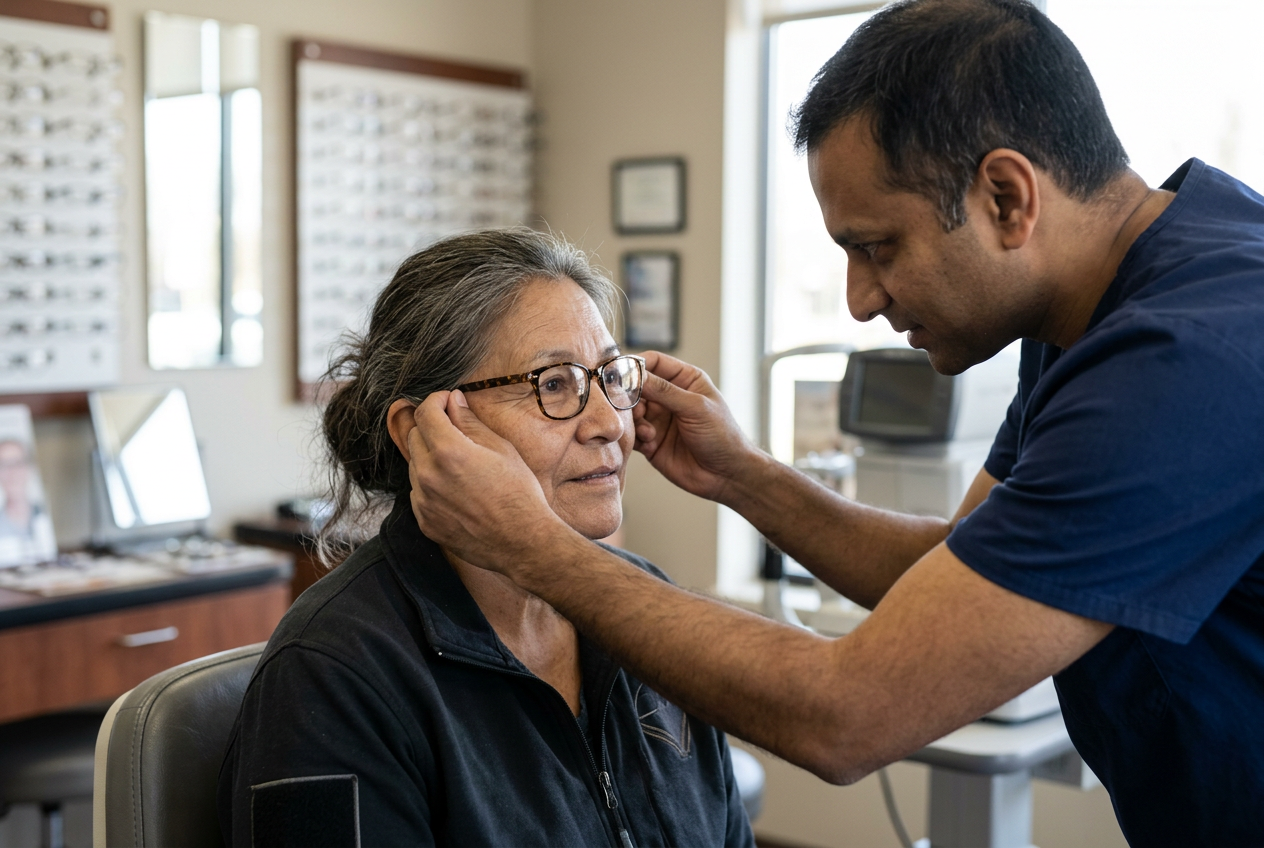
The eye exam comes with enrollment. The glasses do not, unless you fit a §17.149 category, and reading glasses for ordinary aging eyes are the classic denial. Where glasses are granted most often is the medical route: if your vision changed because of a condition the VA is treating, such as diabetes, a stroke, multiple sclerosis, a TBI, or cataract surgery, ask your provider to put that link in your chart.
VA Health Care Usually Stops at Your Teeth. The Law Decides Who Gets the Dentist
This one surprises almost every veteran I talk to. Enrolling in VA health care does not get you a VA dentist. Free VA dental care is rationed by law into eligibility classes under 38 CFR §17.161, and if you do not fit a class, the clinic will tell you no no matter how bad the tooth is. That is not a clerk being difficult. That is the regulation.
The classes that open the door to full care are the ones I want you to know cold. Class I covers a service-connected dental condition rated compensable. Class IIC covers former prisoners of war, any needed dental care. Class IV covers veterans rated 100 percent schedular or paid at the 100 percent rate through TDIU, any needed dental care. Class V covers veterans in a Chapter 31 Veteran Readiness and Employment program, for the dental work the rehab plan needs. Narrower classes cover combat or service trauma, homeless program participants, and dental problems that are aggravating a service-connected condition or complicating care the VA is already giving you.
Here is the trap: a temporary 100 percent rating. A veteran recovering from surgery under the hospital or convalescence rules gets paid at 100 percent for a while and assumes the dental door opened with it. It did not. Class IV requires a 100 percent schedular rating or TDIU. A temporary total rating does not qualify, so do not schedule the crowns until your rating says you are actually there.
Your part: pull your latest rating decision, find your combined rating and whether TDIU is granted, and match yourself to a class before you ask the clinic. If you are close to 100 percent, that dental care is one more reason to finish the fight for the rating.

The Four Dental Doors Veterans Miss, Including the One You Can Buy
Most veterans stop at "I am not 100 percent, so I get nothing." That is not the whole picture. There is a short window right after discharge, a door for service injuries and former POWs, a dental claim most people never file, and an insurance program almost every enrolled veteran can buy.
Here is the trap: most ordinary dental problems, such as cavities, replaceable missing teeth, abscesses, and gum disease, are service connected under 38 CFR §3.381 only for treatment purposes, not for a monthly payment. A dental claim is about getting the work done, not about raising your rating. Go in knowing what you are actually asking for.
Your part: read the four cards below, find the one that fits you, and act on it before a window closes.

Rated 100 Percent or TDIU: Use It
If you are rated 100 percent schedular or paid at the 100 percent rate through TDIU, you are Class IV, and the VA owes you any needed dental care, not just emergencies. Exams, cleanings, fillings, crowns, and dentures are on the table. I see veterans who reached 100 percent years ago and never once saw a VA dentist because nobody told them. Call your VA medical center dental clinic, tell them you are Class IV, and ask to be scheduled.

Just Got Out? 180 Days for One-Time Care
Under Class II, a veteran with a service-connected, noncompensable dental condition at discharge can get a one-time course of dental care by applying within 180 days of separation, if the service-length rules are met and the separation paperwork does not show a complete dental exam and all needed treatment shortly before discharge. Miss the 180 days and this door closes for good. If you are newly out, put the dental application on your first-month list.

Service Trauma and Former POWs
Teeth damaged by a combat wound or service trauma, such as a blow to the face in training or a vehicle accident on duty, fall under Class IIA, with treatment for that condition. Former prisoners of war are Class IIC and eligible for any needed outpatient dental care. If your service records show a facial injury or dental work after an accident, file the dental claim and attach those records. Trauma is the dental claim veterans most often forget they have.

Everyone Else: The VA Dental Insurance Program
If no free class fits, the VA Dental Insurance Program under 38 U.S.C. §1712C lets any veteran enrolled in VA health care, and family members enrolled in CHAMPVA, buy discounted private dental coverage from carriers the VA contracts with, currently Delta Dental and MetLife. You pay the premium and copays, enrollment runs through the carrier, and the plans usually carry a 12-month commitment. Buying it does not take away any free VA dental care you qualify for now or later.
Too Far or Too Long a Wait? The VA Has to Send You Outside, and the Numbers Are in the Regulation
No veteran should have to drive three hours or wait three months for care, and since the MISSION Act you do not have to take that as a favor. Under 38 U.S.C. §1703 and 38 CFR §17.4010, the VA has to send you to an in-network community provider, at VA expense, when you meet one of six eligibility rules. The one that matters most for most veterans is the access standard in 38 CFR §17.4040, and it is written in plain numbers.
For primary care, mental health care, and non-institutional extended care, you qualify if the VA cannot get you in within 30 minutes of average drive time or within 20 days of your request. For specialty care, it is 60 minutes or 28 days. You only have to miss one of the two. A veteran who lives ten minutes from the clinic still qualifies if the wait is longer than the standard. The other doors are just as real: the VA does not offer the care you need, you live in a state with no full-service VA medical facility, you and your VA clinician agree outside care is in your best medical interest, the VA service line fails its own quality standards, or you are covered by the old Choice Program grandfather rule.
Here is the trap: the wait-time clock can be waived by you without realizing it. The 20-day and 28-day limits do not apply if you agree to a later appointment. When a scheduler offers you a date seven weeks out and you say "okay, that works," you may have just given away your community care eligibility. Drive time is also measured by the VA's mapping software, not by your bad experience in traffic, so the wait is usually the easier standard to prove.
Your part: when a scheduler gives you a date, do the math before you say yes. If it is past 20 days for primary or mental health care, or past 28 days for specialty care, say these words: I do not agree to that date. I am asking for community care under the access standards.

Getting Community Care Without Getting Stuck With the Bill
Community care is a right when you meet a standard, but the VA pays only when you follow its rules for getting there. Most of the horror stories I hear are not about eligibility. They are about a veteran who was eligible, went to the outside doctor on his own, and got the bill.
Here is the trap: if the VA says you do not qualify, that decision does not go to the Board of Veterans' Appeals. Under 38 CFR §17.4010, community care eligibility is handled through the VA's clinical appeals process at the medical center. Veterans file a Notice of Disagreement on a community care denial and wait a year for nothing. Ask your facility's patient advocate for the clinical appeal instead, and put the request in writing.
Your part: read the four cards below, because each one is a place where veterans lose money or lose care they were owed.

Ask at the Moment the Wait Is Too Long
The eligibility clock starts when you contact the VA and request the care, so the request itself matters. When you hear a long wait, ask the scheduler or your provider for a community care eligibility check right then, and write down the date, the name, and the appointment date you were offered. If nothing moves, go to the patient advocate at your VA medical center. A dated note of every call is what turns a polite request into proof.

No Authorization, No Payment
For scheduled care, the VA has to authorize the community provider before you go. Self-referral is not covered. Before the visit, confirm the referral was approved, the provider is in the VA network, and the visit is for the care the referral lists. A follow-up visit or a new test the outside doctor orders may need its own approval. If the community office asks for your insurance card, tell them you are there on a VA referral so the claim goes to the right payer.

Urgent Care Needs No Referral
Under 38 CFR §17.4600, if you are enrolled in VA health care and have been seen by the VA or an in-network community provider in the past 24 months, you can walk into an in-network urgent care clinic for minor illnesses and injuries with no pre-approval. Tell the clinic at check-in that you are using your VA urgent care benefit. It covers things like a sprain, a sinus infection, or a minor cut, not chronic care or dental work, and a small copay may apply depending on your priority group.

In the ER? The VA Must Hear Within 72 Hours
In a real emergency, go to the nearest emergency room. Do not drive past a hospital looking for a VA. But under 38 CFR §17.4020, someone has to notify the VA within 72 hours of when emergency treatment starts so the VA can authorize it. The hospital can make that report, but do not assume it did. Have your spouse or a family member confirm the report was made and write down the date. That one step is often the difference between a paid ER visit and a denied one.
The Free Card That Opens the Base Gate: Your Veteran Health ID Card and What Any Rating Unlocks
Most veterans I talk to think the Veteran Health Identification Card is just the thing you show at the clinic window. It is that. But since January 1, 2020, it is also the key to a benefit a lot of rated veterans have never used: in-person shopping at military commissaries and exchanges, and use of many base recreation facilities.
The law is 10 U.S.C. §1065, added by the Purple Heart and Disabled Veterans Equal Access Act of 2018. It opened those privileges to veterans with any service-connected rating, including 0 percent, to Purple Heart recipients, to former prisoners of war, and to primary family caregivers approved under the VA's comprehensive caregiver program. Veterans rated 100 percent and Medal of Honor recipients already had access through a Defense Department ID card. Commissary groceries are sold at cost with no sales tax, and the exchange is tax-free.
The card is free, but it is a health care card. You have to be enrolled in VA health care first, then request it online or at your VA medical center with a government photo ID. It carries no Social Security number and no date of birth, by design.
Here is the trap: the base does not care that you are rated. It cares what is printed on the card. To be honored at the gate, your card has to show the eligibility line SERVICE CONNECTED, PURPLE HEART or FORMER POW. A veteran who got his card before his rating came through often carries one with no eligibility line, gets turned away, and assumes the benefit is not real. It is. The card is just out of date.
Your part: pull out your card and look for that line. If it is missing, ask your VA medical center for a new card that reflects your rating. If you are not enrolled in VA health care, enroll. The card is only one reason, and it is the smallest one.

Four Things to Know Before You Drive to the Base, or Skip the Drive Entirely
The card gets you eligible. It does not, by itself, get you through the gate. Here is what I tell every veteran before that first trip, and the one door that needs no card at all.
Here is the trap: veterans hand the wrong card to the wrong counter. The digital Veteran ID Card in your VA.gov account proves you served, and that is all it does. It will not get you on a base, into a commissary or into an exchange, and it will not check you in at a VA hospital. Only the Veteran Health ID Card with the eligibility line, or a Defense Department ID card, works at the gate.
Your part: read the four cards below before you go, so the trip is not wasted.

The First Visit Starts at the Visitor Control Center
Eligibility is not entry. The first time you go to an installation, stop at the Visitor Control Center. They run a background check on the spot, and many bases will set you up for recurring access so you do not repeat it every visit. Bring your Veteran Health ID Card and a REAL ID or passport. Remember that the privilege is for you, not your family. Spouses and children do not get their own access under this law. Your part: call the base ahead of time and ask what the visitor center needs.

Online Exchange Shopping Needs No Card at All
Since Veterans Day 2017, every honorably discharged veteran, rated or not, can shop the military exchange websites tax-free for life, and use the military travel discount site. You verify your status once through the VetVerify service, which checks Defense Department records. If your discharge does not show up correctly, you can upload your DD-214. This is the easiest way for a homebound or rural veteran to get the discount. Your part: verify once and shop from your kitchen table.

Caregivers and the 0 Percent Veteran Who Cannot Get a Card
A primary family caregiver approved in the VA comprehensive caregiver program qualifies on their own, using the VA eligibility letter plus a REAL ID or passport. A 0 percent veteran who cannot enroll in VA health care because of income, and so cannot get the card, has a workaround: the Defense Department has accepted the VA enrollment letter called VA Form H623A, showing priority group 8E, with a REAL ID. Your part: caregivers, keep that eligibility letter with your ID.

Know What the Privilege Does Not Cover
The law reaches commissaries, exchanges and base retail recreation like golf, bowling and campgrounds. It does not generally open the fitness centers, which the military holds for readiness. A small user fee is added to credit and signature-debit purchases at the commissary for patrons eligible only under this law, and cash or PIN debit avoids it. If you are rated 100 percent, ask a Defense Department ID office about a full military ID card, which opens more than the VA card does. Your part: pay with PIN debit and ask about the ID card if you are at 100.
You Are Not Asking for a Favor: Your Rights as a VA Patient, and the Advocate Paid to Fix Problems
A lot of veterans from the older generations were raised to take what they are handed and say thank you. That is honorable at a dinner table. At a VA medical center it quietly costs you care. When the exam was rushed, the consult vanished, the bill should not exist, or the call never came back, you are not complaining. You are enforcing rights written into federal regulation.
Those rights are in 38 CFR §17.33, the VA's patients' rights regulation. Paragraph (g) is the one I want every veteran to know: you may present a grievance about any matter, for yourself or for someone else, to facility staff, other VA officials, government officials, members of Congress, or anyone else, without fear of reprisal. Patients admitted to a VA facility are supposed to be told these rights and given them in writing.
Congress also built a person to receive those grievances. Under 38 U.S.C. §7309A, the VA runs an Office of Patient Advocacy, and every VA medical facility has a patient advocate whose job is to resolve health care complaints the clinic could not fix, track them, and explain your rights to you. The same law requires an electronic system that lets you submit a complaint and follow its status.
Here is the trap: a complaint made out loud at a front desk leaves no trail. Two weeks later nobody remembers it, and you are back at the start. The advocate system runs on a record: dates, names, what was promised, and what actually happened.
Your part: keep a notebook for every VA contact. When something goes wrong, ask the front desk for the patient advocate by that title, hand over your dates and names, and ask for the complaint to be logged so you can follow it.

When the Clinic Will Not Fix It: Four More Doors, and the One Thing the Advocate Cannot Change
The patient advocate is the first door, not the only one. Use the doors in order, and keep writing things down at every step.
Here is the trap: veterans take a rating decision to the patient advocate and wait for a fix that cannot come. The advocate handles health care. A denied claim, a low rating, or a wrong effective date is a benefits decision, and it changes only through a Higher-Level Review, a Supplemental Claim, or a Board appeal, filed inside the one-year window. Complaining about it does not stop that clock.
Your part: sort the problem first. A care problem goes to the advocate. A claim problem goes to an appeal lane, and that is where I come in.

Ask for a VA Social Worker by Name
A VA social worker is part of your health care team, and too few veterans ever meet one. Social workers line up home care, transportation, caregiver support, housing help and community programs, and they are the clinical door into most VA long-term care. A rating does not get you one. Being enrolled in VA health care and asking does. Your part: at your next primary care visit, say the words: I would like to be connected with a social worker.

Escalate Past the Facility When It Stalls
If the advocate cannot resolve it, the complaint can go higher. The White House VA Hotline began in 2017 as a round-the-clock complaint line and was folded into the VA's main contact center in 2022, which still takes complaints about care and service and routes them to the right office. Section 17.33 also protects your right to take the grievance to your member of Congress, whose caseworkers can send a formal inquiry to the VA. Your part: escalate with your notebook in hand, and write down every case number you are given.

Free Legal Help for Older Veterans Is Closer Than You Think
Most areas have a senior legal aid program, funded through the Older Americans Act, that helps older adults with wills, housing, debt, consumer problems and scams, usually at no cost. You reach it through your local Area Agency on Aging, and the national Eldercare Locator service will connect you to yours. A VA claim is a separate matter: only an accredited attorney, claims agent or service officer can represent you before the VA. Your part: for a will or a landlord problem, go to your Area Agency on Aging. For a VA claim, use an accredited representative.

Elder Abuse Is Not a Family Secret You Have to Keep
Abuse of an older veteran is often not a stranger. It is financial exploitation, neglect or mistreatment by someone close, and VA benefits are a target. Every state runs Adult Protective Services, which takes confidential reports, and the Eldercare Locator will connect you. If a person managing a veteran's VA money as a fiduciary is misusing it, the VA can investigate and replace that fiduciary under 38 CFR Part 13. If someone is in immediate danger, call emergency services first. Your part: if something feels wrong, report it. You do not need proof to make the call.
Care Without the Drive: Telehealth, Meds by Mail, and the Preventive Care Your Enrollment Already Covers
Most veterans I talk to treat VA health care like a fire extinguisher. They only reach for it when something is already burning. That is backwards. The care that keeps you out of the emergency room is already part of what you were enrolled for, and most of it can happen without a long drive to the medical center.
Start with the regulation. 38 CFR §17.38 sets out the medical benefits package every enrolled veteran receives, and it expressly includes preventive care as defined in 38 U.S.C. §1701(9): periodic medical exams, screenings for veterans at higher risk, immunizations, health and nutrition education, monitoring of medications, routine vision testing, and preventive mental health and substance use services. Those are not extras. They are written into the package.
Then the drive. In the MISSION Act of 2018, Congress added 38 U.S.C. §1730C, which lets VA clinicians treat you by telehealth wherever you are and wherever they are, even across state lines. That is why a VA doctor can see you by video at your kitchen table, and why living far from a medical center is no longer a reason to go without follow-up care.
Here is the trap: veterans assume enrollment means sick visits only, so they skip the yearly exam, the screenings, and the vaccines. Then a condition that could have been caught early shows up late, and harder to treat. And when the claim comes later, there is no treatment record showing the problem building over time.
Your part: call your PACT team and ask for a preventive care review: which screenings and vaccines you are due for. In the same call, ask to be set up for video visits so the follow-ups do not depend on a ride.

Four Ways to Get More Care With Less Hassle, and the Copay You May Not Owe
Once you are enrolled, the VA has built several doors that most veterans never walk through. Each one below is part of the same health care you already have. You only have to ask for it.
Here is the trap: veterans pay medication copays they do not owe. Under 38 CFR §17.110(c), no medication copay is charged to a veteran rated 50 percent or more service connected or paid at the 100 percent rate through individual unemployability, for medication to treat a service-connected condition, to a veteran whose income is at or below the VA pension limit, to former prisoners of war, to catastrophically disabled veterans, to Medal of Honor recipients, and in several other cases. If one of those fits you and you are still getting a bill, the billing is wrong.
Your part: look at your last pharmacy statement. If you fit an exemption, ask the facility billing office to correct it and to refund what you paid.

Video and Phone Visits From Home
Thanks to 38 U.S.C. §1730C, your VA clinician can see you by video on a phone, tablet or computer, or by phone when video will not work. Follow-ups, medication checks, mental health care and many specialty visits are done this way every day. If you do not have a device or a good connection, ask whether the VA can loan you a tablet. Many veterans qualify. Your part: at your next appointment, ask the clinic to switch your routine follow-ups to video and to walk you through a test call first.

Prescriptions Delivered to Your Door
Most VA prescriptions can be mailed to your home from the VA's mail-order pharmacy, so you do not stand in line or drive in for refills. You can request refills through the VA's online health portal, by the automated refill line on your prescription label, or by mail. Check your copay status under §17.110 before you assume you owe anything. Your part: ask your pharmacist to put your regular medications on mail-order refills, and keep at least a couple of weeks on hand so a mail delay never leaves you short.

Whole Health: Care Built Around Your Own Goals
Whole Health is the VA's approach that starts with what matters to you, not just what is wrong with you. Depending on your facility, it can include health coaching, nutrition counseling, physical therapy and movement programs, help quitting tobacco, and pain care that does not rely only on medication, such as yoga, tai chi or acupuncture. It all falls under the health education and preventive care in §17.38. Your part: tell your primary care provider you want to start Whole Health, and ask about a personal health plan built on your own goals.

Mental Health Is Health Care, Not a Separate Line
Sleep trouble, anger, grief and low mood are health problems, and the VA treats them as part of primary care. Many clinics have a mental health provider working inside the primary care team, so you can be seen the same day without a separate referral. Preventive mental health and substance use services are part of the §17.38 package, and Vet Centers, covered elsewhere on this site, offer confidential counseling outside the medical center. If you or someone you love is in danger, reach emergency help right away. Your part: say it plainly at your next visit: I want to talk to someone about how I am doing. That sentence opens the door.
Acupuncture, Chiropractic and Massage Are Real Care, and Every Visit Writes Evidence Into Your File
A lot of veterans think of acupuncture, chiropractic care, massage, yoga and tai chi as extras, the soft stuff you do when the real medicine is not working. I want you to look at it differently. When a VA provider orders it, it is medical care, and every visit leaves a dated note in your record. For a claim, that note can matter more than the treatment itself.
Start with the rule. 38 CFR §17.38 sets out the medical benefits package every enrolled veteran receives, and §17.38(b) says care is provided when an appropriate health care professional decides it is needed to promote, preserve, or restore your health and it fits generally accepted standards of medical practice. That is the door these therapies come through. They are not handed out on request. Your provider orders them because your condition needs them, and that order is itself a medical finding about how much your condition is costing you.
Now think about what an acupuncturist or chiropractor writes down. Where it hurts. How far you can turn your neck or bend your back today. How often the pain flares and how long it lasts. What you could not do this week. That is the exact language the rating schedule runs on. For joints and the spine, 38 CFR §4.40 and §4.45 require the VA to account for functional loss from pain, weakness, fatigue and lack of endurance, and §4.59 recognizes painful motion. In DeLuca v. Brown, 8 Vet. App. 202 (1995), and Mitchell v. Shinseki, 25 Vet. App. 32 (2011), the Court made clear that pain is rated by what it takes away, not by whether it shows on an x-ray.
Here is the trap: you walk out of a session feeling looser, the note says patient tolerated treatment well, improved, and that is the only line anyone reads. Six months of notes that say improved can look like a condition that is getting better, when the truth is you need the treatment every two weeks just to keep working. The note only says what you told the provider that day.
Your part: at every visit, say the hard part out loud before the treatment starts. How many flare-ups since the last visit, how many days they lasted, and the one thing you could not do. Ask the provider to put the flare-up count and your range of motion in the note. Then get copies of those notes at least once a year so they are in your hands when you file.

Four Things That Turn Complementary Care Into Claim Evidence
The care helps your body. The record helps your claim. These four points are where I see veterans either build a strong file out of their treatment or let it slip away without anyone noticing.
Here is the trap: the VA examiner sees you for twenty minutes on a good day and writes that you have full motion with no flare-ups reported. If the notes from two years of treatment are not in your file, or nobody points to them, that one good day becomes your rating.
Your part: before any exam or new claim, pull your complementary care notes together, mark the pages that show flare-ups and lost function, and make sure they are in the file before the examiner opens it.

Treatment That Helps Cannot Be Used to Rate You Lower
In Jones v. Shinseki, 26 Vet. App. 56 (2012), the Court held that the VA may not deny a higher rating because medication relieves your symptoms unless the diagnostic code itself says to consider the effect of medication. Some codes do, like the ones that rate on continuous treatment or required medication. Most do not. When a decision says your condition is controlled, ask whether the code allows that reasoning at all. Your part: if a denial leans on how well a treatment works, flag it. You are rated on the condition, not on your best day after a treatment.

Flare-Ups Live in the Treatment Notes
In Sharp v. Shulkin, 29 Vet. App. 26 (2017), the Court held that an examiner cannot dodge flare-ups just because you are not having one at the exam. The examiner has to estimate the extra loss of function during a flare using all the evidence, including your own statements and your treatment records. A chiropractor's or acupuncturist's notes that log flare frequency and duration are exactly that evidence. Your part: make sure your provider records how often you flare, how long it lasts, and what you cannot do during it.

Outside Records Do Not Always Reach Your Claim File
Many of these therapies are delivered by community care providers outside the VA. Those are private records. Under 38 CFR §3.159(c)(1) the VA must make reasonable efforts to get private records you identify, but that is a request, not a guarantee, and it can stall. VA records are different: under §3.159(c)(2) the VA has to keep trying until it gets them or concludes they do not exist or that more effort would be futile. Your part: get your own copies of every outside treatment note and submit them yourself. Do not count on them arriving on their own.

Mind-Body Classes Document Your Mental Health Too
Group yoga, mindfulness, tai chi and art therapy notes often record what is happening to you emotionally: panic in the room, needing to leave early, trouble concentrating, missed sessions. Under 38 CFR §4.126(a), the VA rates a mental condition on the frequency, severity and duration of your symptoms across all the evidence, then applies §4.130. Vet Center counseling is kept separately from your regular VA medical record. Your part: name every program and Vet Center you attend on your claim so those records are requested, and keep your own copies.
Building a VA Medical Care & Priority Groups Claim That Wins
Every claim stands on three legs. Knock one out and the claim falls over, no matter how bad your symptoms are. Before you file, look at your file and find all three. If one is missing, that is the piece to build first. The VA will not build it for you, and filing without it usually just buys you a denial letter and lost time.
 01
01A current diagnosis
A doctor has to say you have it, now, in writing. Not "reports symptoms of", a diagnosis. Without this leg, nothing else in the file matters.
 02
02A link to your service
An event, an injury, an exposure, or an already service-connected condition. Service records, unit records, buddy statements, and your own account all count as evidence.
 03
03A nexus that ties the two together
A medical opinion stating it is at least as likely as not that your service caused or aggravated the condition. That phrase is a legal standard: 50 percent or better. It is the leg most denials break.
Document the problem before you file
• Keep a dated symptom log for at least 30 days. Frequency, severity, and what it stopped you from doing.
• Get statements from people who see it, a spouse, a coworker, a battle buddy. Lay evidence is legal evidence.
• Pull your private treatment records. The VA only has to help; it does not have to go find everything.
• Write down what you have stopped doing. Lost work, lost sleep, lost activities. That is what impairment looks like on paper.
Your Rights in This Process
Most veterans walk into this system without knowing the rules the VA itself has to follow. That is how claims get denied for missing evidence the VA was supposed to help you find, and how exams get done by the wrong clinician. These six rights are written into federal regulation. Know them before you file, and make the VA honor every one of them when it decides your claim.

It costs nothing to file
Filing a VA claim is free. Accredited representatives may only charge for work on an appeal after an initial decision, and those fees are capped by 38 CFR §14.636.

The VA has a Duty to Assist you
Under 38 CFR §3.159 the VA must help you get the evidence it needs, and it must tell you what is missing before it denies you for missing it.

You can ask for a different examiner
You may request a trauma-informed clinician, or a clinician of a specific gender, for a C&P examination. Ask before the exam is scheduled.

You can claim every condition you have
There is no limit and no penalty. Primary conditions, secondary conditions, and conditions made worse by service all get filed.

You can appeal and be re-evaluated
A denial is not the end. You may submit new evidence, request a higher-level review, appeal to the Board, and ask for re-evaluation when your condition worsens.

You must be considered for TDIU
If your service-connected conditions keep you from holding substantially gainful employment, you may be paid at the 100 percent rate without a 100 percent rating.
When You Are Ready to File
Talk to an accredited representative before you file. It costs nothing to ask, and the order you file in changes what the VA is allowed to award you. Albert L. Thombs Jr. is VA-Accredited Claims Agent #45147. A short conversation now can save you a year spent waiting in the wrong review lane.
Your part starts at the kitchen table. Pull your DD-214, your rating decision if you have one, and the names of every doctor who treats you today. Under 38 CFR 3.159 the VA has to help you gather records, but it can only chase the records you tell it about. Leave a doctor off the 21-4142 and that treatment may never reach your file.

The application itself
This is the form that opens a disability compensation claim. List every condition you are claiming, and name the secondary conditions explicitly.
Release for private records
Authorises the VA to request records from your private doctors. Without it, treatment outside the VA may never reach your file.
Lay or buddy statement
The official form for your own statement and for statements from people who witnessed the event or the change in you.
What It Takes to Claim This Benefit
Confirm you meet the eligibility rules for this specific benefit, the criteria below and in the governing regulations tell you exactly what the VA is looking for.
Gather the proof that matches those rules, service records, medical evidence, income or dependency documents, and the physician statements the VA weighs.
File the right form the right way, the correct application, fully supported, so the VA cannot deny it on a technicality or delay it for missing evidence.
 Veteran Representation
 Veteran Representation
The Forms & Applications We File For You
These are the applications that drive this benefit. Start any of them on our site and an accredited agent prepares and files it for you, correctly, the first time.
Application for Health Benefits
Enrolls you in VA health care and sets your priority group.
Start this with usAppoint Us as Your Representative
Authorizes our accredited agent to act on your behalf with the VA on this benefit.
Start this with usSee How Ratings Drive This Benefit
Most benefits scale with your combined disability rating, and the VA does not add your ratings the way you would expect. Work the real math below. The VA uses the combined ratings table in 38 CFR 4.25, which applies each rating to whatever is left of your remaining efficiency, then rounds to the nearest 10. That is why a 50% and a 30% come out to 70%, not 80%. Before you assume you are short of a threshold for this benefit, run your own numbers here and compare them to your rating decision letter.
Why 50% + 30% Does NOT Equal 80%
The VA uses “whole-person” math, not simple addition. This is how ratings really stack.
The VA always begins from a whole, healthy person (100%).
50% of 100 is subtracted. You have 50% “efficiency” left.
30% is taken from the REMAINING 50 (0.30 × 50 = 15). 50 − 15 = 35 left.
100 − 35 = 65, then rounded to the nearest 10 → 70%.
Bottom line: 50% and 30% combine to 65% → rounded to 70%, not 80%. The same math turns two 50% ratings into 75% → rounded to 80%, not 100%. Every rating you add is worth less than the last. That is why which conditions you claim, and in what order, matters as much as how many.
 Veteran Representation
Not sure if you qualify?
An accredited agent reviews your eligibility for this benefit at no cost and tells you straight whether it is worth pursuing. If it is, we prepare and file every form for you.