

Effective Dates · 38 CFR §3.400
Effective Date Review
Your effective date is the single day that decides how many months of back pay the VA owes you, and the VA gets it wrong constantly. Under 38 CFR 3.400 the date defaults to whichever came later, the day you filed or the day entitlement arose, but seven separate rules can legally push it years earlier, and most veterans never invoke a single one.
At the 2026 rate a single veteran at 70% draws $1,808.45 a month. Miss your correct date by two years and that is more than $43,000 the VA quietly keeps, tax-free money that was yours under 38 U.S.C. 5301. The earlier date is usually already sitting in your file: an Intent to File you forgot about, an informal claim filed before March 24, 2015, a hospitalization report, or a prior denial the VA never fully adjudicated. There is also a rule almost nobody uses, if you filed within one year of separation your date can reach back to the day after discharge. I read your entire claims history for every one of these, then show you how an Intent to File, submitted today, locks the clock while I build the rest.
Why the Effective Date Decides How Much the VA Owes You
Veterans obsess over the rating percentage and treat the effective date like paperwork. That is backwards. The percentage sets your monthly check, but the effective date multiplies it by every month the VA owes you, and that number is almost always the bigger one. Under 38 CFR §3.400 the general rule is the date the VA received your claim or the date entitlement arose, whichever is later, and “later” is the VA’s default setting, not your friend.
Run the actual math at the 2026 rate. A single veteran at 70% draws $1,808.45 a month. Move the date back one year and that is roughly $21,700 in retroactive pay. Two years clears $43,000. A CUE motion that reaches back a decade can run into six figures. All of it is tax-free under 38 U.S.C. §5301, so you keep the whole number. (Estimates. Back pay is calculated on the historical rate in effect each month, adjusted for COLA, plus any dependents; the VA publishes the official figures.)
Here is a detail the VA will not volunteer: under 38 CFR §3.31 compensation is paid from the first day of the month after your effective date, because the VA pays in arrears. On a large retroactive award that shifted month is real money, and it is one more reason the exact date has to be nailed down instead of accepted.
The VA is currently sitting on roughly 640,000 pending claims and averaging about 69 days to decide one. While that clock runs against you, a locked effective date is the one thing standing between the delay and your back pay. I read your full claims history for every date the rules will support, then fight for every month between the date the VA gave you and the date you actually earned.

Effective Date Rules by Scenario
Your effective date is not one rule. It is a set of rules under 38 CFR 3.400, and which one applies depends on how and when your claim reached the VA. Find your situation below, then pull your own paperwork and check the date on your award letter against it. If they do not match, that difference is money, and nobody at the VA is going to call you about it.

Filed within one year of discharge (38 CFR §3.400(b)(2))
This is the rule almost nobody uses. If your claim reaches the VA within one year of your separation date, the effective date is the day after you left active duty, not the day you filed. File eleven months out and you still capture nearly a full year of back pay you would otherwise forfeit for good.

Original claims (38 CFR §3.400(b))
The effective date is the date the VA receives the claim or the date entitlement arose, whichever is later. File on March 1 but the diagnosis is not documented until June 1, and the date becomes June 1. That is exactly why you build the medical record before you file, not after, every undocumented month is a month of pay the VA gets to keep.

Increased rating, one-year look-back (38 CFR §3.400(o)(2))
If the evidence shows your condition measurably worsened within the year before you filed for an increase, the effective date can be backdated to the date that worsening became factually ascertainable, up to one full year earlier. A single dated treatment note is often what unlocks it.

Reopened claims, Supplemental (38 CFR §3.400(r) / §3.2500)
File a Supplemental Claim within one year of the denial and the effective date holds at the original claim date. Miss that one-year window by a single day and the date resets to your new filing, erasing every month in between. This deadline is sacred, there is no grace period.

Intent to File (38 CFR §3.155)
An Intent to File (VA Form 21-0966) establishes your effective date up to one year before the formal claim. File the ITF on January 1 and the complete claim the following December, and your date is still January 1. It costs nothing and takes minutes, and it is the single cheapest way to protect thousands in back pay.

Liberalizing law changes (38 CFR §3.114)
When new law creates eligibility, like the PACT Act, you can receive an effective date as early as the date the law took effect, provided you file within one year of the change. The PACT Act date is August 10, 2022, and veterans denied for the same condition before that date can revisit it through a Supplemental Claim.

CUE in effective date assignment (38 CFR §3.105(a))
If the VA assigned the wrong date in a final decision, a Clear and Unmistakable Error motion corrects it and reaches back to the date it should have been, with no time limit at all. This is the heaviest effective-date tool that exists, and it can reach back decades.
Intent to File (ITF), The Free Insurance Policy
An Intent to File (VA Form 21-0966) is the simplest, most powerful date-protection tool available. It takes minutes to file, costs nothing, and locks in your potential effective date up to one year before your complete claim is submitted. If you are thinking about filing a claim but do not have all your evidence ready, file an ITF today. It starts the clock. You then have 12 months to gather evidence, obtain a nexus letter, get a private DBQ, and submit the complete claim, all with the effective date locked to the ITF date. I specifically hunt for ITF submissions that were filed and then abandoned, that earlier ITF date may still be the correct effective date for your current claim if the VA never properly closed it out.

Case Snapshot, Tinnitus and Hearing Loss
Correct rating plus $34,000 in recovered back pay. The veteran had the correct disability rating for tinnitus and hearing loss, but the effective date assigned by the VA was wrong. I traced an informal claim filed years earlier, under the rules in place before March 24, 2015, that VA never decided, a written communication to a VA facility expressing intent to file for hearing-related conditions.
Under 38 CFR §3.400, the earlier informal claim date should have been the effective date. The VA never processed it, which means the veteran lost years of monthly compensation that was rightfully owed.
I filed for correction of the effective date. Result: $34,000 in retroactive back pay recovered, with no change to the rating itself. (Anonymized; individual results vary based on specific dates, rating percentages, and dependent status.)

What I Look for in an Effective Date Review
When I review an effective date, I go back through the whole claims file, not just the last decision. Earlier dates hide in old letters, forgotten forms, and claims the VA never finished deciding. Here is the checklist I work from. You can start it yourself: request your C-file, lay out every piece of paper by date, and look for anything you sent before the date the VA used.

Intent to File submissions, or informal claims filed before March 24, 2015, that the VA did not acknowledge

Prior claims that were denied or unadjudicated, if the VA never decided a condition you raised, that earlier claim date may be the correct effective date

Errors in the original effective date assignment, wrong date of claim receipt, wrong date entitlement arose, or failure to apply a liberalizing law

Service treatment records that establish an earlier date of entitlement than the VA recognized

CUE in any prior decision that assigned an effective date, these can reach back years or decades

PACT Act or other legislative changes that may retroactively change the effective date for presumptive conditions

Continuous pursuit of claims across multiple decisions, if you never stopped fighting, the original date may still apply
Inside the VA’s Procedural Manual
Effective date rules are set by statute, 38 U.S.C. §5110, and by regulation, 38 CFR §3.400. The M21-1 is only the VA's internal processing manual and never overrides them. The general rule: the effective date of an award is the date of receipt of the claim or the date entitlement arose, whichever is later. For increased ratings, §3.400(o)(2) allows an effective date up to one year before the claim if the evidence shows the increase was factually ascertainable within that year.
For claims filed under the AMA framework, filing within one year of a decision preserves the original effective date under 38 CFR §3.2500(h), the continuous pursuit rule, which carries the claim through every appeal lane. Missing the one-year window resets the effective date to the new filing date, every month lost is a month of back pay forfeited.
Key CAVC precedent: Rice v. Shinseki, 22 Vet. App. 447 (2009), held that a TDIU claim is part of an increased-rating claim when raised by the record, meaning the effective date for TDIU can reach back to the increased-rating filing. Norris v. West, 12 Vet. App. 413 (1999), established rules for determining when a disability increase is “factually ascertainable” for the one-year look-back under §3.400(o)(2).

Two Inspector General Audits That Prove Dates Get Missed

The effective date is where the money is, and it is where the VA's own auditors keep finding mistakes. In VA OIG Report No. 17-04919-210 (2018), the OIG found that about 43 percent of cases involving an Intent to File were assigned the wrong effective date, with an estimated $72.5 million in improper payments. The OIG tied it to how the VA rolled out the intent-to-file process: no standard procedures, weak training, and limited system support.
Then the PACT Act came, and the problem came with it. In VA OIG Report No. 24-01153-52 (April 2025), the OIG estimated that about 24 percent of PACT Act-related claims, roughly 31,400 of 131,000, carried an incorrect effective date, with at least $6.8 million in improper payments. The causes it named were the complexity of the law, a lack of detailed guidance, and automated date tools that were not reliable.
That last finding is the one I want you to sit with. A computer picked the date and a person signed off on it. So do not assume the date on your decision letter is right. Find your Intent to File confirmation, which protects your date under 38 CFR §3.155(b) if the full claim followed within one year. Find the date your claim was received. Then compare both to the effective date the VA assigned under §3.400. If they do not line up, that gap is back pay, and it is worth a review.
Estimate Your Effective Date
Enter your dates and see the earliest effective date the rules may support, plus roughly how many months of back pay that date has already earned. At $1,808.45 a month for a single veteran at 70%, every month the VA shaves off your date is real money you will never see again.

Effective Date Estimator
This is an estimate for planning only. Effective-date law (38 CFR §3.400) has many exceptions, reopened claims, CUE, liberalizing laws like the PACT Act, and staged ratings can all move the date. A file review is the only way to know what date the record actually supports.
The Five Dates We Check
What date did VA use, and why?
Claim Date
The date VA received your formal claim, the starting point for most effective-date calculations under 38 CFR §3.400.
Intent-to-File Date
An ITF can establish an earlier effective date up to one year before the formal claim, if the claim is completed in time.
Date Entitlement Arose
When the evidence shows the disability first existed. VA generally uses the later of this date or the claim date.
Decision Dates
Prior decisions that may affect the calculation, including unadjudicated claims, abandoned filings, and decisions that got it wrong.
Continuous-Pursuit Dates
Timely review requests that keep the original claim alive. A break in continuous pursuit can reset the effective date to the later filing.
The Advocate’s Take
Every veteran I talk to wants to know the percentage. Almost nobody asks about the date. And that is backwards, because the effective date is where the money is. The rating tells the VA how much to pay you each month. The effective date tells them how many months to pay you for. Get the right rating with the wrong date and you could be leaving years of back pay on the table, and the VA will not call you to tell you it made a mistake.
Here is how the VA looks at it. The general rule under 38 CFR §3.400 is the later of two dates: when the VA received your claim, or when the entitlement arose (when the condition actually existed). Notice that word, later. The VA is not going to back-date you to when your knee first started hurting in 2009 if you did not file until 2023. That is why the date you put the VA on notice matters so much, and why I keep hammering the same advice: file an Intent to File, VA Form 21-0966, the minute you are thinking about a claim. It locks in your date for one year while you gather evidence.
There are exceptions, and this is where good dates get lost. If you file within one year of discharge, your effective date can go back to the day after you separated. If you keep a claim continuously pursued under §3.2500, meaning you file the next review within a year of every decision, you keep the original date all the way through. If the VA rated you under a law that later changed in your favor, like the PACT Act or the Nehmer rules for Agent Orange veterans, special effective date rules may apply. And if you sent in something years ago that the VA never acted on, a letter, a statement, a medical record that showed you wanted benefits, that may be a pending, unadjudicated claim, which means the date may go back to then.
What wrecks dates? Letting a decision go final by missing the one-year window. Filing a brand new claim instead of a Supplemental Claim and resetting the clock. Letting an Intent to File expire. Not keeping copies of what you sent. I have seen veterans lose three and four years of back pay because they filed the right claim in the wrong form.
When I review a file, I build a timeline: every claim, every decision, every Intent to File, every piece of mail the VA received, and every law change that applies. Then I compare that timeline to the date the VA assigned. If the date is wrong, I challenge it in the right lane. If the error is undebatable and buried in an old final decision, we look at a CUE motion under §3.105(a).
Your part: keep every letter the VA has ever sent you and every copy of what you sent them, with dates. If you have a decision now, look at the effective date, not just the percentage, and bring it to me. Before you file anything new, file an Intent to File. It costs nothing and it can be worth thousands.
The effective date controls how much back pay you are owed, and the VA gets it wrong more often than most veterans realize. The date turns on when you first told the VA about your condition and what the record shows from that point forward. Watch the official VA video below to understand how the claim and exam process builds that record, then let me check whether your date matches it.
Why the Date Decides the Back Pay
Your effective date sets where back pay begins. Under 38 CFR §3.400 it is usually the later of the date the VA received your claim or the date entitlement arose, and an Intent to File can lock in an earlier date while you build the claim. These official VA videos explain how compensation and the combined rating are calculated, so you can see what each month of the right date is worth.
How Your Combined Rating Is Calculated
Tips to Prepare for Your VA Claim Exam
Building a Effective Date Review Claim That Wins
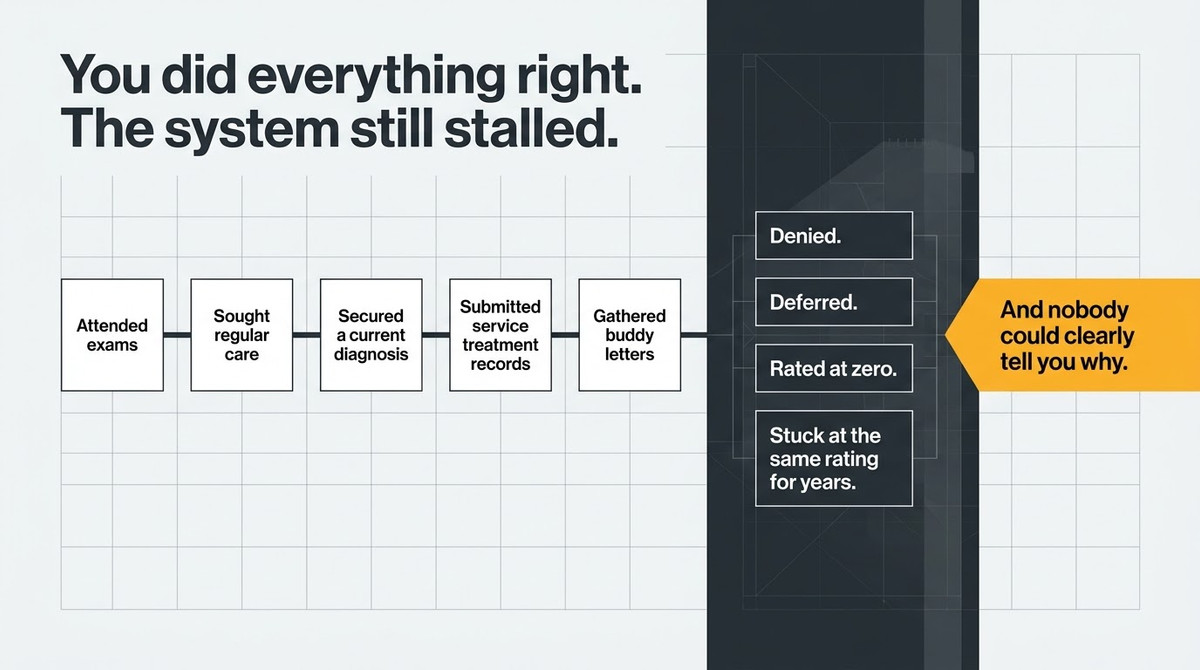
Every claim stands on three legs. Knock one out and the claim falls over, no matter how bad your symptoms are. Before you file, look at your file and find all three. If one is missing, that is the piece to build first. The VA will not build it for you, and filing without it usually just buys you a denial letter and lost time.
 01
01A current diagnosis
A doctor has to say you have it, now, in writing. Not "reports symptoms of", a diagnosis. Without this leg, nothing else in the file matters.
 02
02A link to your service
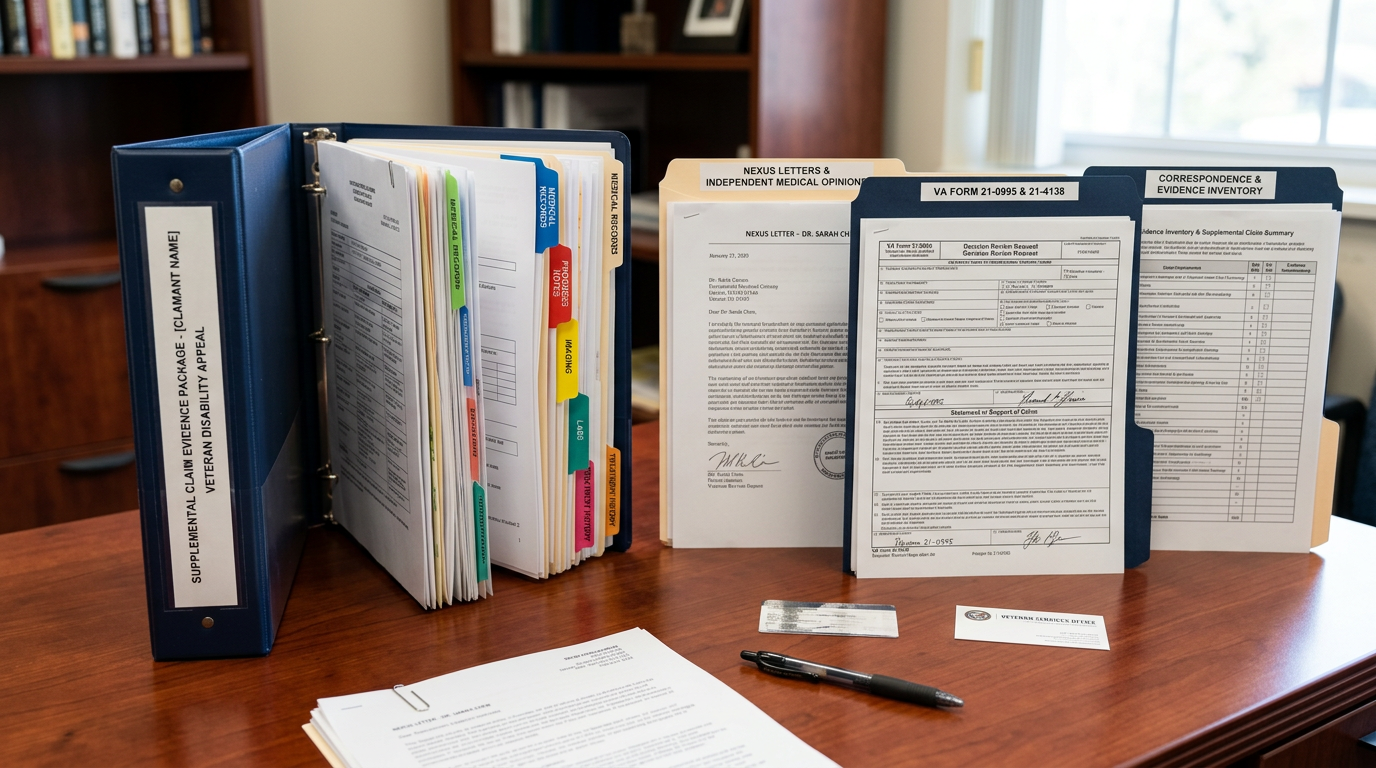
An event, an injury, an exposure, or an already service-connected condition. Service records, unit records, buddy statements, and your own account all count as evidence.
 03
03A nexus that ties the two together
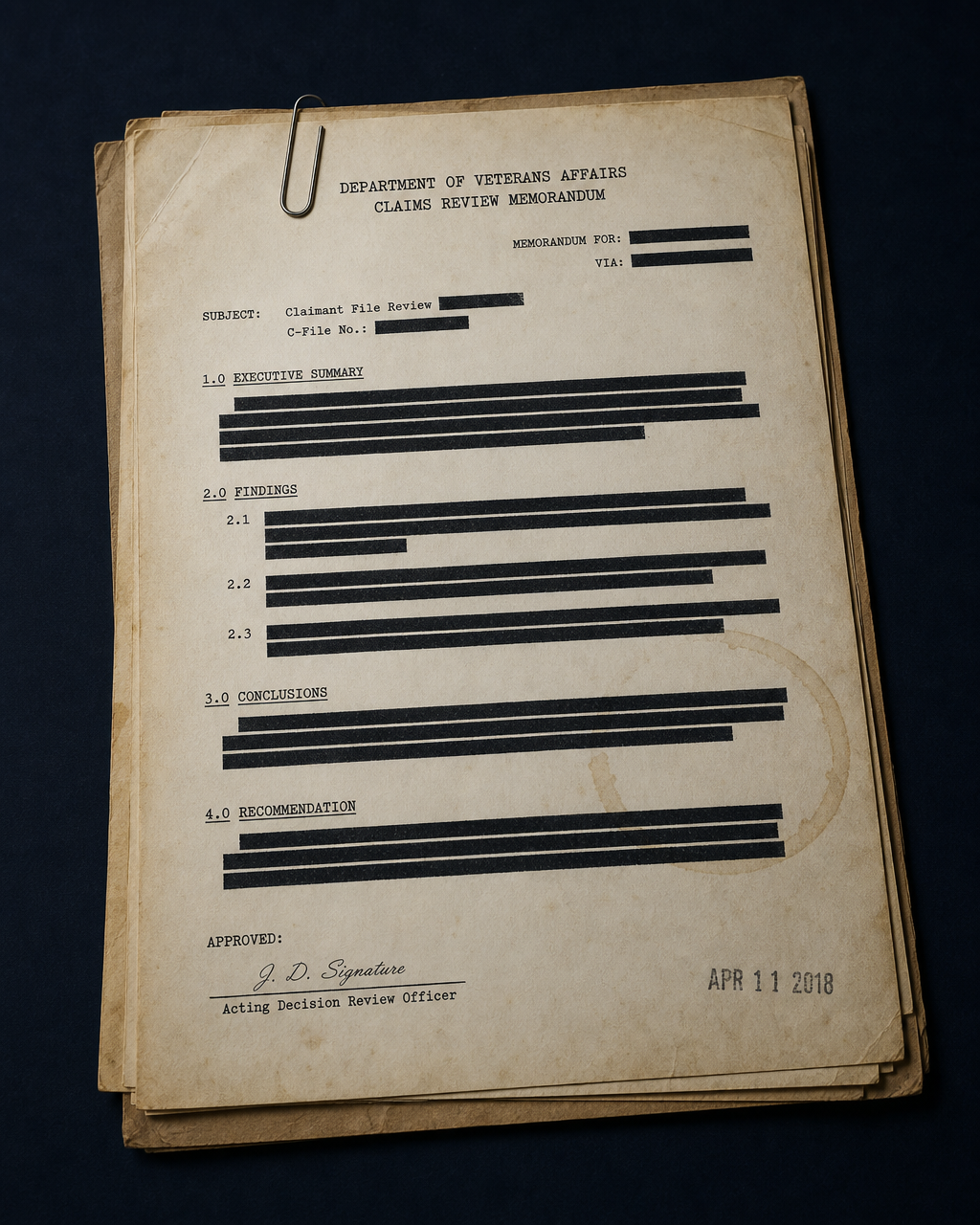
A medical opinion stating it is at least as likely as not that your service caused or aggravated the condition. That phrase is a legal standard: 50 percent or better. It is the leg most denials break.
Document the problem before you file
• Keep a dated symptom log for at least 30 days. Frequency, severity, and what it stopped you from doing.
• Get statements from people who see it, a spouse, a coworker, a battle buddy. Lay evidence is legal evidence.
• Pull your private treatment records. The VA only has to help; it does not have to go find everything.
• Write down what you have stopped doing. Lost work, lost sleep, lost activities. That is what impairment looks like on paper.
Your Rights in This Process
Most veterans walk into this system without knowing the rules the VA itself has to follow. That is how claims get denied for missing evidence the VA was supposed to help you find, and how exams get done by the wrong clinician. These six rights are written into federal regulation. Know them before you file, and make the VA honor every one of them when it decides your claim.

It costs nothing to file
Filing a VA claim is free. Accredited representatives may only charge for work on an appeal after an initial decision, and those fees are capped by 38 CFR §14.636.

The VA has a Duty to Assist you
Under 38 CFR §3.159 the VA must help you get the evidence it needs, and it must tell you what is missing before it denies you for missing it.

You can ask for a different examiner
You may request a trauma-informed clinician, or a clinician of a specific gender, for a C&P examination. Ask before the exam is scheduled.

You can claim every condition you have
There is no limit and no penalty. Primary conditions, secondary conditions, and conditions made worse by service all get filed.

You can appeal and be re-evaluated
A denial is not the end. You may submit new evidence, request a higher-level review, appeal to the Board, and ask for re-evaluation when your condition worsens.

You must be considered for TDIU
If your service-connected conditions keep you from holding substantially gainful employment, you may be paid at the 100 percent rate without a 100 percent rating.
The Nine Questions Every Veteran Should Be Able to Answer
This is the standard I hold every page on this site to. Before you file anything on your effective date, you should be able to answer these nine questions. If you cannot answer them yet, you are not ready, and that is exactly what my review is for. This is education first, representation second.

What is this?
The effective date is the day your benefits legally begin, and it controls how much back pay you receive. Getting the percentage right means little if the date is wrong.

What must the VA decide?
The correct effective date under the rule that applies to your type of award, direct service connection, an increase, a presumptive, a liberalizing law, or CUE.

What must the evidence prove?
When your entitlement arose and when you filed or established intent to file. The earlier of the correct dates under the governing rule usually controls.

What is the VA responsible for?
Applying the correct effective-date rule, honoring any intent-to-file date, and explaining in writing which date it used and why.

What are you responsible for?
Preserving your dates by filing timely, using intent-to-file when appropriate, and pursuing reviews continuously so you do not forfeit an earlier date.

What can go wrong?
The VA defaults to the date you filed instead of the date entitlement arose, ignores an intent-to-file, or overlooks continuous pursuit. Each one costs real money.

What you should not do
Do not accept the back-pay figure without checking the date behind it, and do not let an appeal lapse and break your continuous pursuit.

What I review as your accredited agent
I check five dates on every file, the claim date, the intent-to-file date, the date entitlement arose, the decision dates, and the continuous-pursuit dates, then I ask what date the VA used and why.

What happens next
If the date is wrong, I challenge it through the right route. A corrected effective date can add months or years of retroactive benefits.
Representation Means Telling You the Truth
Do Not File Yet If…
Before you take action on an effective-date challenge, check whether any of these apply. Filing at the wrong time can weaken your claim, waste a deadline, or put you on a longer path than necessary. I would rather tell you to wait than watch you lose an effective date or hand the VA a thin file it can deny in a week. A denial is not the end, but it costs you months. Read each item below honestly. If one fits your situation, call us first and we will tell you what to fix before anything gets filed.





Frequently Asked Questions
The effective date decides how much back pay you get, and the VA gets it wrong more often than people think. These are the questions I hear when a veteran suspects the date on the letter is too late. Your part is to find the earliest document in your file that shows you asked for benefits, and compare it to the date the VA used.
How is back pay calculated?
Can I get an effective date before I filed my claim?
What is an “informal claim” and can it help my effective date?
How does the PACT Act affect effective dates?
Can an effective date be changed after the decision is final?
What is the one-year rule for Supplemental Claims?
How does Intent to File (ITF) protect my effective date?

When You Are Ready to File
Talk to an accredited representative before you file. It costs nothing to ask, and the order you file in changes what the VA is allowed to award you. Albert L. Thombs Jr. is VA-Accredited Claims Agent #45147. A short conversation now can save you a year spent waiting in the wrong review lane.
Your part starts at the kitchen table. Pull your DD-214, your rating decision if you have one, and the names of every doctor who treats you today. Under 38 CFR 3.159 the VA has to help you gather records, but it can only chase the records you tell it about. Leave a doctor off the 21-4142 and that treatment may never reach your file.

Protect the date going forward
If you have not filed yet, an Intent to File holds your date for one year under §3.155(b). This is the cheapest protection in the whole system.
Get the Intent to File form on VA.govChallenge the date on the record
If the evidence for an earlier date is already in your file, a Higher-Level Review is how we make the VA look again. File within one year of the decision that set the date.
Request a Higher-Level Review on VA.govTake the date to a judge
When the date turns on how the law applies, the Board is often the right lane. A Veterans Law Judge reviews the effective date de novo.
File a Board Appeal on VA.govKeep Reading
One page never tells the whole story of a claim. The VA rates every condition on its own evidence, its own exam and its own diagnostic code, and the pieces connect in ways most veterans never see until a decision letter lands. These are the pages that pick up where this one stops. Read them before you file, not after a denial, because the cheapest fix in this process is the mistake you never make.

Clear and Unmistakable Error (CUE)
The most powerful effective date tool, correct an old VA error and reach back decades.
Read more
Supplemental Claims
File within one year of a denial to preserve the original effective date.
Read more
TERA / PACT Act
Liberalizing law dates can push your effective date back to August 10, 2022.
Read more
Rating Increases
A worsened condition can also reset your effective date up to one year earlier.
Read more