

Degenerative Disc Disease (DDD) / Degenerative Arthritis of the Spine
The discs between your vertebrae are shock absorbers made mostly of water. Under years of compressive load they dry out, flatten and crack. The vertebrae then sit closer together, the joints grind, and the body lays down bone spurs. It does not heal. It only progresses.
The word "degenerative" makes VA examiners want to blame your age. Your job is to show the wear started in uniform. The occupational medicine literature on axial load, whole-body vibration and disc degeneration is clear, a career of parachute landings, tracked-vehicle jolts, and heavy rucking does not produce the same disc profile as a desk career, and it should not be rated the same way. Age is a factor in everyone; it is not an explanation.
The Diagnostic Codes
Conditions Rated In Back, Neck & Spine
These are the codes the VA will actually stamp on a decision in this group. The code you are granted under decides which formula is used, and that decides your percentage. Degenerative Disc Disease is highlighted below.
DC 5237

Cervical / Thoracic / Lumbosacral Strain
Overstretching or tearing of the muscles, tendons and ligaments that hold a spinal region together. This is the most commonly granted spine diagnosis in the VA system, and it is the one most often under-rated, because examiners treat it as "just a muscle pull" instead of measuring what it actually does to your motion.
Read the full page
DC 5242

Degenerative Disc Disease (DDD) / Degenerative Arthritis of the Spine
The discs between your vertebrae are shock absorbers made mostly of water. Under years of compressive load they dry out, flatten and crack. The vertebrae then sit closer together, the joints grind, and the body lays down bone spurs. It does not heal. It only progresses.
You are reading this page
DC 5243

Herniated Disc / Intervertebral Disc Syndrome (IVDS)
The disc wall ruptures and the nucleus pushes into the spinal canal, pressing directly on a nerve root. This is the spine condition that produces the most dramatic nerve symptoms, sciatica, arm pain, foot drop, bladder dysfunction, and it is the only one that has its own alternative rating formula based on incapacitating episodes.
Read the full page
DC 5238

Spinal Stenosis
The spinal canal narrows, from bone spurs, thickened ligaments, bulging discs, or all three, and the spinal cord or nerve roots run out of room. Stenosis is progressive, it does not reverse, and the hallmark symptom is neurogenic claudication: leg pain and weakness that gets worse when you walk and better when you lean forward.
Read the full page
DC 5235

Vertebral Fracture
A vertebral body cracks under force, a blast, a fall, a parachute landing, a vehicle rollover. The fracture may heal, but the vertebra never returns to its original height, and the mechanical consequences, altered load distribution, accelerated degeneration at adjacent levels, and progressive kyphosis, last the rest of your life.
Read the full page
DC 5240

Ankylosing Spondylitis
An inflammatory autoimmune disease that fuses the vertebrae together over time. The spine literally turns into a single rigid column of bone. Unlike every other spine condition on this page, ankylosing spondylitis is not caused by mechanical wear, it is a disease process. But military service can trigger it, and the VA recognizes it.
Read the full page
Before Anything Gets Rated
What The VA Is Actually Looking For, And What Service Connection Really Means
Before the VA ever opens the rating schedule, it asks one question: is this disability the government’s responsibility? That is what “service connection” means. It is not a diagnosis, it is not sympathy, and it is not a reward for having served. It is a legal finding that a current, diagnosed disability is linked to something that happened to you in uniform. Percentages come later. If service connection is not established, there is nothing to rate and the claim is denied, no matter how bad the degenerative disc disease is.

For Degenerative Disc Disease Specifically
For DDD of the spine under DC 5242, VA rates the condition under 38 CFR §4.71a using the General Rating Formula for Diseases and Injuries of the Spine, which means the examiner is measuring range of motion in degrees, the presence of muscle spasm, guarding, and any ankylosis, not your pain level alone. Service connection most often runs direct, requiring a current diagnosis of degenerative disc or degenerative joint disease of the spine, an in-service event or exposure (parachute operations, tracked-vehicle duty, heavy load-bearing, a documented back injury, or cumulative axial loading), and a nexus opinion from a qualified clinician stating the degeneration is at least as likely as not related to that service exposure. The VA's M21-1, Part III, Subpart iv, Chapter 4, Sections A–B (Musculoskeletal Conditions), conditions require the rater to order a Compensation and Pension exam if the service treatment records show any back complaint and the nexus is not already established in the file, if that exam is inadequate or the examiner dismisses military occupational stress as mere aging, that exam is ripe for a challenge under Barr v. Nicholson. The word 'degenerative' is not a disqualifier; the legal standard under 38 CFR §3.102 is benefit of the doubt, and the occupational exposure evidence for spine loading in combat arms, aviation, and heavy logistics MOSs is well-documented enough to support a nexus opinion. Age alone cannot be the sole basis for denial when the veteran's occupational history distinguishes their spinal loading from the general population.
The three elements the VA must find. All three. Every time.
These come out of Caluza v. Brown and Shedden v. Principi, and they are the checklist a rating officer works through on your file. Miss one and the claim fails on that element alone.
A current, diagnosed disability
A doctor has to have written a diagnosis in a medical record, degenerative disc disease or degenerative arthritis of the spine. Symptoms by themselves are not a disability the VA can rate. Saunders v. Wilkie held that pain causing functional impairment can be a disability, but you still need a clinician to document it as diagnosed and impairing. The diagnosis must exist now, during the claim period, not only years ago.
An in-service event, injury, illness or aggravation
Something in service had to have happened, an injury, an exposure, a documented sick call, or steady wear over a career. It does not have to be one dramatic moment and it does not have to be spelled out in your service treatment records: buddy statements, unit records, performance evaluations and your own competent lay testimony can establish it.
A medical nexus linking the two
A qualified medical opinion that says the current diagnosis is at least as likely as not related to the in-service event. That phrase matters: at least as likely as not means 50 percent or better. Under 38 C.F.R. §3.102, when the evidence is evenly balanced, the benefit of the doubt goes to you and the claim must be granted.
The five ways service connection is established
Most veterans only know the first one. The other routes are lower-effort paths to the same grant, and the secondary route is the one most often left on the table.
Direct, 38 C.F.R. §3.303(a)
The injury or disease began in service and never went away. The classic route: three elements, one nexus opinion.
Chronicity and continuity, §3.303(b)
A chronic condition shown in service, plus continuity of the same symptoms from separation to now, can establish the link without a formal nexus opinion. Your own testimony about symptoms you can observe is competent evidence.
Presumptive, §3.307 and §3.309
Certain chronic diseases are presumed service connected if they manifest to a compensable degree within a set window after separation. You do not have to prove causation at all.
Secondary, §3.310(a) and (b)
A disability proximately due to, or aggravated by, an already service-connected condition is itself service connected. This is how the radiculopathy, adjacent-segment disease, and chronic-pain depression that DDD drives get on the rating sheet.
Aggravation of a pre-service condition, §3.306
If you entered service with a condition and service made it permanently worse, the increase is compensable. The VA must rebut the presumption of soundness by clear and unmistakable evidence, a bar it frequently fails to meet.
VA medical care, 38 U.S.C. §1151
An additional disability caused by VA treatment, surgery, or a failure to diagnose is compensated as if it were service connected.
The bottom line, there is no way around this
No diagnosis, no rating. It has to be chronic. It has to cause impairment.
Without a diagnosis, the VA will not rate your claim.
A rater cannot apply DC 5242 without a physician's written diagnosis of degenerative disc disease, degenerative arthritis, or spondylosis at a named spinal level, 'back pain' or 'muscle strain' in the service treatment records is not enough and is exactly how VA denies these claims at the threshold. Veterans who separated with only a notation of 'LBP' or 'cervicalgia' need a current imaging-confirmed diagnosis from a treating provider or a C&P examiner before the rating formula can even be applied.
The condition must be chronic.
DDD is by definition a progressive, irreversible structural change visible on X-ray or MRI, so chronicity is usually the easiest element to establish, but only if the veteran has current imaging in the file. A gap of years between the last documented treatment and the claim date gives VA an opening to argue the condition resolved or is unrelated to service, so a continuous treatment history or a current physician statement explaining the natural progression of the disease closes that gap.
It must cause actual impairment.
Under DC 5242 and the General Rating Formula, a zero-percent rating is assigned when the diagnosis exists but range of motion is normal and there are no other objective findings, meaning a veteran with real daily pain but a C&P exam showing full flexion walks away with nothing compensable. The formula keys on degrees of forward flexion, combined range of motion, and the presence of ankylosis, so if the C&P examiner does not test motion after repetitive use or during a flare, the rating will understate the actual impairment in violation of 38 CFR §4.59 and DeLuca v. Brown.
What this means for you before you file: Before you file, get current MRI or X-ray reports that name the specific spinal levels and findings, and line up a treating physician willing to write a nexus opinion connecting your military occupational exposures to those structural changes, without both, the claim will stall at development or come back at zero. Under Sharp v. Shulkin, the C&P examiner cannot dismiss flare-up functional loss with an unsupported estimate, a bare conclusion is inadequate. Under Mitchell v. Shinseki, pain-limited motion must be documented in degrees, not just acknowledged.
The Percentages
Rating Schedule, Degenerative Disc Disease, Diagnostic Code 5242
DDD is rated under the General Rating Formula identical to strain (DC 5237). The key difference is the DC 5003 backup: when measured motion is noncompensable but painful motion is objectively confirmed and arthritis is documented by X-ray, DC 5003 provides 10% per major joint group involved. Veterans with visible disc destruction on film but near-normal motion are the exact population this rule was written for.

100%
Unfavorable ankylosis of the entire spine.
50%
Unfavorable ankylosis of the entire thoracolumbar spine.
40%
Unfavorable ankylosis of the entire cervical spine; or forward flexion of the thoracolumbar spine 30° or less; or favorable ankylosis of the entire thoracolumbar spine.
30%
Forward flexion of the cervical spine 15° or less; or favorable ankylosis of the entire cervical spine.
20%
Forward flexion of the thoracolumbar spine greater than 30° but not greater than 60°; or forward flexion of the cervical spine greater than 15° but not greater than 30°; or the combined ROM of the thoracolumbar spine not greater than 120°; or the combined ROM of the cervical spine not greater than 170°; or muscle spasm or guarding severe enough to result in an abnormal gait or abnormal spinal contour.
10%
Forward flexion of the thoracolumbar spine greater than 60° but not greater than 85°; or forward flexion of the cervical spine greater than 30° but not greater than 40°; or combined ROM of the thoracolumbar spine greater than 120° but not greater than 235°; or combined ROM of the cervical spine greater than 170° but not greater than 335°; or muscle spasm, guarding, or localized tenderness not resulting in abnormal gait or abnormal spinal contour.
Service Connection
Advice from the Advocate
This is where I stop explaining the rules and tell you how I would build your Degenerative Disc Disease claim if you were sitting across my desk. Read the causation notes below twice. The VA will not connect the dots for you, even though 38 CFR 3.159 says it has a duty to assist. Your job is to put the in-service event, the current diagnosis and the medical link on paper, then make the examiner deal with all three.

The advocate's notes on causation, Degenerative Disc Disease
The separate arguments that decide this code: where the VA will attack, the regulation that answers it, and the evidence that closes the gap.
1Where the VA attacks first, "this is just aging"
The VA will point at your birthday. You point at your DD-214 and your MOS. Degeneration that shows up at 45 in a man who jumped out of aircraft for eight years is not the same as degeneration in a man who sat at a desk, and the occupational medicine literature says so. Force the examiner to address why your degeneration, at your level, at your age, is more likely than not attributable to the loading history in your record.
2The presumptive window, arthritis under §3.309(a)
Degenerative arthritis is a listed chronic disease under 38 CFR §3.309(a). If it manifested to a compensable degree within one year of separation, §3.307 presumes it was incurred in service and you do not have to prove the nexus at all. Pull every record from your first year out, a VA visit, urgent care, an employer physical, a chiropractor. One dated entry inside that window converts a contested fight into a presumption.
3The secondary route, degeneration driven by another rated joint
If the VA already pays you for a knee, an ankle, a hip or a foot, the altered gait that condition produces loads your spine unevenly for years. That is a textbook secondary claim under 38 CFR §3.310(a), and if the spine was already degenerating, §3.310(b) covers the worsening. The nexus opinion you need is about biomechanics between two body parts, a far easier opinion for a physician to write.
Exposure & Aggravation
How Degenerative Disc Disease Develops In Service, And Why The VA Blames Your Age

The VA wants an in-service event, and most veterans think that means one dramatic injury. It does not. Years of duty that wore the body down count too, and under 38 CFR 3.306 a condition service made worse can still be connected. Find yourself in the list below, then put that duty in writing with dates, units and names. The board only weighs what you put on paper.
How veterans pick this up in uniform, Degenerative Disc Disease
Discs do not fail overnight. They fail under years of axial compression, parachute landings, tracked-vehicle vibration, heavy rucking, and the cumulative effect of body armor on every spine in the formation. The VA will point at your age and call it natural. The occupational medicine literature on vibration-induced disc degeneration says the rate of wear is driven by the load history, not the calendar. Your job is to make the examiner address your specific load history, not hide behind a generic "age-related" boilerplate.
- Airborne and Air Assault, in any MOS: every parachute landing fall and every fast-rope insertion is an axial compression event, and a career can be dozens or hundreds of them.
- Rotary and fixed-wing aircrew (15-series, 1A-series, Naval Aircrew): sustained airframe vibration plus repeated hard landings.
- Armor and mechanized crews (19K, 11M, Bradley, Abrams, Stryker, LAV) and 88M/12N: hours of off-road whole-body vibration, and the jolt a track commander takes standing in an open hatch.
- Small-boat crews, SWCC and shipboard sailors: repeated slamming impacts on the water, plus a career of ladderwells and knee-knockers.
- Artillery and tank crews (13B, 13F, 19K, 0811): recoil, lifting rounds, and working in a concussive environment.
Who is most prone to it
Anyone with jump status, aircrew status, or years inside a tracked or wheeled vehicle. Also every veteran past 40, which is exactly why the VA reaches for "age-related" on this one. Age is not a defense. The question is whether service caused it OR accelerated it, and acceleration is compensable.
The Symptoms
What Degenerative Disc Disease Actually Feels Like
Read this list the way the examiner will. Every symptom you live with but never report is a symptom the VA treats as if it does not exist. The rating schedule pays for how Degenerative Disc Disease affects your daily life and your work, so the details matter. Check off what matches your day, tell your doctor in those words, and make sure it lands in your treatment record before the exam.

- Deep, constant ache that is worse in the morning and after inactivity
- Sharp catches of pain on bending, twisting or standing up
- Audible grinding, popping or crunching in the region
- Loss of height over the years as disc spaces collapse
- Pain that radiates into the shoulder or hip as the spurs crowd nerve roots
- Stiffness after sitting, the "movie-theater" effect, where getting up is harder than walking
- Pain that increases after driving, standing at a counter, or carrying anything
- Flare-ups that last days and require bed rest
- Numbness or tingling in the arms or legs when a spur presses a nerve root
- Weakness in the grip or the foot drop that signals nerve involvement
How this one is rated
Rated on the General Rating Formula for Diseases and Injuries of the Spine under 38 CFR §4.71a, the same formula used for strain. However, DDD also qualifies for a separate pathway under DC 5003 (degenerative arthritis), which provides a minimum 10% per major joint group when painful motion is confirmed by X-ray, even if the measured range is technically noncompensable. That means X-ray confirmation of arthritis is not optional; it is the gate to an entire additional rating pathway.
What you are measured against
Same motion thresholds as all spine conditions under the General Formula. The additional DDD-specific requirement is X-ray confirmation of degenerative changes to open the DC 5003 pathway. Without the imaging on record, the rater cannot apply the code even if the degeneration is obvious clinically.
Each One On Its Own Page
Secondary Conditions, Aggravated or Caused by a Current Service-Connected Condition
Under 38 CFR §3.310(a), a disability that is proximately due to a service-connected condition is service-connected in its own right, and under §3.310(b), so is any additional disability caused when a service-connected condition aggravates a problem you already had. Each condition below is a separate evaluation with its own diagnostic code and its own percentage. They do not fold into the degenerative disc disease rating, they stack on top of it. A veteran who claims only the primary condition leaves these ratings on the table.

Radiculopathy from compressed nerve roots
As disc spaces collapse, bone spurs crowd the nerve roots. Each nerve that fires, sciatic for the legs (DC 8520), cervical radiculopathy for the arms, is a separate rating under §3.310(a). A veteran with DDD and bilateral sciatica should be carrying three ratings, not one.

Adjacent-segment disease, the levels above and below
When one disc level fails, the levels above and below it work harder and degenerate faster. This is called adjacent-segment disease and it is a documented secondary condition under §3.310(b), the aggravation provision. If your original claim was at L4-L5 and now L3-L4 is deteriorating, that progression is compensable.

Depression, sleep disruption and TDIU
A spine that grinds and radiates pain 24 hours a day produces depression, anxiety, and insomnia, all separately ratable under §4.130. When the degeneration is severe enough that you cannot work, TDIU under §4.16 compensates the total occupational loss. Document every job task the spine has eliminated.
Accredited Claims Agent #45147
Ready To Get This Rated Correctly?
You have read how the VA rates Degenerative Disc Disease. Now the question is whether your file proves it. We represent veterans on a No Win, No Fee basis: 20% Direct-Pay paid by the VA from back pay, or 30% High-Complexity, and you owe nothing for representation if your rating does not increase. If you only need the roadmap, the Mission 5 Brief is a separate $750 flat fee. You bring the records, we build the argument.
Back, Neck & Spine, In Detail
Back, Neck & Spine, Service Connection In Depth
Here is each claimable condition in this group on its own terms, what it is, what service did to it, and what the VA requires before it will connect it.

Cervical / Thoracic / Lumbosacral Strain
A strain is the diagnosis the VA hands out most and rates least. There is no scan that shows a strained muscle, no blood test, no fracture line. The entire evaluation is built from how far you can move, how much it hurts when you do, and whether the examiner can feel muscle spasm or guarding, a finding that alone can carry you from 10% to 20% without a single extra degree of lost motion. If your examiner skipped palpation, they destroyed half your evidence.
Read the full Spinal Strain page
Degenerative Disc Disease (DDD) / Degenerative Arthritis of the Spine
The word "degenerative" makes VA examiners want to blame your age. Your job is to show the wear started in uniform. The occupational medicine literature on axial load, whole-body vibration and disc degeneration is clear, a career of parachute landings, tracked-vehicle jolts, and heavy rucking does not produce the same disc profile as a desk career, and it should not be rated the same way. Age is a factor in everyone; it is not an explanation.
You are reading this page now

Herniated Disc / Intervertebral Disc Syndrome (IVDS)
A herniated disc is rated two ways and the VA must give you the higher one. The General Rating Formula rates on range of motion, and the Incapacitating Episodes Formula under DC 5243 rates on the total weeks of doctor-prescribed bed rest in the past 12 months. Most veterans do not know the second formula exists, and even fewer track the bed-rest weeks that would trigger it. Six weeks of prescribed bed rest in a year is worth 60%, regardless of how far you can bend.
Read the full Herniated Disc / IVDS page
Spinal Stenosis
Stenosis is the slow squeeze. The canal narrows over years, and the symptoms creep up until one day you realize you cannot walk a city block without stopping to lean on something. The classic sign, the "shopping cart" posture, leaning forward for relief, is so distinctive that clinicians name it. The VA rates stenosis on range of motion under the General Formula, but the real value in the claim lives in the nerve roots being compressed and the secondary conditions that compression produces.
Read the full Spinal Stenosis page
Vertebral Fracture
A vertebral fracture changes the geometry of the spine permanently. Even a "healed" compression fracture leaves the vertebra shorter, shifts the load to the levels above and below, and starts a cascade of degeneration that was not happening before the fracture. The General Rating Formula gives a baseline 10% for loss of 50% or more of vertebral body height, but the real value is in the downstream conditions the fracture sets off.
Read the full Vertebral Fracture page
Ankylosing Spondylitis
Ankylosing spondylitis is the spine condition that goes straight to the top of the schedule. When the spine fuses, favorable or unfavorable ankylosis, the rating is 30% to 100% depending on how much of the spine is involved and what position it fused in. The disease is progressive, it does not reverse, and the VA cannot rate a fused spine on range of motion it no longer has. The rating reflects the anatomical reality.
Read the full Ankylosing Spondylitis pageThe C&P Exam
What To Expect At The Degenerative Disc Disease Exam
This is the encounter your rating is built on. The examiner has a checklist and a limited window, what follows is exactly what happens in that room, so none of it surprises you.
Clinical Section, What To Expect at the Exam
The Degenerative Disc Disease Examination, Diagnostic Code 5242
The one spine exam where imaging is mandatory, and the one most often lost because nobody cited the X-ray.
Degenerative disc disease is the one spine condition where imaging is a required part of the exam, because Diagnostic Code 5003 will not open at all without X-ray confirmation of degenerative arthritis. The examiner has to do both jobs, measure the motion, and confirm the arthritis is documented by X-ray.
Condition
Degenerative Disc Disease, DC 5242
Governing questionnaire
VA Form 21-0960M-14, Back (Thoracolumbar Spine) Conditions, and/or 21-0960M-13, Neck (Cervical Spine) Conditions
Click the form number to open the official questionnaire on VA.gov.
01In The Room
What happens during the exam
The tests and maneuvers for this condition
- Repetitive-use testing in all six planes for each segment claimed.
- Screening for radicular signs at each degenerated level, because objective neurologic abnormalities are rated separately under Note (1).
- Painful motion under §4.59, which supports the minimum compensable rating for the joint even when motion is otherwise noncompensable.
- Palpation for spasm, guarding and localized tenderness, mapped to the degenerated levels.
What gets measured, and to what number
Thoracolumbar spine, six planes
Forward flexion 0–90°, extension 0–30°, left and right lateral flexion 0–30° each, left and right lateral rotation 0–30° each. Normal combined range of motion is 240°.
Cervical spine, six planes
Forward flexion 0–45°, extension 0–45°, left and right lateral flexion 0–45° each, left and right lateral rotation 0–80° each. Normal combined range of motion is 340°.
Imaging
X-ray evidence of degenerative arthritis must be in the record and identified by level. Disc space narrowing, osteophytes, endplate sclerosis and facet arthropathy should each be named.
Levels involved
Each affected level is listed separately, C5-6, L4-5, L5-S1, because multi-level disease and the number of joint groups affect the DC 5003 pathway.
02Orientation
What to expect during this exam
What makes this exam different from every other C&P exam
1X-ray confirmation is a legal prerequisite, not a formality
Diagnostic Code 5003 will not open at all without X-ray evidence of degenerative arthritis. This is the only spine pathway with a hard imaging gate. An examiner who writes "degenerative changes noted" without identifying the study and the levels has left the rater unable to apply the code, and a veteran with real arthritis and near-normal motion walks away with zero.
2This is the exam where §4.59 pays even when motion does not
If your measured motion is noncompensable but painful motion is objectively confirmed, DC 5003 provides 10 percent per major joint group. Degenerative disc disease is the classic scenario for that rule, because the discs can be visibly destroyed on film while you still bend to 80 degrees. The examiner has to affirmatively document objective evidence of painful motion for that pathway to open.
3The number of levels changes the math
Multi-level disease is not the same claim as single-level disease. Whether two or more major joints or two or more minor joint groups are involved is a specific question on the DC 5003 pathway, and it needs each affected level named individually, C5-6, L4-5, L5-S1, not a blanket sentence about generalized degeneration.
See it before you sit in the room
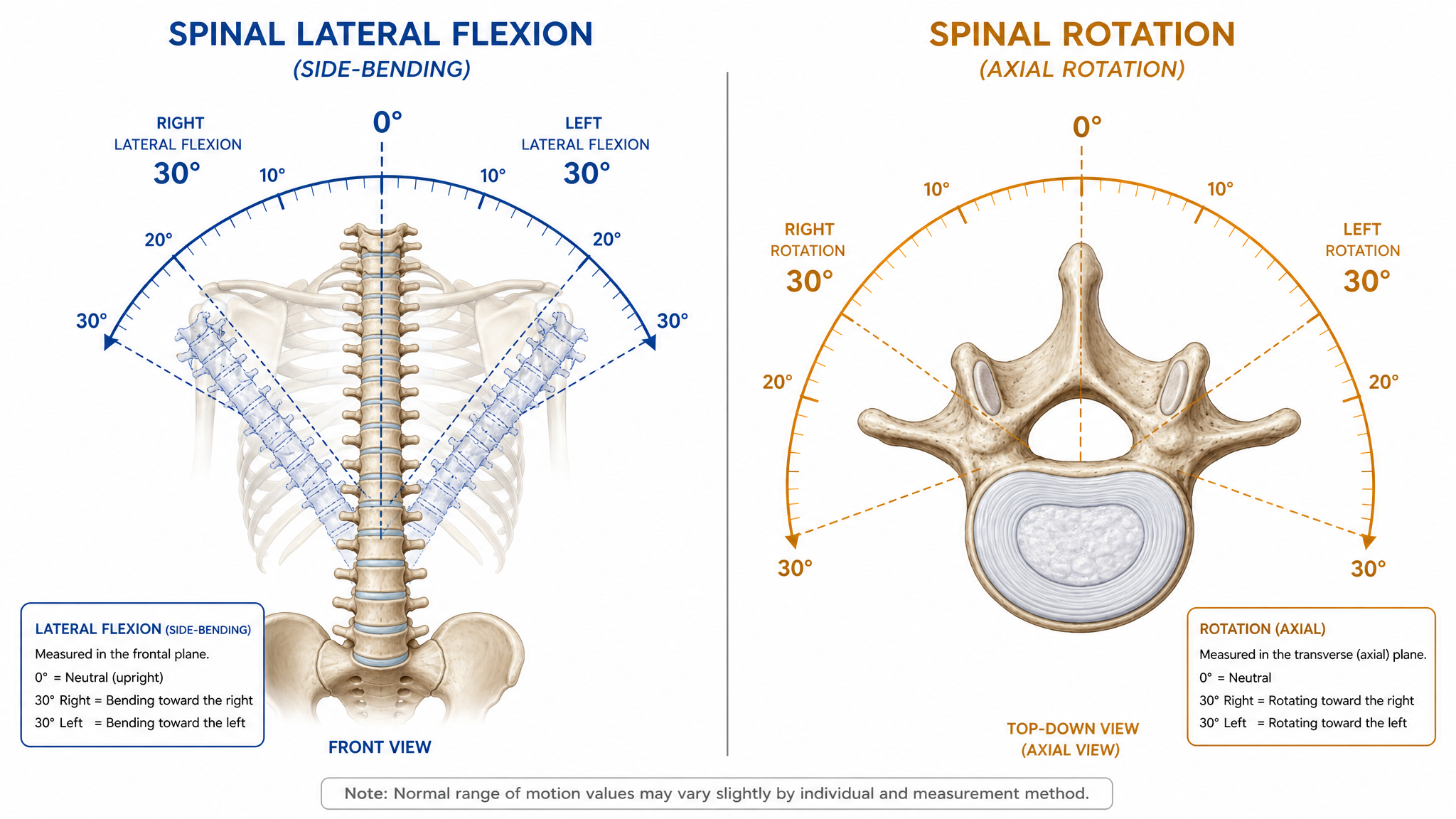
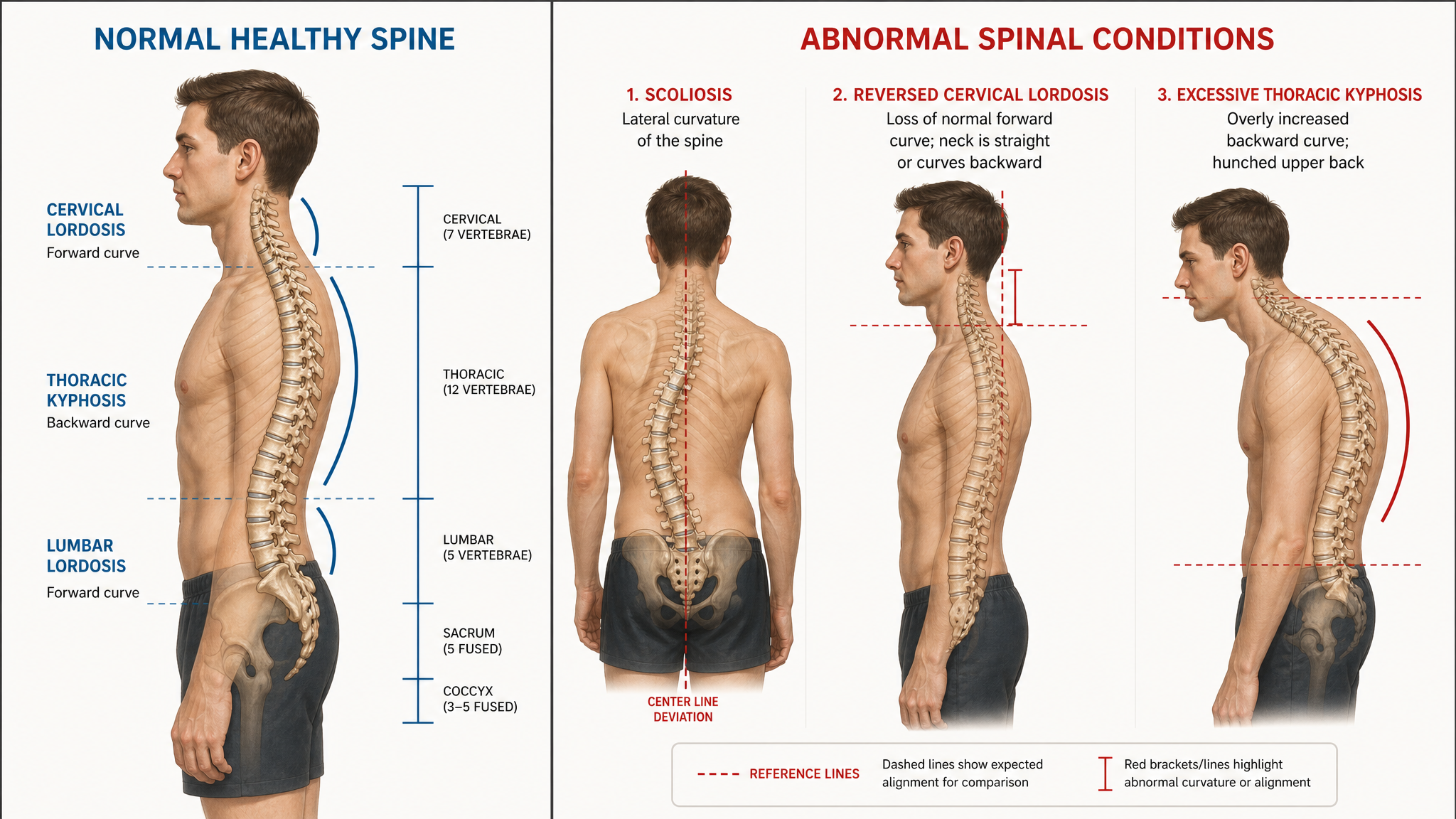
03Preparation
Know your symptoms and secondary factors
What the report must actually say about degenerative disc disease, dc 5242
- That degenerative arthritis is established by X-ray findings, with the study date and the levels.
- Whether the limitation of motion is compensable on the General Rating Formula, and if it is not, whether painful motion is objectively confirmed by swelling, muscle spasm or satisfactory evidence of painful motion.
- Whether two or more major joints or two or more minor joint groups are involved.
- The cervical and thoracolumbar segments evaluated and reported separately.
Pain level, frequency, lost work and functional loss, how to say them

Tell the examiner about the X-ray, DC 5003 requires it
Diagnostic Code 5003 will not open without X-ray confirmation of degenerative arthritis. If your imaging shows degenerative changes but the examiner does not cite the specific study and levels, the rater cannot apply the code, and a veteran with real arthritis and near-normal motion walks away with 0%.
Bring a copy of the radiology report and point to the levels with documented changes.
"My X-ray from [date] shows degenerative changes at L4-L5 and L5-S1. I want to make sure that imaging is in the report."

Describe the grinding, popping and crunching
Crepitus, audible grinding or popping, is objective evidence of bone-on-bone contact from collapsed disc spaces. The examiner can sometimes feel it during motion testing. Mention it before they start measuring so they listen for it.
Note which movements produce it and whether it has gotten louder or more frequent over the years.
"When I bend forward or twist I can feel and hear grinding in my low back. It has gotten worse every year."

Report the "movie-theater" stiffness
Degenerative discs stiffen after inactivity, sitting through a movie, a long drive, or a desk shift. This is diagnostically distinct from strain stiffness and tells the examiner the disc spaces are loading abnormally. Quantify the sit-to-stand transition: how long until you can walk normally.
Include how often you have to stand up and move during sedentary tasks.
"After sitting for 30 minutes I cannot stand up straight. It takes me a full minute of walking before I can straighten out."

Quantify the flare-ups and bed-rest days
DDD qualifies for the IVDS incapacitating-episode formula (DC 5243) as an alternative to the General Formula, and the VA must apply whichever gives you the higher rating. An "incapacitating episode" is a period of doctor-prescribed bed rest. If your flare-ups require bed rest, say so and give the total weeks in the last 12 months.
Keep a flare-up log with dates, duration, and whether you sought medical care during each one.
"In the last 12 months I have had about six weeks total where I was flat on my back and could not work. My doctor prescribed bed rest for two of those episodes."

Report radiating symptoms, they are separate ratings
Disc degeneration crowds nerve roots and produces radiating pain, numbness, and weakness in the arms or legs. Each affected nerve is rated separately under the peripheral nerve codes (DC 8520 for sciatic, DC 8510-8519 for upper extremity nerves). If you have tingling in your fingers or shooting pain down your leg, say exactly where it goes.
Describe whether the radiation is constant or intermittent, and which activities trigger it.
"I get shooting pain down the back of my left leg to the foot, and my right hand goes numb when I look up. Both started after the discs got worse."
Secondary conditions to raise in the same appointment
Every secondary condition laid out in the Secondary Conditions section above belongs in this same appointment. Name each one out loud, tell the examiner how the primary condition caused it or made it worse, and ask that it be noted in the report. Under 38 CFR 3.310, a secondary condition the examiner never hears about is a secondary condition the VA never rates. Bring your list on paper so nothing gets left in the parking lot.
What to expect at this specific exam
- Bring the actual imaging report, not just a summary. If the X-ray is more than a couple of years old, ask your provider for a current one before the exam is scheduled.
- Know your levels by name and be able to say them. An examiner who hears "L4-5 and L5-S1" writes down something different than one who hears "my lower back."
- If a private MRI or CT exists that VA does not have, submit it before the exam so it is in the file the examiner reviews.
- If another service-connected joint changed how you walk, say it at the exam. That is the seed of a secondary theory and it belongs in the examiner’s history section.
04The Protocol
What procedures are required during the exam
These are not courtesies. Each comes out of the regulation or out of binding case law. Take this list in with you and tick them off as they happen.

01Goniometer range of motion, six planes
38 C.F.R. §4.71a
Same six-plane measurement as strain, with a goniometer, not by eyeball. Repetitive-use testing (three reps) is mandatory. The DDD-specific wrinkle: the degenerative spine often loses lateral flexion and rotation before it loses forward flexion, so those four side planes are where your combined ROM drops below the threshold.
The combined ROM number catches what the forward-flexion number misses. A veteran with 75° flexion (noncompensable) but only 15° of each lateral flexion and rotation has a combined ROM of 195°, which IS compensable at 10%.

02X-ray or MRI confirmation of degenerative changes
38 C.F.R. §4.71a, DC 5003
DC 5003 requires X-ray evidence of degenerative arthritis. The examiner must cite the specific imaging study, the date, and the levels involved. "Degenerative changes noted" without identifying the study is insufficient for the rater to apply the code.
Without the imaging citation, the entire DC 5003 pathway, which provides a minimum 10% per major joint group when motion is painful but noncompensable, is closed. This is the imaging gate that separates DDD from strain.

03Neurological examination of the extremities
38 C.F.R. §4.124a
The examiner must test sensation, reflexes, and motor strength in both upper and lower extremities to document any radiculopathy from disc compression. Each affected nerve root is rated separately, skipping the neuro exam means separate ratings go undocumented.
Radiculopathy is the single most valuable secondary finding in a DDD exam. A missed nerve finding can be worth 10-40% per extremity.

04Flare-up and incapacitating-episode estimation
38 C.F.R. §4.71a, DC 5243
The examiner must estimate additional functional loss during flare-ups in degrees and document the total weeks of doctor-prescribed bed rest in the last 12 months. The IVDS formula (DC 5243) rates on bed-rest weeks, and the VA must apply whichever formula, General or IVDS, gives the higher rating.
The IVDS alternative formula can produce a 60% rating (6+ weeks of bed rest in 12 months) even when ROM measurements alone would yield only 10-20%.
05The Standard
What makes an exam adequate
Read your exam report against these. An exam that fails the standard is legally inadequate, and an inadequate exam is something you challenge rather than accept.
The range of motion has to be MEASURED, not estimated
38 CFR §4.46 states that the use of a goniometer in the measurement of limitation of motion is indispensable in examinations conducted within the Department of Veterans Affairs. An examiner who eyeballs your bend and writes a number has not complied with the regulation. This is the most common defect in a spine exam and it is the easiest one to spot from the chair.
Joints must be tested in every required condition
Under Correia v. McDonald, a joint examination for pain must, wherever possible, record active motion, passive motion, motion in weight-bearing and motion in non-weight-bearing, and where relevant, the range of the opposite undamaged joint. An exam that records one set of numbers and stops is incomplete on its face, and that incompleteness is grounds to challenge it.
Flare-ups have to be addressed, not dodged
Under Sharp v. Shulkin, when a veteran describes flare-ups, the examiner is obligated to estimate the additional loss of motion during a flare based on all the available evidence, including your own account of it. "I cannot opine without resorting to mere speculation" is not automatically acceptable; the examiner has to have actually sought the information first and explained why an estimate is impossible.
Repetitive use and functional loss must be factored in
Sections 4.40 and 4.45, and the DeLuca line of cases, require that pain, weakness, fatigability, incoordination and lack of endurance after repeated use be considered, and expressed in additional degrees of lost motion where that is feasible. Your rating is supposed to reflect what you can do on the fifth repetition and on a bad day, not just the first careful bend of the morning.
Neurological findings must be separately documented
Note (1) to the General Rating Formula requires that any associated objective neurologic abnormality be evaluated separately under an appropriate diagnostic code. If your leg symptoms were mentioned in the narrative but never tested and never assigned, the exam did not do what the schedule requires of it.
The examiner must review the record when the question requires it
Where a medical opinion on cause, aggravation or a secondary relationship was requested, the examiner is expected to review the relevant evidence and give a reasoned explanation. A bare conclusion, "less likely than not related to service" with no reasoning attached, carries little weight, and an opinion with no rationale is challengeable.
The examiner has to be qualified for the body system
The VA may use its own clinicians or a contract vendor. Either way, the examiner is expected to have the competence to evaluate the system being examined. If a spinal exam with a neurological component was performed by someone who never tested a reflex, that is a problem worth raising.
The exam has to be CURRENT
A rating is supposed to reflect your condition now. An exam performed before a documented worsening, or years before the decision, may not support the current evaluation, and you can request a new one on that basis.
06Afterward
What happens after your exam is complete
The examiner writes the report and submits it, it is reviewed for completeness, and only then does the claim move toward a rating decision. Here is what actually controls the clock.
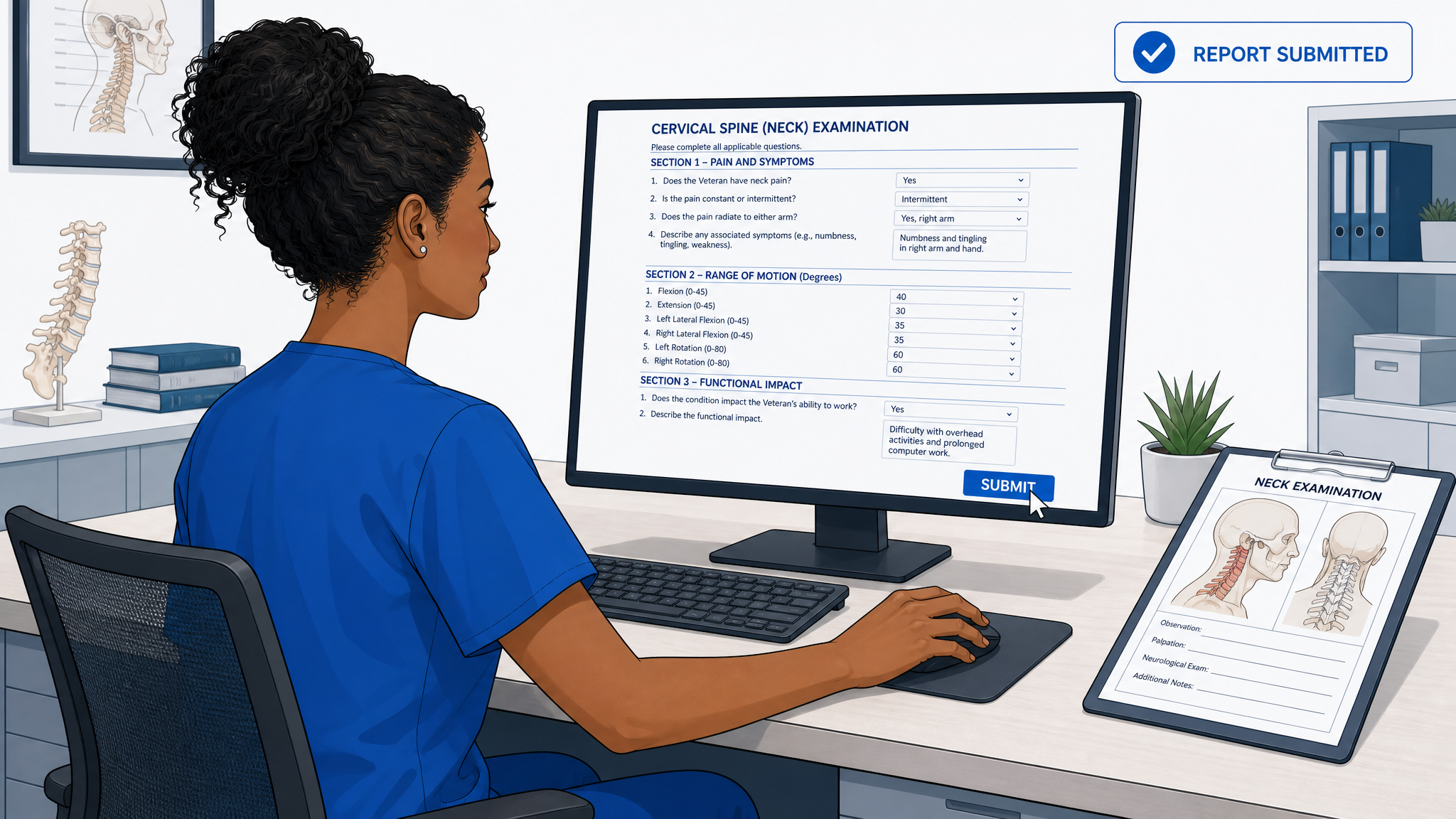
The examiner writes and submits the report
Days 1–5 after the exam
The examiner compiles the history, the physical findings, the measurements and any testing into the questionnaire, adds any requested medical opinion, and submits it. Contract vendors typically have a turnaround requirement measured in days, not weeks.
Nothing about your claim moves while this is happening, and nothing you do speeds it up. What matters is that the report is written from notes taken in the room, which is exactly why what you said, and how the examiner recorded it, is already locked in by the time you get to your car. Request your copy now rather than later.

Quality review, and the request for clarification
Days 3–30
The report is reviewed for completeness. If it is internally inconsistent, missing a required field or missing the opinion the VA asked for, it goes back for correction or a second opinion. This is the single most common cause of a claim appearing to stall after the exam.
Understand what a finished exam actually means: it means the appointment happened, not that your claim is ready for a decision. If the reviewer finds a blank range-of-motion field, an opinion that does not answer the question that was asked, or findings that contradict each other, the file goes back out for more information. That is a normal quality control step, not a rejection of your claim, and it is not a sign that you did something wrong, but it does add weeks, and it is the reason so much of what you read online sounds like the system is broken.

Your status tracker moves backward, and it is usually not bad news
Any time after the exam
The online tracker shows eight steps. Veterans watch it reach step 7 or 8, then find it back at step 3 or 4 a week later. That regression almost always means one thing: the file went back for additional information, most often a returned or clarified exam.
This is the number one thing veterans panic about, and it is misread constantly. The tracker is not a countdown, it is a location marker. When the VA decides it needs one more piece of evidence, a corrected exam, a clarifying medical opinion or an outstanding record, the claim is routed back to the evidence gathering step and the bar redraws itself where the file physically is. It does not mean a denial. It does not mean your case was thrown out or restarted. It does not erase anything already in the file, and it does not change your effective date. What it does mean is that something in the record was not good enough to decide on yet, which is worth knowing, because if the weak link is the exam, this is the window where a corrective statement or a private opinion from your own doctor does the most good.

Evidence gathering closes
Varies
Before anyone rates your claim, the file has to be built. This is the stretch where the Regional Office pulls together everything the decision will rest on: your service treatment records, your VA medical records, any federal records, the C&P exam report, and any private records it has requested on your behalf. The claim sits here until the VA is satisfied the record is complete enough to decide, which is exactly why a status tracker can appear to stall or slide backward at this step. You are not powerless while it sits here. Anything you put into the file yourself lands the day you send it, and every relevant record you add now is one less thing the rater can later say was missing.
A VA request to a private provider is a letter that may or may not be answered, and the VA will wait on it for weeks before moving on, sometimes without ever getting a response. A record you walk in yourself, or upload through your claim, is in the file the day you send it. So do not sit and wait to be asked. If you know a treatment record, an imaging report, a surgical note or a buddy statement exists and it matters, send it now, with a VA Form 21-4138 statement that explains in plain words what the document is and what it shows. This is also the window where a corrective statement or a private medical opinion from your own doctor does the most good, before the rater has locked in a decision, not after. Once the evidence gathering step closes, the file goes to a rating specialist, and your chance to shape the record cheaply and quickly closes with it.

Rating decision and promulgation
Typically several weeks after the last piece of evidence lands
This is the stage where your evidence finally becomes a number. A rating specialist, not the examiner, and not a doctor, takes everything in the file and applies the rating schedule to it: the exam findings, your range-of-motion measurements, your lay statements, your private records and any medical opinions. They assign a diagnostic code to each condition, pull a percentage from the schedule, set your effective date, and either grant, deny or defer each issue. The decision is then reviewed and authorized, promulgation is simply the VA’s word for making it official, and the decision letter and code sheet are generated and mailed. Where an award is made, payment follows the effective date rules, and back pay is calculated to that date.
Read the code sheet, not just the percentage. It names the diagnostic code used, the exact measurements relied on and the effective date assigned, and that is where most mistakes live. This is a human being reading a file under a production quota, and the two things that go wrong most often are a rater using the pre-repetition range-of-motion numbers instead of the worst-case figures §4.59 and §4.40 require, and a claimed condition being decided on a thin record or quietly left out. Check whether painful motion was accounted for, whether your radiculopathy was rated separately under Note (1) or folded into the spine rating, and whether every condition you claimed was actually addressed. A decision you do not read is a decision you cannot challenge, and the deadline to challenge it starts the day the letter is dated, not the day you understand it.

C&P examination is the decision letter
The day it lands in your mailbox
The envelope holds two different documents: the narrative decision letter, and the code sheet. Together they are the single most important piece of paper in your claim, because every deadline, every appeal option and every dollar of back pay is set by what is printed on them, not by what you were told at the exam.
Most veterans read one thing on that letter: the percentage. Then they either celebrate it or get angry at it, and file it in a drawer. That is the mistake. The percentage is the conclusion; the reasons section is the reasoning, and the reasoning is what you attack. It tells you which diagnostic code the rater used, which range-of-motion figures they relied on and which they ignored, whether painful motion under §4.59 was accounted for, whether your neurological findings were rated separately under Note (1) or folded into the spine rating, which conditions were decided, which were deferred, and which were never addressed at all. It also assigns your effective date, which controls back pay. A rating that looks low is very often not a disagreement about how bad your neck is, it is a rater who used the pre-repetition numbers, or missed the radiculopathy, or rated one side and not both. You cannot see any of that from the percentage. Do not go by the percentage alone, and do not decode it by yourself if you are not sure what you are looking at, have someone who reads these for a living read it with you before the clock runs out. You have one year from the date on that letter to file a Higher-Level Review (VA Form 20-0996), a Supplemental Claim (VA Form 20-0995) or a Board appeal, and the deadline runs from the date printed on the letter, not the date you opened it. Bring it to this office and we will go through it line by line, at no cost, and tell you plainly whether it is right.
What normal looks like: 30 to 60 days for a simple claim, longer for a complex one
After your exam you should expect some kind of notification from the VA, a decision, a request for more information, or a notice that another exam has been scheduled. For a straightforward, single-issue claim that often lands within 30 to 60 days. But 30 to 60 days is a rough guide, not a rule, and it is not a ceiling. A claim with several conditions, a toxic-exposure or presumptive question, a returned exam, or missing records routinely takes 90 days or more, and that alone does not mean anything is wrong, the more moving parts your case has, the longer the VA takes to work it. Inside the window that is normal for a case like yours, silence is expected and there is nothing to fix, and a tracker that jumps backward is normal too.
What matters is not a fixed number of days, it is whether the claim is still moving and whether you can get a straight answer about where it is. Once you are well past what is normal for a case like yours and the VA either goes silent or cannot tell you what the claim is waiting on, stop waiting. That is usually where the real trouble hides, an exam that came back twice, a records request that was never answered, a claimed condition that got dropped, or a file sitting in the wrong queue. Call the VA at 800-827-1000, ask specifically what the claim is waiting on and who it is assigned to, and write down the answer. If you cannot get a straight answer, or the answer tells you the exam is the problem, that is the moment to bring it to this office rather than sitting on it for another three months. Problems raised early get fixed inside the claim. Problems discovered in a denial letter get fixed on appeal, and that costs you a year.
Other things that control the clock
Six things decide how long you wait, and none of them are visible from the tracker alone.

The average is a moving number
Check it at the source, not second-hand
The VA publishes an average days-to-complete figure for disability claims that moves month to month; check the current number on the VA’s own claim status page rather than relying on any second-hand figure. In practice, most veterans see a decision somewhere between roughly three and eight months from the date the claim was filed, with the exam usually falling in the middle of that window.
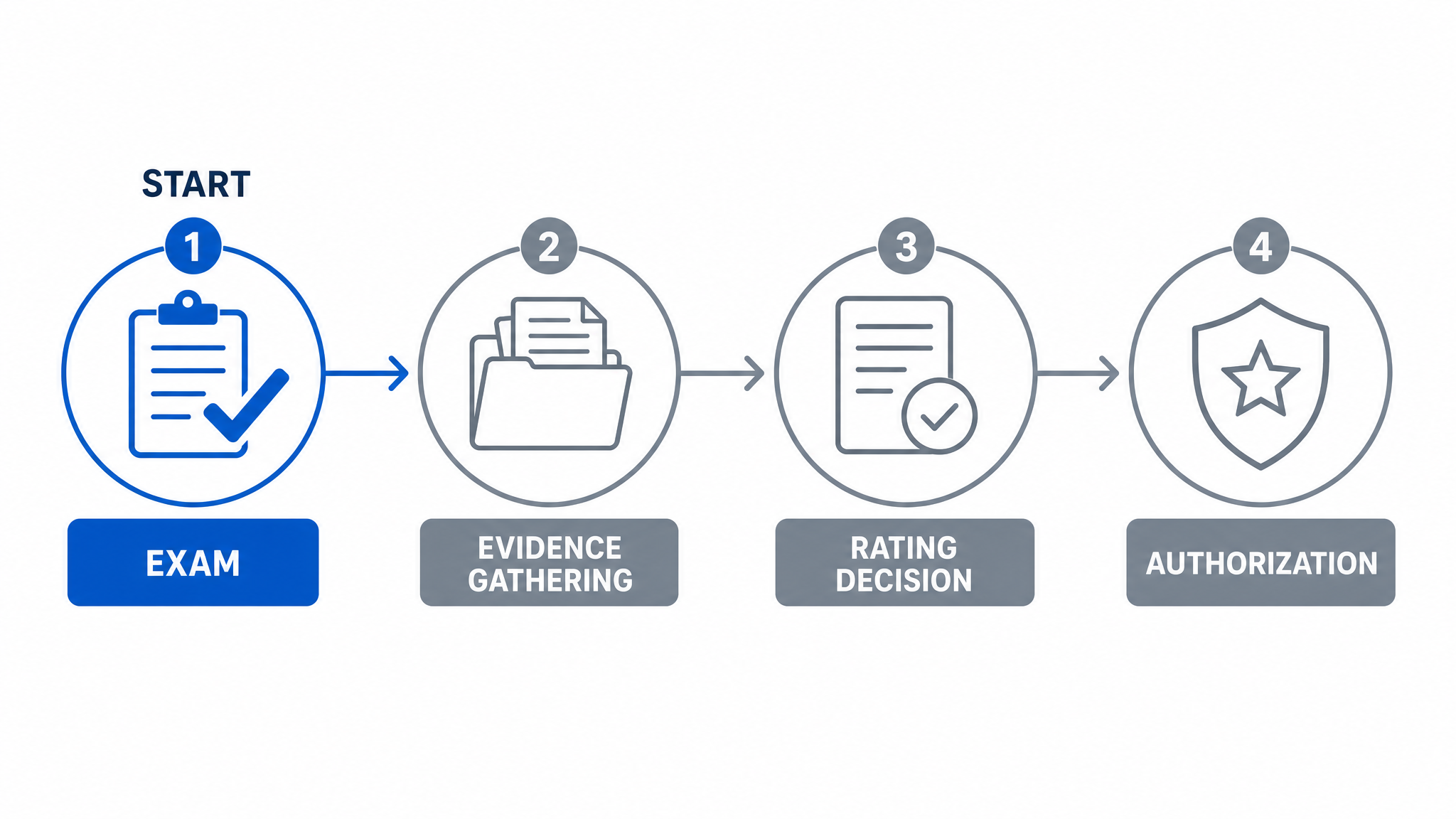
The exam is not the last step
Three stages still sit in front of you
The exam is not the last step. The clock does not start at the exam and it does not stop there either, the claim still has to clear evidence gathering, the rating decision and authorization.
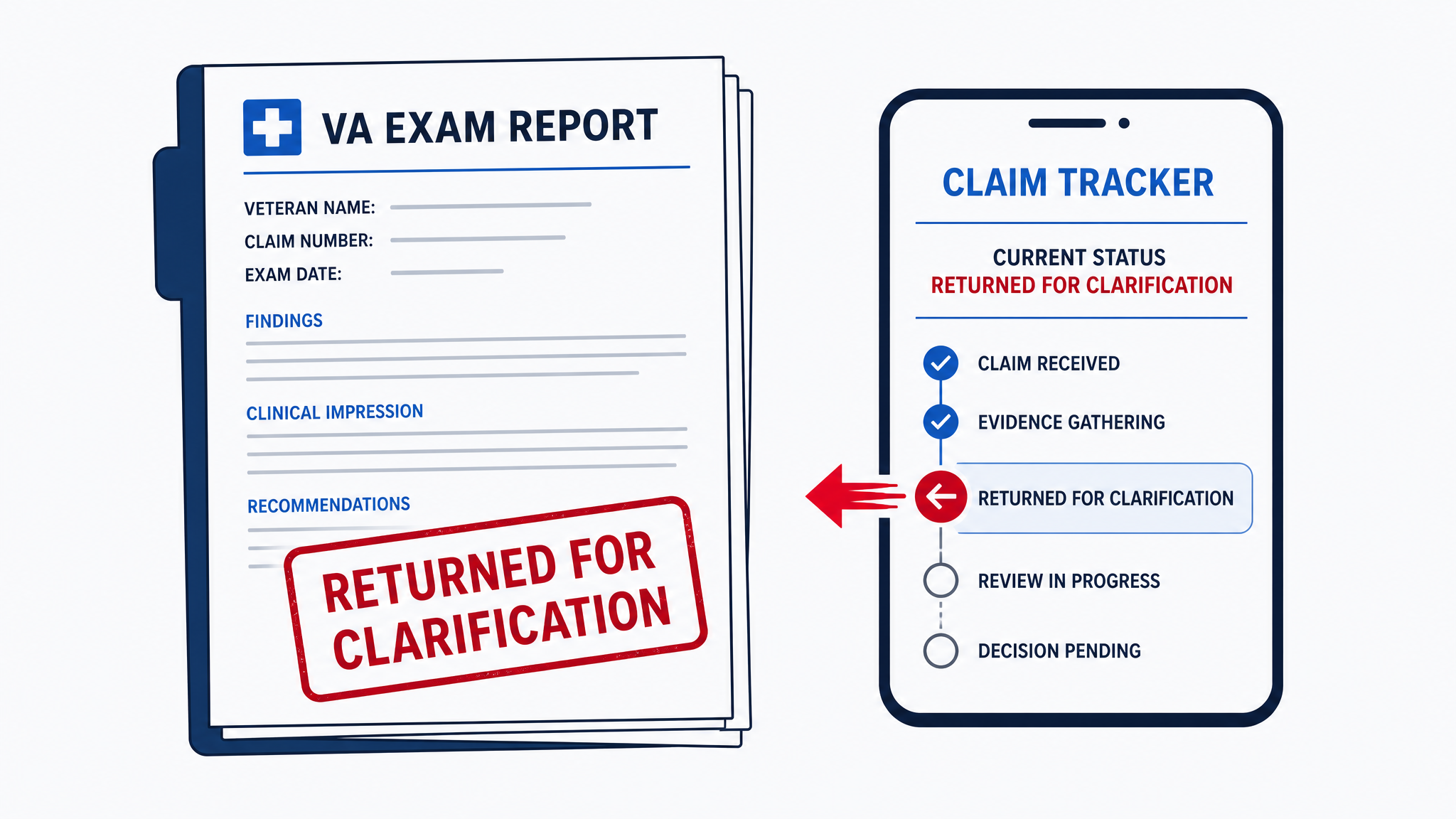
A returned exam is the invisible delay
The reason a tracker slides backward
A returned or clarified exam is the most common invisible delay, and it is why a tracker can slide backward. Expect some contact from the VA within 30 to 60 days of the exam. Past 60 days with nothing at all, call and ask specifically what the claim is waiting on.
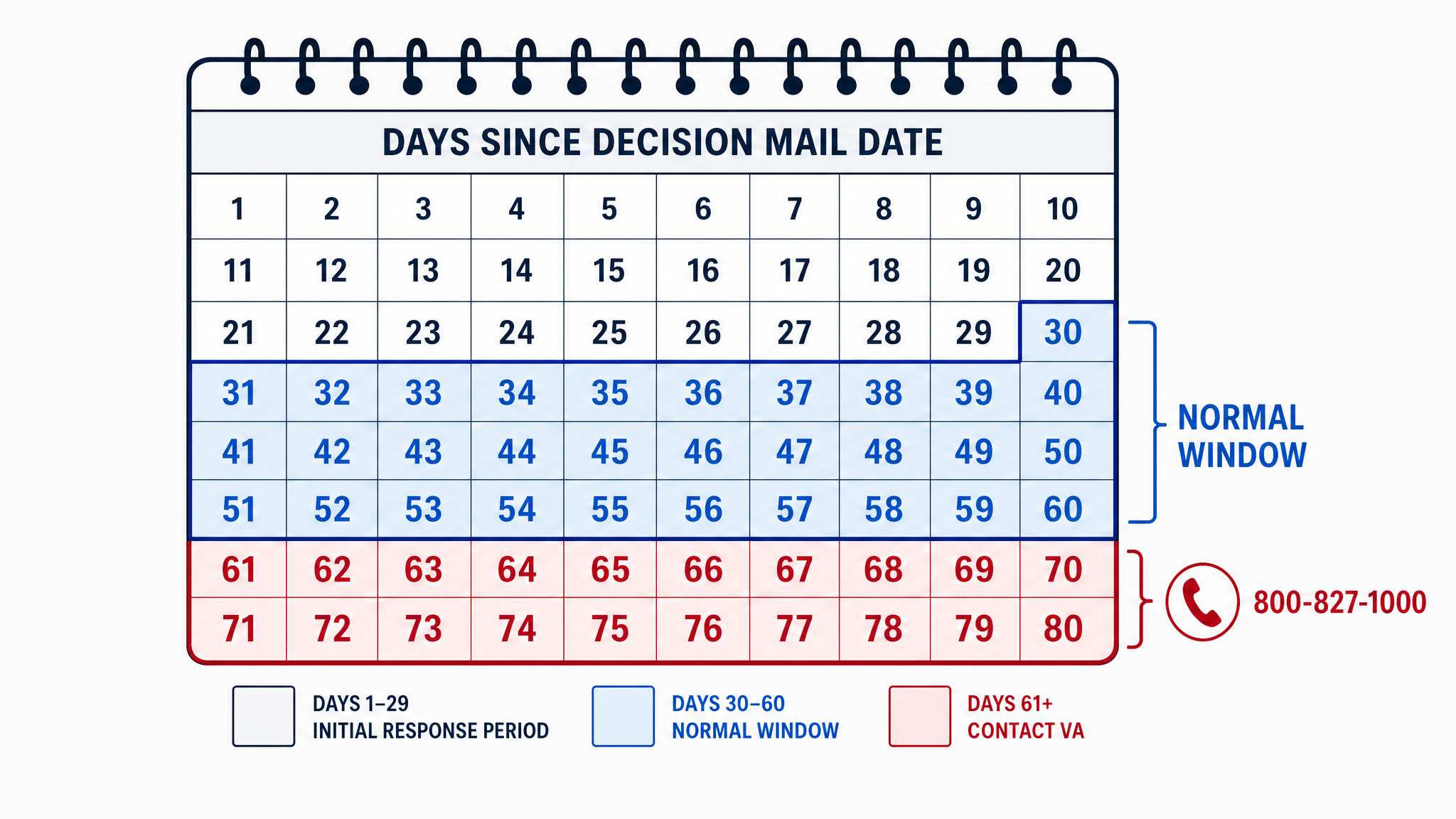
30 to 60 days is a guide, not a deadline
A complex case can take 90 days or more
Thirty to sixty days is a rough average for a simple, single-issue claim, not a hard rule and not a ceiling. A claim with several conditions, a presumptive or toxic-exposure question, a returned exam, or missing records can easily take 90 days or more, and that alone does not mean anything is wrong. Watch whether the claim is still moving, not the calendar. Only when it stalls well past what is normal for a case like yours, and no one can tell you what it is waiting on, should you stop waiting, call 800-827-1000 and ask what the claim is waiting on and who it is assigned to.

Watch your status yourself, in one of three places
Weekly, not daily
Check your own status in one of three places: your VA.gov claim status page, the VA Health and Benefits mobile app, or by calling 800-827-1000. Check it weekly, not daily. And understand exactly what a status check can tell you: if a decision is posted in your account, it is live; if it is not posted, it is not ready. That is the whole rule. This is not something your representative or your attorney can speed up, we see the same thing you see, at the same time, and calling us to ask does not move it. Calling the VA to ask for an update does not move it either. Watch it yourself, weekly, and the moment a decision posts, bring it to us.

Your decision letter arrives, read it, then start the appeal clock
What to do the day it lands in your mailbox
The decision letter is the finish line of the claim and the starting line of the appeal, and the moment it arrives, a one-year clock starts running. Read it the same day. Find the combined rating, the percentage assigned to each condition, and the effective date, because the effective date controls how far back your back pay reaches. Then request a copy of your C&P exam report so you can see whether the rater used your real range-of-motion numbers or ignored the radiculopathy. If any part of the decision is wrong, a low rating, a denied condition, or a bad effective date, you have three appeal lanes, and you must choose one within one year of the date printed on the letter: a **Higher-Level Review (VA Form 20-0996)**, where a senior reviewer re-decides on the same evidence; a **Supplemental Claim (VA Form 20-0995)**, when you have new and relevant evidence such as a private DBQ or your own range-of-motion exam; or a **Board Appeal (VA Form 10182)** to a Veterans Law Judge. Miss that one-year deadline and the decision becomes final. You can still file again later, but you lose the original effective date, and that lost time is lost back pay you never get back. Bring the letter to this office before the year runs out and we will read it with you, line by line, at no cost.
07Remedy
How to report a bad exam
Where this exam goes wrong
Examiners routinely write "degenerative changes noted" without citing the X-ray. A rater who cannot find the imaging finding in the file cannot apply DC 5003, and a veteran with real arthritis and near-normal motion walks away with nothing.

Write it down the moment you get to your car
Date, start time, end time, the examiner’s name and credentials, the vendor, every test that was performed, and every test that was not. A contemporaneous note written the same day is evidence. A memory reconstructed four months later is not.

Get the exam report and the questionnaire
Request a copy through VA.gov, through a written request to the Regional Office, or by calling 800-827-1000. You cannot challenge what you have not read. Compare it line by line against what actually happened in the room.

Name the defect specifically, with the citation
Never write "the exam was unfair." Write "no goniometer was used, contrary to 38 CFR §4.46" or "flare-ups were reported and not addressed, contrary to Sharp v. Shulkin" or "repetitive use testing was not performed, contrary to 38 CFR §4.40 and DeLuca." A specific, citable defect is what forces action.
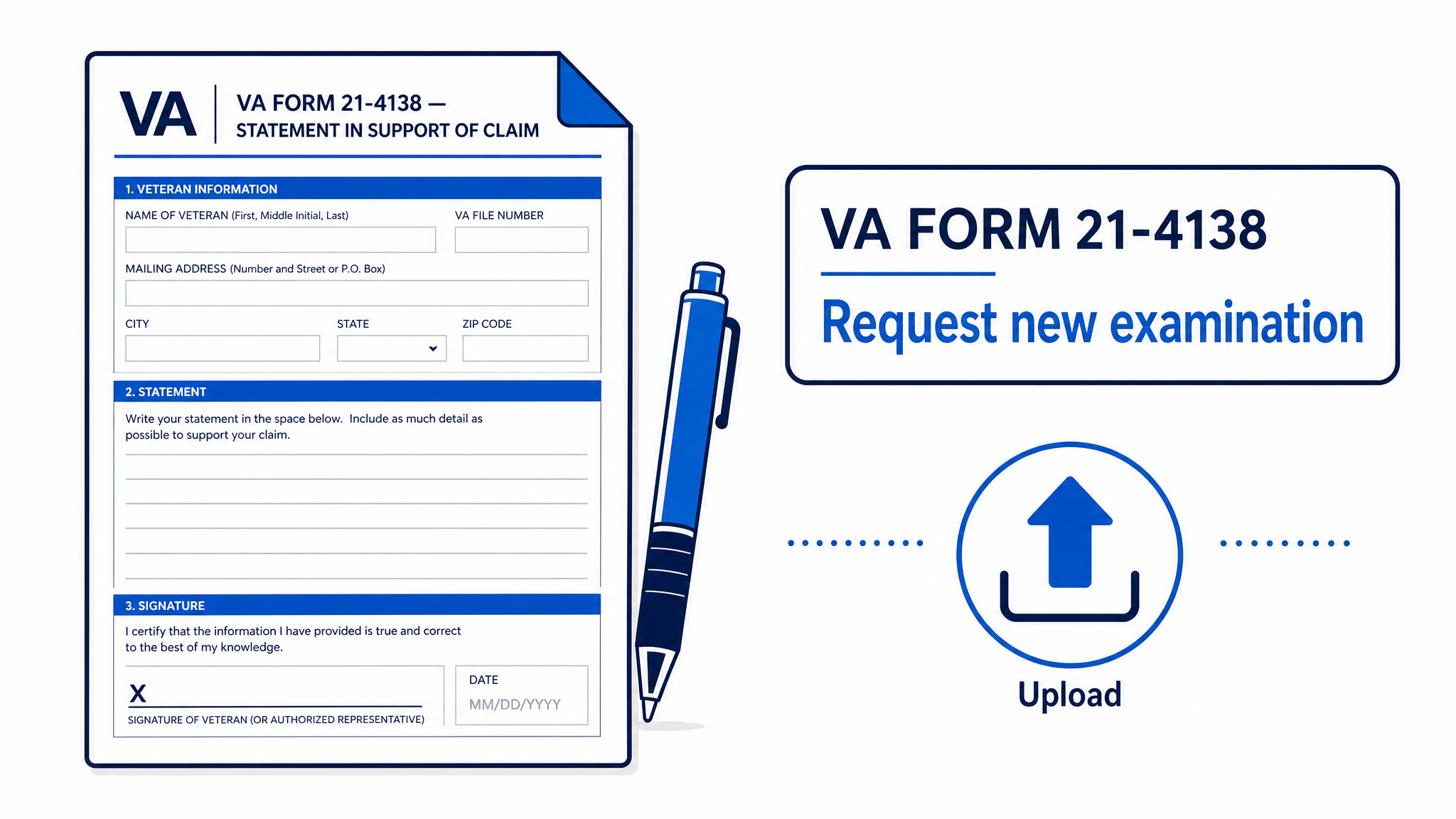
Submit a statement asking for a new examination
VA Form 21-4138, Statement in Support of Claim, filed through VA.gov or mailed to the Evidence Intake Center. State the defect, cite the authority, and request a new or supplemental examination. Do this BEFORE the decision if the claim is still open, it is far easier than undoing a decision afterward.
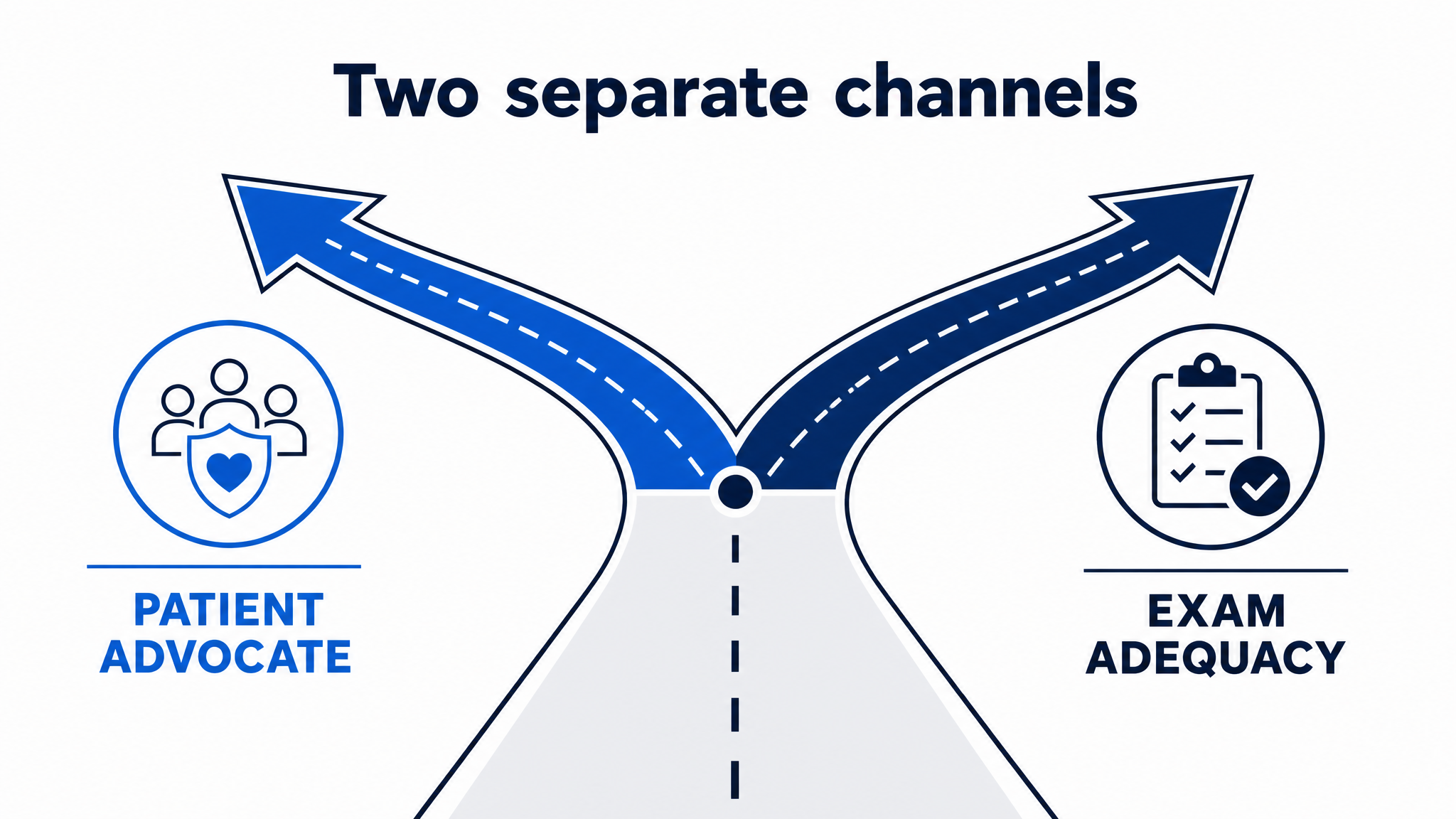
Report examiner conduct separately
If the problem is behavior rather than methodology, you were rushed out, dismissed, never touched, or treated with hostility, file a complaint with the VA facility’s Patient Advocate, or with the vendor directly for a contract exam, and copy the Regional Office. Conduct complaints and adequacy challenges are two different tracks and you can run both.

If a decision has already issued, pick the right lane
A Higher-Level Review (VA Form 20-0996) argues the VA erred on the evidence it had, the right vehicle when the exam was inadequate on its face. A Supplemental Claim (VA Form 20-0995) is the vehicle when you are adding new and relevant evidence, such as your own private range-of-motion examination or a completed DBQ from your treating provider.
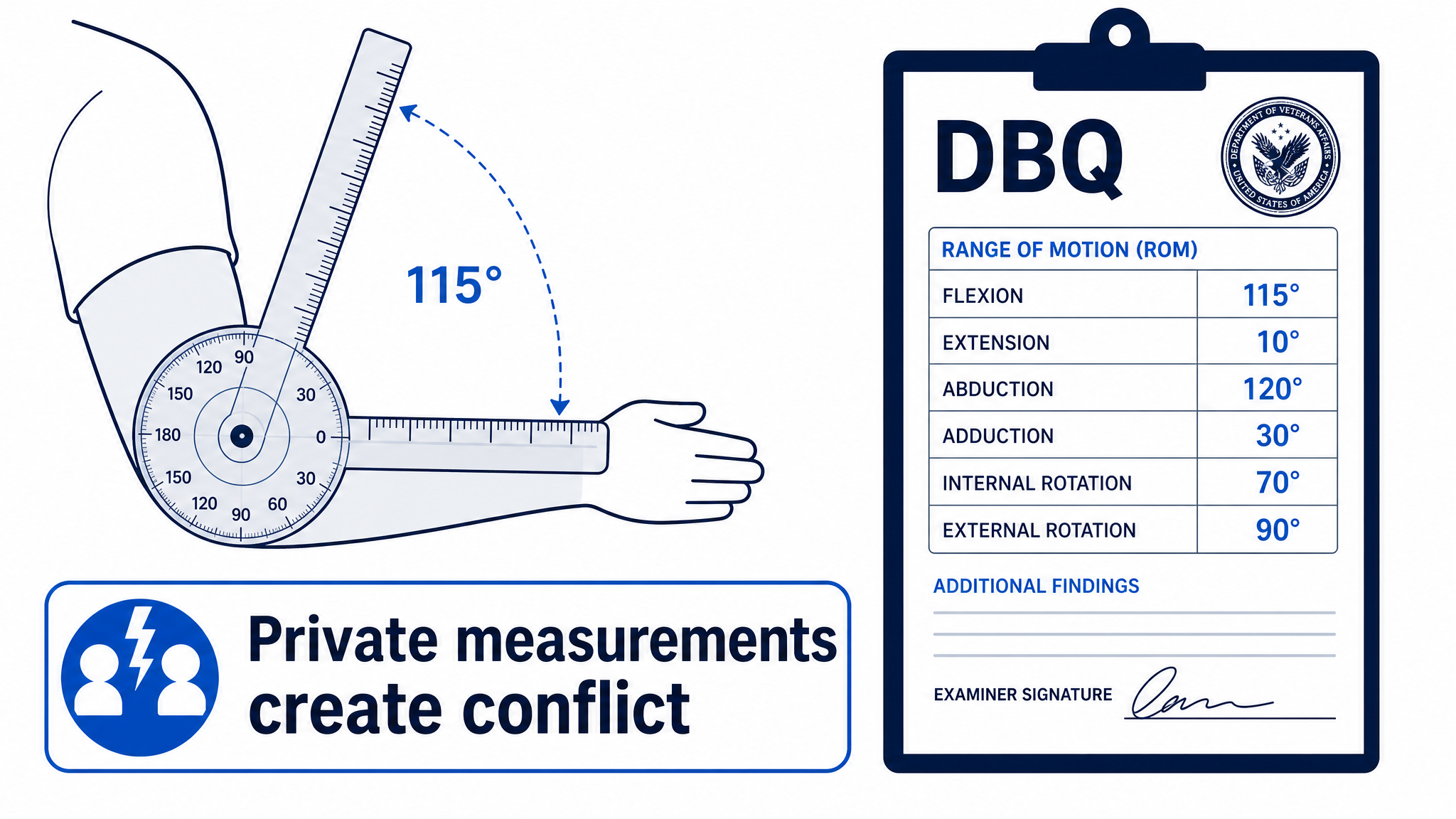
Put your own measurements on the table
A private examination with full goniometric measurements, or a DBQ completed by your own provider, creates a conflict in the evidence that the VA has to resolve, and under 38 CFR §3.102 reasonable doubt is resolved in your favor.
End of clinical section
Degenerative Disc Disease, DC 5242
See It Before You Sit In The Room
Degenerative Disc Disease Explained
Princeton Spine & Joint Center
DDD, Facts & Information
Frederick Earlstein
The Questions Veterans Actually Ask
Degenerative Disc Disease Claims, Frequently Asked Questions
Straight answers to the questions that decide degenerative disc disease claims, the ratings, the separate evaluations, and the exam mistakes that cost veterans money. Read every answer with your own file open. If an answer depends on a record you do not have yet, that is the next thing to request, from your doctor, your unit or the VA itself.
DDD is evaluated under DC 5242 using the General Rating Formula. The highest is 100% for unfavorable ankylosis of the entire spine. DDD also qualifies for the IVDS incapacitating-episode formula (DC 5243) as an alternative, 6+ weeks of doctor-prescribed bed rest in 12 months yields 60%. The VA must apply whichever formula gives you the higher rating.