

Unemployability · 38 CFR §4.16
Individual Unemployability (TDIU)
When your service-connected disabilities prevent you from working, the VA pays at the 100% rate
Total Disability based on Individual Unemployability pays you at the 100% rate when your service-connected disabilities keep you from holding real work, even when your combined schedular rating is below 100%. You do not have to be rated 100% to get paid at 100%. Under 38 CFR §4.16, a percentage on paper does not always capture what a disability does to your ability to earn a living. I read the whole file, run the combined-rating math, turn a medical claim into a vocational one, and close every lane the VA could use to deny you.
What Is TDIU?
Let me tell you what TDIU really is, because the VA is not going to knock on your door and explain it. Total Disability based on Individual Unemployability pays you at the 100% rate when your service-connected disabilities keep you from holding down real work, even when your combined schedular rating is sitting below 100%. Read that again. You do not have to be rated 100% to get paid at 100%.
Here is the logic the law actually recognizes. Under 38 CFR §4.16, a percentage on paper does not always capture what a disability does to your ability to earn a living. I have sat across from veterans rated at 70% who cannot keep a job because of PTSD, chronic pain, or a brain that will not cooperate. That veteran has earned the 100% rate, and my job is to prove it.
And the money is not small. For 2026, the 100% rate for a single veteran with no dependents runs about $3,938.58 per month, against roughly $1,808.45 at 70%. That is over $25,000 a year the VA is quietly counting on you never claiming. Every dollar is an estimate, so confirm the current rate on VA.gov, but you see the point.

The Two Paths to TDIU
There are two ways to qualify. The first is schedular, where your ratings already meet fixed thresholds. The second is extraschedular, where they do not, but the evidence still shows you cannot work. I check both on every file, and you should know which one fits you before the VA decides for you.

Schedular TDIU, §4.16(a)
You meet the schedular thresholds if you have a single service-connected condition rated at 60% or higher, OR a combined rating of 70% or higher with at least one condition at 40% or higher. For the combined threshold, disabilities of a common etiology or from a single accident may be treated as one disability.

Extraschedular TDIU, §4.16(b)
If you do not meet the schedular thresholds but your service-connected conditions still prevent substantially gainful employment, you may qualify for extraschedular TDIU. There is no minimum rating threshold required, but the claim must be referred to the Director of Compensation Service and requires compelling evidence of unemployability. It is less common, but it is available for veterans with lower combined ratings.
How I Work a TDIU Case
Every advocate will tell you they fight for you. Here is what that actually looks like when a TDIU file lands on my desk. This is the roadmap, and I am handing it to you whether you hire me or run it yourself.
That is the discipline. One condition at a time, the math before the argument, and never a lane left open for a denial. It is the same way my whole team works every file.

I read the whole file, not just the denial
The answer to a TDIU claim is almost always buried in records the veteran forgot they had, a failed work attempt, a leave of absence, a supervisor who wrote you up for missing shifts. I go looking for it before I write a single word.

I do the combined-rating math first
Before anything else I check whether you already meet the §4.16(a) thresholds, one condition at 60%, or 70% combined with one at 40%. If you are one condition short, we go get that condition rated. We do not chase the number blind.

I turn a medical claim into a vocational one
TDIU is not how sick you are, it is why you cannot work. I connect your specific functional limits to the specific job tasks you can no longer perform. That is the argument a rater cannot wave away in 12 minutes.

I build the VA Form 21-8940 like an exhibit
Your work history, your education, why you left your last job, it all has to tell one consistent story. A sloppy 21-8940 sinks strong claims every single day.

I close the escape routes before the VA finds them
If the evidence raises unemployability, the VA must consider TDIU even if you never filed the form, that is Roberson v. Principi. If the schedular thresholds are not met, I demand the extraschedular referral under §4.16(b). I do not leave them a lane to deny you on a technicality.
The Evidence That Wins TDIU Claims
I will say it again because it is the whole ballgame: TDIU is a vocational question, not just a medical one. The VA wants to know whether your service-connected conditions, weighed against your education, training, and work history, keep you from securing and holding substantially gainful employment. Here is exactly the evidence I go after to prove it.

VA Form 21-8940 (Application for Increased Compensation Based on Unemployability), the TDIU-specific application documenting work history, education, and why you left your last job

Vocational expert opinion, a professional assessment of how your specific functional limitations impact your ability to perform jobs consistent with your education and experience

Employer statements, documentation from former employers about accommodations, absences, performance issues, or termination reasons related to your service-connected conditions

Social Security Disability determination, if SSDI has found you disabled, this supports your TDIU claim (different standard, but persuasive evidence)

Treatment records showing frequency and severity of symptoms that interfere with work, missed appointments due to flare-ups, medication side effects, cognitive limitations

Failed work attempts, short employment periods that ended because of service-connected symptoms demonstrate inability to maintain substantially gainful employment
TDIU + SMC = Additional Compensation
Veterans receiving TDIU may also qualify for Special Monthly Compensation. Under 38 CFR §3.350(i), if you have TDIU based on a single disability and additional service-connected disabilities independently rated at 60% or higher, you may qualify for SMC-S (Housebound rate), paid above the 100% rate.
This is why I always review the entire file for additional claimable conditions, even after TDIU is granted. Every additional service-connected disability increases the chance of qualifying for SMC.

Marginal Employment, 38 CFR §4.16(a)
Here is a myth I have to bust constantly: "Albert, I did a little work last year, so I must be disqualified." Not so fast. The VA defines substantially gainful employment as work paying above the federal poverty threshold for one person. Earn below that line and it is marginal employment, which does not disqualify you from TDIU.
Additionally, employment in a protected environment, such as a family business, sheltered workshop, or position with special accommodations that would not exist in a competitive work setting, may be considered marginal regardless of income. The question is whether you could secure and maintain that employment in a normal competitive environment.

Where the VA Gets This Wrong
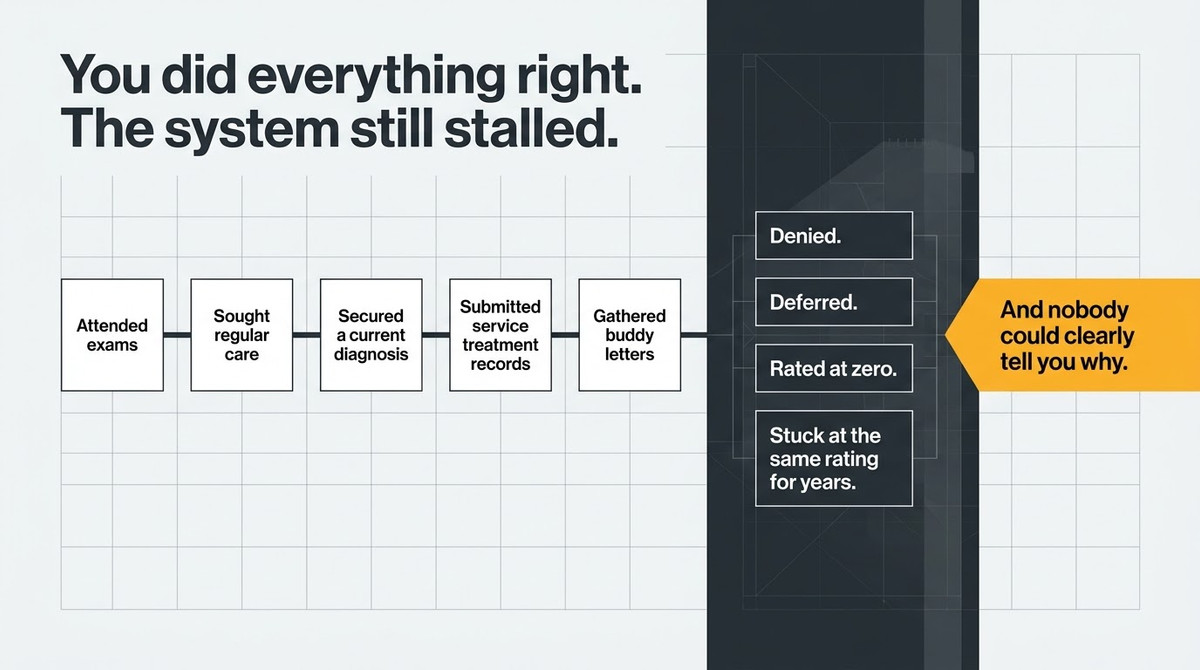
A TDIU denial is not always a correct denial. These are the recurring errors I look for the moment I open a file, and any one of them can be the reason a strong claim was wrongly denied. Hold your own decision letter next to this list and check it line by line.

Failing to infer a TDIU claim, under Roberson v. Principi (2001), if the evidence raises the issue of unemployability, the VA must consider TDIU even if VA Form 21-8940 was never filed

Defining "substantially gainful employment" by job title instead of functional capacity, the question is whether the veteran can perform the job reliably and consistently, not whether a job exists

Ignoring the combined effect of multiple service-connected conditions on employability, rating each condition in isolation when their aggregate impact prevents work
Counting protected or sheltered employment as substantially gainful, a family business that creates a position specifically to accommodate the veteran is marginal employment under §4.16(a)

Failing to refer extraschedular TDIU under §4.16(b) when the evidence clearly shows unemployability but the schedular thresholds are not met

Revoking TDIU based on a single snapshot of employment without considering the veteran's full work history, failed work attempts, and whether the employment was truly sustainable
What the Courts Have Said About Unemployability

The law of TDIU is 38 CFR §4.16, and the courts have filled in the words the regulation leaves open. In Ray v. Wilkie, 31 Vet. App. 58 (2019), the Court defined "unable to secure and follow a substantially gainful occupation." It has an economic side, whether you can earn more than marginal income, and a noneconomic side: your work history, education, skills and training, and what your service-connected conditions do to your ability to sit, stand, walk, lift, concentrate, follow instructions, and get along with coworkers and supervisors. A rater who just writes "capable of sedentary work" has not done that analysis.
In Geib v. Shinseki, 733 F.3d 1350 (Fed. Cir. 2013), the Federal Circuit made clear that whether you are unemployable is a decision for the VA adjudicator, not a medical question for the examiner. The examiner describes your limitations. The rater has to apply them to your real work history. And under Rice v. Shinseki, 22 Vet. App. 447 (2009), when the record raises unemployability during a claim for an increase, TDIU is part of that claim, which can matter a great deal for your effective date.
So when I read a TDIU denial, I look for those failures by name. Did the rater weigh your education and work history, or just a job title? Did they let an examiner's one-line "can work" opinion decide a legal question? Did they ignore unemployability that was already in the record on an increase claim? Your part is to give me the honest work picture: every job, why it ended, what you could not do anymore, and what your days look like now.
Why Your Combined Rating Matters for TDIU
Schedular TDIU requires a combined 70% with one condition at 40%. This diagram shows how the VA math works, and where you may be one condition away from the TDIU threshold. Under 38 CFR 4.16, conditions from a common cause or affecting a single body system can count as one disability for that 40% requirement. Run your ratings below, then compare the result to your work history. If you cannot hold steady work because of your service-connected conditions, that is the question that decides TDIU.
Why 50% + 30% Does NOT Equal 80%
The VA uses “whole-person” math, not simple addition. This is how ratings really stack.
The VA always begins from a whole, healthy person (100%).
50% of 100 is subtracted. You have 50% “efficiency” left.
30% is taken from the REMAINING 50 (0.30 × 50 = 15). 50 − 15 = 35 left.
100 − 35 = 65, then rounded to the nearest 10 → 70%.
Bottom line: 50% and 30% combine to 65% → rounded to 70%, not 80%. The same math turns two 50% ratings into 75% → rounded to 80%, not 100%. Every rating you add is worth less than the last. That is why which conditions you claim, and in what order, matters as much as how many.
The Advocate's Take
TDIU is the most underutilized benefit in the VA system. Veterans at 60% or 70% who cannot work are leaving $25,000 or more per year on the table because they either do not know TDIU exists, or they were told they do not qualify. The VA does not proactively offer TDIU, you have to claim it. I review every file for TDIU eligibility: the rating thresholds, the employment history, the functional limitations, and whether an extraschedular referral is warranted. If you cannot work because of what the military did to your body or mind, you should be paid at the 100% rate. Period.

TDIU starts with the math. Your combined rating decides whether you meet the schedular thresholds under §4.16(a), or whether I need to push your case under §4.16(b). Watch the VA explain how that combined rating is built below, so you understand exactly where you stand before we talk about unemployability.
Watch How the VA Builds Your Combined Rating
TDIU turns on your combined rating and the 40%/70% thresholds. These official VA explainers show exactly how that math is done, the same math that decides whether you qualify for schedular TDIU. Watch them with your rating decision in hand and note where you sit against each threshold.
How Your Combined Rating Is Calculated
How VA Disability Compensation Works
Building a Individual Unemployability (TDIU) Claim That Wins
Every claim stands on three legs. Knock one out and the claim falls over, no matter how bad your symptoms are. Before you file, look at your file and find all three. If one is missing, that is the piece to build first. The VA will not build it for you, and filing without it usually just buys you a denial letter and lost time.
 01
01A current diagnosis
A doctor has to say you have it, now, in writing. Not "reports symptoms of", a diagnosis. Without this leg, nothing else in the file matters.
 02
02A link to your service
An event, an injury, an exposure, or an already service-connected condition. Service records, unit records, buddy statements, and your own account all count as evidence.
 03
03A nexus that ties the two together
A medical opinion stating it is at least as likely as not that your service caused or aggravated the condition. That phrase is a legal standard: 50 percent or better. It is the leg most denials break.
Document the problem before you file
• Keep a dated symptom log for at least 30 days. Frequency, severity, and what it stopped you from doing.
• Get statements from people who see it, a spouse, a coworker, a battle buddy. Lay evidence is legal evidence.
• Pull your private treatment records. The VA only has to help; it does not have to go find everything.
• Write down what you have stopped doing. Lost work, lost sleep, lost activities. That is what impairment looks like on paper.
Your Rights in This Process
Most veterans walk into this system without knowing the rules the VA itself has to follow. That is how claims get denied for missing evidence the VA was supposed to help you find, and how exams get done by the wrong clinician. These six rights are written into federal regulation. Know them before you file, and make the VA honor every one of them when it decides your claim.

It costs nothing to file
Filing a VA claim is free. Accredited representatives may only charge for work on an appeal after an initial decision, and those fees are capped by 38 CFR §14.636.

The VA has a Duty to Assist you
Under 38 CFR §3.159 the VA must help you get the evidence it needs, and it must tell you what is missing before it denies you for missing it.

You can ask for a different examiner
You may request a trauma-informed clinician, or a clinician of a specific gender, for a C&P examination. Ask before the exam is scheduled.

You can claim every condition you have
There is no limit and no penalty. Primary conditions, secondary conditions, and conditions made worse by service all get filed.

You can appeal and be re-evaluated
A denial is not the end. You may submit new evidence, request a higher-level review, appeal to the Board, and ask for re-evaluation when your condition worsens.

You must be considered for TDIU
If your service-connected conditions keep you from holding substantially gainful employment, you may be paid at the 100 percent rate without a 100 percent rating.
The Nine Questions Every Veteran Should Be Able to Answer
This is the standard I hold every page on this site to. Before you file anything on TDIU, you should be able to answer these nine questions. If you cannot answer them yet, you are not ready, and that is exactly what my review is for. This is education first, representation second.

What is this?
Total Disability based on Individual Unemployability pays at the 100% rate when your service-connected disabilities keep you from substantially gainful employment, even if your combined rating is below 100%.

What must the VA decide?
Whether your service-connected conditions, weighed against your education and work history, prevent you from working, under 38 CFR §4.16.

What must the evidence prove?
Not how sick you are, but why you cannot work. The evidence must connect specific functional limits to the specific job tasks you can no longer perform.

What is the VA responsible for?
Considering TDIU whenever the record raises unemployability, even if you never filed the form, and referring extraschedular TDIU under §4.16(b) when the schedular thresholds are not met.

What are you responsible for?
Completing VA Form 21-8940 accurately, documenting your work history and failed work attempts, and attending your exams.

What can go wrong?
The VA judges employability by job title instead of functional capacity, ignores the combined effect of your conditions, or fails to make the extraschedular referral.

What you should not do
Do not assume that a little marginal work disqualifies you, and do not leave the 21-8940 vague. A sloppy form sinks strong claims.

What I review as your accredited agent
I check the §4.16(a) math first, turn a medical claim into a vocational one, build the 21-8940 like an exhibit, and close every lane the VA could use to deny you.

What happens next
If granted, you are paid at the 100% rate. I then check whether the file also supports SMC-S, because additional conditions can add compensation above 100%.
Representation Means Telling You the Truth
Do Not File Yet If…
Before you take action on a TDIU claim, check whether any of these apply. Filing at the wrong time can weaken your claim, waste a deadline, or put you on a longer path than necessary. I would rather tell you to wait than watch you lose an effective date or hand the VA a thin file it can deny in a week. A denial is not the end, but it costs you months. Read each item below honestly. If one fits your situation, call us first and we will tell you what to fix before anything gets filed.





A Grant Is Not the End of the Analysis
After a Favorable Decision
A grant does not mean “case closed.” Every favorable decision must be audited. I review each of the following before advising you that the decision is fully correct. The VA makes mistakes in grants too, and a wrong effective date or a missed condition can cost you for years. Pull your decision letter and check it against these points with me.

Was the correct diagnostic code and evaluation assigned?
Compare the assigned code and percentage against the rating schedule criteria. A correct diagnosis with the wrong code can mean the wrong evaluation.

Did VA select the correct effective date?
Check whether VA used your claim date, your Intent to File date, or the date entitlement arose. An incorrect effective date can cost thousands in back pay.

Does VA have the correct family information?
Where dependency compensation applies, verify VA has accurate dependent information. Missing or outdated records reduce your monthly payment.

Does the record raise unemployability?
If service-connected disabilities prevent substantially gainful employment, the record may support Total Disability Based on Individual Unemployability even at a combined rating below 100%.

Does the disability picture raise Special Monthly Compensation?
Certain combinations of disabilities, loss of use, or the need for aid and attendance may qualify for SMC categories that provide compensation above the standard rate.

Is the condition subject to future review?
Unless the rating is static or permanent, VA may schedule a future examination. Know whether your rating is protected and when VA might reassess.

Was P&T established where applicable?
Permanent and Total status unlocks additional benefits including Chapter 35 Dependents' Educational Assistance and exemption from future routine examinations.

Does the family understand the award?
Particularly important for aging veterans. The family should understand the rating, what records to preserve, and what survivor benefits may apply.
Frequently Asked Questions
TDIU pays at the 100% rate when your service-connected conditions keep you from holding a steady job, even if your combined rating is lower. These are the questions veterans ask me most about work, income, and the forms. Your part is to document how your conditions actually stop you from working, with dates, jobs, and what happened.
Can I work and still receive TDIU?
What is the difference between schedular and extraschedular TDIU?
Does TDIU pay more than a 100% schedular rating?
Can TDIU be revoked?
What evidence is most important for a TDIU claim?
Can I get TDIU and Social Security Disability at the same time?

When You Are Ready to File
Talk to an accredited representative before you file. It costs nothing to ask, and the order you file in changes what the VA is allowed to award you. Albert L. Thombs Jr. is VA-Accredited Claims Agent #45147. A short conversation now can save you a year spent waiting in the wrong review lane.
Your part starts at the kitchen table. Pull your DD-214, your rating decision if you have one, and the names of every doctor who treats you today. Under 38 CFR 3.159 the VA has to help you gather records, but it can only chase the records you tell it about. Leave a doctor off the 21-4142 and that treatment may never reach your file.

The TDIU application
This is the form for Individual Unemployability under §4.16. It asks for your work history, your education, and when you last worked full time. Be exact. The rater reads this against Ray v. Wilkie.
Get the TDIU application on VA.govWhat your last employer reports
The VA sends this form to the employers you list on the 21-8940. It shows your job, your hours, your pay, and any accommodations. Know what it will say before the VA gets it back.
See the employer form on VA.govCoworkers and supervisors
A statement from someone who watched you need breaks, miss shifts, or get special treatment is how we prove marginal or protected employment. Use this form for them.
Get the lay statement form on VA.govKeep Reading
One page never tells the whole story of a claim. The VA rates every condition on its own evidence, its own exam and its own diagnostic code, and the pieces connect in ways most veterans never see until a decision letter lands. These are the pages that pick up where this one stops. Read them before you file, not after a denial, because the cheapest fix in this process is the mistake you never make.

Combined Ratings Formula
The VA math that decides whether you meet the 40%/70% schedular TDIU thresholds
Read more
Special Monthly Compensation
TDIU can open the door to SMC-S, additional pay above the 100% rate
Read more
Rating Increases
One condition short of the threshold? An increase can put you over the line
Read more
Appeal Options Guide
If TDIU was denied, choose the review lane that fits the error
Read more