
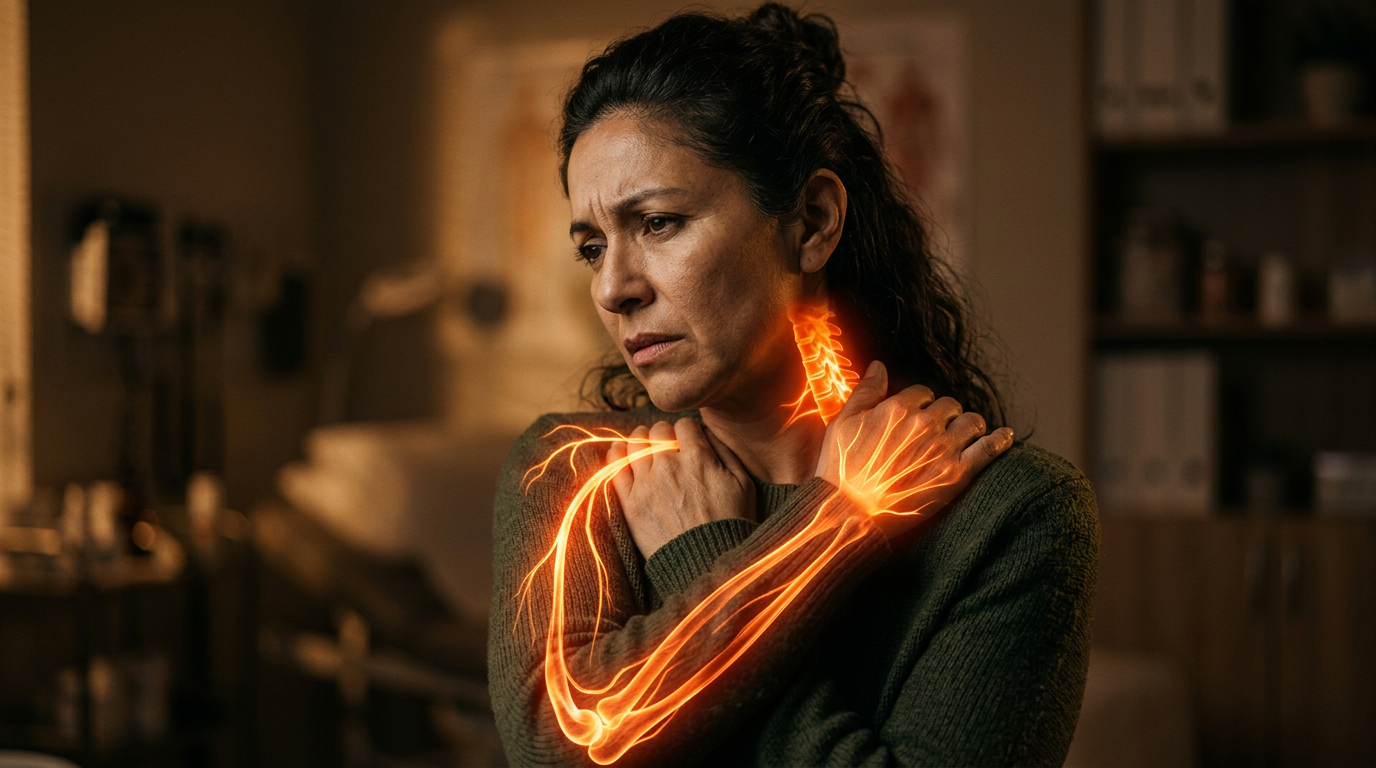
Cervical Radiculopathy, Upper Extremity Nerve Root Compression
A nerve root pinched in your neck sends pain, numbness and weakness down the shoulder, arm and into the hand.
Cervical radiculopathy is not part of your neck rating. The neck itself is rated on range of motion under 38 CFR §4.71a, Diagnostic Codes 5235–5243. The nerve running out of that neck and down your arm is a separate disability rated under 38 CFR §4.124a, and Note (1) to the General Rating Formula for Diseases and Injuries of the Spine says it in the regulation’s own words: rate any associated objective neurologic abnormalities separately, under an appropriate diagnostic code. Two ratings, not one. Each arm is its own rating, and if both arms are involved the bilateral factor at 38 CFR §4.26 is added on top. Veterans carrying a neck rating and nothing else are, more often than not, missing two evaluations.
The Diagnostic Codes
Conditions Rated In Radiculopathy
These are the codes the VA will actually stamp on a decision in this group. The code you are granted under decides which formula is used, and that decides your percentage. Cervical Radiculopathy is highlighted below.
DC 8510–8513
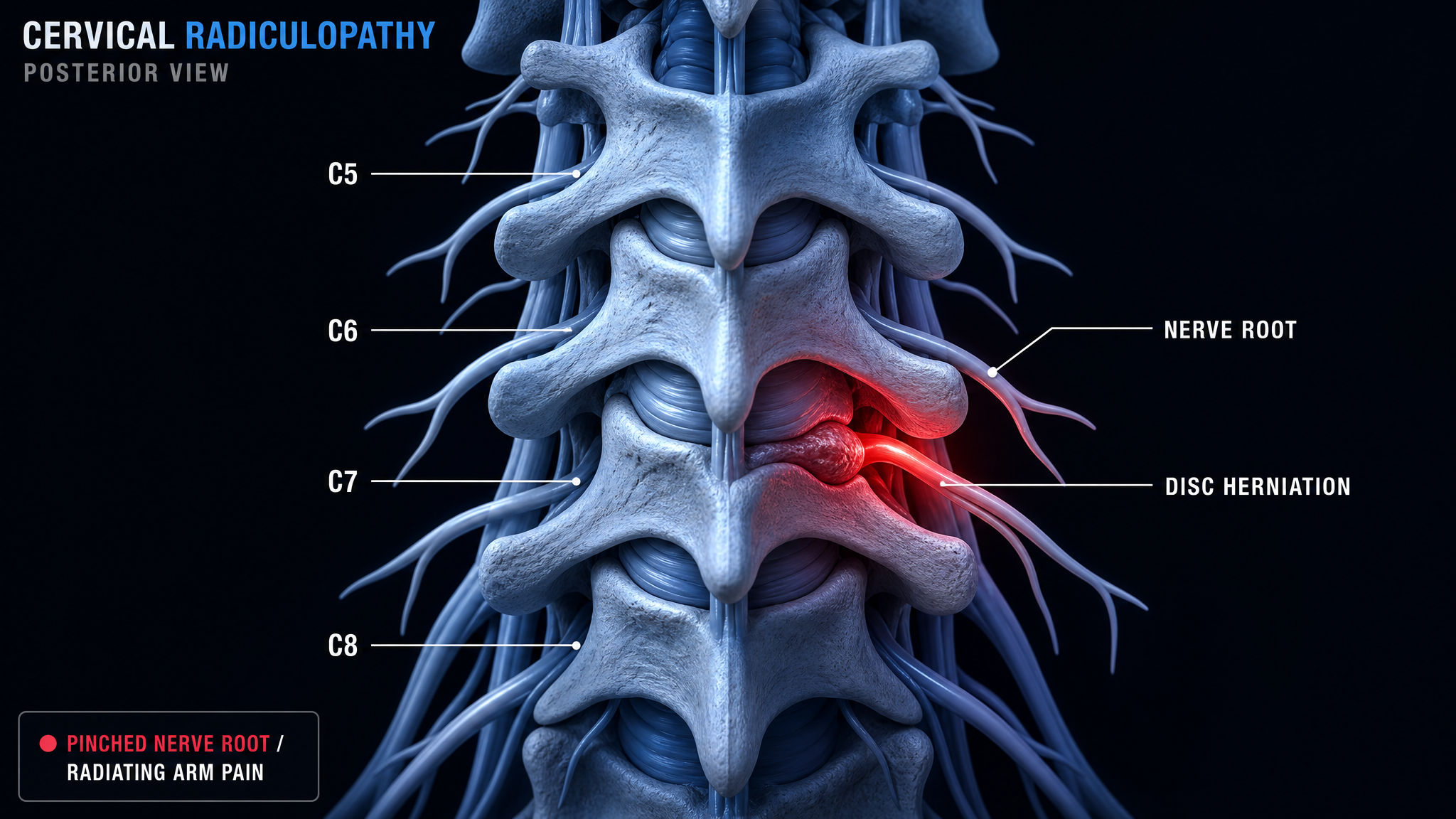
Cervical Radiculopathy, Upper Extremity Nerve Root Compression
A nerve root pinched in your neck sends pain, numbness and weakness down the shoulder, arm and into the hand.
You are reading this page
DC 8520
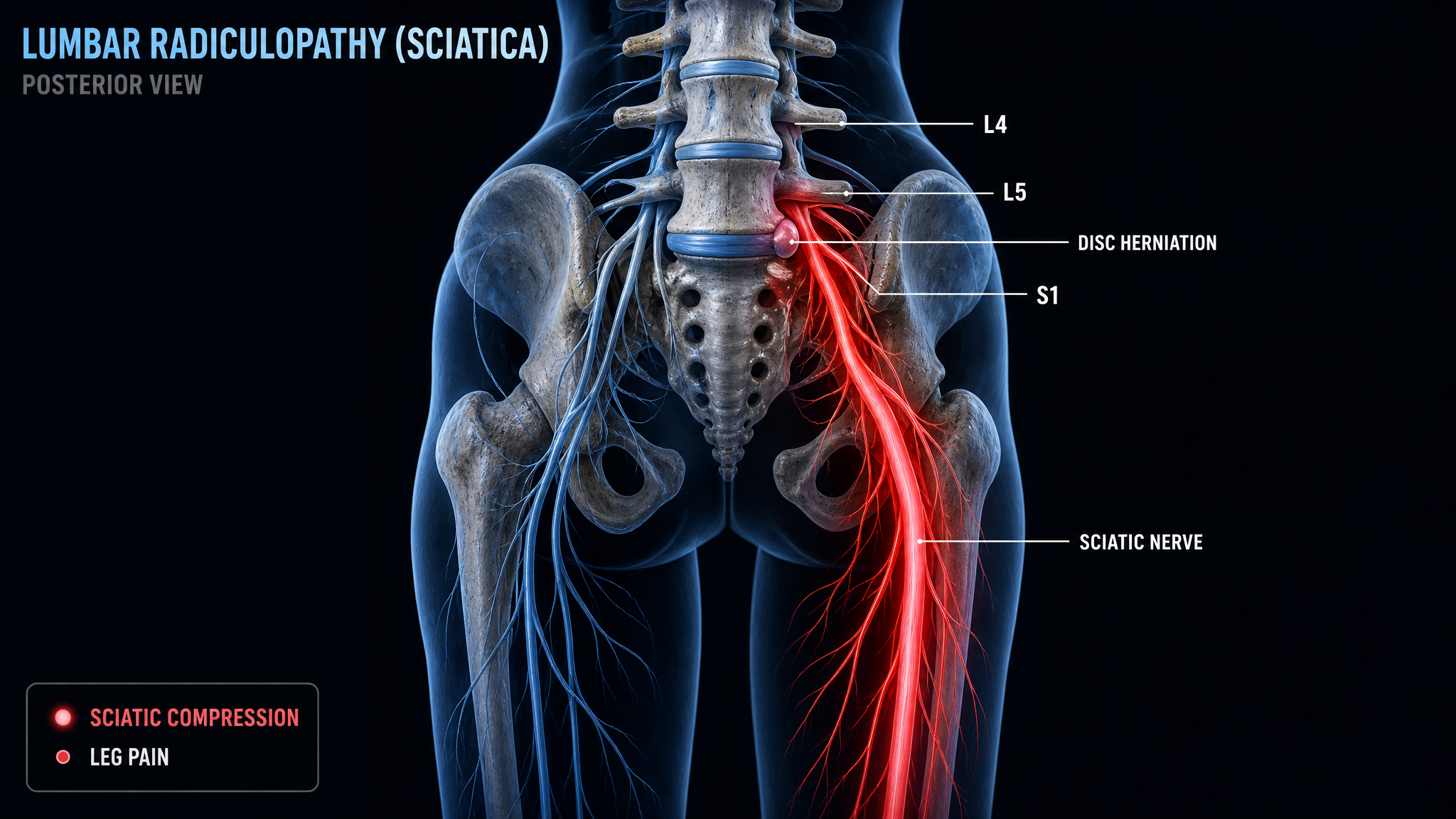
Sciatica, Sciatic Nerve Radiculopathy of the Lower Extremity
A nerve root pinched in your low back sends pain, numbness and weakness down the buttock, the back of the thigh, the calf and into the foot.
Read the full page
DC 8526
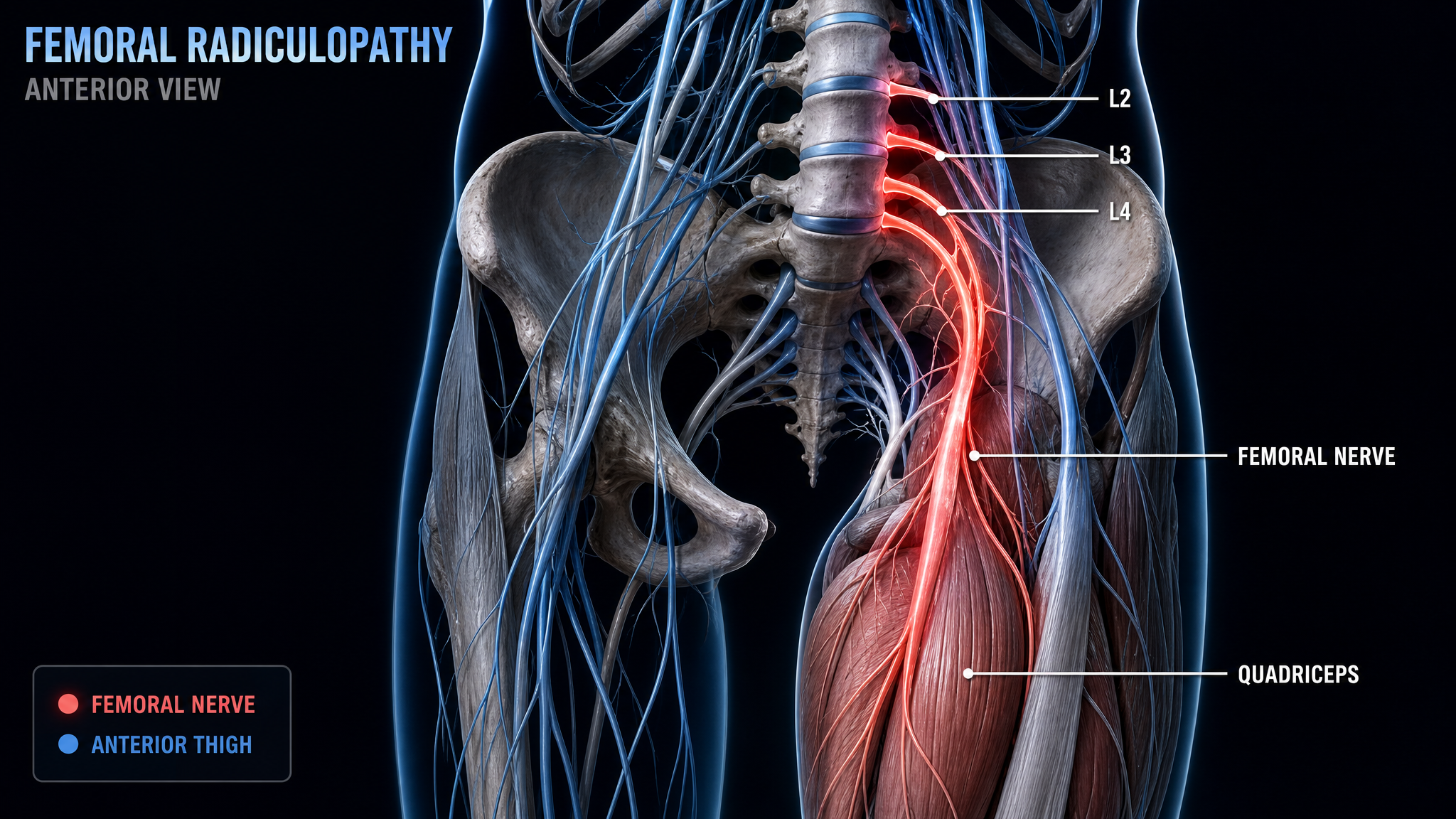
Femoral Radiculopathy, Anterior Crural Nerve Involvement of the Lower Extremity
A nerve root pinched at L2, L3 or L4 sends pain, numbness and quadriceps weakness down the FRONT of the thigh to the knee, and almost nobody asks about it.
Read the full page
Before Anything Gets Rated
What The VA Is Actually Looking For, And What Service Connection Really Means
Before the VA ever opens the rating schedule, it asks one question: is this disability the government’s responsibility? That is what “service connection” means. It is not a diagnosis, it is not sympathy, and it is not a reward for having served. It is a legal finding that a current, diagnosed disability is linked to something that happened to you in uniform. Percentages come later. If service connection is not established, there is nothing to rate and the claim is denied, no matter how bad the cervical radiculopathy is.

For Cervical Radiculopathy Specifically
The VA needs a diagnosis of cervical radiculopathy tied to a specific nerve root level, C5, C6, C7, or C8, written in a medical record by a clinician, not inferred from symptom complaints alone. Service connection is most often won direct (neck injury, heavy lifting, vehicle accidents, parachute landings, or repetitive overhead work documented in service treatment records) or secondary to a service-connected cervical spine condition under 38 CFR §3.310, where the already-rated neck disability is compressing the nerve root. Once service connection is established, the rating under DC 8510–8513 keys entirely on which peripheral nerve is affected and the severity of motor and sensory loss, mild, moderate, or severe, measured against the General Rating Formula for Peripheral Nerves under 38 CFR §4.124a; M21-1, Part III, Subpart iv, Chapter 4, Section N (Neurological Conditions and Convulsive Disorders) requires the rater to identify the specific nerve root and document objective neurological findings, not just subjective pain. Both arms must be evaluated independently, and a claim that lists only neck symptoms without identifying radicular involvement in the extremity will be developed and rated as a spine claim only, leaving the nerve root ratings on the table.
The three elements the VA must find. All three. Every time.
These come out of Caluza v. Brown and Shedden v. Principi, and they are the checklist a rating officer works through on your file. Miss one and the claim fails on that element alone.
A current, diagnosed disability
A doctor has to have written a diagnosis in a medical record, cervical radiculopathy at C6-C7 with sensory deficit in the median nerve distribution, right C7 radiculopathy with motor weakness of the triceps and wrist extensors, left C8 radiculopathy with grip weakness and intrinsic hand muscle atrophy. Symptoms by themselves are not a disability the VA can rate. Saunders v. Wilkie held that pain causing functional impairment can be a disability, but you still need a clinician to document it as diagnosed and impairing. The diagnosis must exist now, during the claim period, not only years ago.
An in-service event, injury, illness or aggravation
Something in service had to have happened, an injury, an exposure, a documented sick call, or steady wear over a career. It does not have to be one dramatic moment and it does not have to be spelled out in your service treatment records: buddy statements, unit records, performance evaluations and your own competent lay testimony can establish it.
A medical nexus linking the two
A qualified medical opinion that says the current diagnosis is at least as likely as not related to the in-service event. That phrase matters: at least as likely as not means 50 percent or better. Under 38 C.F.R. §3.102, when the evidence is evenly balanced, the benefit of the doubt goes to you and the claim must be granted.
The five ways service connection is established
Most veterans only know the first one. The other routes are lower-effort paths to the same grant, and the secondary route is the one most often left on the table.
Direct, 38 C.F.R. §3.303(a)
The injury or disease began in service and never went away. The classic route: three elements, one nexus opinion.
Chronicity and continuity, §3.303(b)
A chronic condition shown in service, plus continuity of the same symptoms from separation to now, can establish the link without a formal nexus opinion. Your own testimony about symptoms you can observe is competent evidence.
Presumptive, §3.307 and §3.309
Certain chronic diseases are presumed service connected if they manifest to a compensable degree within a set window after separation. You do not have to prove causation at all.
Secondary, §3.310(a) and (b)
A disability proximately due to, or aggravated by, an already service-connected condition is itself service connected. This is how cervical radiculopathy causing secondary carpal tunnel syndrome, chronic pain disorder secondary to cervical radiculopathy, depression or anxiety secondary to chronic radicular pain, and rotator cuff pathology secondary to altered shoulder mechanics from cervical nerve root compression get on the rating sheet get on the rating sheet.
Aggravation of a pre-service condition, §3.306
If you entered service with a condition and service made it permanently worse, the increase is compensable. The VA must rebut the presumption of soundness by clear and unmistakable evidence, a bar it frequently fails to meet.
VA medical care, 38 U.S.C. §1151
An additional disability caused by VA treatment, surgery, or a failure to diagnose is compensated as if it were service connected.
The bottom line, there is no way around this
No diagnosis, no rating. It has to be chronic. It has to cause impairment.
Without a diagnosis, the VA will not rate your claim.
The VA cannot rate cervical radiculopathy if the medical record only documents neck pain or cervical strain, the diagnosis must specifically name radiculopathy and identify the nerve root level or at minimum the affected extremity distribution. Veterans lose this element constantly because their treatment records say 'cervical spondylosis' or 'neck pain radiating to the arm' without a clinician ever writing the word radiculopathy or ordering the nerve conduction study or MRI that confirms root compression. Without that named diagnosis in the record, the rater has no disability to evaluate under DC 8510–8513, and the claim collapses back into the neck rating alone.
The condition must be chronic.
Cervical radiculopathy must be shown as a continuing condition, not a one-time complaint, a single ER note from a flare-up with no follow-up treatment is not enough to establish chronicity under 38 CFR §3.303. The record needs to show repeated treatment visits, ongoing medication, physical therapy, or specialist follow-up that traces the nerve symptoms across time from service or from the onset of the secondary relationship. A gap of years with no treatment is the opening the VA uses to argue the condition resolved, so every flare, every refill, every complaint documented in a clinical note is evidence of continuity.
It must cause actual impairment.
Under DC 8510–8513 and §4.124a, the rating is driven by objective evidence of motor loss, sensory loss, or both, mild, moderate, or severe, not by how much pain the veteran reports. A veteran with documented radiculopathy who presents to a C&P exam without demonstrable weakness, reflex loss, or measurable sensory deficit will be rated zero percent, which means service-connected but no compensation, because the formula requires functional impairment the examiner can observe and record. The zero-percent trap is real: if the exam day happens to be a good day and the examiner does not probe for grip strength, dermatomal sensory testing, or reflex asymmetry, the rating will not reflect the actual disability.
What this means for you before you file: Before you file, get an MRI of the cervical spine and a nerve conduction study or EMG in the record that identifies the compressed root level, and make sure at least one treating clinician has written the diagnosis as cervical radiculopathy, not just neck pain, with a note linking it to your service-connected neck condition or to an in-service event. Line up buddy statements and personal statements documenting grip failures, dropped objects, and nighttime symptoms, because those functional losses are exactly what separates a mild rating from a moderate one under the peripheral nerve formula. Under Colvin v. Derwinski, the VA cannot override a treating pulmonologist with its own medical judgment. If your PFT results and clinical picture conflict with the C&P rating, demand a qualified specialist reconcile the discrepancy.
The Percentages
Rating Schedule, Cervical Radiculopathy, Diagnostic Codes 8510, 8511, 8512 and 8513
Reproduced from 38 CFR §4.124a, Diseases of the Peripheral Nerves. Every percentage below is given as major / minor, the dominant extremity first. Ratings under 8510–8513 are for paralysis; the parallel codes 8610–8613 rate the same nerve groups as neuritis and 8710–8713 as neuralgia. Under 38 CFR §4.123 neuritis characterized by loss of reflexes, muscle atrophy, sensory disturbances and constant pain is rated on the scale for incomplete paralysis, and under 38 CFR §4.124 neuralgia characterized by a dull and intermittent pain is rated at a maximum equal to moderate incomplete paralysis.

Note
The wholly-sensory cap, §4.124a, preamble. "The term *incomplete paralysis* … indicates a degree of lost or impaired function substantially less than the type picture for complete paralysis given with each nerve, whether due to varied level of the nerve lesion or to partial regeneration. When the involvement is wholly sensory, the rating should be for the mild, or at most, the moderate degree."
70% / 60%
Upper radicular group (fifth and sixth cervicals), DC 8510. Complete paralysis: all shoulder and elbow movements lost or severely affected, hand and wrist movements not affected.
50% / 40%
DC 8510, Severe incomplete paralysis of the upper radicular group.
40% / 30%
DC 8510, Moderate incomplete paralysis of the upper radicular group.
20% / 20%
DC 8510, Mild incomplete paralysis of the upper radicular group.
70% / 60%
Middle radicular group, DC 8511. Complete paralysis: adduction, abduction and rotation of arm, flexion of elbow, and extension of wrist lost or severely affected.
50% / 40%
DC 8511, Severe incomplete paralysis of the middle radicular group.
40% / 30%
DC 8511, Moderate incomplete paralysis of the middle radicular group.
20% / 20%
DC 8511, Mild incomplete paralysis of the middle radicular group.
70% / 60%
Lower radicular group, DC 8512. Complete paralysis: all intrinsic muscles of hand, and some or all of flexors of wrist and fingers, paralyzed (substantial loss of use of hand).
50% / 40%
DC 8512, Severe incomplete paralysis of the lower radicular group.
40% / 30%
DC 8512, Moderate incomplete paralysis of the lower radicular group.
20% / 20%
DC 8512, Mild incomplete paralysis of the lower radicular group.
90% / 80%
All radicular groups, DC 8513. Complete paralysis of all radicular groups of the affected upper extremity.
70% / 60%
DC 8513, Severe incomplete paralysis of all radicular groups.
40% / 30%
DC 8513, Moderate incomplete paralysis of all radicular groups.
20% / 20%
DC 8513, Mild incomplete paralysis of all radicular groups.
Note
Named nerves are also available. Where the deficit follows a single peripheral nerve rather than a root group, the VA rates under that nerve instead, circumflex/axillary (DC 8518), radial (DC 8514), median (DC 8515) or ulnar (DC 8516). The rule is the same: one rating per nerve, per extremity, and they combine under 38 CFR §4.25 with the bilateral factor at §4.26 applied when both arms are involved.
Service Connection
Advice from the Advocate
This is where I stop explaining the rules and tell you how I would build your Cervical Radiculopathy claim if you were sitting across my desk. Read the causation notes below twice. The VA will not connect the dots for you, even though 38 CFR 3.159 says it has a duty to assist. Your job is to put the in-service event, the current diagnosis and the medical link on paper, then make the examiner deal with all three.
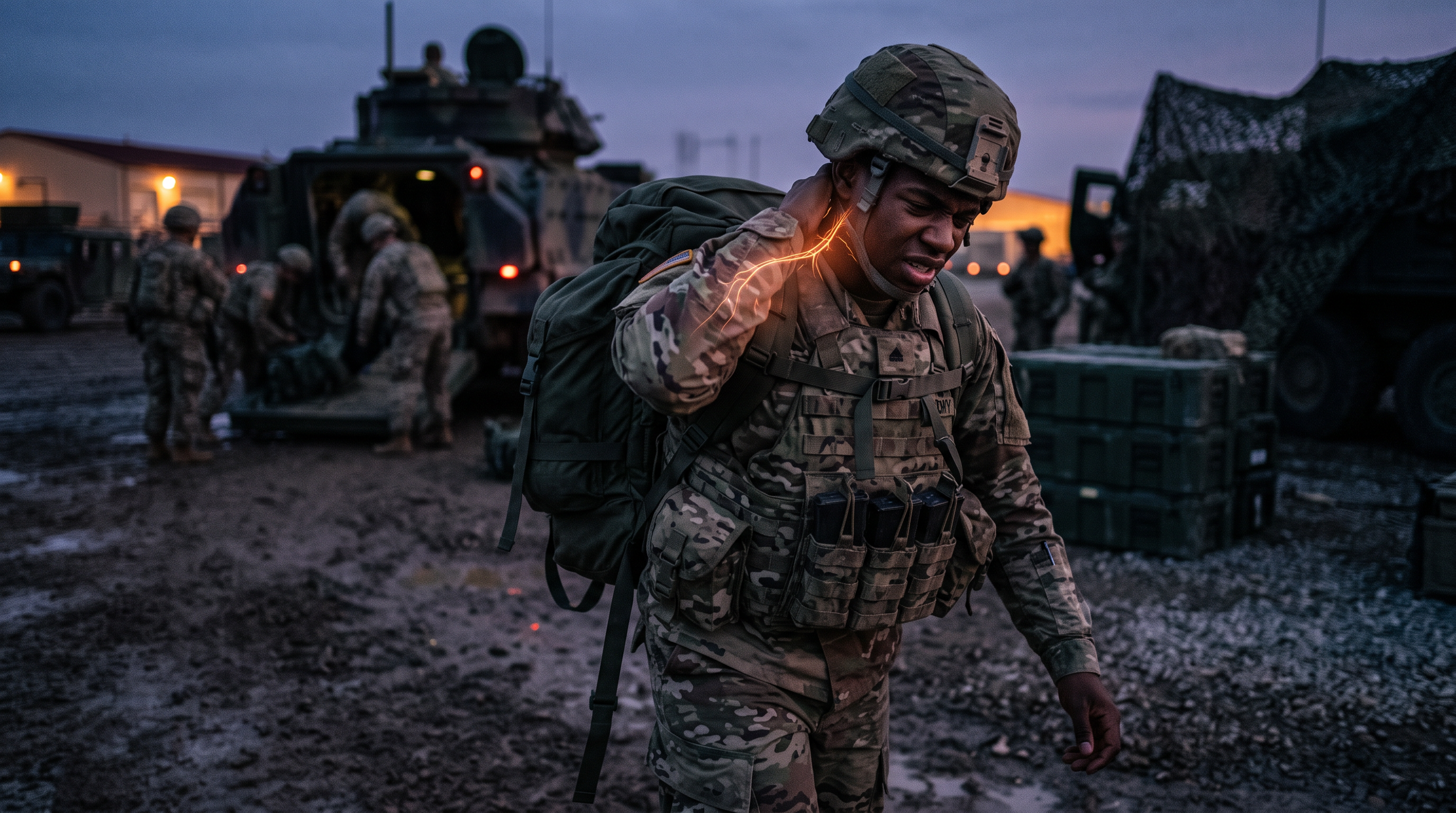
The advocate's notes on causation, Cervical Radiculopathy
The separate arguments that decide this code: where the VA will attack, the regulation that answers it, and the evidence that closes the gap.
1It is secondary to the neck you are already rated for, §3.310(a) and §3.310(b)
This is the single most-missed rating on the site. 38 CFR §3.310(a) grants service connection for any disability that is proximately due to or the result of a service-connected disease or injury, and §3.310(b) separately grants it for the aggravation of a nonservice-connected condition by a service-connected one. If your cervical strain, degenerative disc disease or stenosis is service-connected and a nerve root coming out of that same neck is compressed, the radiculopathy is service-connected as a matter of law once the medical link is stated. You do not have to prove it started in service. You have to prove it comes from the neck that did.
2The regulation orders a separate rating, Note (1) to the General Rating Formula, §4.71a
The VA frequently folds arm symptoms into the neck percentage and calls it done. The rating schedule itself forbids that. Note (1) to the General Rating Formula for Diseases and Injuries of the Spine directs the adjudicator to "evaluate any associated objective neurologic abnormalities, including, but not limited to, bowel or bladder impairment, separately, under an appropriate diagnostic code." Separately is the regulation’s word, not ours. And 38 CFR §4.14 does not bar it, because limitation of neck motion and impaired nerve function are different functional losses with different manifestations.
3Direct service connection where the neck was never claimed, §3.303(a) and §3.303(d)
Radiculopathy can be directly service-connected even with no spine rating at all. 38 CFR §3.303(a) covers disability resulting from injury incurred in the line of duty, and §3.303(d) expressly permits service connection when the disease is first diagnosed after discharge, provided the evidence establishes it was incurred in service. A documented in-service neck injury, a blast event, or years of documented load-bearing with the helmet and armor described in your MOS is the in-service event. The EMG you got at fifty is the current diagnosis. The nexus opinion bridges them.
4A thin record does not defeat you, §3.303(b) and Buchanan v. Nicholson
If the service treatment records show one line about a stiff neck and nothing else, 38 CFR §3.303(b) allows service connection on continuity of symptomatology, and the Federal Circuit held in Buchanan v. Nicholson, 451 F.3d 1331 (Fed. Cir. 2006) that the absence of contemporaneous medical records cannot be the sole basis for rejecting competent lay evidence. You are competent to report that your hand has gone numb since Bragg. Your spouse is competent to report watching you drop a coffee cup. Buddy statements are evidence, not stories.
5Combat and field conditions relax the proof standard, 38 U.S.C. §1154(b) and §3.304(d)
If the injury happened in combat, 38 U.S.C. §1154(b) and 38 CFR §3.304(d) require the VA to accept lay or other evidence of that injury as sufficient proof of service incurrence if it is consistent with the circumstances, conditions or hardships of the service, even in the absence of any official record, and the presumption may be rebutted only by clear and convincing evidence. Nobody filled out a sick-call slip after a rollover in a TIC.
6One rating per arm, plus the bilateral factor, §4.25 and §4.26
Radiculopathy in both arms is two separate evaluations, not one. They are combined under the combined-ratings table at 38 CFR §4.25, and because they affect paired extremities, 38 CFR §4.26 requires the VA to add a bilateral factor of 10 percent of the combined value of the two before combining that figure with the rest of your disabilities. Adjudicators forget the bilateral factor constantly, and it is visible on the face of a code sheet.
Exposure & Aggravation
How Cervical Radiculopathy Happens In Service, And How It Gets Worse

The VA wants an in-service event, and most veterans think that means one dramatic injury. It does not. Years of duty that wore the body down count too, and under 38 CFR 3.306 a condition service made worse can still be connected. Find yourself in the list below, then put that duty in writing with dates, units and names. The board only weighs what you put on paper.
How veterans pick this up in uniform, Cervical Radiculopathy
Cervical Radiculopathy rarely announces itself with one dramatic moment. It is built by what service asked of your body over months and years, and once it is service-connected, it is compensated for how it keeps getting worse, not for how it started. Below is how veterans pick this up in uniform, and who is most prone to it.
- Kevlar, plate carrier, night-vision counterweight and a rucksack yoke loading the cervical spine every hour of every patrol
- Airborne parachute-landing falls and helicopter hard landings driving axial compression straight through C5–C7
- IED blast overpressure and vehicle rollovers with the head whipped against a hatch, headrest or turret ring
- Years of head-down work in an engine bay, a hull, a cockpit or a radio rack with the neck held in flexion
- Combatives, boxing smokers and unit sports played hard on concrete
- Crew-served weapons and gun-truck duty with the head turned and braced against recoil
- Sick-call entries reading "neck strain, Motrin, RTD" that were never followed by imaging
- Aircraft carrier flight-deck and shipboard work with a cranial and a ladder well taken at speed
Who is most prone to it
Infantry, airborne and air assault, cavalry scouts, combat engineers, aircrew and aviation mechanics, armor and turret gunners, motor-transport operators, Seabees, hull technicians, avionics and radio techs, and anyone who wore a helmet with a counterweight for a decade.
The Symptoms
What Cervical Radiculopathy Actually Feels Like
Read this list the way the examiner will. Every symptom you live with but never report is a symptom the VA treats as if it does not exist. The rating schedule pays for how Cervical Radiculopathy affects your daily life and your work, so the details matter. Check off what matches your day, tell your doctor in those words, and make sure it lands in your treatment record before the exam.

- Burning, electric or shooting pain that starts in the neck and runs into the shoulder blade, arm or hand
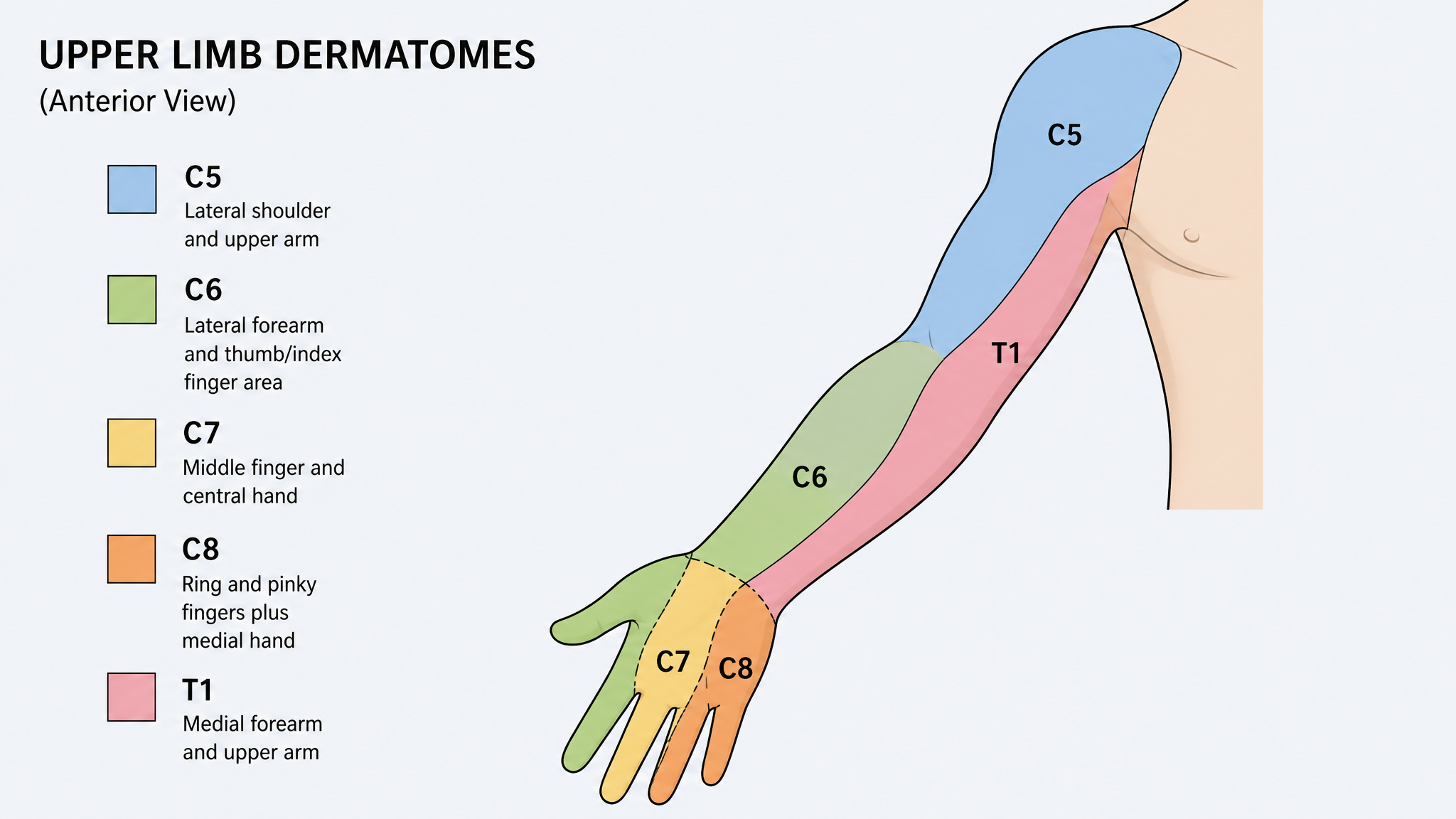
- Numbness or pins and needles in specific fingers, thumb and index (C6), middle finger (C7), ring and little finger (C8)
- Weakness lifting the arm overhead, or a grip that fails without warning
- Dropping cups, keys, tools, objects leaving the hand before your brain registers it
- Symptoms that spike when you tilt your head toward the bad side or look up
- Relief when you put your hand on top of your head (the shoulder abduction relief sign)
- Visible loss of muscle bulk in the shoulder, upper arm or the web space of the thumb
- Night pain that wakes you and forces you out of bed to shake the arm out
How this one is rated
Cervical radiculopathy is rated as incomplete paralysis of the affected nerve group, graded mild, moderate, or severe, up to complete paralysis. Upper extremity ratings also turn on handedness: the major (dominant) extremity is rated higher than the minor at every level, and 38 CFR §4.69 provides that only one extremity may be considered major. Critically, §4.124a contains a ceiling most veterans are never told about, when the involvement is wholly sensory, the rating should be for the mild, or at most, the moderate degree. Numbness alone caps you. Documented strength loss, reflex loss and measured atrophy are what break that cap.
What you are measured against
The nerve root level is identified by which dermatome is numb, which reflex is diminished (biceps C5–C6, brachioradialis C6, triceps C7), and which myotome is weak, then confirmed against EMG, nerve-conduction studies and the MRI level.
Each One On Its Own Page
Secondary Conditions, Aggravated or Caused by a Current Service-Connected Condition
Under 38 CFR §3.310(a), a disability that is proximately due to a service-connected condition is service-connected in its own right, and under §3.310(b), so is any additional disability caused when a service-connected condition aggravates a problem you already had. Each condition below is a separate evaluation with its own diagnostic code and its own percentage. They do not fold into the cervical radiculopathy rating, they stack on top of it. A veteran who claims only the primary condition leaves these ratings on the table.

Myelopathy red flags, cord compression, not just a root
When the neck compresses the spinal cord itself and not just a root, the picture changes: clumsy hands that cannot button a shirt, a stumbling wide-based walk, and bladder urgency. These are neurosurgical red flags, raise them the moment they appear, because cord myelopathy is a different, more serious disability and a reason for urgent imaging.

Cervicogenic headache from the neck (§3.310)
A pinched cervical spine drives headaches that start at the base of the skull and wrap forward, cervicogenic headaches. They are separately service-connectable as secondary to the neck under §3.310, and if they are frequent and prostrating they carry their own rating. Mention them; nobody rates a headache that is not in the record.

Sleep disturbance and mood from chronic arm pain
An arm that burns and goes numb every night wrecks sleep, and chronic pain that will not let you rest or work drives depression and anxiety. Both are separately service-connectable as secondary to the pain under §3.310, say the nights you lose and the mood it puts you in, because what is not written is not rated.
Accredited Claims Agent #45147
Ready To Get This Rated Correctly?
You have read how the VA rates Cervical Radiculopathy. Now the question is whether your file proves it. We represent veterans on a No Win, No Fee basis: 20% Direct-Pay paid by the VA from back pay, or 30% High-Complexity, and you owe nothing for representation if your rating does not increase. If you only need the roadmap, the Mission 5 Brief is a separate $750 flat fee. You bring the records, we build the argument.
Radiculopathy, In Detail
Radiculopathy, Service Connection In Depth
Here is each claimable condition in this group on its own terms, what it is, what service did to it, and what the VA requires before it will connect it.

Cervical Radiculopathy, Upper Extremity Nerve Root Compression
Cervical radiculopathy is not part of your neck rating. The neck itself is rated on range of motion under 38 CFR §4.71a, Diagnostic Codes 5235–5243. The nerve running out of that neck and down your arm is a separate disability rated under 38 CFR §4.124a, and Note (1) to the General Rating Formula for Diseases and Injuries of the Spine says it in the regulation’s own words: rate any associated objective neurologic abnormalities separately, under an appropriate diagnostic code. Two ratings, not one. Each arm is its own rating, and if both arms are involved the bilateral factor at 38 CFR §4.26 is added on top. Veterans carrying a neck rating and nothing else are, more often than not, missing two evaluations.
You are reading this page now
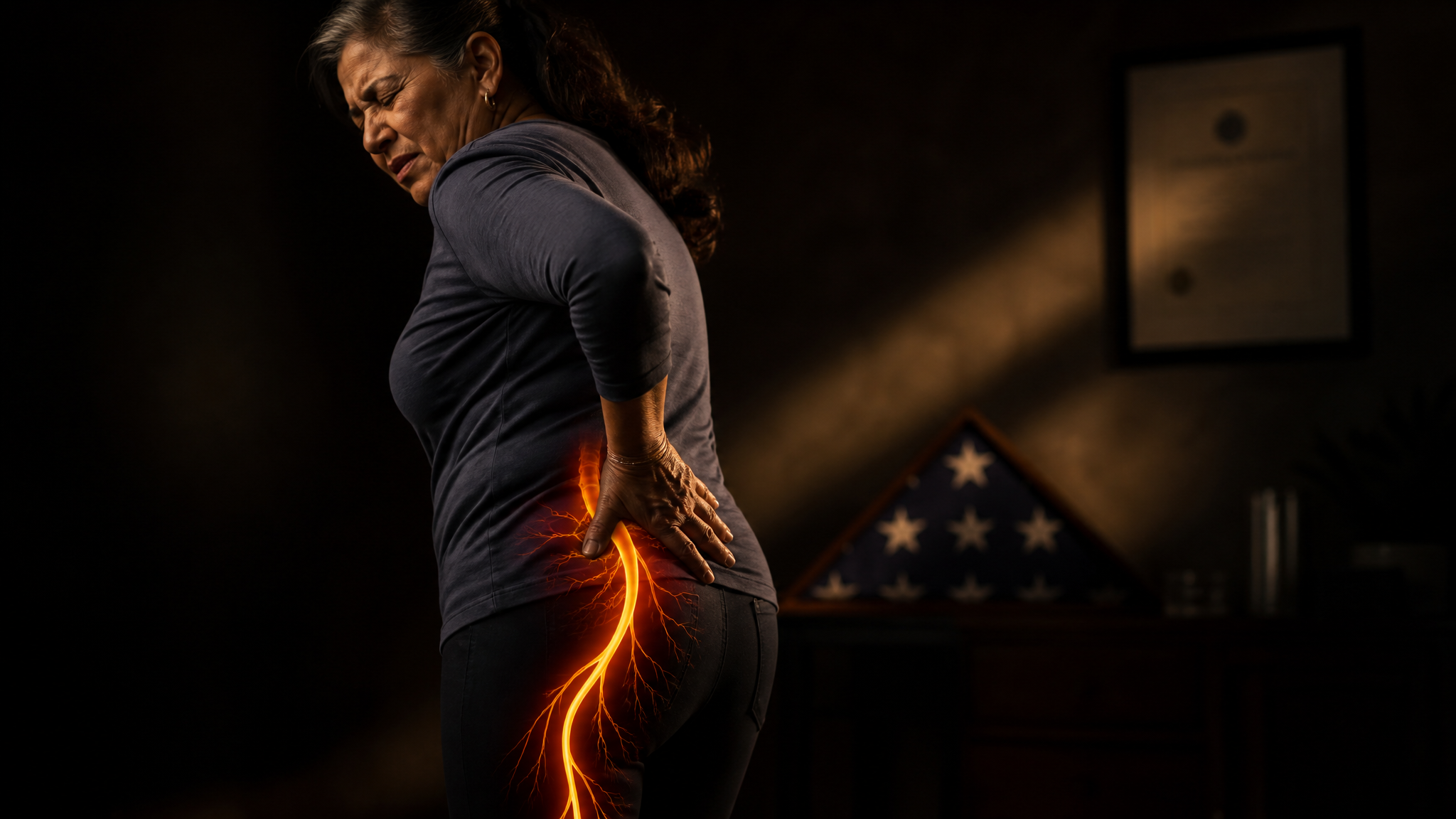
Sciatica, Sciatic Nerve Radiculopathy of the Lower Extremity
Sciatica is not part of your low back rating. The lumbar spine is rated on degrees of forward flexion under 38 CFR §4.71a, Diagnostic Codes 5235–5243. The sciatic nerve running out of that spine and down your leg is a separate disability rated under 38 CFR §4.124a, Diagnostic Code 8520, and Note (1) to the General Rating Formula for Diseases and Injuries of the Spine says it in the regulation’s own words: evaluate any associated objective neurologic abnormalities separately, under an appropriate diagnostic code. Two ratings, not one. Each leg is its own rating, and when both legs are involved the bilateral factor at 38 CFR §4.26 is added on top of the combined value. A veteran carrying a low back rating and nothing else is, more often than not, missing two evaluations.
Read the full Sciatica (Sciatic Nerve) page
Femoral Radiculopathy, Anterior Crural Nerve Involvement of the Lower Extremity
Ask a veteran about leg pain from the back and he will point to the back of his leg. That is sciatica, DC 8520. The anterior crural (femoral) nerve, Diagnostic Code 8526, carries pain down the front of the thigh to the knee from the L2, L3 and L4 roots, and it is missed constantly for one reason: the examiner performs a straight-leg raise, which tests the back of the leg, and never performs the femoral nerve stretch test, which is the only maneuver that tests the front. They are separate nerves with separate codes. A veteran can hold a lumbar spine rating, a sciatic rating and a femoral rating, in each leg, and Note (1) to the General Rating Formula at 38 CFR §4.71a does not make it optional: associated objective neurologic abnormalities are evaluated separately.
Read the full Femoral Radiculopathy pageThe C&P Exam
What To Expect At The Cervical Radiculopathy Exam
This is the encounter your rating is built on. The examiner has a checklist and a limited window, what follows is exactly what happens in that room, so none of it surprises you.
Clinical Section, What To Expect at the Exam
What to Expect at Your Cervical Radiculopathy C&P Examination
Diagnostic Codes 8510–8513, this exam is decided by reflexes, strength and a tape measure, not by how well you describe pain
Your percentage here is an **adjective**, mild, moderate, severe, and **§4.124a** says that when the involvement is **wholly sensory** the rating is capped at **mild, or at most, moderate**. That single sentence is why an exam that records "reports numbness in the right hand" and nothing else will produce a 20% when the objective findings supported far more. Everything that breaks the sensory cap is **measured**: graded strength, graded reflexes, and limb circumference in centimeters. If the examiner does not take those measurements, they cannot be used, and the rating defaults down.
Condition
Cervical Radiculopathy, DC 8510–8513
Governing questionnaire
VA Form 21-0960C-8, Peripheral Nerves Conditions (Not Including Diabetic Sensory-Motor Peripheral Neuropathy) Disability Benefits Questionnaire
Click the form number to open the official questionnaire on VA.gov.
01In The Room
What happens during the exam
The tests and maneuvers for this condition
- Spurling maneuver, both directions
- Shoulder abduction relief sign
- Biceps, brachioradialis and triceps reflexes, both arms
- Manual muscle testing 0–5 through every cervical myotome, both arms
- Light-touch and pinprick mapping of C5 through T1, both arms
- Grip strength, with a dynamometer where available
- Upper-arm and forearm circumference in centimeters, both arms
- Review of the cervical MRI and the EMG / nerve-conduction study, correlated to a specific root level
What gets measured, and to what number
Muscle strength, graded 0 to 5
Shoulder abduction (C5), elbow flexion and wrist extension (C6), elbow extension and wrist flexion (C7), finger flexion (C8), finger abduction (T1), both arms, so the unaffected side is the baseline.
Deep tendon reflexes, graded 0 to 4+
Biceps (C5–C6), brachioradialis (C6) and triceps (C7), compared side to side. A diminished or absent reflex is an objective neurological finding, it is not sensory.
Dermatome-by-dermatome sensory testing
Light touch and pinprick scored normal, decreased or absent at C5, C6, C7, C8 and T1 individually, not one global "decreased sensation, right upper extremity".
Limb circumference for atrophy
Measured in centimeters at a fixed distance above the elbow and at the forearm, on both arms. Thenar eminence wasting should be described specifically.
Provocative testing
Spurling test: the neck is extended and rotated toward the symptomatic side with axial compression, with the position that reproduces the arm symptoms recorded, plus the shoulder abduction relief sign.
Severity stated in the regulation’s language
An explicit statement, for each upper extremity, of whether the picture is paralysis, neuritis or neuralgia, whether the involvement is wholly sensory, and whether the incomplete paralysis is mild, moderate or severe.
02Orientation
What to expect during this exam
What makes this exam different from every other C&P exam
1Handedness changes the number before anything else does
Every cervical nerve code is written as major / minor. The dominant arm is rated higher at every single level. Under 38 CFR §4.69 only one extremity may be considered major, and if you are ambidextrous the injured one is treated as the major. Make sure the examiner records which hand you write with, it is a line people skip and it is worth an entire rating step.
2The tape measure is what defeats the wholly-sensory cap
Marked muscular atrophy is the objective finding that moves you off mild. It is proven by limb circumference measured in centimeters at a fixed landmark on both arms, not by an examiner glancing at your shoulders. If the report has no numbers, ask why, and note it.
3Each arm is its own exam and its own rating
The DBQ has a left column and a right column for a reason. An examiner who tests the symptomatic side only has produced a report the rater cannot use to grant the second extremity, and the bilateral factor at §4.26 never gets applied.
See it before you sit in the room
03Preparation
Know your symptoms and secondary factors
What the report must actually say about cervical radiculopathy, dc 8510–8513
- "The pain starts in my neck and travels into my [shoulder / arm / these specific fingers]", name the fingers.
- "I am right-handed" (or left), say it out loud so handedness is in the report.
- "I drop things", and give a real example with roughly how often it happens.
- "My arm is weak, not just numb", the word **weak** is what moves you past the sensory cap.
- "This arm is smaller than the other one", and ask that both be measured with a tape.
- "Both arms are affected" if they are, and ask that each be evaluated separately.
- "It wakes me at night and I have to get up and shake it out."
Pain level, frequency, lost work and functional loss, how to say them

Say "weak," not only "numb"
The wholly-sensory cap in the preamble to §4.124a holds a numbness-only arm at mild, or at most moderate. The word that lifts the ceiling is weakness, the examiner has to grade motor strength before any rating above moderate is on the table.
Describe what the weakness does: the grip lets go without warning, you cannot hold the arm overhead to change a bulb, the coffee cup slips out of your hand. That is motor loss, and motor loss is graded on the 0–5 scale the schedule pays on.
"It is not just numb, the hand is weak. My grip gives out and I drop things before I even feel it."

Name the exact fingers that go numb
The fingers that are numb tell the examiner which root is pinched, thumb and index is C6, the middle finger is C7, the ring and little finger is C8. "My hand is numb" gives the rater nothing to attach a diagnostic code to; a named dermatome ties the arm to a specific disc on your MRI.
Point at the fingers in the exam and say the pattern out loud. If it changes with neck position, say that too, symptoms that spike when you look up or tilt toward the bad side are the classic radicular picture.
"The numbness is in my thumb and index finger" (or "middle finger," or "ring and little finger"), name them, do not wave at the whole hand.

Say which hand you write with, out loud
Every cervical nerve code is written major / minor, and under §4.69 the dominant arm is rated higher at every level. Handedness is a single line examiners skip constantly, and it is worth an entire rating step. If you are ambidextrous, the injured arm is treated as the major one.
Do not assume the examiner will ask. State it plainly, and if it is your dominant arm that is affected, make sure that fact lands in the report.
"I am right-handed" (or left), and "it is my dominant arm that is affected," if it is.

Ask that BOTH arms be measured with a tape
Marked muscular atrophy measured in centimeters is one of the findings that lifts the rating above moderate, and it only exists on paper if someone used a tape at a marked landmark on both arms. A visibly thinner arm or a hollowed-out thumb web that is never measured is a rating you will not get.
If both arms are involved, say so and ask that each be rated separately, two evaluations combine under §4.25 and the bilateral factor at §4.26 rides on top.
"This arm is smaller than the other one, and the muscle at the base of my thumb has wasted, please measure both arms with a tape and record the centimeters."
Secondary conditions to raise in the same appointment
Every secondary condition laid out in the Secondary Conditions section above belongs in this same appointment. Name each one out loud, tell the examiner how the primary condition caused it or made it worse, and ask that it be noted in the report. Under 38 CFR 3.310, a secondary condition the examiner never hears about is a secondary condition the VA never rates. Bring your list on paper so nothing gets left in the parking lot.
What to expect at this specific exam
- Bring the EMG / nerve-conduction report and the cervical MRI report, the level in the imaging is what ties the nerve to the neck.
- Bring the note from the provider who linked the arm symptoms to your neck, if you already have one.
- Write down, before you go, exactly which fingers go numb on which hand.
- Log dropped objects, night waking and missed work for the previous 90 days with dates.
- Bring any brace, splint or cervical collar you actually use, and the prescription for it.
- Do not stretch the neck out beforehand to make the exam more comfortable, you will be measured at your best hour, not your average one.
04The Protocol
What procedures are required during the exam
These are not courtesies. Each comes out of the regulation or out of binding case law. Take this list in with you and tick them off as they happen.
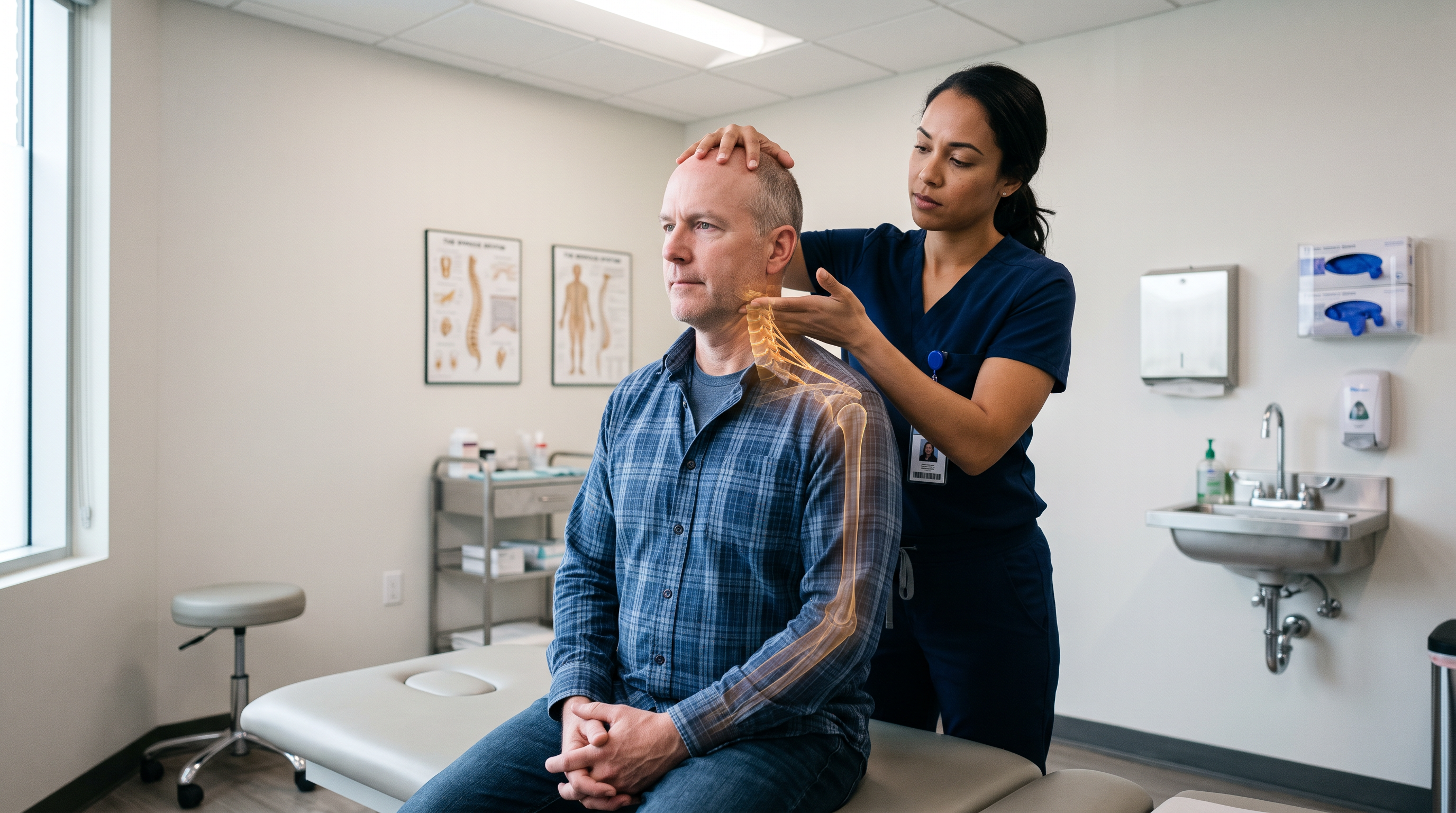
01The Spurling maneuver, with the provoking position recorded
38 CFR §4.124a
The Spurling test, the neck is extended and rotated toward the symptomatic side with gentle downward pressure, is the provocative test that ties the arm symptoms to the neck. The examiner must record the position that reproduces the arm pain, along with the shoulder abduction relief sign.
A report that says only "positive" tells the adjudicator nothing usable. The finding is which position reproduced your arm symptoms and where they traveled. Watch for the exam that reproduces your pain and then writes a single word, or skips the test on the arm that is not the worst one, that omission is how a second, ratable arm goes unwritten.

02Manual muscle strength testing graded 0 to 5
38 CFR §4.124a, preamble
Shoulder abduction (C5), elbow flexion and wrist extension (C6), elbow extension and wrist flexion (C7), finger flexion (C8) and finger abduction (T1), tested on BOTH arms and graded 0 to 5, not described in words. Graded weakness is one of the findings that break the wholly-sensory cap.
The preamble to §4.124a holds a sensation-only arm at mild or moderate no matter how it behaves. Graded motor loss is what lifts it. So the examiner has to resist each movement and write a grade, on both arms, because the unaffected side is the baseline. A report that calls the arm "numb" and leaves the strength fields blank has quietly capped your evaluation before the rater ever sees it.

03Deep tendon reflexes graded and compared side to side
38 CFR §4.124a
The biceps (C5–C6), brachioradialis (C6) and triceps (C7) reflexes, graded 0 to 4+ and compared between the two arms. A diminished or absent reflex is objective evidence, not a symptom you reported.
Reflexes cannot be faked and cannot be exaggerated, which is exactly why they carry weight. An absent triceps reflex on the symptomatic side, next to a normal one on the other, is hard, gradable proof of C7 root involvement, the kind of finding that survives a rater inclined to call everything mild. The failure to watch for is a report that grades the good arm, calls the reflexes "2+ and symmetric," and never actually tested the arm that is numb.

04Dermatome-by-dermatome sensory mapping
38 CFR §4.124a
Light touch and pinprick scored normal, decreased or absent at C5, C6, C7, C8 and T1 individually, over the shoulder, the thumb and index, the middle finger, the ring and little finger, not a single global "sensation intact, right upper extremity."
The dermatome that is numb is what identifies the root level, and the level is what ties the arm to a specific disc on your MRI. An examiner who checks one spot and writes "sensation intact distally" has skipped the step that makes the finding usable. Numb thumb and index points to C6, a numb middle finger to C7, a numb ring and little finger to C8, and the record should say which.

05Upper-arm and forearm circumference measured with a tape
38 CFR §4.124a
Both arms measured in centimeters at a fixed, stated landmark above the elbow and at the forearm, with the thumb web (thenar eminence) described specifically. Marked atrophy is what supports the higher evaluations, and it only exists in the record if someone used a tape.
Atrophy is the difference between an arm the schedule calls moderate and one it calls severe, and it is the finding examiners most often eyeball instead of measure. A visibly wasted arm recorded as "no atrophy noted" is a defect you can point to. Insist the measurement be taken at the same landmark on both arms and written in centimeters, because a two-centimeter difference on paper is worth far more than a paragraph describing a thinner arm.

06Handedness recorded, and each arm evaluated separately
38 CFR §4.69
The examiner must record which hand you write with and complete the left and the right column of the DBQ separately. Under §4.69 the dominant (major) arm is rated higher at every level, and only one arm may be treated as major.
The DBQ has a left column and a right column for a reason. An examiner who tests the symptomatic side only has produced a report the rater cannot use to grant the second arm, and the bilateral factor at §4.26 never gets applied. Handedness sets the entire major/minor scale before any percentage is chosen, so make sure it is written down and make sure both arms are examined even if only one hurts today.

07MRI and EMG correlated to a root level, with severity stated per arm
38 CFR §4.124a
The report must tie the cervical MRI and the EMG / nerve-conduction study to a specific root level, and must state, for EACH arm, whether the picture is paralysis, neuritis or neuralgia, whether the involvement is wholly sensory, and whether the incomplete paralysis is mild, moderate or severe.
The imaging level is what proves the pinched nerve lives in your neck and not somewhere else, and the EMG is the objective confirmation. But the rating still turns on the adjective. A report that grants the neck and describes the arm only as "radiculopathy" leaves the rater no language to assign a percentage, and the separate arm rating, the most valuable part of the claim, goes unwritten. Make the examiner grade severity in the exact words of the schedule, for each arm.
05The Standard
What makes an exam adequate
Read your exam report against these. An exam that fails the standard is legally inadequate, and an inadequate exam is something you challenge rather than accept.
The range of motion has to be MEASURED, not estimated
38 CFR §4.46 states that the use of a goniometer in the measurement of limitation of motion is indispensable in examinations conducted within the Department of Veterans Affairs. An examiner who eyeballs your bend and writes a number has not complied with the regulation. This is the most common defect in a spine exam and it is the easiest one to spot from the chair.
Joints must be tested in every required condition
Under Correia v. McDonald, a joint examination for pain must, wherever possible, record active motion, passive motion, motion in weight-bearing and motion in non-weight-bearing, and where relevant, the range of the opposite undamaged joint. An exam that records one set of numbers and stops is incomplete on its face, and that incompleteness is grounds to challenge it.
Flare-ups have to be addressed, not dodged
Under Sharp v. Shulkin, when a veteran describes flare-ups, the examiner is obligated to estimate the additional loss of motion during a flare based on all the available evidence, including your own account of it. "I cannot opine without resorting to mere speculation" is not automatically acceptable; the examiner has to have actually sought the information first and explained why an estimate is impossible.
Repetitive use and functional loss must be factored in
Sections 4.40 and 4.45, and the DeLuca line of cases, require that pain, weakness, fatigability, incoordination and lack of endurance after repeated use be considered, and expressed in additional degrees of lost motion where that is feasible. Your rating is supposed to reflect what you can do on the fifth repetition and on a bad day, not just the first careful bend of the morning.
Neurological findings must be separately documented
Note (1) to the General Rating Formula requires that any associated objective neurologic abnormality be evaluated separately under an appropriate diagnostic code. If your leg symptoms were mentioned in the narrative but never tested and never assigned, the exam did not do what the schedule requires of it.
The examiner must review the record when the question requires it
Where a medical opinion on cause, aggravation or a secondary relationship was requested, the examiner is expected to review the relevant evidence and give a reasoned explanation. A bare conclusion, "less likely than not related to service" with no reasoning attached, carries little weight, and an opinion with no rationale is challengeable.
The examiner has to be qualified for the body system
The VA may use its own clinicians or a contract vendor. Either way, the examiner is expected to have the competence to evaluate the system being examined. If a spinal exam with a neurological component was performed by someone who never tested a reflex, that is a problem worth raising.
The exam has to be CURRENT
A rating is supposed to reflect your condition now. An exam performed before a documented worsening, or years before the decision, may not support the current evaluation, and you can request a new one on that basis.
06Afterward
What happens after your exam is complete
The examiner writes the report and submits it, it is reviewed for completeness, and only then does the claim move toward a rating decision. Here is what actually controls the clock.
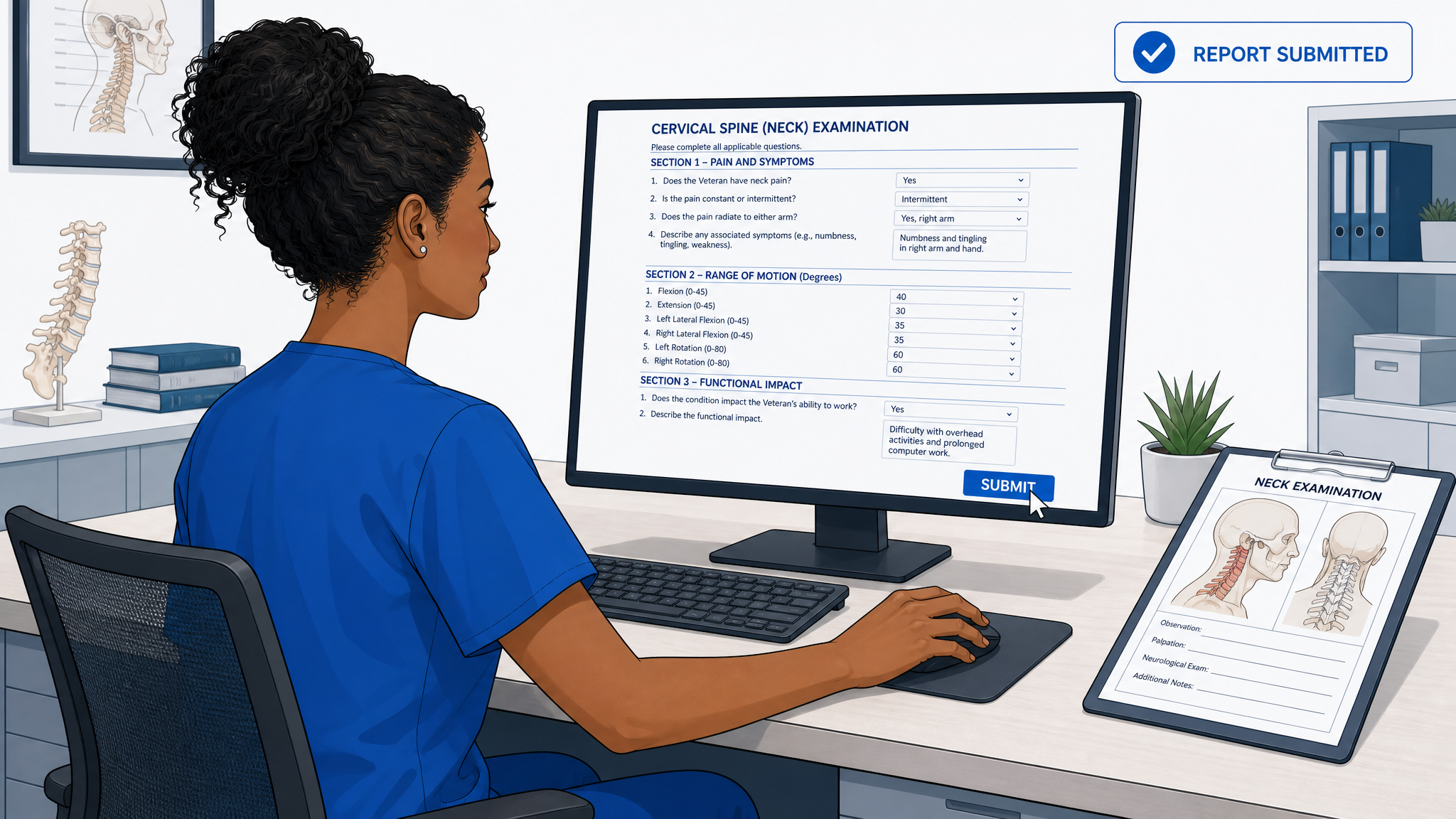
The examiner writes and submits the report
Days 1–5 after the exam
The examiner compiles the history, the physical findings, the measurements and any testing into the questionnaire, adds any requested medical opinion, and submits it. Contract vendors typically have a turnaround requirement measured in days, not weeks.
Nothing about your claim moves while this is happening, and nothing you do speeds it up. What matters is that the report is written from notes taken in the room, which is exactly why what you said, and how the examiner recorded it, is already locked in by the time you get to your car. Request your copy now rather than later.
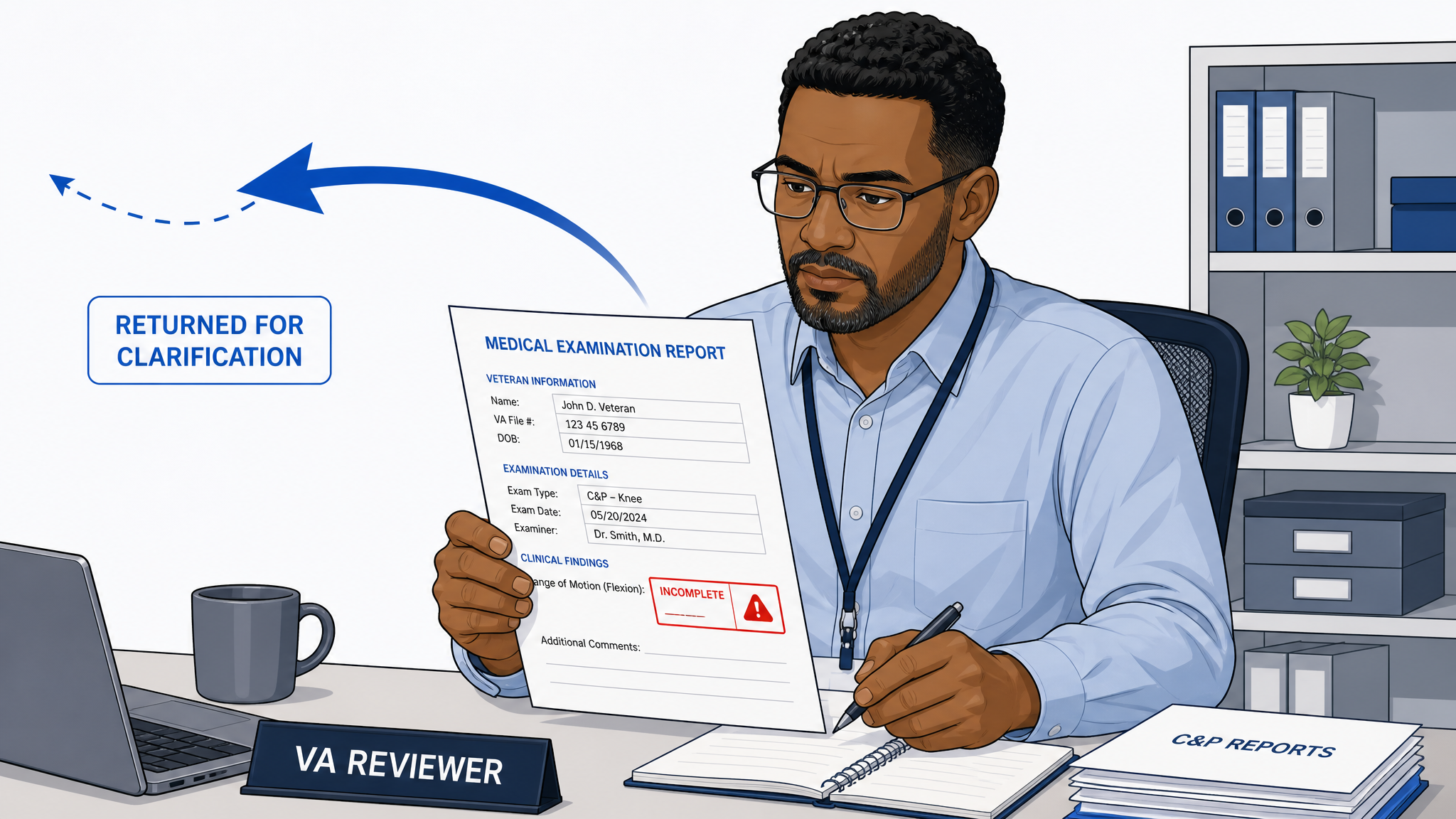
Quality review, and the request for clarification
Days 3–30
The report is reviewed for completeness. If it is internally inconsistent, missing a required field or missing the opinion the VA asked for, it goes back for correction or a second opinion. This is the single most common cause of a claim appearing to stall after the exam.
Understand what a finished exam actually means: it means the appointment happened, not that your claim is ready for a decision. If the reviewer finds a blank range-of-motion field, an opinion that does not answer the question that was asked, or findings that contradict each other, the file goes back out for more information. That is a normal quality control step, not a rejection of your claim, and it is not a sign that you did something wrong, but it does add weeks, and it is the reason so much of what you read online sounds like the system is broken.
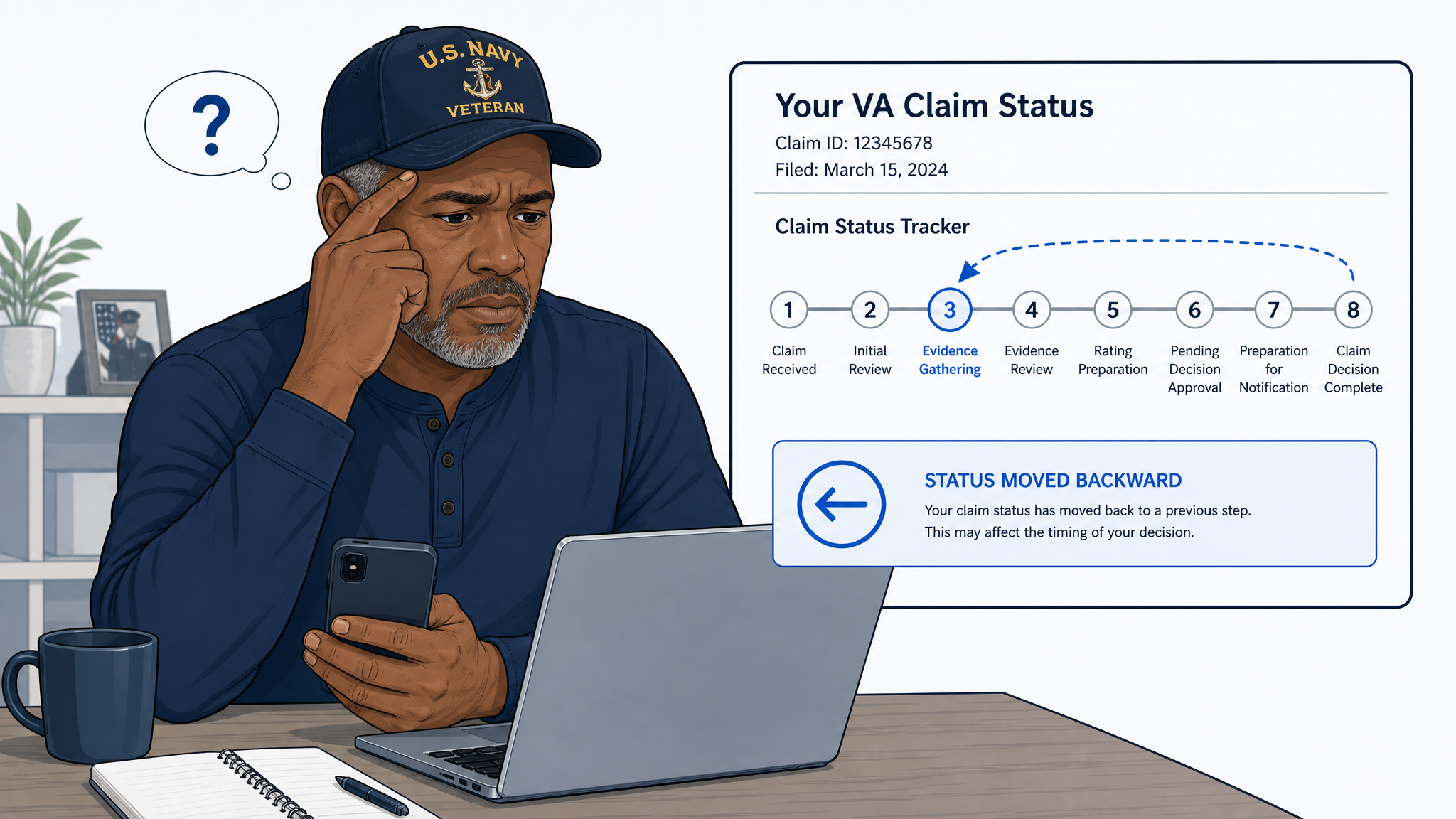
Your status tracker moves backward, and it is usually not bad news
Any time after the exam
The online tracker shows eight steps. Veterans watch it reach step 7 or 8, then find it back at step 3 or 4 a week later. That regression almost always means one thing: the file went back for additional information, most often a returned or clarified exam.
This is the number one thing veterans panic about, and it is misread constantly. The tracker is not a countdown, it is a location marker. When the VA decides it needs one more piece of evidence, a corrected exam, a clarifying medical opinion or an outstanding record, the claim is routed back to the evidence gathering step and the bar redraws itself where the file physically is. It does not mean a denial. It does not mean your case was thrown out or restarted. It does not erase anything already in the file, and it does not change your effective date. What it does mean is that something in the record was not good enough to decide on yet, which is worth knowing, because if the weak link is the exam, this is the window where a corrective statement or a private opinion from your own doctor does the most good.

Evidence gathering closes
Varies
Before anyone rates your claim, the file has to be built. This is the stretch where the Regional Office pulls together everything the decision will rest on: your service treatment records, your VA medical records, any federal records, the C&P exam report, and any private records it has requested on your behalf. The claim sits here until the VA is satisfied the record is complete enough to decide, which is exactly why a status tracker can appear to stall or slide backward at this step. You are not powerless while it sits here. Anything you put into the file yourself lands the day you send it, and every relevant record you add now is one less thing the rater can later say was missing.
A VA request to a private provider is a letter that may or may not be answered, and the VA will wait on it for weeks before moving on, sometimes without ever getting a response. A record you walk in yourself, or upload through your claim, is in the file the day you send it. So do not sit and wait to be asked. If you know a treatment record, an imaging report, a surgical note or a buddy statement exists and it matters, send it now, with a VA Form 21-4138 statement that explains in plain words what the document is and what it shows. This is also the window where a corrective statement or a private medical opinion from your own doctor does the most good, before the rater has locked in a decision, not after. Once the evidence gathering step closes, the file goes to a rating specialist, and your chance to shape the record cheaply and quickly closes with it.

Rating decision and promulgation
Typically several weeks after the last piece of evidence lands
This is the stage where your evidence finally becomes a number. A rating specialist, not the examiner, and not a doctor, takes everything in the file and applies the rating schedule to it: the exam findings, your range-of-motion measurements, your lay statements, your private records and any medical opinions. They assign a diagnostic code to each condition, pull a percentage from the schedule, set your effective date, and either grant, deny or defer each issue. The decision is then reviewed and authorized, promulgation is simply the VA’s word for making it official, and the decision letter and code sheet are generated and mailed. Where an award is made, payment follows the effective date rules, and back pay is calculated to that date.
Read the code sheet, not just the percentage. It names the diagnostic code used, the exact measurements relied on and the effective date assigned, and that is where most mistakes live. This is a human being reading a file under a production quota, and the two things that go wrong most often are a rater using the pre-repetition range-of-motion numbers instead of the worst-case figures §4.59 and §4.40 require, and a claimed condition being decided on a thin record or quietly left out. Check whether painful motion was accounted for, whether your radiculopathy was rated separately under Note (1) or folded into the spine rating, and whether every condition you claimed was actually addressed. A decision you do not read is a decision you cannot challenge, and the deadline to challenge it starts the day the letter is dated, not the day you understand it.
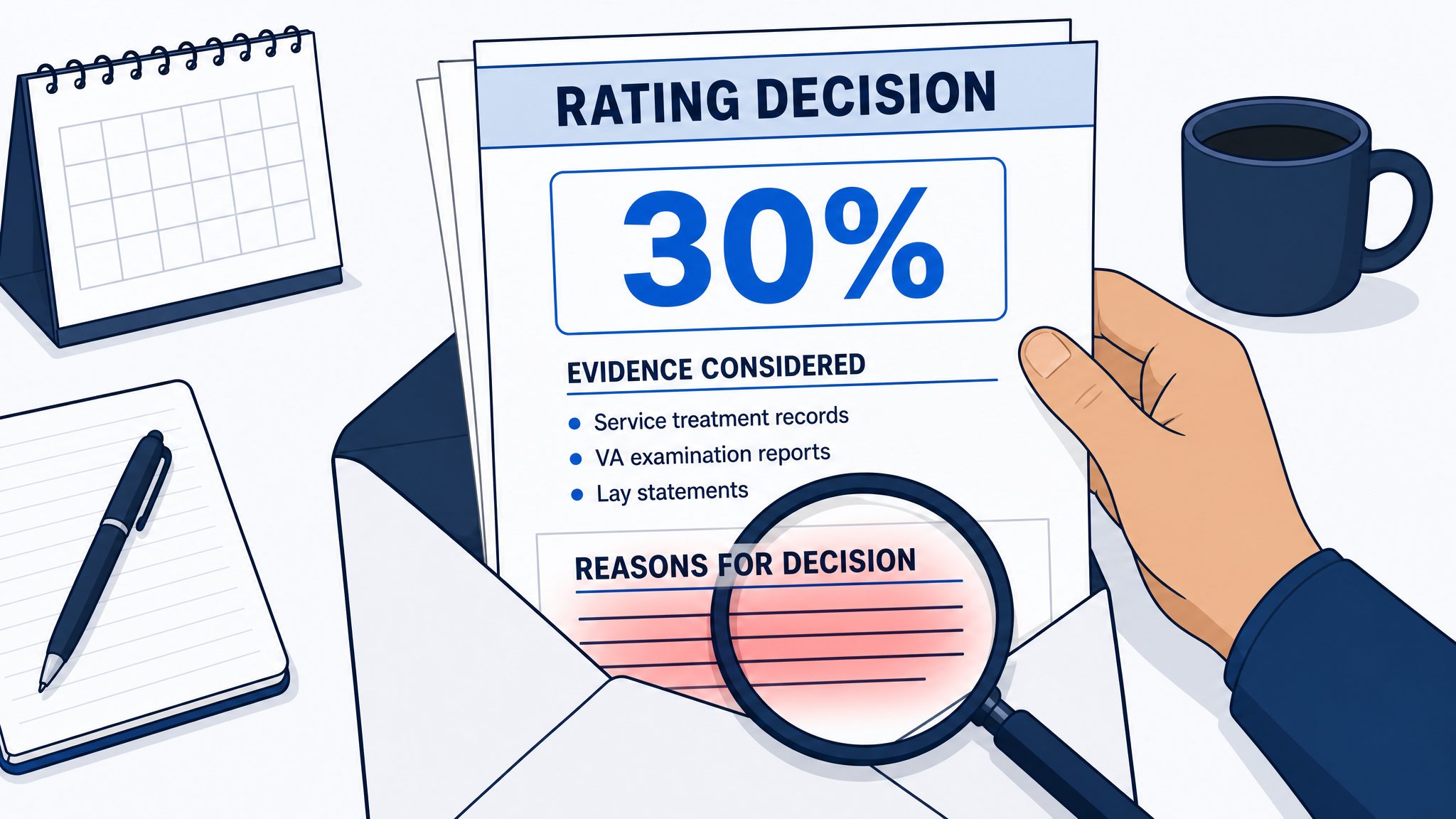
C&P examination is the decision letter
The day it lands in your mailbox
The envelope holds two different documents: the narrative decision letter, and the code sheet. Together they are the single most important piece of paper in your claim, because every deadline, every appeal option and every dollar of back pay is set by what is printed on them, not by what you were told at the exam.
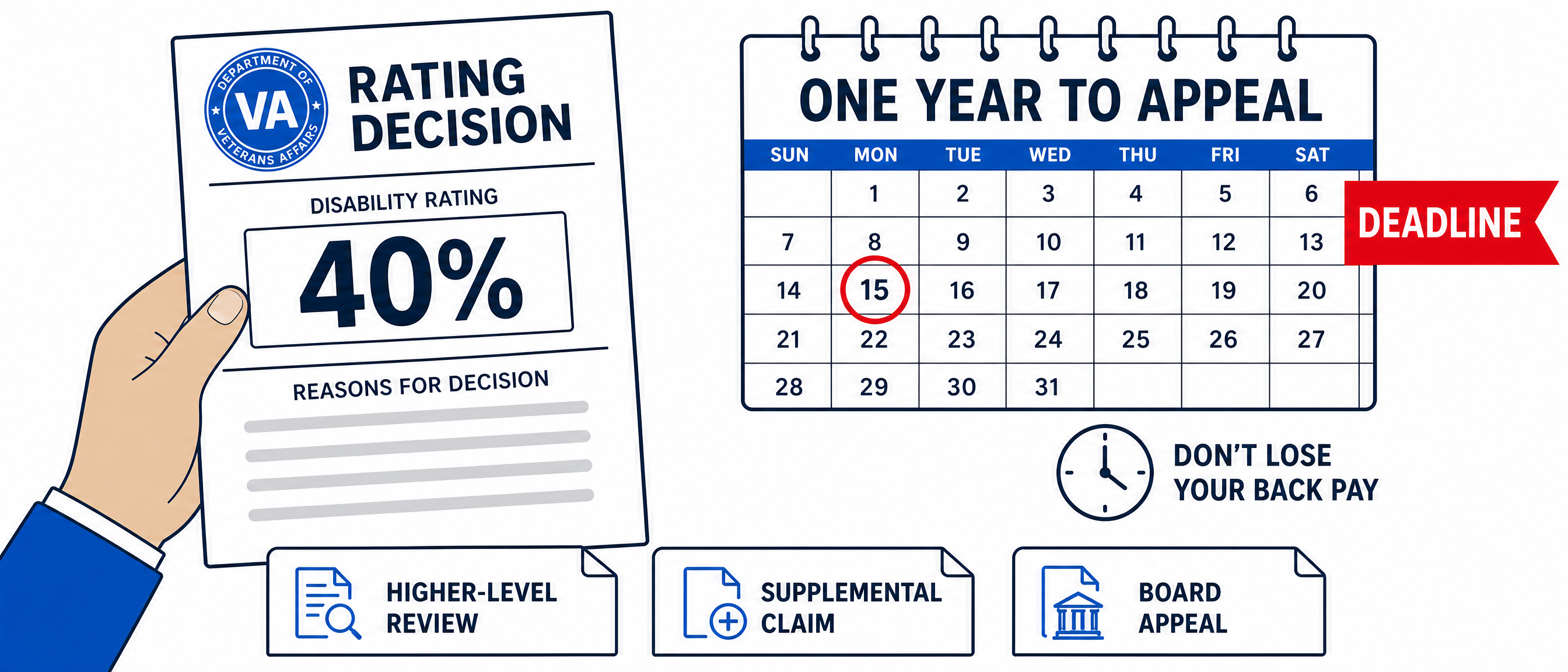
Most veterans read one thing on that letter: the percentage. Then they either celebrate it or get angry at it, and file it in a drawer. That is the mistake. The percentage is the conclusion; the reasons section is the reasoning, and the reasoning is what you attack. It tells you which diagnostic code the rater used, which range-of-motion figures they relied on and which they ignored, whether painful motion under §4.59 was accounted for, whether your neurological findings were rated separately under Note (1) or folded into the spine rating, which conditions were decided, which were deferred, and which were never addressed at all. It also assigns your effective date, which controls back pay. A rating that looks low is very often not a disagreement about how bad your neck is, it is a rater who used the pre-repetition numbers, or missed the radiculopathy, or rated one side and not both. You cannot see any of that from the percentage. Do not go by the percentage alone, and do not decode it by yourself if you are not sure what you are looking at, have someone who reads these for a living read it with you before the clock runs out. You have one year from the date on that letter to file a Higher-Level Review (VA Form 20-0996), a Supplemental Claim (VA Form 20-0995) or a Board appeal, and the deadline runs from the date printed on the letter, not the date you opened it. Bring it to this office and we will go through it line by line, at no cost, and tell you plainly whether it is right.
What normal looks like: 30 to 60 days for a simple claim, longer for a complex one
After your exam you should expect some kind of notification from the VA, a decision, a request for more information, or a notice that another exam has been scheduled. For a straightforward, single-issue claim that often lands within 30 to 60 days. But 30 to 60 days is a rough guide, not a rule, and it is not a ceiling. A claim with several conditions, a toxic-exposure or presumptive question, a returned exam, or missing records routinely takes 90 days or more, and that alone does not mean anything is wrong, the more moving parts your case has, the longer the VA takes to work it. Inside the window that is normal for a case like yours, silence is expected and there is nothing to fix, and a tracker that jumps backward is normal too.
What matters is not a fixed number of days, it is whether the claim is still moving and whether you can get a straight answer about where it is. Once you are well past what is normal for a case like yours and the VA either goes silent or cannot tell you what the claim is waiting on, stop waiting. That is usually where the real trouble hides, an exam that came back twice, a records request that was never answered, a claimed condition that got dropped, or a file sitting in the wrong queue. Call the VA at 800-827-1000, ask specifically what the claim is waiting on and who it is assigned to, and write down the answer. If you cannot get a straight answer, or the answer tells you the exam is the problem, that is the moment to bring it to this office rather than sitting on it for another three months. Problems raised early get fixed inside the claim. Problems discovered in a denial letter get fixed on appeal, and that costs you a year.
Other things that control the clock
Six things decide how long you wait, and none of them are visible from the tracker alone.

The average is a moving number
Check it at the source, not second-hand
The VA publishes an average days-to-complete figure for disability claims that moves month to month; check the current number on the VA’s own claim status page rather than relying on any second-hand figure. In practice, most veterans see a decision somewhere between roughly three and eight months from the date the claim was filed, with the exam usually falling in the middle of that window.
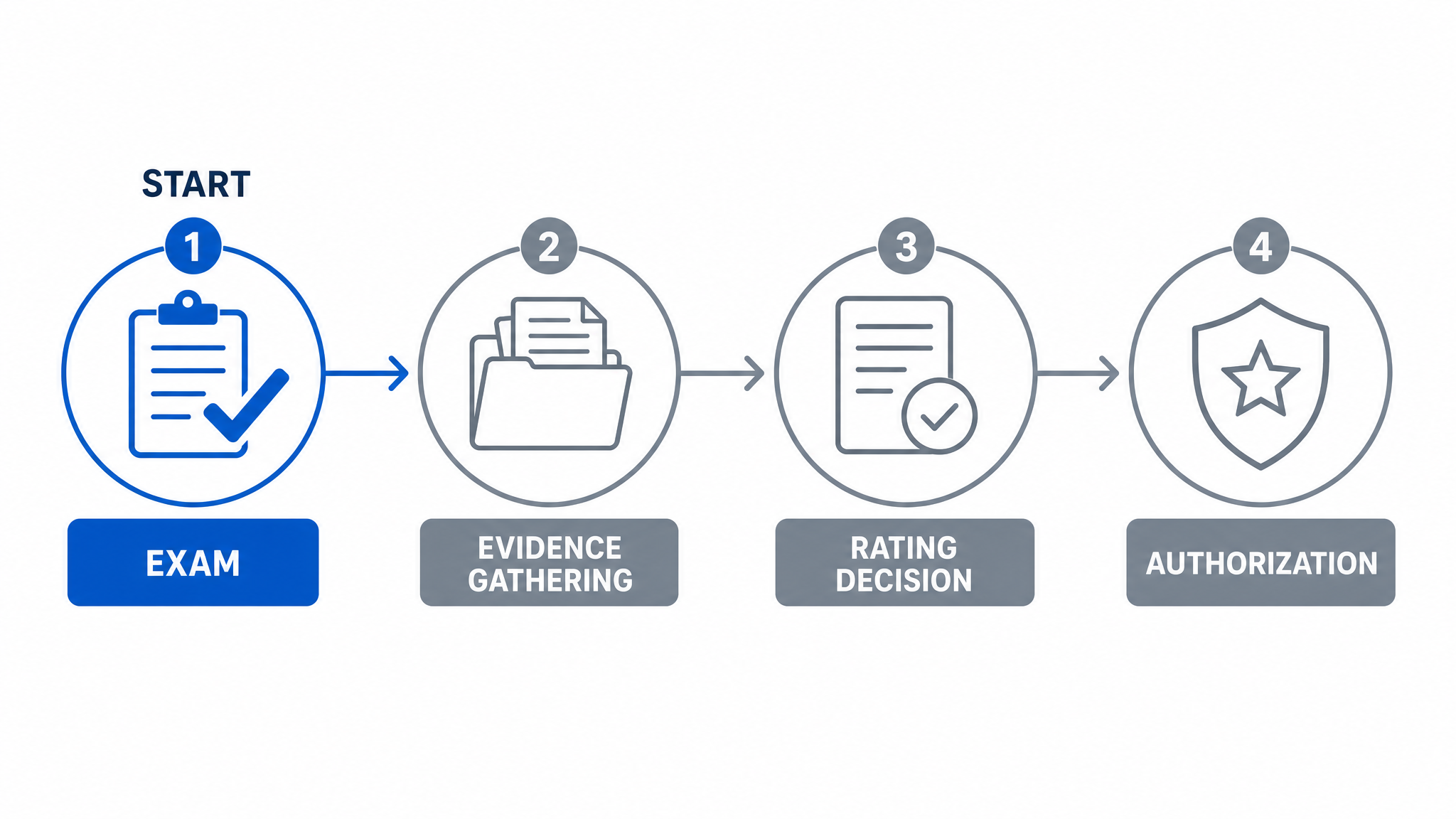
The exam is not the last step
Three stages still sit in front of you
The exam is not the last step. The clock does not start at the exam and it does not stop there either, the claim still has to clear evidence gathering, the rating decision and authorization.
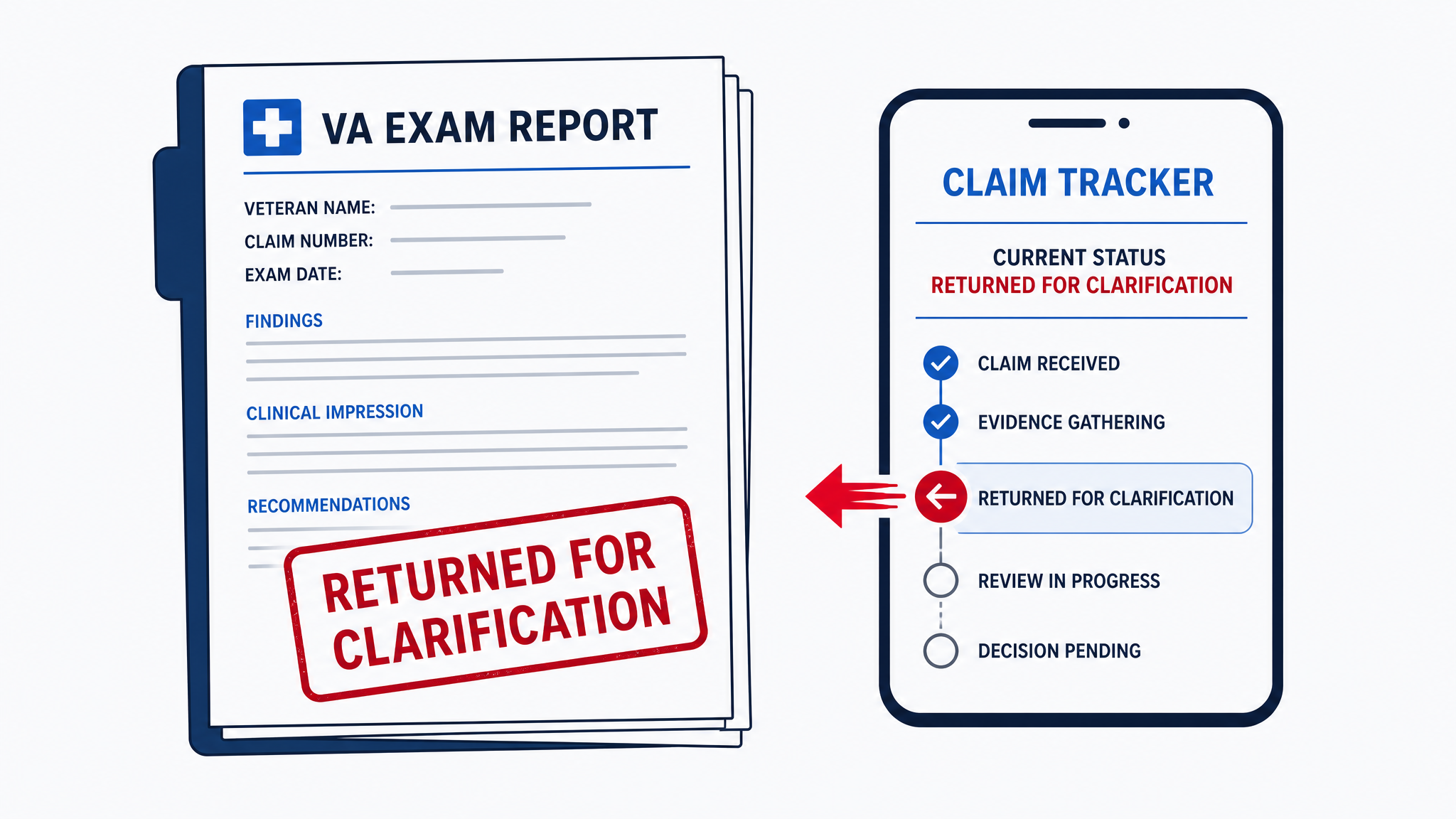
A returned exam is the invisible delay
The reason a tracker slides backward
A returned or clarified exam is the most common invisible delay, and it is why a tracker can slide backward. Expect some contact from the VA within 30 to 60 days of the exam. Past 60 days with nothing at all, call and ask specifically what the claim is waiting on.
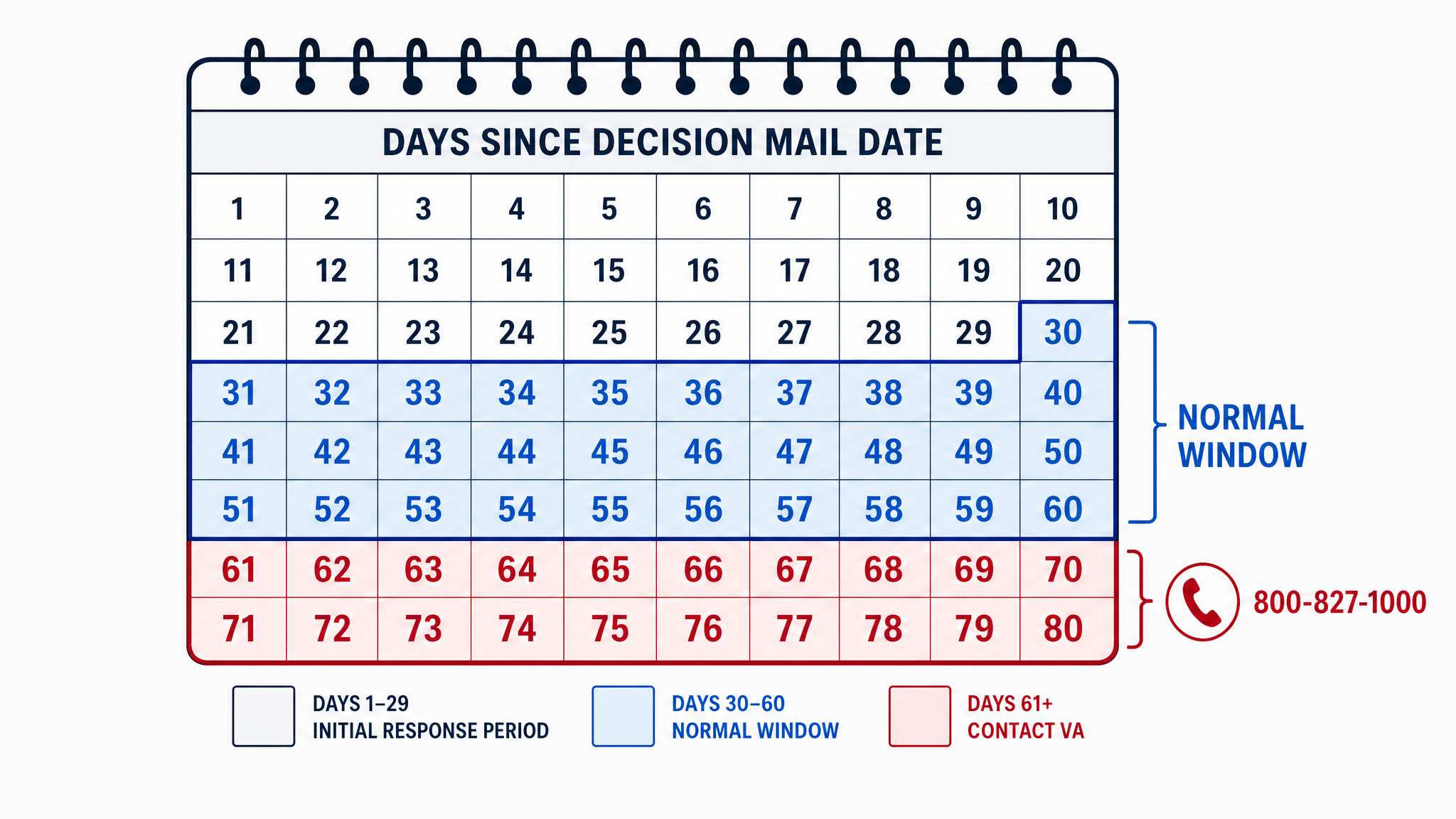
30 to 60 days is a guide, not a deadline
A complex case can take 90 days or more
Thirty to sixty days is a rough average for a simple, single-issue claim, not a hard rule and not a ceiling. A claim with several conditions, a presumptive or toxic-exposure question, a returned exam, or missing records can easily take 90 days or more, and that alone does not mean anything is wrong. Watch whether the claim is still moving, not the calendar. Only when it stalls well past what is normal for a case like yours, and no one can tell you what it is waiting on, should you stop waiting, call 800-827-1000 and ask what the claim is waiting on and who it is assigned to.
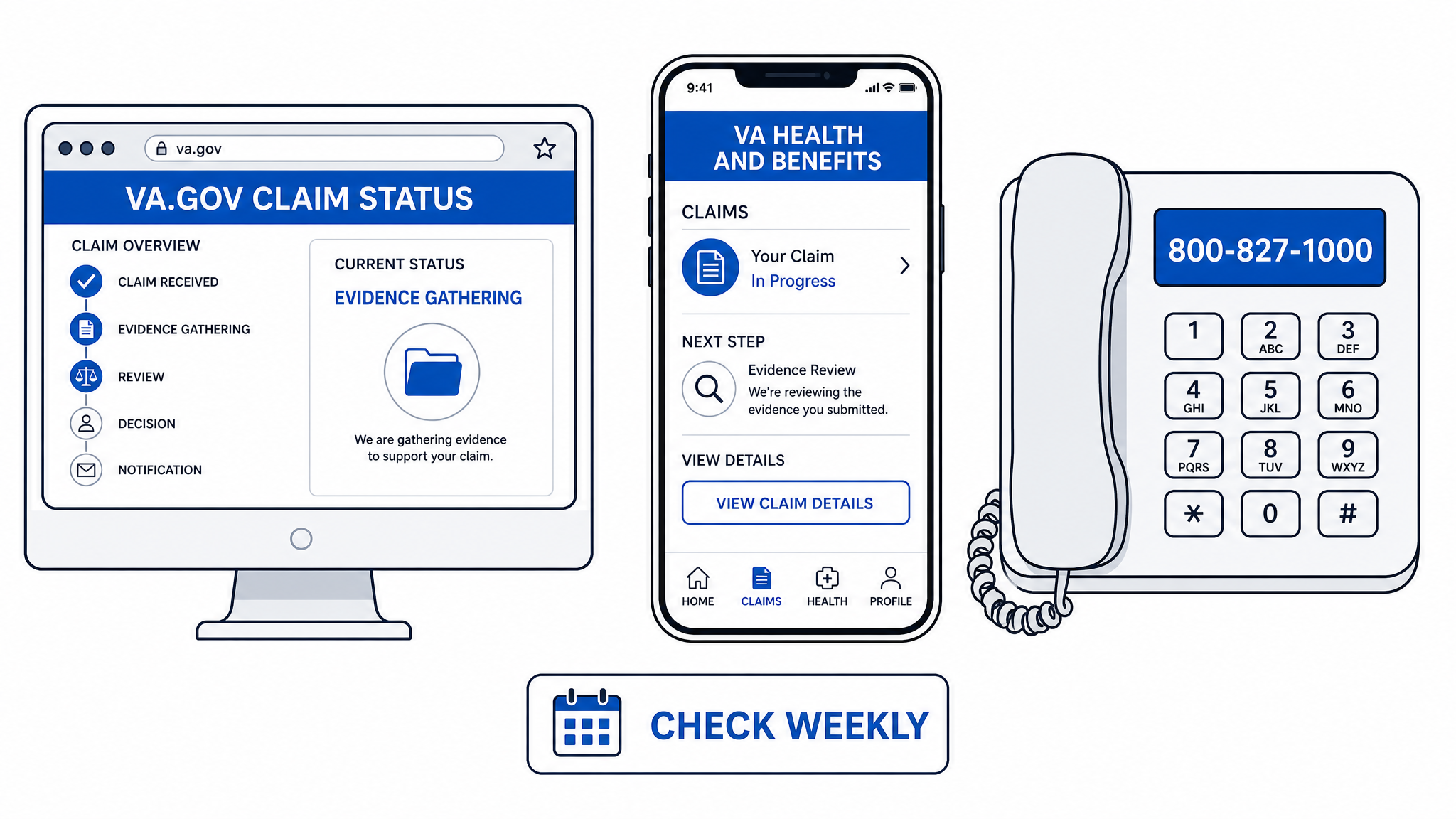
Watch your status yourself, in one of three places
Weekly, not daily
Check your own status in one of three places: your VA.gov claim status page, the VA Health and Benefits mobile app, or by calling 800-827-1000. Check it weekly, not daily. And understand exactly what a status check can tell you: if a decision is posted in your account, it is live; if it is not posted, it is not ready. That is the whole rule. This is not something your representative or your attorney can speed up, we see the same thing you see, at the same time, and calling us to ask does not move it. Calling the VA to ask for an update does not move it either. Watch it yourself, weekly, and the moment a decision posts, bring it to us.
Your decision letter arrives, read it, then start the appeal clock
What to do the day it lands in your mailbox
The decision letter is the finish line of the claim and the starting line of the appeal, and the moment it arrives, a one-year clock starts running. Read it the same day. Find the combined rating, the percentage assigned to each condition, and the effective date, because the effective date controls how far back your back pay reaches. Then request a copy of your C&P exam report so you can see whether the rater used your real range-of-motion numbers or ignored the radiculopathy. If any part of the decision is wrong, a low rating, a denied condition, or a bad effective date, you have three appeal lanes, and you must choose one within one year of the date printed on the letter: a **Higher-Level Review (VA Form 20-0996)**, where a senior reviewer re-decides on the same evidence; a **Supplemental Claim (VA Form 20-0995)**, when you have new and relevant evidence such as a private DBQ or your own range-of-motion exam; or a **Board Appeal (VA Form 10182)** to a Veterans Law Judge. Miss that one-year deadline and the decision becomes final. You can still file again later, but you lose the original effective date, and that lost time is lost back pay you never get back. Bring the letter to this office before the year runs out and we will read it with you, line by line, at no cost.
07Remedy
How to report a bad exam
Where this exam goes wrong
The characteristic failure in this exam is a report that says **"subjective numbness, right upper extremity, strength 5/5, reflexes 2+"** with no dermatome map, no circumference measurement, and no statement of severity for each arm. That report will be rated **mild** under the wholly-sensory cap and nothing more. An examination report that omits the findings the rating criteria require is **inadequate for rating purposes** under **38 CFR §4.2**, which obligates the adjudicator to return it, and that is an argument to make in writing, not a fact to accept.

Write it down the moment you get to your car
Date, start time, end time, the examiner’s name and credentials, the vendor, every test that was performed, and every test that was not. A contemporaneous note written the same day is evidence. A memory reconstructed four months later is not.
Get the exam report and the questionnaire
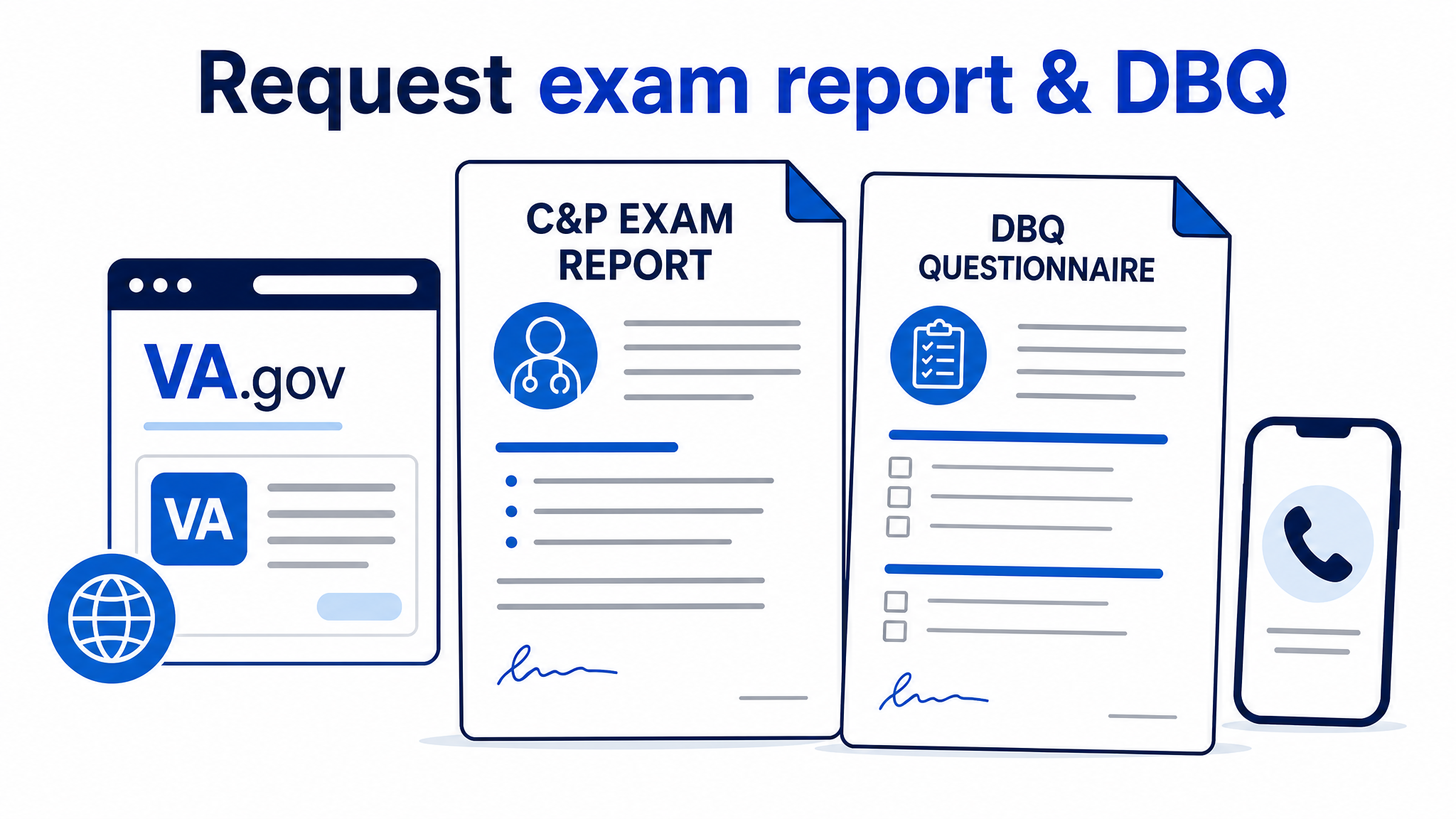
Request a copy through VA.gov, through a written request to the Regional Office, or by calling 800-827-1000. You cannot challenge what you have not read. Compare it line by line against what actually happened in the room.

Name the defect specifically, with the citation
Never write "the exam was unfair." Write "no goniometer was used, contrary to 38 CFR §4.46" or "flare-ups were reported and not addressed, contrary to Sharp v. Shulkin" or "repetitive use testing was not performed, contrary to 38 CFR §4.40 and DeLuca." A specific, citable defect is what forces action.
Submit a statement asking for a new examination
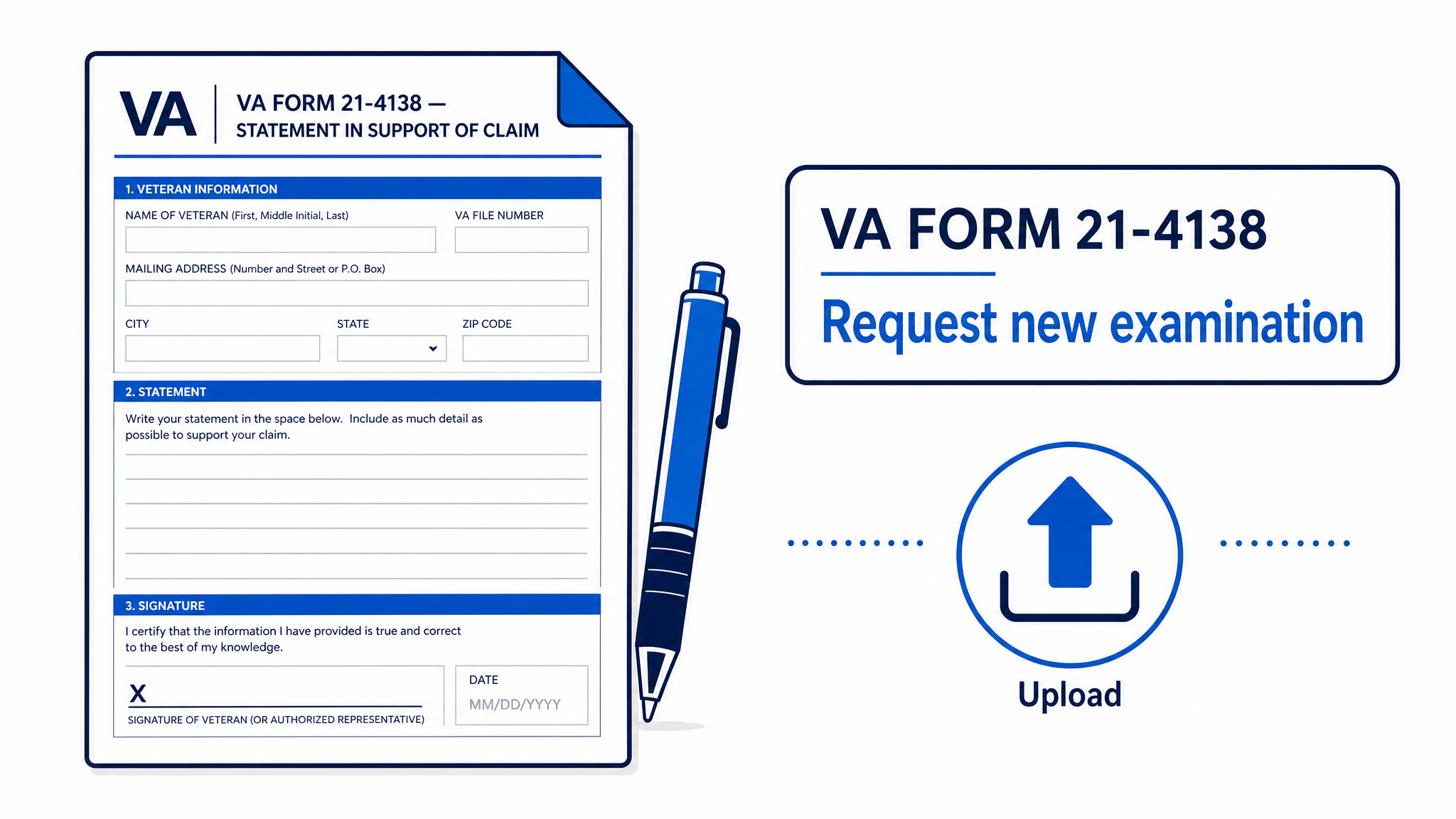
VA Form 21-4138, Statement in Support of Claim, filed through VA.gov or mailed to the Evidence Intake Center. State the defect, cite the authority, and request a new or supplemental examination. Do this BEFORE the decision if the claim is still open, it is far easier than undoing a decision afterward.
Report examiner conduct separately
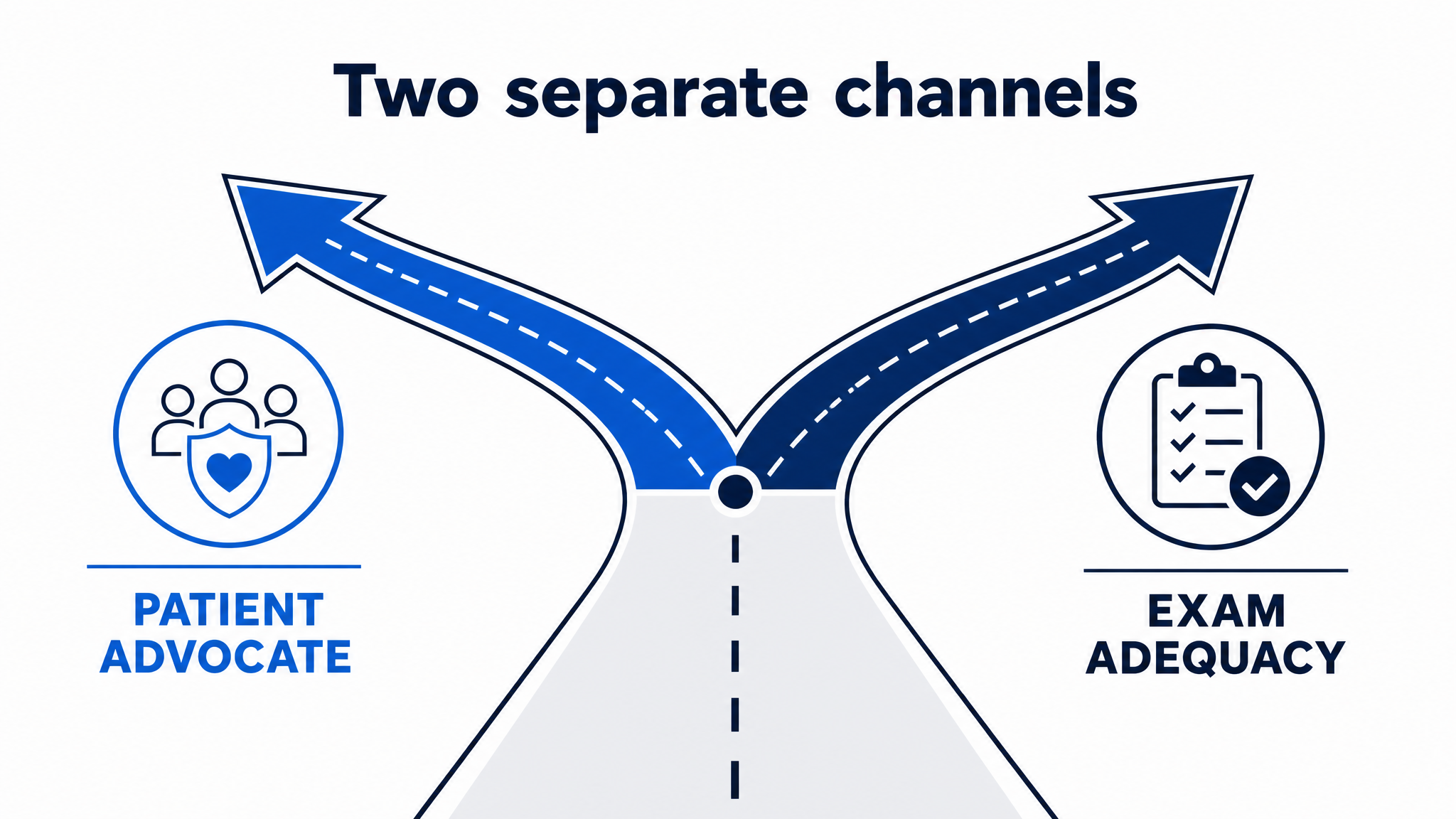
If the problem is behavior rather than methodology, you were rushed out, dismissed, never touched, or treated with hostility, file a complaint with the VA facility’s Patient Advocate, or with the vendor directly for a contract exam, and copy the Regional Office. Conduct complaints and adequacy challenges are two different tracks and you can run both.

If a decision has already issued, pick the right lane
A Higher-Level Review (VA Form 20-0996) argues the VA erred on the evidence it had, the right vehicle when the exam was inadequate on its face. A Supplemental Claim (VA Form 20-0995) is the vehicle when you are adding new and relevant evidence, such as your own private range-of-motion examination or a completed DBQ from your treating provider.
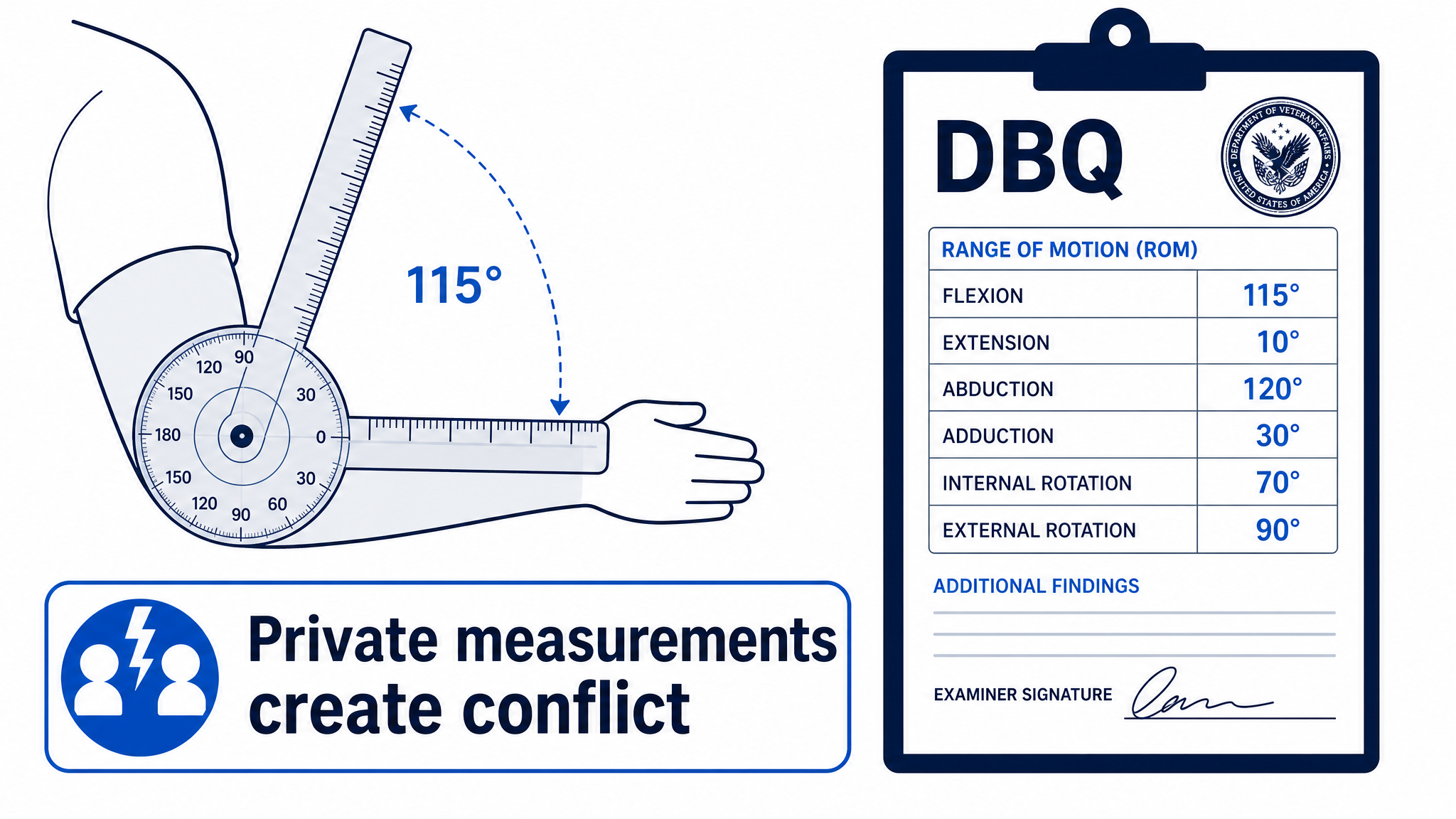
Put your own measurements on the table
A private examination with full goniometric measurements, or a DBQ completed by your own provider, creates a conflict in the evidence that the VA has to resolve, and under 38 CFR §3.102 reasonable doubt is resolved in your favor.
End of clinical section
Cervical Radiculopathy, DC 8510–8513
See It Before You Sit In The Room
Cervical Radiculopathy | "Pinched" Nerve in the Neck, Education, Exercises, Myths
E3 Rehab
Cervical Radiculopathy: Pinched Nerve in Neck Explained
Performance Place Sports Care
The Questions Veterans Actually Ask
Cervical Radiculopathy Claims, Frequently Asked Questions
Straight answers to the questions that decide cervical radiculopathy claims, the ratings, the separate evaluations, and the exam mistakes that cost veterans money. Read every answer with your own file open. If an answer depends on a record you do not have yet, that is the next thing to request, from your doctor, your unit or the VA itself.
Cervical Radiculopathy is evaluated under DC 8510–8513. The scale runs across 18 rating levels, and the highest is Note, which the VA assigns for: The wholly-sensory cap, §4.124a, preamble. "The term *incomplete paralysis* … indicates a degree of lost or impaired function substantially less than the type picture for complete paralysis given with each nerve, whether due to varied level of the nerve lesion or to partial regeneration. When the involvement is wholly sensory, the rating should be for the mild, or at most, the moderate degree.". Where your evaluation actually lands depends on how your exam and records document those criteria, not on how bad the condition feels on an average day.
Every condition in Radiculopathy