Respiratory & Sleep
Sinusitis & Rhinitis
Chronic sinus and nasal conditions rated under §4.97
Chronic sinusitis is rated under Codes 6510–6514 on the number of incapacitating and non-incapacitating episodes per year, while allergic rhinitis (Code 6522) turns on nasal obstruction and polyps. Both are common after burn-pit and airborne-hazard exposure and are PACT Act presumptives.
Each Condition, Broken Out
Every Condition In This Category Has Its Own Page
These are separate diagnostic codes with separate criteria, separate exams and separate money. Each one below opens a full page: how it is rated, the schedule spelled out, the service-connection arguments, and exactly what happens at that specific C&P exam.
DC 6510-6514
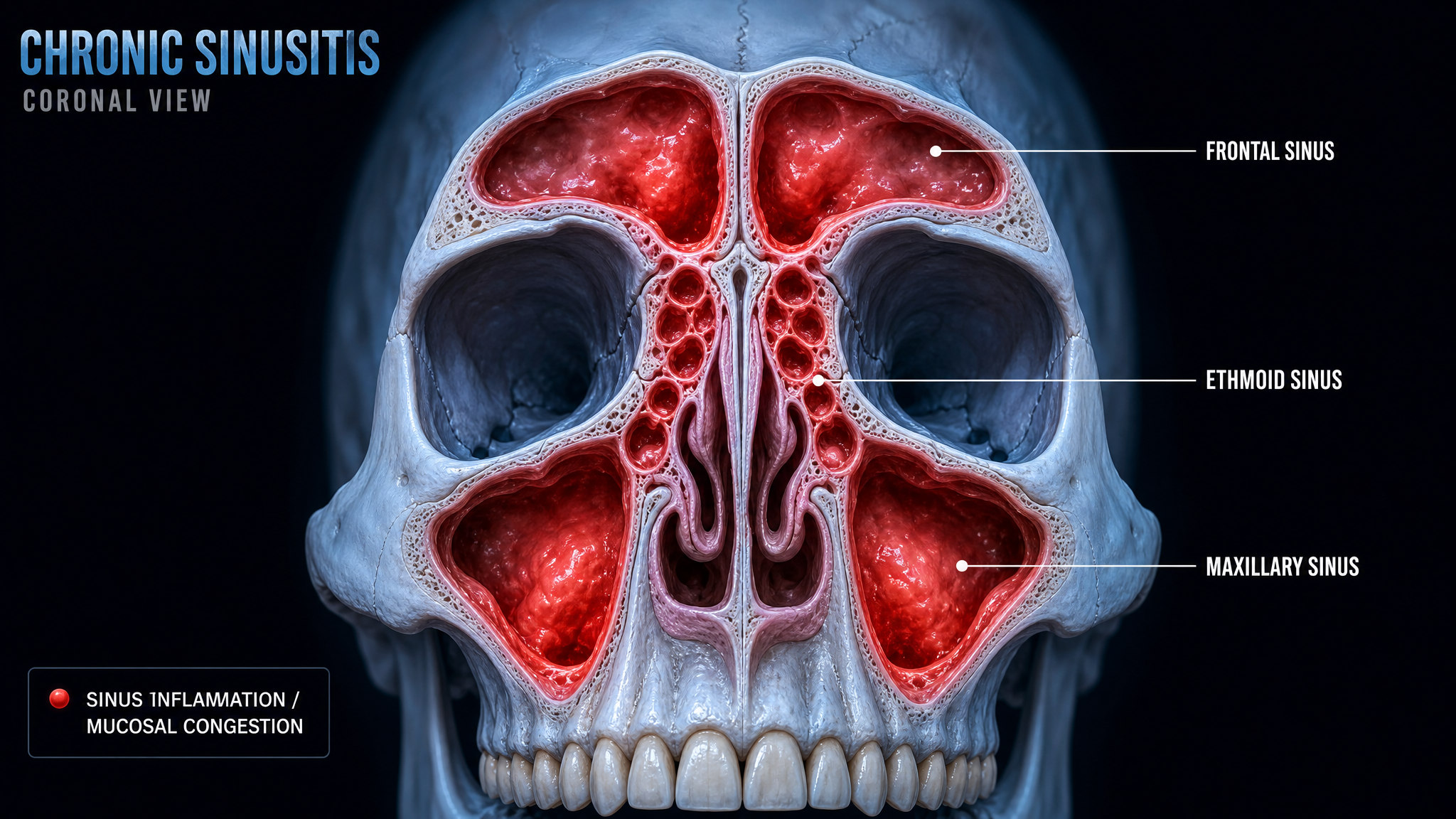
Chronic Sinusitis
Sinus infections that keep coming back, congestion, facial pain, headaches and drainage that never fully clear.
Read the full Chronic Sinusitis (DC 6510–6514) page
DC 6522
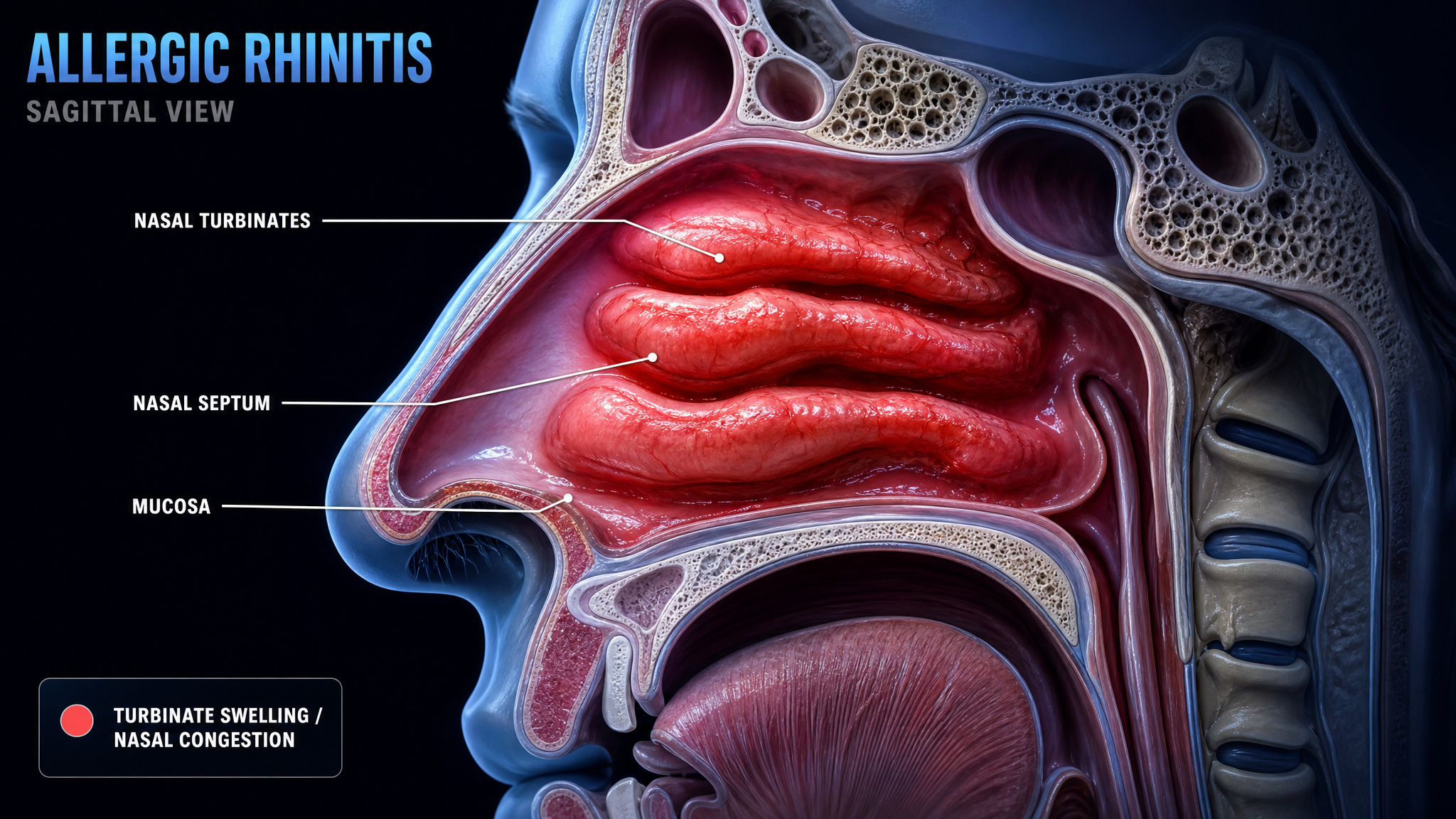
Allergic & Chronic Rhinitis
A constantly blocked, runny nose that makes it hard to breathe freely no matter the season.
Read the full Allergic & Chronic Rhinitis (DC 6522) page
What Sinusitis & Rhinitis Really Is
Chronic sinus disease is dismissed as allergies. In reality it means pressure behind your face most of the year, headaches, drainage, broken sleep, and repeated courses of antibiotics. The VA rates sinusitis and rhinitis on very specific counted events, and once you know what is being counted the claim becomes straightforward.

What it actually means
Chronic sinus disease is dismissed as allergies. In reality it means pressure behind your face most of the year, headaches, drainage, broken sleep, and repeated courses of antibiotics. The VA rates sinusitis and rhinitis on very specific counted events, and once you know what is being counted the claim becomes straightforward.

What the VA measures
Sinusitis under codes 6510 through 6514 is rated on the number of incapacitating episodes per year requiring prolonged antibiotic treatment, or on non-incapacitating episodes characterized by headaches, pain, and purulent discharge or crusting, with 50 percent following radical surgery with chronic osteomyelitis or near constant sinusitis. Allergic rhinitis under code 6522 turns on whether there are polyps and on the degree of nasal obstruction.

Why claims get missed
The criteria count episodes, and an incapacitating episode is defined as one requiring bed rest and treatment by a physician. Veterans have six sinus infections a year and no record shows the count in those terms. For rhinitis, the presence of polyps and the percentage of nasal passage obstruction are the entire rating, and a rhinoscopy note stating obstruction of both nasal passages settles it.
What in Your Service Causes Sinusitis & Rhinitis
Service connection is not a feeling, it is a chain of evidence. These are the pathways the VA already recognises. Find yours, then make sure your file says it out loud.
Burn pits and airborne hazards
Chronic sinusitis and chronic rhinitis are both presumptive conditions under the PACT Act for veterans with qualifying service. No exposure proof required.
Dust, sand, and particulate exposure
Sustained exposure in desert and austere environments produces permanent mucosal damage.
Documented in-service infections
Repeated sick call visits for sinus infection during service support direct service connection for the chronic disease.
Facial or nasal trauma
A broken nose or facial fracture creates the deviation and obstruction that leads to chronic sinus disease.
Sinusitis Is Rated by Counting Episodes
Chronic sinusitis is evaluated under the General Rating Formula for Sinusitis (Codes 6510–6514) on how many episodes you have per year. Non-incapacitating episodes involve headaches, pain, and purulent discharge; incapacitating episodes require bed rest and treatment prescribed by a physician, typically with prolonged antibiotics. Higher ratings require more frequent episodes, or radical surgery with chronic residuals. Keeping a record of every infection and its treatment is the difference between a low and a full rating.

Rhinitis and the Burn-Pit Connection
Allergic and vasomotor rhinitis (Code 6522) is rated on the degree of nasal obstruction and whether polyps are present. Both sinusitis and rhinitis are increasingly tied to burn-pit and airborne-hazard exposure, and under the PACT Act these chronic respiratory conditions can be presumptive for veterans who served in qualifying locations, meaning the exposure connection is presumed rather than something you must prove.

What to Document
Sinusitis is rated under §4.97 on how many episodes you have each year and how they were treated, so the rater is counting. If an episode is not in your records, it did not happen as far as the VA is concerned. Keep a dated log of every flare, every antibiotic course, and every doctor visit, and make sure your provider writes the episode down. Here is what needs to be on paper.

Number of incapacitating vs. non-incapacitating episodes per year

Antibiotic courses and physician-directed treatment

Nasal obstruction percentage and polyps (rhinitis)

Burn-pit / airborne-hazard exposure for PACT Act
Establishing Service Connection
To establish service connection for a condition, veterans must meet three criteria. First, there must be a current diagnosis. Second, there must be evidence of an in-service event or exposure that could have caused or aggravated it, including airborne hazards, burn pits, or a service-connected condition. Third, a nexus, a medical link, must connect the in-service event to the current condition.

Current diagnosis of the condition

In-service event, exposure, or a service-connected primary condition

Medical nexus linking the condition to service ("at least as likely as not")

Diagnostic testing (e.g., sleep study or nasal/sinus evaluation)

Records documenting symptom frequency and treatment
Why Work With an Accredited Advocate
Veterans should seek the assistance of an Accredited VA Disability Advocate because we guide you through the complex claims process and ensure all necessary evidence is gathered and presented effectively. Our advocates are trained to identify and link service-related conditions, increasing the likelihood of a successful claim. We also provide personalized representation, helping veterans navigate appeals and secure the benefits they deserve. As a VA-Accredited Claims Agent, our fees are regulated under 38 CFR §14.636, and there are no fees unless we win your appeal.

The Rating Schedule, Spelled Out
Sinusitis and rhinitis are rated under 38 CFR §4.97. Chronic sinusitis (Diagnostic Codes 6510–6514) is rated on the General Rating Formula for Sinusitis, driven by incapacitating and non-incapacitating episodes; allergic and vasomotor rhinitis (Diagnostic Code 6522) is rated on nasal obstruction and polyps.
Detected by imaging only.
One or two incapacitating episodes per year requiring prolonged (4 to 6 weeks) antibiotic treatment, or three to six non-incapacitating episodes per year characterized by headaches, pain and purulent discharge or crusting.
Three or more incapacitating episodes per year requiring prolonged antibiotic treatment, or more than six non-incapacitating episodes per year with headaches, pain and purulent discharge or crusting.
Following radical surgery with chronic osteomyelitis, or near-constant sinusitis with headaches, pain and tenderness of the affected sinus, and purulent discharge or crusting after repeated surgeries.
Without polyps, but with greater than 50 percent obstruction of the nasal passage on both sides, or complete obstruction on one side.
With polyps.
Key Points to Remember
These are the rules the rating board applies to this condition, stripped down to what you can act on. Read each one and ask a single question: does my file prove it? If the answer is no, that is your homework, not the VA's. The VA has a duty to assist under 38 CFR 3.159, but it has no duty to build your argument for you.

Sinusitis is rated under 38 CFR §4.97 (DC 6510–6514) on incapacitating and non-incapacitating episodes
Allergic rhinitis is rated under DC 6522 based on nasal obstruction and polyps

Document the frequency of episodes and any antibiotic-treated infections

Often linked to airborne-hazard and burn-pit exposure under the PACT Act
What to Expect at Your Sinusitis and Rhinitis C&P Examination
Sinusitis under 38 CFR §4.97 is rated on a count, not on a symptom description. The criteria are the number of non-incapacitating episodes per year characterized by headaches, pain and purulent discharge or crusting, and the number of incapacitating episodes per year requiring prolonged antibiotic treatment of four to six weeks. Rhinitis under Diagnostic Code 6522 is rated on obstruction percentages and on the presence of polyps. Bring the count.

A record of how many non-incapacitating episodes you had in the past 12 months, with dates, three to six per year is the 10% criterion and more than six supports 30%.

A record of incapacitating episodes requiring prolonged antibiotic treatment of four to six weeks, which drive the higher evaluations.

Your antibiotic history from the pharmacy record, which is the objective proof of both counts.

For rhinitis, measurement of nasal obstruction as a percentage on each side, since greater than 50% obstruction of both passages or complete obstruction on one side is the 10% criterion.

Examination for nasal polyps, which carry 30% under Diagnostic Code 6522 regardless of obstruction.

CT imaging of the sinuses and any surgical history, including radical surgery with chronic osteomyelitis or repeated surgeries, which support the 50% level.

Exposure history, burn pits, sand and dust, chemicals and airborne hazards, and a nexus opinion tying the chronic condition to it.
What Happens Once the C&P Exam Is Complete
The examiner compiles a detailed report, your medical history, physical findings, and diagnostic results, and assesses the severity, symptoms, and impact of your condition. That report is sent to the VA Regional Office handling your claim and becomes part of your official file, reviewed alongside your other evidence.
The VA may send the report back for corrections, clarification, or a second opinion if it finds it incomplete or unclear. This can delay your claim, because the VA requires thorough and accurate information to decide. Your claim only moves to the decision phase once the VA is satisfied with the evidence, which is exactly why the quality of the file we build for you matters so much. Once decided, your effective date controls how far back your back pay reaches, and any denial can be challenged through a Supplemental Claim, Higher-Level Review, or Board appeal.

The Advocate’s Take
If you have been fighting sinus infections since the burn pits, that is not a nuisance, it is a countable, ratable condition, and under the PACT Act the exposure link may already be presumed.
Every Level the VA Can Assign You
These percentages come straight out of the rating schedule that governs sinusitis & rhinitis, Diagnostic Code 6510–6514. Read them slowly. If your current rating does not match what your records actually show, that gap is exactly what an appeal exists to correct.
0%
Detected by imaging only.
10%
One or two incapacitating episodes per year requiring prolonged (4 to 6 weeks) antibiotic treatment, or three to six non-incapacitating episodes per year characterized by headaches, pain a…
30%
Three or more incapacitating episodes per year requiring prolonged antibiotic treatment, or more than six non-incapacitating episodes per year with headaches, pain and purulent discharge o…
50%
Following radical surgery with chronic osteomyelitis, or near-constant sinusitis with headaches, pain and tenderness of the affected sinus, and purulent discharge or crusting after repeate…
Secondary Claims, Both Directions
Under 38 CFR §3.310, a condition caused or made worse by an already service-connected condition is itself service connected. That runs in both directions, and it is the single largest pool of unclaimed compensation in the system.
What can cause sinusitis & rhinitis
If one of these is already service connected, this condition can be claimed as secondary to it.
GERD
Refluxed acid reaching the upper airway causes chronic inflammation of the sinuses and throat.
Deviated septum or facial trauma
Mechanical obstruction produces chronic infection.
Immunosuppressive medication
Treatment for another service-connected condition increases infection frequency.
What sinusitis & rhinitis can cause
If this condition is already service connected, each of these is a separate claim you may be owed.
Headaches, including migraine
Sinus disease is a documented headache generator, and headaches are rated separately.
Sleep apnea and sleep disturbance
Nasal obstruction is a recognized contributor to airway collapse and fragmented sleep.
Asthma and lower airway disease
The unified airway means upper airway inflammation drives lower airway disease.
Depression and fatigue
Years of pressure, drainage, and lost sleep have downstream effects.
A secondary claim still needs two things: a current diagnosis of the secondary condition, and a medical opinion saying it is at least as likely as not caused or aggravated by the service-connected condition. You do not have to prove it happened in service.
Building a Sinusitis & Rhinitis Claim That Wins
Every claim stands on three legs. Knock one out and the claim falls over, no matter how bad your symptoms are. Before you file, look at your file and find all three.
 01
01A current diagnosis
A doctor has to say you have it, now, in writing. Not "reports symptoms of", a diagnosis. Without this leg, nothing else in the file matters.
 02
02A link to your service
An event, an injury, an exposure, or an already service-connected condition. Service records, unit records, buddy statements, and your own account all count as evidence.
 03
03A nexus that ties the two together
A medical opinion stating it is at least as likely as not that your service caused or aggravated the condition. That phrase is a legal standard: 50 percent or better. It is the leg most denials break.
Document the problem before you file
• Keep a dated symptom log for at least 30 days. Frequency, severity, and what it stopped you from doing.
• Get statements from people who see it, a spouse, a coworker, a battle buddy. Lay evidence is legal evidence.
• Pull your private treatment records. The VA only has to help; it does not have to go find everything.
• Write down what you have stopped doing. Lost work, lost sleep, lost activities. That is what impairment looks like on paper.
Your Rights in This Process
Most veterans walk into this system without knowing the rules the VA itself has to follow. That is how claims get denied for missing evidence the VA was supposed to help you find, and how exams get done by the wrong clinician. These six rights are written into federal regulation. Know them before you file, and make the VA honor every one of them when it decides your claim.

It costs nothing to file
Filing a VA claim is free. Accredited representatives may only charge for work on an appeal after an initial decision, and those fees are capped by 38 CFR §14.636.

The VA has a Duty to Assist you
Under 38 CFR §3.159 the VA must help you get the evidence it needs, and it must tell you what is missing before it denies you for missing it.

You can ask for a different examiner
You may request a trauma-informed clinician, or a clinician of a specific gender, for a C&P examination. Ask before the exam is scheduled.

You can claim every condition you have
There is no limit and no penalty. Primary conditions, secondary conditions, and conditions made worse by service all get filed.

You can appeal and be re-evaluated
A denial is not the end. You may submit new evidence, request a higher-level review, appeal to the Board, and ask for re-evaluation when your condition worsens.

You must be considered for TDIU
If your service-connected conditions keep you from holding substantially gainful employment, you may be paid at the 100 percent rate without a 100 percent rating.
Questions Veterans Ask About Sinusitis & Rhinitis Claims
What counts as an incapacitating episode?
The regulation defines it as one requiring bed rest and treatment by a physician. If you have been down for days with a sinus infection, your record needs to say bed rest and it needs to say prescribed antibiotics, with dates.
Do I have to prove burn pit exposure?
No. Chronic sinusitis and chronic rhinitis are on the PACT Act presumptive list. Qualifying service dates and locations plus the diagnosis are what you need.
Why did my rhinitis get zero percent?
Probably because nobody documented the obstruction percentage or the presence of polyps. Those two facts are the entire rating for code 6522. A rhinoscopy note describing greater than 50 percent obstruction on both sides, or complete obstruction on one side, is what supports the compensable level.
When You Are Ready to File
Talk to an accredited representative before you file. It costs nothing to ask, and the order you file in changes what the VA is allowed to award you. Albert L. Thombs Jr. is VA-Accredited Claims Agent #45147.
The application itself
This is the form that opens a disability compensation claim. List every condition you are claiming, and name the secondary conditions explicitly.
Release for private records
Authorises the VA to request records from your private doctors. Without it, treatment outside the VA may never reach your file.
Lay or buddy statement
The official form for your own statement and for statements from people who witnessed the event or the change in you.
What This Rating Is Worth (2026)
| 10% | $180.42/mo |
| 20% | $356.66/mo |
| 30% | $552.47/mo |
| 40% | $795.84/mo |
| 50% | $1,132.90/mo |
| 60% | $1,435.02/mo |
| 70% | $1,808.45/mo |
| 80% | $2,102.15/mo |
| 90% | $2,362.30/mo |
| 100% | $3,938.58/mo |
Rates shown are the veteran-alone amounts effective December 1, 2025. A spouse, children, or dependent parents increase your payment at 30% and above. Every 10% you are under-rated can cost you thousands of dollars a year for the rest of your life.
Estimate Your Exact Pay Veteran Representation
Your VA Claim Exam: What to Expect
This official VBA video walks you through the entire C&P exam process. Understanding what happens in that room is the difference between a rating that reflects your true condition and one that undervalues you.
 Veteran Representation
What It Takes to Win These Benefits
Winning is not about how bad the condition is. It is about what your file proves. The rating board checks three things, and if one is missing the claim stalls no matter how much you hurt. Line up the evidence below before you file, not after the denial. The VA must help you gather records, but you are the one who knows where they are.
The Three-Part Test
Service connection under 38 CFR §3.303 requires all three:
- 1A current, diagnosed disability
- 2An in-service event, injury, or exposure
- 3A medical nexus linking the two
 Veteran Representation
The medical evidence the VA is actually looking for:
VA Claim Exams: Respiratory, Cardiology, Ear/Nose/Throat
This exam is specific to your body system. The examiner uses a specialized DBQ for this category of conditions, and the tests they perform determine your exact rating level. Watch this before your appointment.
What to Expect at Your C&P Exam
Your Compensation & Pension (C&P) exam is not treatment. It is a rating tool. The examiner will not fix anything, they complete a Disability Benefits Questionnaire (DBQ) and check the boxes that decide your rating. What happens in that room can move your rating an entire level, so walk in prepared.
 Veteran Representation
The Forms You File, We Prepare Them For You
These are the forms that drive this claim. Start any of them on our site and an accredited agent prepares and files it for you, correctly, the first time.
Application for Disability Compensation
The core application that opens or reopens your claim.
Start this with usStatement in Support of Claim
Your own account and buddy/lay statements that fill the gaps in your record.
Start this with usAppoint Us as Your Representative
Authorizes our accredited agent to act on your behalf with the VA.
Start this with usUnemployability (TDIU) Application
Claims 100% pay when your conditions keep you from working, even below 100%.
Start this with usDisability Benefits Questionnaire
The exam form that captures the severity criteria for this specific condition.
Start this with usSMC & TDIU, When Your Rating Isn't the Whole Story
TDIU, Paid at 100% Without a 100% Rating
Total Disability based on Individual Unemployability (38 CFR §4.16) pays you at the 100% rate when your service-connected conditions prevent substantially gainful employment, even if your combined rating is lower. You may qualify if:
- One condition is rated 60% or higher, or
- Two+ conditions combine to 70% with at least one rated 40%, and
- Those conditions keep you from holding steady, gainful work.
- Cannot meet the numbers? Extraschedular TDIU under §4.16(b) may still apply.
Special Monthly Compensation (SMC)
SMC (38 CFR §3.350) pays above the normal schedule for especially serious losses, loss or loss of use of a body part, being housebound, or needing the aid and attendance of another person. Common levels:
- SMC-K, Loss / loss of use, Add-on for loss or loss of use of a specific body part (hand, foot, eye, reproductive organ, or certain other losses). Paid on top of your regular compensation. Can stack (up to the statutory cap).
- SMC-S, Housebound, Statutory housebound: a single 100% disability plus additional disabilities of 60%+, or substantially confined to your home. Veteran-alone rate shown.
- SMC-L, Aid & Attendance, You need the regular aid and attendance of another person, or have anatomical loss/loss of use of both feet, one hand and one foot, blindness, or are permanently bedridden. Veteran-alone rate shown.
- SMC-M, Higher Aid & Attendance, A higher level of aid and attendance (e.g., loss of use of both hands, or loss of use of both legs at a higher level). Veteran-alone rate shown.
These are the benefits veterans most often leave on the table because no one told them they qualified. If any of this sounds like your situation, call an accredited agent at 702-992-4883, we screen for SMC and TDIU on every case.
Keep Reading
One page never tells the whole story of a claim. The VA rates every condition on its own evidence, its own exam and its own diagnostic code, and the pieces connect in ways most veterans never see until a decision letter lands. These are the pages that pick up where this one stops. Read them before you file, not after a denial, because the cheapest fix in this process is the mistake you never make.