

Other Programs
Additional VA Benefits
Education, home loans, vocational rehab, and other programs you earned
Beyond monthly compensation, service-connected veterans may qualify for education, home-loan, vocational rehabilitation, and adaptive-equipment programs. Each program has its own application and its own rules, and none of them start automatically when you get a rating. Your part is to read the programs below, match them to your rating and your goals, and apply for each one separately while keeping copies of every application and letter.
The Programs Beyond the Check
A service-connected rating can open doors well beyond monthly compensation. These programs are administered separately by different offices, each has its own form, and none of them are triggered automatically by your rating decision. If you do not apply, nothing happens.
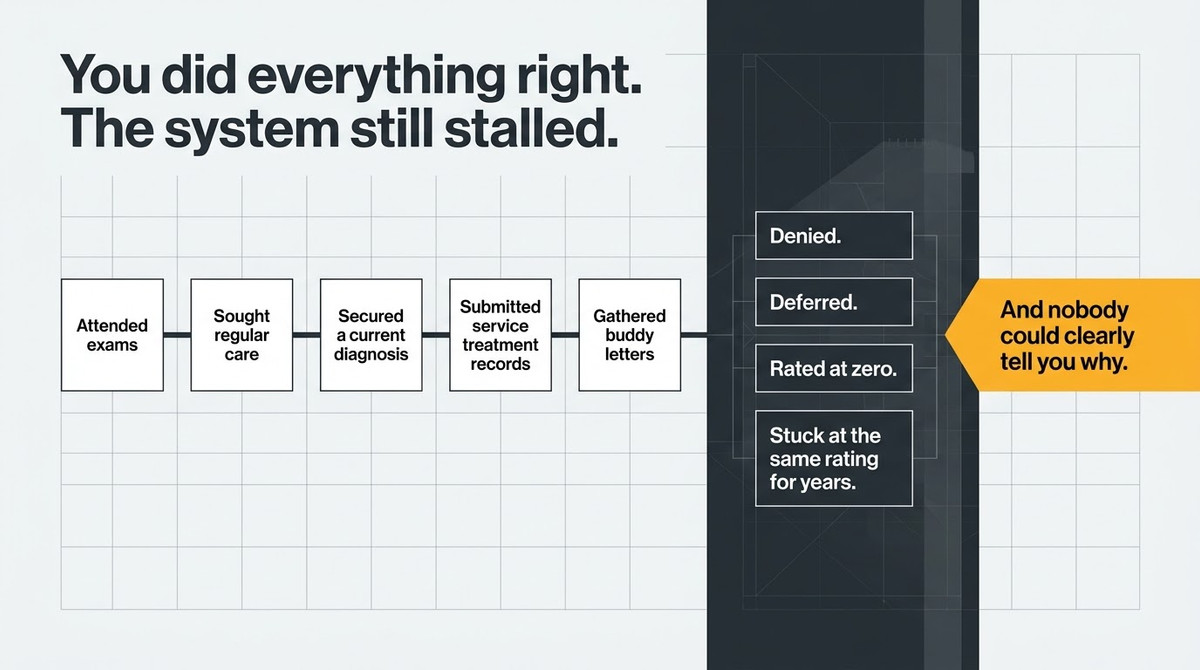
Programs Worth Investigating

Veteran Readiness and Employment, Chapter 31
Tuition, training, and employment services for veterans with a service-connected rating and an employment handicap. Generally requires at least a 10% rating (or 20% for some entitlement paths). Often more generous than the GI Bill, and it can be used after it. VA Form 28-1900.

VA home loan guaranty and funding-fee waiver
Veterans receiving compensation for a service-connected disability are generally exempt from the funding fee, commonly thousands of dollars on a single purchase. If you closed a VA loan before your rating was granted and the effective date precedes the closing, you may be entitled to a refund of the fee you paid.

Automobile allowance and adaptive equipment
A one-time grant toward a vehicle under §3.808 for qualifying loss of use of a hand or foot, permanent vision impairment, or (for adaptive equipment only) severe ankylosis of the knees or hips. VA Forms 21-4502 and 10-1394.
Annual clothing allowance
Under §3.810, an annual payment where a prosthetic or orthopedic appliance, or a prescribed skin medication, wears out or stains your clothing. Payable per qualifying item. VA Form 10-8678, with an August 1 deadline each year.

Specially Adapted Housing / Special Home Adaptation
Grants under §3.809 to build, buy, or modify an accessible home for qualifying permanent and total disabilities. VA Form 26-4555.

Chapter 35 Dependents’ Educational Assistance
Education benefits for the spouse and children of a veteran rated permanently and totally disabled, or who died of a service-connected condition. VA Form 22-5490.

Program of Comprehensive Assistance for Family Caregivers
A stipend and support services for the primary caregiver of a veteran with a serious service-connected injury who needs personal care services. VA Form 10-10CG.
Housing Grants Are Not Loans: SAH, SHA and the Family Home
Veterans hear "VA housing help" and picture the home loan, the one you pay back. This is different. The adapted housing grants under 38 U.S.C. Chapter 21 and 38 CFR 3.809 and 3.809a are money you never repay, and they stack on top of a VA loan. You can buy the house with the loan and adapt it with the grant.
The Specially Adapted Housing (SAH) grant pays up to $126,526 for fiscal year 2026. It covers the most serious service-connected losses: the loss or loss of use of more than one limb, the loss or loss of use of a lower leg together with the residuals of an organic disease or injury, blindness in both eyes at 20/200 or worse, certain severe burns, or the loss or loss of use of one lower extremity after September 11, 2001 that leaves you unable to balance or walk without braces, crutches, canes or a wheelchair. You must own, or will own, the home.
The Special Home Adaptation (SHA) grant pays up to $25,350 for fiscal year 2026 for the loss or loss of use of both hands, certain severe burns, or certain respiratory or breathing injuries. For SHA, the home can be owned by you or by a family member.
Here is the trap. Congress caps the post-9/11 single-extremity path at 120 grants a fiscal year. If you qualify after the cap is hit, you are not denied. You wait for the next fiscal year, which starts October 1. Get the application in so you are in line.
You do not have to spend it all at once. You can draw on the grant up to 6 times over your lifetime, up to the cap. And if you are living in a family member's home, the Temporary Residence Adaptation (TRA) grant can adapt that house too: up to $50,961 if you qualify for SAH, or $9,100 if you qualify for SHA. You do not have to own that house.
Your part: apply on VA Form 26-4555 as soon as the qualifying rating is granted, and bring me your rating decision if the loss of use was never rated. A grant that depends on a rating you do not have yet starts with fixing the rating.

HISA: The Ramp and Roll-In Shower Grant Most Veterans Qualify For
Most veterans never meet the SAH or SHA rules. That does not end the conversation. The Home Improvements and Structural Alterations (HISA) benefit, run through the VA medical center's Prosthetic and Sensory Aids Service, pays for medically necessary changes to your home: permanent ramps, roll-in showers, wider doorways, lowered counters and sinks, and the plumbing or electrical work that home medical equipment needs.
It is a lifetime benefit. You can get up to $6,800 to address a service-connected disability, or a non-service-connected disability if you also have a single service-connected disability rated at 50% or more. The VA will not combine percentages to reach that 50%. For any other disability, the lifetime limit is $2,000.
HISA runs on a prescription, not a claim. A VA physician writes or approves it, describing the project and why you need it medically. Then you file VA Form 10-0103 with an itemized contractor estimate and a color photo of the area to be changed. If you rent, the owner must sign a notarized statement allowing the work.
Here is the trap. HISA will not pay for portable ramps, porch lifts, stair glides, hot tubs, exterior decking, new construction or routine repairs like a roof or furnace. Families buy a stair glide, send in the receipt and get nothing. Get the prescription and the approval before the contractor starts.
Your part: tell your VA primary care provider exactly what in the house is hurting you, the tub you cannot step over, the steps you cannot climb, and ask for a HISA referral in those words. Keep a copy of the prescription and the estimate.

The Car Allowance and the Equipment Grant: Approval Comes Before the Purchase
There are two separate benefits here under 38 U.S.C. Chapter 39 and 38 CFR 3.808, and veterans mix them up constantly. The automobile allowance is a payment toward buying a specially equipped vehicle, up to $27,908.90 effective October 1, 2026. The adaptive-equipment grant pays for the modifications themselves: power steering, power brakes, special seats and windows, and lift equipment to get in and out.
You may qualify if a service-connected disability, or one treated as service-connected under 38 U.S.C. 1151, involves the loss or permanent loss of use of one or both hands or feet, vision of 20/200 or worse in the better eye with glasses (or a visual field of 20 degrees or less), a severe burn injury, or ALS. Ankylosis of one or both knees or hips qualifies you for the equipment grant only, not the allowance.
Loss of use is not the same as amputation. A hand or foot that no longer does its job can qualify the same as one that is gone. If your rating decision never called it loss of use, that is the first fight, and it often opens Special Monthly Compensation at the same time.
Here is the trap. You must file and get approval before you buy. The VA will not reimburse a vehicle or equipment you already purchased on your own. Before you sign anything, make sure the seller agrees to send the VA the completed claim form and an itemized invoice.
Your part: file VA Form 21-4502 for the allowance, and take VA Form 10-1394 for adaptive equipment to the prosthetic representative at your VA medical center. Do not set foot on a dealer's lot until the approval is in your hand.

The Clothing Allowance: Small Check, Every Year, Easy to Miss
If a brace, prosthetic or wheelchair you use for a service-connected condition is wearing holes in your clothes, or a skin medicine prescribed for one stains your shirts and pants beyond repair, 38 CFR 3.810 says the VA pays you for it. The rate effective December 1, 2025 is $1,053.19 per allowance.
It is per allowance, not per veteran. You can be paid more than one if you have more than one device, more than one skin medicine, or a device or medicine that damages more than one type of clothing. A knee brace that shreds trousers and a back brace that wears through shirts are two different problems. List every one.
Here is the trap. The VA holds every application until the August 1 closing date each year and pays between September 1 and October 31. Miss August 1 and that year is gone. Applying in September does not get you this year's check.
Your part: write down each device or prescribed skin medicine and the clothing it ruins, then apply online, by mail on VA Form 10-8678, or through your VA medical center. If a new device or medicine is added later, apply for the additional allowance before the next August 1.

No Veteran Should Sleep in a Car: The VA Homeless Programs and the Door Most Veterans Miss
I have sat across the table from veterans who were living in their truck and still thought the VA had nothing for them. That is wrong. The VA runs a whole set of homeless programs under chapter 20 of title 38, and you do not need a disability rating to use them. Housing is a health care issue to the VA, so the help runs through the medical centers, not the claims office.
The law is broad on purpose. 38 U.S.C. §2002(a) uses the federal McKinney-Vento definition of homeless, which covers more than sleeping outside. It reaches a veteran in a shelter, in a motel paid for by someone else, doubled up because he lost his place, or about to lose his housing with nowhere to go. The VA also follows the Housing First approach. You get a roof first, and the treatment, the job help and the paperwork come after, not as a test you have to pass to get indoors.
The front door is simple. Every VA medical center has a homeless program coordinator, and the VA runs a National Call Center for Homeless Veterans that is staffed around the clock. You do not have to be enrolled in VA health care before you ask. Asking is what starts the enrollment.
Here is the trap: the veteran with bad paper or a short enlistment assumes he is shut out, so he never asks. Read 38 U.S.C. §2002(b). For these homeless programs, a veteran qualifies regardless of length of service. The only discharges that bar the door are a dishonorable discharge or a discharge from a general court-martial. An other than honorable discharge does not, by itself, keep you out.
Your part: walk into the nearest VA medical center and ask for the homeless program coordinator by title. Do not let the front desk send you to the claims line. Say the words "I am a veteran and I am homeless" or "I am about to lose my housing," and make them write it down.

Keys, Rent, and a Bridge: The Four Programs That Move Veterans Indoors
Once you are in the door, the coordinator matches you to a program. These are the four I see change lives most often. They work for different situations, so know which one fits yours before you sit down, and ask for it by name.
Here is the trap: veterans wait until the eviction notice is taped to the door. By then the cheapest fix is gone. SSVF homelessness prevention exists to pay the gap before you lose the home. The day you fall behind on rent is the day to ask, not the day the sheriff shows up.
Your part: bring your lease, any late notice or eviction paper, proof of income and your DD-214 if you have it. Missing papers do not stop the process, but having them speeds it up.

HUD-VASH: A Voucher Plus a Case Manager
HUD-VASH pairs a HUD housing voucher with VA case management. The referral comes from the VA medical center, and housing agencies cannot hold a VASH veteran on a waiting list. Under HUD rules updated in 2024, service-connected disability compensation is not counted when deciding if you qualify, so your rating does not price you out. It is still counted when your rent share is figured, so do not be surprised by that. Your part: ask the coordinator for a HUD-VASH referral by name.

SSVF: Rent, Deposits and Utilities Before You Lose It
Supportive Services for Veteran Families runs under 38 U.S.C. §2044 and 38 CFR Part 62. Local nonprofit grantees deliver it to very low-income veteran families, measured as a percent of area median income. It covers rapid re-housing if you already lost your place and homelessness prevention if you are about to, including rent, security deposits, utilities, moving costs and counseling. Your part: call the local SSVF grantee the first month you fall behind.

Grant and Per Diem: The Bridge to Permanent Housing
The Grant and Per Diem program under 38 U.S.C. §2012 and 38 CFR Part 61 funds community transitional housing. Stays generally run up to 24 months, with extensions possible, while you work on income, treatment and a permanent place. It is a bridge, not a destination. Your part: use the time to get your claim, your income and your housing plan in order so you leave with keys, not a referral.

Bad Paper, Health Care and the Justice System
Under 38 U.S.C. §2002(b), an other than honorable discharge does not bar the chapter 20 homeless programs, only a dishonorable or general court-martial discharge does. Health Care for Homeless Veterans outreach workers go to shelters and streets, and Veterans Justice Programs reach veterans in jails, courts and reentry. Your part: if you are leaving incarceration, ask for the Veterans Justice Outreach specialist before release.
Bad Paper Is Not a Verdict: The VA Makes Its Own Character of Discharge Decision
I talk to veterans in their fifties and sixties who have carried an other than honorable discharge for thirty years and never once filed a claim. Somebody told them it was over, and they believed it. A discharge that is not honorable does not automatically bar you from VA benefits. In many cases the VA has to look at your service itself and decide.
The rule is 38 CFR §3.12. An honorable or general discharge settles it in your favor. For an other than honorable discharge or a bad conduct discharge from a special court-martial, the VA makes its own character of discharge determination. Benefits are barred only if one of the listed bars applies. The statutory bars come from 38 U.S.C. §5303: a general court-martial sentence, desertion, being AWOL for 180 continuous days without compelling circumstances, and a few others. The regulatory bars in §3.12(d) cover things like accepting a discharge in lieu of a general court-martial, mutiny or spying, an offense involving moral turpitude, and willful and persistent misconduct.
The VA rewrote those regulatory bars in a final rule effective June 25, 2024. The compelling circumstances exception now reaches both moral turpitude and willful and persistent misconduct, and the VA must weigh things like the length and quality of the rest of your service and the reasons behind the conduct, including PTSD, depression, traumatic brain injury, substance use, combat trauma, and sexual assault or harassment. And under §3.12(b), no bar applies at all if you were insane, as the VA defines it in §3.354, at the time of the offense. If you were denied under the old rules, you can ask for a new determination.
Even when a bar does apply, the door is not fully shut. Under 38 CFR §3.360, a veteran barred only by a regulatory bar can still get VA health care for disabilities incurred or aggravated in service. Under 38 U.S.C. §1720I, a former service member with an other than honorable discharge, not dishonorable and not from a court-martial, can get mental health care from the VA if he served more than 100 days and deployed to a combat theater or contingency operation, or if he experienced military sexual trauma.
Here is the trap: veterans wait for a discharge upgrade before they ever ask the VA. The upgrade can take a long time, and the VA review is a separate path you can start right now. Waiting costs you months or years of care and compensation you may already qualify for.
Your part: file the claim and ask in writing for a character of discharge determination. Write a statement explaining what was happening in your life and in your health when the conduct occurred, and attach every record that shows it.

Two Separate Fights: The Military Board Changes the Paper, the VA Decides the Benefits
There are two different agencies here, and veterans mix them up constantly. The VA decides whether your service qualifies you for VA benefits. Only your military branch can change what your discharge actually says. You can run both at the same time, and many veterans should.
The branch has two kinds of boards. Each service has a Discharge Review Board under 10 U.S.C. §1553. You generally apply on DD Form 293, and only within 15 years of discharge. A DRB cannot change a discharge issued by a general court-martial. The other is the Board for Correction of Military Records under 10 U.S.C. §1552, called the Board for Correction of Naval Records for the Navy and Marine Corps. You apply on DD Form 149. It is the path when it has been more than 15 years, when a general court-martial was involved, or when the DRB already said no. There is no fee to apply to either board.
A correction board can fix far more than the discharge. Section 1552 lets it correct any error or injustice in your record: pay and allowances, a disability separation that should have been a medical retirement, rank and promotions, dates of service, awards, and evaluations. For an aging veteran, a corrected record can change retirement pay, VA eligibility, and what your family receives after you are gone.
Here is the trap: veterans read that the correction board has a three-year deadline and quit. That clock runs from when you discovered the error, and Section 1552 lets the board waive it in the interest of justice. Boards consider late applications all the time. What hurts you is not the delay. It is failing to explain it.
Your part: if you are past three years, say why in plain words: you never knew this remedy existed, you only recently found the error, records surfaced late, or illness kept you from acting. Then ask the board directly to waive the deadline.

Four Things That Decide Whether an Upgrade or Correction Request Wins
I have read a lot of these applications. The ones that win are specific, documented, and honest about the bad facts. The ones that lose ask for fairness in general terms and prove nothing.
Here is the trap: the board starts out presuming your record is correct. The burden is on you to show it is not. A heartfelt letter that never says exactly what is wrong, or exactly what the record should say instead, is the most common reason these requests are denied.
Your part: before you mail anything, write one sentence naming the exact error and one sentence naming the exact correction you want. Every document you attach should prove one of those two sentences.

Pick the Right Board and the Right Form
Send it to the wrong place and you lose months. Under 15 years since discharge and no general court-martial: your branch's Discharge Review Board on DD Form 293. Over 15 years, a general court-martial, a DRB denial, or a record problem other than the discharge: the correction board for your branch on DD Form 149. The correction board also generally expects you to try any routine records or pay-correction channel in your branch first. Your part: confirm the board and form before you write a word, and keep a copy of everything you send.

PTSD, TBI and MST Get Liberal Consideration
For a long time, boards treated the misconduct as the whole story. Not anymore. Under 10 U.S.C. §1552(h), when a request is based on PTSD or a traumatic brain injury tied to combat or military sexual trauma, the board must review it with liberal consideration that the condition contributed to the discharge, and must look at VA and civilian medical evidence. The Hagel, Kurta and Wilkie guidance memos reinforce how boards apply it. Your part: get a treating provider to explain in writing how the condition connects to the conduct behind your discharge.

Fix the Record, Not Just the Discharge
Many veterans never learn that the correction board can repair the rest of the file too: a medical retirement that should have happened, a promotion that was never processed, missing awards, wrong dates of service, an unfair evaluation. When the board grants relief, the service corrects the record, and pay or allowances that follow from the correction come with it. Your part: pull your full personnel file and service treatment records, and list every error you find, not just the one that hurts most.

Tell the Before-and-After Story With Proof
The strongest statements show who you were before the event, what changed during service, and how that change drove the conduct. Back it up with your DD-214, service and medical records, VA treatment records and rating decisions, and buddy statements from people who saw the change happen. Do not hide the bad facts. Explain them with records. Your part: ask two people who served with you or knew you then to write down what they saw, in their own words, and sign it.
You Do Not Age Out of the GI Bill: No Age Limit, and for Many of You, No Expiration Date
Veterans in their fifties tell me the GI Bill was for their younger years. Then I ask one question: did you ever use all of it? Most of them never checked. There is no age limit on using GI Bill education benefits. None. What matters is when you were discharged and how many months you have left.
The Post-9/11 GI Bill is Chapter 33. It pays up to 36 months of benefits for college, trade school, apprenticeships, on-the-job training, certifications, and licensing tests. Depending on your benefit level, it covers tuition and fees paid to the school, a monthly housing allowance, and a books and supplies stipend. The older Montgomery GI Bill, Chapter 30, works differently: it pays a monthly amount straight to you, and you pay the school.
Now the time limits. The Forever GI Bill, the Harry W. Colmery Veterans Educational Assistance Act of 2017, amended 38 U.S.C. §3321. If your last discharge from active duty was on or after January 1, 2013, your Post-9/11 benefit never expires. If you were discharged earlier, you generally had 15 years from that discharge. The Montgomery GI Bill generally carries a 10-year window under 38 U.S.C. §3031. So the real question is never how old you are. It is when you last left active duty and what is still unused.
For an aging veteran, this is not about school spirit. It is about training that fits your body now, a certification that keeps you working, or finishing a degree you started thirty years ago.
Here is the trap: veterans talk themselves out of a benefit they never checked. Somebody told them it was too late, or they assumed it, and the months just sat there. The VA will not call you to say you still have entitlement.
Your part: ask the VA for your Certificate of Eligibility, or look up your remaining GI Bill entitlement on your VA account. Write down your last discharge date next to the number of months left. Those two facts tell you where you stand.

Two Periods of Service, Up to 48 Months: What the Supreme Court Changed in 2024
This is the part almost nobody over fifty knows about, and it is worth real months of school. For years, the VA told veterans who had two separate periods of service that they had to pick: switch Montgomery to Post-9/11 under 38 U.S.C. §3327, and accept a cap at whatever was left of their 36 months. A lot of veterans lost benefits doing exactly what the VA told them to do.
On April 16, 2024, the Supreme Court decided Rudisill v. McDonough. The Court held that a veteran with two separate periods of qualifying service, each one earning its own benefit, is entitled to both the Montgomery and the Post-9/11 GI Bill, up to the 48-month total cap in 38 U.S.C. §3695. You do not have to give one up to get the other.
The VA began applying the decision on its own to veterans whose education decisions were made on or after August 15, 2018. If your decision is older than that, you generally have to ask. The source article I worked from predates this ruling and never mentions it, which is exactly why I am telling you.
If you only have one period of service, the old choice still applies. Switching from Montgomery to Post-9/11 is an irrevocable election under §3327 and 38 CFR §21.9520. Once you make it, you cannot take it back. A veteran who switches may get a proportional refund of the contribution he paid into Montgomery, but only if he goes on to use up his Post-9/11 entitlement. Do not count on that refund unless you plan to use every month.
Here is the trap: veterans switch programs on a hunch because somebody said Chapter 33 is always better. It often is. Always is how veterans get burned. And veterans with two periods of service who switched years ago assume the cap they were given is final. Rudisill says it may not be.
Your part: pull your DD-214s and count your separate periods of active service. If you have two and your education decision is older than August 15, 2018, ask the VA in writing to apply Rudisill and recalculate your entitlement. If you have one, run the numbers on your school and training plan before you sign any election.

Four Things That Decide How Far the GI Bill Takes You After Fifty
Having months left is only half of it. How far those months go depends on the school you pick, the training you choose, who you can share them with, and whether the paperwork is filed right.
Here is the trap: veterans look at the price of a school, assume the GI Bill cannot cover it, and walk away. Or they enroll and never get certified, and the payments never start. The benefit was there both times.
Your part: before you enroll anywhere, sit down with the school's certifying official and go through all four of these with your Certificate of Eligibility in hand.

Public Tuition, Private Caps, and the Yellow Ribbon
At the full Post-9/11 benefit level, in-state tuition and fees at a public school are paid in full under 38 U.S.C. §3313. Private and foreign schools are paid up to a national maximum set each year. When a school costs more than that cap, the Yellow Ribbon Program under 38 U.S.C. §3317 can cover some or all of the gap, but only at participating schools, and generally only if you are at the 100 percent benefit level. Your part: ask the school, in writing, whether it participates in Yellow Ribbon and how many spots it funds for your program.

Training That Fits the Body You Have Now
The GI Bill is not only for a four-year degree. It can pay for trade and technical schools, apprenticeships and on-the-job training, licensing and certification tests, and other approved non-college programs. For a veteran whose back or knees cannot take the old job, a certification can protect your income for the next fifteen years. If you have a service-connected rating, Veteran Readiness and Employment, Chapter 31, may fit even better and can be used after the GI Bill. Your part: confirm the program is VA-approved before you pay a deposit.

Sharing Months With Family: Only While You Serve
Under 38 U.S.C. §3319, transferring Post-9/11 months to a spouse or child is approved by the Defense Department, and the transfer must be made while you are still serving, generally after six years of service with an agreement to serve four more. Once you are out, you cannot add a new spouse or child. If you named dependents before you left, you may still be able to move months among the people already named. The dependent applies to the VA on VA Form 22-1990e. Your part: if you never transferred, use the months yourself. If you are still serving, check the transfer in milConnect personally.

The Right Form and the Certifying Official
Apply for education benefits on VA Form 22-1990. If you are changing your school or program, or asking for a Rudisill recalculation, use VA Form 22-1995. Then the school's certifying official has to report your enrollment to the VA. Without that certification, no tuition and no housing allowance goes out. A Veterans Service Officer or an accredited representative can help you sort out which benefit to use first. Your part: meet the certifying official before the term starts, hand over your Certificate of Eligibility, and ask the day your enrollment was reported.
Your VA Home Loan Did Not Expire: It Is Reusable, and Your Age Has Nothing to Do With It
I hear it every month from veterans in their fifties and sixties: "I used my VA loan back in the eighties, so that is done." It is not done. The home loan guaranty under 38 U.S.C. §3702 is an entitlement, not a coupon. You can use it to buy, build, improve, or refinance a home, and you can use it more than once. There is no age limit anywhere in the statute.
What it still does for you at this stage of life is real. In many cases there is no down payment and no private mortgage insurance. If you receive VA compensation for a service-connected disability, you are exempt from the funding fee under 38 U.S.C. §3729(c), and if your effective date reaches back before your closing, you can ask for that fee back. And since January 1, 2020, the Blue Water Navy Vietnam Veterans Act of 2019 removed the county loan limits for veterans with full entitlement, so the VA no longer caps how much of your loan it guarantees in that situation.
Here is the trap: veterans rule themselves out before the VA ever looks at the file. They assume one loan used it up, or that a loan they paid off twenty years ago still counts against them, or that a lender will laugh at a sixty-year-old borrower. Lenders cannot use your age against you, and the VA decides your entitlement from the record, not from your memory.
Your part: request your Certificate of Eligibility on VA Form 26-1880, online or through any VA-approved lender. The COE shows exactly how much entitlement you have left. Read it before you decide what you can or cannot do.

Four Ways Veterans Over Fifty Put the Home Loan to Work Again
The house that fit at thirty-five rarely fits at sixty. The stairs get steeper, the yard gets bigger, and the grandkids live three states away. The VA home loan was built for exactly this kind of move, if you know how the entitlement actually works.
Here is the trap: veterans hear that a prior loan is paid off and assume the entitlement came back on its own. It usually does not. Restoration is a decision the VA makes on a request, and the rules turn on whether you sold the old house or still own it.
Your part: before you list a house or sign a contract on a new one, work through all four of these with your COE in front of you.

Downsize or Move Closer to Family
You do not always have to sell first. If you still have remaining entitlement, you may be able to take a second VA loan while the first is still open, which matters when you are buying the one-story place near your daughter before the old house sells. When part of your entitlement is still tied up, the guaranty on the new loan is figured from what is left, and a lender may ask for some money down. Your part: have the lender run your remaining entitlement from the COE before you make an offer, not after.

Getting Your Full Entitlement Restored
Under 38 U.S.C. §3702(b), used entitlement can be restored when the old loan is paid in full and the property is sold, or when a qualified veteran buyer assumes the loan and substitutes their own entitlement for yours. If you paid the loan off but kept the house, you can get a one-time restoration, and only once. Paid off alone is not enough to make it automatic. Your part: if you sold or paid off a VA-financed home, request restoration when you apply for your COE and attach the closing statement or payoff letter.

The Lender, the Fee, and the Refinance
Use a VA-approved lender and ask whether they close VA loans every week or once a year. Read the closing disclosure line by line: if you receive compensation, the funding fee should show as exempt. If you already paid one on a loan closed after your effective date, ask the VA for a refund. If you already have a VA loan, the Interest Rate Reduction Refinance Loan, the IRRRL, can lower the rate or move you from an adjustable to a fixed loan with limited paperwork. Your part: compare at least two VA lenders before you sign anything.

When the Payments Start Slipping
A medical setback, a spouse's lost income, or a decision letter that has not come yet can put a mortgage behind. If you have a VA-guaranteed loan, the VA has loan technicians who can step in with your servicer, and servicers have tools like a repayment plan, special forbearance, and loan modification before foreclosure is ever on the table. Ignore any "foreclosure rescue" company that charges you up front. The help through the VA and your servicer costs nothing. Your part: contact your servicer and the VA loan technicians before the second missed payment, not after the notice arrives.
Veteran Readiness and Employment Is Not the GI Bill: It Is a Plan Built Around What Your Disability Took
Most veterans file Veteran Readiness and Employment, Chapter 31, under the same mental heading as the GI Bill, and that is why so few of them use it. The GI Bill pays for school. VR&E is a rehabilitation program. You get an assigned Vocational Rehabilitation Counselor, and together you build an Individualized Written Rehabilitation Plan under 38 CFR §21.80 around your service-connected conditions, your skills, and the work you can actually sustain. It can pay tuition, fees, books, supplies, and tools, plus a monthly subsistence allowance under 38 U.S.C. §3108 while you train, and none of it reduces your compensation.
Here is who qualifies under 38 U.S.C. §3102. You need a discharge other than dishonorable and a service-connected rating of 20 percent or more with an employment handicap, or 10 percent with a serious employment handicap. Service members waiting on a medical discharge can qualify with a memorandum rating. For years there was a 12-year window to use it. For veterans discharged on or after January 1, 2013, Congress removed that limit in 2020, and older veterans can still get the window extended when the employment handicap is serious. Entitlement generally runs up to 48 months of services, and the VA can go beyond that for a serious handicap.
Here is the trap: a counselor looks at a veteran who is still working and decides there is no employment handicap. That is not the test. Under 38 CFR §21.51, an employment handicap is an impairment of your ability to prepare for, obtain, or keep employment consistent with your abilities, aptitudes, and interests. A veteran grinding through a job his back or his PTSD can no longer carry still has a handicap, and a denial on that basis can be appealed like any other VA decision.
Your part: apply on VA Form 28-1900. Before the first meeting, write down what your conditions keep you from doing at work, what you are good at, and the job you want next. Walk in with a goal, not a question, because the plan follows whoever shows up prepared.

The Five VR&E Tracks, and How to Land on the One That Fits
VR&E assigns you to one of five tracks, and the track decides what the VA will pay for. Four of them aim at a paycheck. The fifth aims at your independence first. I fold the two fastest tracks into one card below because they share the same goal: getting you back to work without starting over.
Here is the trap: veterans let the track get picked for them in the first meeting. A counselor sees a resume and steers toward the quickest placement, while the veteran wanted the retraining that would last another fifteen years. The plan is a negotiation, and you are allowed to ask why.
Your part: read these four cards before your orientation, decide which track you want, and say so. If the plan you are handed does not fit your limits, ask in writing for the reasons and for the plan to be changed.

Reemployment and Rapid Access to Employment
The Reemployment track returns you to the employer you had before your condition made the job hard, with workplace accommodations, adaptive equipment, and modified duties worked out with the employer. Rapid Access to Employment is for the veteran who already has the skills and needs the job search: resume work, interview coaching, and direct employer connections. Your part: if the old job truly cannot be made to fit, say so early, so the counselor moves you to a track that can.

Self-Employment
For a veteran whose conditions make a fixed schedule unworkable, the Self-Employment track under 38 CFR §21.257 can pay for a business plan review, training, and in some cases the equipment and supplies to start. The VA looks hard at whether the business is viable and fits your limits, so the plan has to be real. Your part: bring a written business concept, your rough startup needs, and a reason your disability makes running your own operation the better fit.

Employment Through Long-Term Services
This is the full retraining track: a college degree, a trade certification, an apprenticeship, or on-the-job training, with tuition, books, supplies, and the monthly subsistence allowance while you train. Programs often run two to four years. It is the track for the veteran whose old career is gone for good. Your part: pick a field that fits the body you have now, and bring labor-market information showing there are jobs in it where you live.

Independent Living
When work is not realistic right now, the Independent Living track under 38 CFR §21.160 provides services that help you live as independently as possible at home: assistive technology, adaptive equipment, therapy coordination, and some home adaptations. It can be a step back toward employment if your condition improves. Your part: if your counselor says you are not feasible for work, ask about this track by name instead of walking away with nothing.
Your Own Business, Your Own Schedule: Veteran Certification Opens Contracts Most Competitors Cannot Touch
For a lot of disabled veterans, running your own business is not the fallback. It is the plan that fits a body that cannot do a fixed eight-hour shift. And the federal government sets aside part of its contracting for businesses like yours. Congress sets a government-wide contracting goal for service-disabled veteran-owned small businesses, and the VA itself must give veteran-owned firms first priority on its own contracts under 38 U.S.C. §8127, the Veterans First program.
The certification rules changed. Since January 1, 2023, the Small Business Administration certifies veteran-owned and service-disabled veteran-owned firms through its VetCert program, and simply saying you qualify is no longer enough for an SDVOSB set-aside. To qualify as service-disabled, the business must be at least 51 percent owned and controlled by one or more veterans with a service-connected disability, and that includes a zero percent rating. A woman veteran can hold women-owned small business certification as well and compete in both set-aside pools.
Here is the trap: veterans build the business first and look at certification last, then find that the ownership papers, the operating agreement, or a partner's control rights knock them out. Certification looks at who really controls the day-to-day decisions, not just whose name is on the paper.
Your part: have your VA rating letter or zero percent decision and your DD-214 ready, set up the ownership so you clearly hold majority control, and apply through VetCert before you chase the first set-aside contract.

Four Doors for Veterans Who Want to Build Something or Get Hired on Their Own Terms
Certification is only one door. The free training, the women-owned pool, and two hiring tools most veterans have never heard of matter just as much. The federal hiring preference rules are covered higher on this page. These four cards pick up where they leave off.
Here is the trap: veterans pay consultants for help that the government already provides for free, from business planning to federal resume review. If someone charges you to fill out a certification application or to help you write a basic federal resume, slow down and check the free route first.
Your part: pick the card that matches where you are today and take its one step this month.

SDVOSB Certification Through VetCert
The SBA VetCert program reviews your ownership, control, and veteran status, and the VA's Veterans First rules under 38 U.S.C. §8127 let VA contracting officers set aside work for certified firms, starting with service-disabled veteran-owned businesses. Your disability rating does not have to be high, only service-connected. Keep your certification current, because an expired one closes the door mid-bid. Your part: register your business in the federal contractor system and apply for VetCert before you bid.

Women-Owned Small Business, Too
The SBA's Women-Owned Small Business program under 15 U.S.C. §637(m) opens set-aside contracts in industries where women-owned firms are underrepresented, with an economically disadvantaged tier for owners who meet the income and asset limits. A woman veteran with a service-connected disability can hold both certifications and compete in both pools. Your part: apply for each certification separately, because neither one carries over to the other automatically.

The Free Training Most Veterans Skip
The SBA's Boots to Business course teaches the basics of opportunity, feasibility, and a business plan, and it is free for transitioning service members, veterans, and spouses. After that, Veterans Business Outreach Centers, Small Business Development Centers, SCORE mentors, and Women's Business Centers offer free one-on-one counseling, and the SBA offers fee relief on some guaranteed loans for veteran-owned businesses. Your part: sit down with a free counselor before you sign a lease or a loan.

Schedule A Hiring and the Free Job Help
Schedule A under 5 CFR §213.3102(u) lets federal agencies hire a person with a serious physical, psychiatric, or intellectual disability without competition, with proof from a licensed medical professional, a vocational rehabilitation specialist, or the VA. It works alongside veterans preference. Outside federal hiring, every American Job Center has Disabled Veterans' Outreach Program specialists under 38 U.S.C. §4103A who give free, one-on-one help. Your part: ask your doctor or VR&E counselor for a Schedule A letter before your next federal application.
Stacking Benefits Strategically
These programs interact with your rating and with each other, and the sequencing matters. Chapter 31 can be used after the GI Bill rather than instead of it. A clothing allowance is payable for each qualifying appliance, not once overall. A funding-fee refund reaches back to loans closed after your effective date, not just future purchases.
None of this appears in your award letter. It is routinely left unclaimed because nobody connected the programs to the rating you just won.

The Advocate’s Take
Your rating is a passport to programs the award letter never mentions. Most veterans cash the monthly check and stop there. That is like buying a house and only using the front porch.
Here is how the VA looks at it. Every program has its own rules and its own form, and the VA does not cross-check them for you. Receiving compensation at any percentage makes you exempt from the VA home loan funding fee. If your rating's effective date falls before your loan closing, you may be owed a refund of the fee you paid. Veteran Readiness and Employment (Chapter 31) helps veterans with a service-connected rating and an employment handicap train for work that fits their limits. Service-Disabled Veterans Life Insurance is open to veterans with new service-connected conditions within two years of the decision. Grants for specially adapted housing, an automobile allowance, and an annual clothing allowance exist for specific disabilities and devices.
What I need from you: your award letter, your loan closing documents if you bought a home with a VA loan, a list of any braces, prosthetics, or skin medications that damage clothing, and your goals for work or school.
Walk through it with me. We line up your effective date against your loan closing and ask the lender and the VA for the funding fee refund. We apply for VR&E on VA Form 28-1900 if work is the goal. We file VA Form 10-8678 for the clothing allowance before the August 1 deadline each year. We check whether your conditions qualify for adapted housing or the auto allowance on VA Form 21-4502. Each one is separate, so we track each one separately.
The pitfalls: missing the two-year insurance window, missing the clothing allowance deadline, and never asking about the funding fee. Shocking, I know, but thousands of dollars sit unclaimed because nobody asked one question.
Your part: pull your loan papers, list your devices and medications, and tell me what you want your next five years to look like. We work WITH you, not FOR you. You earned the whole passport, so let's stamp every page.
Most of the programs on this page are unlocked by your disability rating, which means the claim exam sits underneath every one of them. I want you to understand how that exam works so you are not leaving benefits behind because of a low rating. Watch the official VA videos below, then check which of these programs your rating already qualifies you for.
Straight From the Source
The rating behind this benefit is set at your claim exam. Watch these official VA walkthroughs to understand what that exam involves and how to prepare.
The official overview of the VA claim exam process, what happens, who conducts it, and why it matters for your rating.
What the VA's own guidance covers, what to bring, how to report your symptoms honestly, and the mistakes that cost veterans rating levels.
Building a Additional VA Benefits Claim That Wins
Every claim stands on three legs. Knock one out and the claim falls over, no matter how bad your symptoms are. Before you file, look at your file and find all three. If one is missing, that is the piece to build first. The VA will not build it for you, and filing without it usually just buys you a denial letter and lost time.
 01
01A current diagnosis
A doctor has to say you have it, now, in writing. Not "reports symptoms of", a diagnosis. Without this leg, nothing else in the file matters.
 02
02A link to your service
An event, an injury, an exposure, or an already service-connected condition. Service records, unit records, buddy statements, and your own account all count as evidence.
 03
03A nexus that ties the two together
A medical opinion stating it is at least as likely as not that your service caused or aggravated the condition. That phrase is a legal standard: 50 percent or better. It is the leg most denials break.
Document the problem before you file
• Keep a dated symptom log for at least 30 days. Frequency, severity, and what it stopped you from doing.
• Get statements from people who see it, a spouse, a coworker, a battle buddy. Lay evidence is legal evidence.
• Pull your private treatment records. The VA only has to help; it does not have to go find everything.
• Write down what you have stopped doing. Lost work, lost sleep, lost activities. That is what impairment looks like on paper.
Your Rights in This Process
Most veterans walk into this system without knowing the rules the VA itself has to follow. That is how claims get denied for missing evidence the VA was supposed to help you find, and how exams get done by the wrong clinician. These six rights are written into federal regulation. Know them before you file, and make the VA honor every one of them when it decides your claim.

It costs nothing to file
Filing a VA claim is free. Accredited representatives may only charge for work on an appeal after an initial decision, and those fees are capped by 38 CFR §14.636.

The VA has a Duty to Assist you
Under 38 CFR §3.159 the VA must help you get the evidence it needs, and it must tell you what is missing before it denies you for missing it.

You can ask for a different examiner
You may request a trauma-informed clinician, or a clinician of a specific gender, for a C&P examination. Ask before the exam is scheduled.

You can claim every condition you have
There is no limit and no penalty. Primary conditions, secondary conditions, and conditions made worse by service all get filed.

You can appeal and be re-evaluated
A denial is not the end. You may submit new evidence, request a higher-level review, appeal to the Board, and ask for re-evaluation when your condition worsens.

You must be considered for TDIU
If your service-connected conditions keep you from holding substantially gainful employment, you may be paid at the 100 percent rate without a 100 percent rating.
When You Are Ready to File
Talk to an accredited representative before you file. It costs nothing to ask, and the order you file in changes what the VA is allowed to award you. Albert L. Thombs Jr. is VA-Accredited Claims Agent #45147. A short conversation now can save you a year spent waiting in the wrong review lane.
Your part starts at the kitchen table. Pull your DD-214, your rating decision if you have one, and the names of every doctor who treats you today. Under 38 CFR 3.159 the VA has to help you gather records, but it can only chase the records you tell it about. Leave a doctor off the 21-4142 and that treatment may never reach your file.

The application itself
This is the form that opens a disability compensation claim. List every condition you are claiming, and name the secondary conditions explicitly.
Release for private records
Authorises the VA to request records from your private doctors. Without it, treatment outside the VA may never reach your file.
Lay or buddy statement
The official form for your own statement and for statements from people who witnessed the event or the change in you.
What It Takes to Claim This Benefit
Confirm you meet the eligibility rules for this specific benefit, the criteria below and in the governing regulations tell you exactly what the VA is looking for.
Gather the proof that matches those rules, service records, medical evidence, income or dependency documents, and the physician statements the VA weighs.
File the right form the right way, the correct application, fully supported, so the VA cannot deny it on a technicality or delay it for missing evidence.
 Veteran Representation
 Veteran Representation
The Forms & Applications We File For You
These are the applications that drive this benefit. Start any of them on our site and an accredited agent prepares and files it for you, correctly, the first time.
Application for Disability Compensation
The core application that establishes or reopens the service-connected claim behind most benefits.
Start this with usAppoint Us as Your Representative
Authorizes our accredited agent to act on your behalf with the VA on this benefit.
Start this with usSee How Ratings Drive This Benefit
Most benefits scale with your combined disability rating, and the VA does not add your ratings the way you would expect. Work the real math below. The VA uses the combined ratings table in 38 CFR 4.25, which applies each rating to whatever is left of your remaining efficiency, then rounds to the nearest 10. That is why a 50% and a 30% come out to 70%, not 80%. Before you assume you are short of a threshold for this benefit, run your own numbers here and compare them to your rating decision letter.
Why 50% + 30% Does NOT Equal 80%
The VA uses “whole-person” math, not simple addition. This is how ratings really stack.
The VA always begins from a whole, healthy person (100%).
50% of 100 is subtracted. You have 50% “efficiency” left.
30% is taken from the REMAINING 50 (0.30 × 50 = 15). 50 − 15 = 35 left.
100 − 35 = 65, then rounded to the nearest 10 → 70%.
Bottom line: 50% and 30% combine to 65% → rounded to 70%, not 80%. The same math turns two 50% ratings into 75% → rounded to 80%, not 100%. Every rating you add is worth less than the last. That is why which conditions you claim, and in what order, matters as much as how many.
 Veteran Representation
Not sure if you qualify?
An accredited agent reviews your eligibility for this benefit at no cost and tells you straight whether it is worth pursuing. If it is, we prepare and file every form for you.
Keep Reading
One page never tells the whole story of a claim. The VA rates every condition on its own evidence, its own exam and its own diagnostic code, and the pieces connect in ways most veterans never see until a decision letter lands. These are the pages that pick up where this one stops. Read them before you file, not after a denial, because the cheapest fix in this process is the mistake you never make.

State Veteran Benefits
States offer their own benefits, property-tax exemptions, tuition waivers, license plates, and more, often tied to your VA rating and stacking on top of federal compensation.
Read more
Summary of Benefits
A high-level map of the benefits landscape, compensation, health care, family, education, housing, and state programs, so you can see everything your service may have earned.
Read more