

Mission 5 Intelligence Brief
Before you go to war with the VA, get the intelligence. A 7-section forensic analysis of your claim, delivered in 7 to 10 days, plus a 45-minute strategy call with an accredited agent. I read your C-file, your rating decision and your C&P exams line by line, and I tell you in writing what the VA used, what it ignored and what is missing. You walk away knowing which appeal lane fits your file and what evidence to gather before you file anything.
 Option 1
Standard Direct-Pay
of back pay · VA pays us
Cleaner, more recent, single-issue denials.
View this option Option 2
High-Complexity
of back pay · high-complexity cases
TDIU, stuck ratings, CUE, heavy multi-issue evidence.
View this option Option 3 You’re here
Mission 5 Brief
flat fee · forensic roadmap
A 7-section forensic report + strategy call before you commit.
Viewing this option
7-Section Forensic Report
A comprehensive written analysis of your entire claim, not a form letter. It covers your file inventory, the decision, the law applied, your exams and a step-by-step plan, so every finding points to a next move.

Delivered in 7 to 10 Days
Your brief is completed and delivered within 7 to 10 days of receiving your records. The clock starts when your C-file arrives, so request it from the VA today and send it to us the day it lands.

45-Minute Strategy Call
A direct working session to walk through your brief and your battle plan. Bring your questions and your notes; we go through every finding until you know exactly what to file, what to gather and what to leave alone.
At a Glance
The Mission 5 Brief is a $750 flat-fee forensic read of your file, separate from representation. You get a written seven-section analysis and a strategy call with an accredited agent. The turnaround clock starts when we have your records, so the fastest way to get your brief back is to request your C-file and send it the day it arrives. Here is what you are buying, in four numbers.

$750
Fee
flat fee, paid up front
7 Sections
Deliverable
written forensic analysis
7–10 Days
Turnaround
after records received
45 min
Strategy Call
with an accredited agent

Veterans Assume the VA Is Using Everything They Submitted. It Isn’t.
Most veterans take it for granted that everything they did, every record, every statement, every bit of participation, was captured and actually used to decide their claim. That could not be further from the truth. In many cases the VA is not even using the information you provided.
The Mission 5 Brief gives you an inside look into your own C-file. Often there is far too much in it, and the one piece of evidence that would win your claim is buried, ignored, or missing entirely. You need to know what is in there, and what is not.
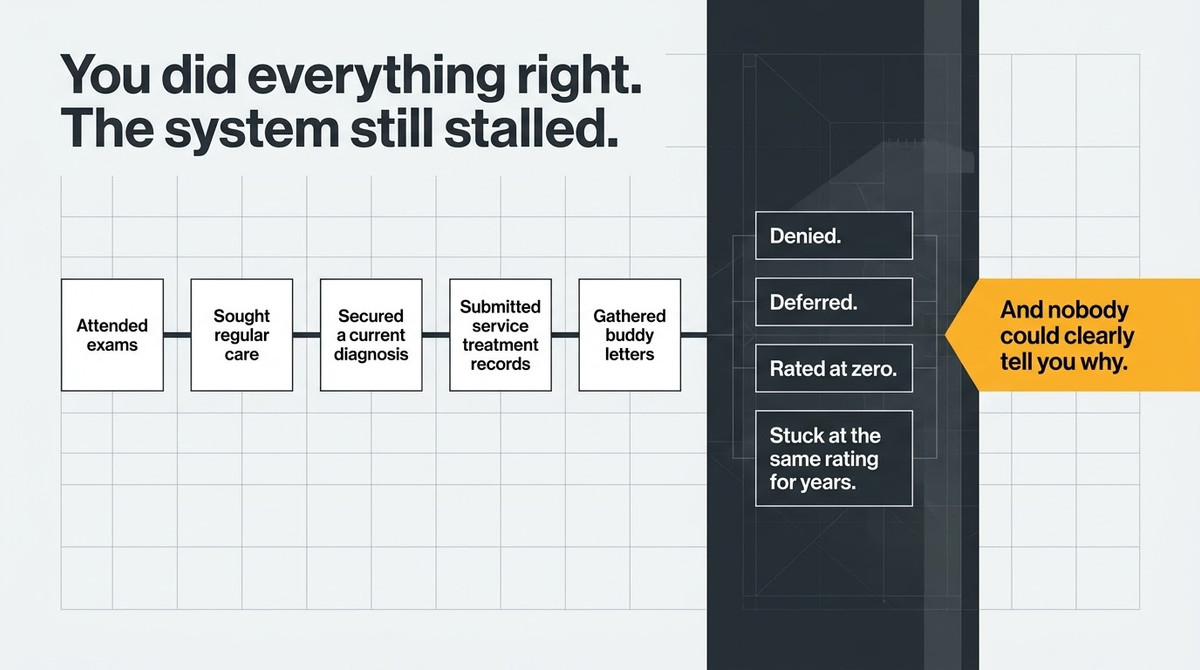
A claim should never sit unresolved for five years. And if you did everything right and were still denied, we take your DBQs and C&P exams and break them down in a forensic report, so you know exactly how your data was used, and how it wasn’t.
What’s buried inside a typical C-file
You can’t win if you don’t know what’s in your file, what’s not in your file, and whether it’s being applied correctly.
That is the entire purpose of the Mission 5 Brief.
The Seven Sections of Your Brief
Every Mission 5 Brief follows the same seven-part structure, so nothing in your file gets skipped. Each section answers one question the VA never explains to you: what is in your file, what the decision actually said, which law applies, whether your exam was adequate and what to do next. Read them in order and you will understand your claim the way a reviewer does, before you spend a single day in the wrong appeal lane.

Service & Exposure Profile
A full reconstruction of your service, deployments, and exposure history, the foundation every theory of connection is built on.

Condition & Rating Analysis
Each claimed condition mapped to the exact diagnostic code and rating criteria the VA is required to apply.
Evidence Gap Assessment
A line-by-line audit of what your file has, what it is missing, and precisely what evidence would close each gap.

Theory-of-Connection Map
Every viable path, direct, secondary, presumptive, aggravation, identified and prioritized, not just the obvious one.

Effective Date & Back Pay Review
An analysis of the earliest defensible effective date and the retroactive benefits potentially owed.

C&P Exam Adequacy Review
A forensic look at whether prior exams were legally adequate, and where an inadequate exam becomes your opening.
Strategic Action Plan
A prioritized, step-by-step battle plan: which review lane, which conditions, which evidence, in what order.
Section 6 Preview: Is Your C&P Exam Adequate?
Your brief includes a forensic review of whether prior exams were legally adequate. Walk through the exam the way we audit it. An exam that skipped your flare-ups, ignored your records, or gave a conclusion with no rationale is not adequate, and the VA has a duty under 38 CFR §3.159 to fix it. Bring your exam report and check it line by line as you go.

How to Describe Your Symptoms, and What to Avoid
The examiner’s notes drive your rating. A single “I’m fine” can cost you an entire rating level.
- Describe your WORST days and flare-ups, not your average day
- Explain how symptoms limit work, sleep, and daily tasks
- State the frequency & duration (“3 flare-ups a week, 2 hours each”)
- Report pain during repetitive motion, not just the first rep
- Be honest about mental-health impact on relationships & focus
- Don’t say “I’m fine” or “I’m good” out of habit or pride
- Don’t minimize or “power through” to look tough
- Don’t exaggerate, credibility is everything on the record
- Don’t describe only your best day
- Don’t assume the examiner has read your whole file
Real Veterans. Real Claims. Real Outcomes.
Every case on this desk belongs to someone who served. These are the veterans this practice represents, across every era, branch, and condition: the Vietnam vet who was told it was too late, the Gulf War vet the system called a mystery, the young veteran who walked out of a five minute exam with a zero. Different stories, same fight. The record decides the claim, so we build the record.
 Veteran Representation
 Veteran Representation
 Veteran Representation
What the VA Sees at Your Exam
Understand the exam your brief evaluates. These are the official VA overviews of the compensation and pension exam. Watch what the VA says should happen in that room, then hold your own exam report up against it. Your brief does the forensic work, but you were the one in the room, and you know what the examiner skipped. Write it down while you still remember.
How Your Combined Rating Is Calculated
VA Claim Exams: Respiratory, Cardiology, Ear/Nose/Throat

Who the M5 Brief Is For
The Mission 5 Intelligence Brief is a flat-fee product, not contingency representation. It is the right first step when you want a professional forensic read on your situation before committing to a fight, or when you want an independent second opinion on a claim that has stalled.
The Mission 5 Brief, Questions Veterans Ask
These are the questions veterans ask me about the Mission 5 Brief before they order one. It is a written analysis of your file, not a promise of a result. The answers explain what it covers and what happens after. Your part is to send me your full file, because the brief can only be as complete as the records I get.
What exactly do I receive with the Mission 5 Intelligence Brief?
How much does the brief cost and are there other fees?
What records do you need from me to build it?
How long does the brief take?
Do I have to hire you for an appeal after I get the brief?
Is the brief worth it if I have not been denied yet?

Understand How the VA Calculates Your Rating
Your combined rating decides your monthly compensation and any retroactive award. This is the math the VA actually uses, and the Mission 5 Brief audits whether it was applied correctly to your file. The VA does not add percentages. Under 38 CFR 4.25 each rating applies only to the efficiency you have left, then the total rounds to the nearest 10, and the bilateral factor in 4.26 can add a few points when both arms or both legs are rated. I check every one of those steps, because a single misapplied step can cost you a full rating level.

Why 50% + 30% Does NOT Equal 80%
The VA uses “whole-person” math, not simple addition. This is how ratings really stack.
The VA always begins from a whole, healthy person (100%).
50% of 100 is subtracted. You have 50% “efficiency” left.
30% is taken from the REMAINING 50 (0.30 × 50 = 15). 50 − 15 = 35 left.
100 − 35 = 65, then rounded to the nearest 10 → 70%.
Bottom line: 50% and 30% combine to 65% → rounded to 70%, not 80%. The same math turns two 50% ratings into 75% → rounded to 80%, not 100%. Every rating you add is worth less than the last. That is why which conditions you claim, and in what order, matters as much as how many.
The Foundation of Every Claim
Section 4 of your brief maps every viable theory of connection. All three prongs must be present, miss one and the claim collapses. That means a current diagnosis, an in-service event, injury, or exposure, and a medical nexus linking the two. Before you file anything, check your own file for all three. If one is missing, that is the gap to close first, not after the denial letter shows up.

The Three Foundations of Direct Service Connection
For direct service connection, the record generally must establish all three. Presumptive, secondary, aggravation, increased-rating, TDIU, and SMC claims follow different or additional standards.
Current Diagnosis
A present, medically documented condition. In most cases a current diagnosis is the clearest foundation, the VA rarely rates a condition it has not confirmed. Narrow legal exceptions exist, but ‘I think I have it’ is not an evidence strategy.
In-Service Event or Exposure
An injury, illness, event, or toxic exposure that occurred (or was aggravated) during active service, shown in records, or presumed under the PACT Act.
The Connection (Nexus)
For direct service connection, the record generally must link the condition to service. Sometimes that requires a medical nexus stating it is “at least as likely as not” (50% or greater). In other cases, federal law supplies a presumption or another legal route.