

Increased Ratings · 38 CFR §3.344
Rating Increases
When your service-connected condition has worsened, the VA owes you a higher rating, and the back pay that comes with it
Conditions get worse. Ratings are supposed to follow, but the VA does not raise them on its own, you have to prove the change. The rating criteria are about function, how the condition limits your daily life and your ability to work, so a current exam and an honest record of your worst days matter more than the diagnosis itself. Push past a rounding threshold and a single increase can add hundreds of dollars a month, plus back pay to the date it worsened.
When Your Condition Gets Worse, Your Rating Should Go Up
Under 38 CFR §3.327, the VA can reexamine a veteran at any time to determine whether a condition has improved or worsened. But the VA rarely initiates increases on its own, it is up to you to file a claim for increased compensation when your condition deteriorates.
A rating increase claim tells the VA: my service-connected condition is worse than it was when you last rated it, and the current rating no longer reflects my actual level of disability. The VA then schedules a new C&P exam, and if the exam supports a higher rating under the applicable diagnostic code criteria, your rating is increased.
The effective date for an increase is generally the date the claim is filed or the date entitlement arose, whichever is later. If medical evidence shows the condition met the criteria for a higher rating before you filed, the effective date can go back up to one year before the filing date.

The DeLuca Factors, What the Examiner Must Measure
For musculoskeletal claims, the DeLuca v. Brown decision (8 Vet. App. 202 (1995)) requires the VA to consider functional loss beyond static range-of-motion measurements. When an examiner records only a baseline measurement and ignores flare-up functional loss, the exam is inadequate under 38 CFR §3.159 and is legally challengeable through a Higher-Level Review or a Board appeal. The factors the examiner is legally required to measure are these:

Functional loss due to pain during use, not just at rest

Functional loss during flare-ups, even if the examiner does not witness the flare-up directly
Weakened movement, excess fatigability, and incoordination

Pain on movement, documented at the exact degree where pain begins
Common Diagnostic Codes for Rating Increases
Every rated condition lives under a diagnostic code in 38 CFR Part 4, and that code decides what the examiner measures and what the rater is allowed to count. Pull your rating decision and find the code next to each condition. If you do not know which code you are rated under, you do not know what evidence moves you up. These are the codes I see most often in increase claims.

Lumbar Spine, DC 5242 and 5243, rated on range of motion, DeLuca factors, and incapacitating episodes (IVDS)

Cervical Spine, DC 5237, rated on range of motion and DeLuca factors

Knee (flexion), DC 5261, rated on range of motion in degrees

Shoulder, DC 5200 and 5201, rated on range of motion and dominant vs. non-dominant arm

Hip (flexion), DC 5251, rated on range of motion in degrees

PTSD / Mental Health, DC 8045 and 9411, rated on occupational and social impairment level under §4.130
Signs Your Condition Warrants a Higher Rating
The VA rates you on the current level of disability, not on how you felt the day you were first rated. Under 38 CFR §3.400(o), an increase can pay back to the date the worsening is shown, so the clock starts with your records. If any of these signs describe you, tell your doctor, get it written in your chart, and keep a dated log. Nobody at the VA is watching your condition for you. That job is yours.

Increased or new medications, especially if your physician has escalated treatment since your last rating

New treatment modalities, surgery, injections, physical therapy, or assistive devices you did not previously need

Decreased range of motion or increased pain during movement

More frequent or more severe flare-ups that limit daily activities

New secondary symptoms, for example, radiculopathy developing from a service-connected back condition

Impact on employment, reduced hours, job loss, or inability to perform duties you previously could

Increased mental health symptoms, more frequent panic attacks, worsening avoidance, greater social isolation
Rating Protections, 38 CFR §3.344
Veterans with ratings held for 5 or more years are protected by stabilization rules. The VA must show sustained improvement, not just a single good day, before reducing a stabilized rating. Ratings held for 20 or more years cannot be reduced except in cases of fraud.
I assess these protections before filing any increase claim to ensure the risk-reward calculus is in your favor.

Laid Up for a Service-Connected Condition? The VA May Owe You 100 Percent for the Recovery
Here is a benefit most veterans never hear about until it is too late to remember the dates. If a service-connected condition puts you in the hospital for a long stretch, or under the knife with weeks of recovery ahead, the VA can pay you at the full 100 percent rate for that period. It does not matter whether your everyday rating is 10, 30, or 60 percent. The law calls these temporary total ratings, and they come from two sections of the rating schedule: 38 CFR §4.29 for hospitalization and 38 CFR §4.30 for convalescence.
Think about what that means for an older veteran. A knee replacement on the knee the VA already rated. Back surgery on the service-connected spine. A long hospital admission for a service-connected heart or lung condition. Each of those can carry one to several months at 100 percent pay, and when the recovery ends, your rating goes back to where it was. You keep the money for the covered months. It is not a permanent increase. It is pay for the weeks you could not function.
Both sections are assigned without regard to the other provisions of the rating schedule. The rater does not measure your range of motion or count your flare-ups. The question is simpler: was the treatment for a service-connected condition, and did it put you in the hospital long enough or leave you needing real recovery time?
Here is the trap: the VA does not go looking for your surgery. Nobody at the regional office is reading your private surgeon's schedule. If you do not tell the VA and send the records, the weeks pass, you heal, and the money never gets paid. The second trap is the wrong joint. Surgery on your non-service-connected left knee does not qualify because your right knee is rated. The treatment has to be for the service-connected condition, and the records have to say so.
Your part: the moment a surgery on a rated condition is scheduled, or a hospital stay for one passes three weeks, tell me. Keep every date: admission, surgery, discharge, and the day your surgeon cleared you. Those dates are the claim.

Hospital Rule or Surgery Rule: How Paragraph 29 and Paragraph 30 Pay, and for How Long
Raters still call these Paragraph 29 and Paragraph 30 ratings, after the section numbers. They work differently, and knowing which one fits your situation tells you what records to gather. Both pay at the 100 percent rate for a set period, so getting the right one matters.
Under §4.29, the trigger is more than 21 days of hospital treatment or observation at VA expense, in a VA hospital or an approved one, for a service-connected condition. The 100 percent starts on the first day of the continuous stay and runs to the last day of the month you are discharged. If you went in for something else and treatment for the service-connected condition started later and ran past 21 days, the rating starts on the first day of that service-connected treatment. If you were sent home before day 21 but needed a long recovery, the regulation lets the VA send the claim up for consideration under §3.321(b)(1).
Under §4.30, the trigger is the treatment result, not the length of the stay, and outpatient surgery counts. The rating runs from the date of admission or outpatient treatment for 1, 2, or 3 months from the first day of the month after you go home. The Court has read convalescence as the stage of recovery after surgery, which includes the time you cannot return to work, in Felden v. West.
Here is the trap: when a temporary total ends, the VA does not have to send you the advance warning it gives before other reductions. Section 4.30 says so directly: the §3.105(e) notice rules do not apply. Your payment just drops back. If you are still recovering when the period runs out, the time to ask for an extension is before it ends, with a doctor's note in hand.
Your part: match your situation to one of the cards below, then gather the record that proves it. A temporary total is won on dates and on what your surgeon wrote, not on how you describe it later.

The 21-Day Hospital Rule, §4.29
More than 21 days of hospital treatment or observation at VA expense for a service-connected condition. Paid at 100 percent from the first day of the stay through the last day of the month of discharge. Long authorized absences during the stay can count as a discharge, so keep track of passes home. Need recovery time after discharge? The hospital rating can carry into a convalescent period.

The Three Surgery and Cast Triggers, §4.30
Any one is enough: (1) surgery needing at least one month of convalescence; (2) surgery with severe postoperative residuals, such as incompletely healed wounds, a recent amputation stump, a major joint immobilized, a body cast, house confinement, or required wheelchair or crutches with no regular weight-bearing; or (3) a major joint immobilized by cast without surgery.

Extensions When Recovery Drags
The first award runs 1, 2, or 3 months. Extensions of 1, 2, or 3 more months can follow under any of the three triggers. For severe residuals or cast immobilization, further extensions of one or more months, up to six months beyond the first six, are possible with the Veterans Service Center Manager’s approval. That can reach a full year in the right case. Every extension rides on a current doctor’s note.

What to Send So It Actually Gets Paid
The operative report or hospital discharge summary, with admission and discharge dates. Your surgeon’s written restrictions: no weight-bearing, crutches, sling, home confinement, off work, and the expected recovery time. A short request on VA Form 21-4138 naming §4.29 or §4.30 and the service-connected condition treated. If the records never tie the surgery to the rated condition, expect a denial.
Inside the VA's Procedural Manual
The law for a rating increase is the rating schedule itself, 38 CFR Part 4, read together with §4.1 and §4.2 (the whole history and an adequate exam). The M21-1 is the VA's internal manual; it interprets Part 4 and never overrides it. The rater must compare the current medical evidence against each rating level in the diagnostic code and assign the highest rating the evidence supports. Under §4.7, when the evidence reasonably approximates the criteria for the higher level, the higher rating is assigned.
For musculoskeletal conditions, the requirement to document functional loss during flare-ups comes from the regulations, 38 CFR §§4.40, 4.45, and 4.59, as the Court applied them in DeLuca v. Brown, 8 Vet. App. 202 (1995), and Sharp v. Shulkin, 29 Vet. App. 26 (2017). An exam that measures only baseline range of motion without addressing flare severity, fatigability, and incoordination is legally inadequate, whatever the VA's manual says.
Key CAVC precedent: Esteban v. Brown, 6 Vet. App. 259 (1994), allows separate ratings for distinct symptoms that do not overlap, meaning one condition can generate multiple ratings if the symptoms affect different functions. Mittleider v. West, 11 Vet. App. 181 (1998), requires the VA to attribute all ambiguous symptoms to the service-connected condition. I apply both to maximize the combined rating at every increase claim.

How a Single Rating Increase Changes Your Combined Total
See how the VA combined rating formula works. A single condition increase can push you past a rounding threshold, the difference between 60% and 70% is $500+ per month. Enter your current ratings, then raise the one condition you think has gotten worse and watch what happens to the total. Sometimes a bigger jump on a smaller condition moves the combined rating more than you expect. Your part is to have current treatment records showing the worsening before you file.

Why 50% + 30% Does NOT Equal 80%
The VA uses “whole-person” math, not simple addition. This is how ratings really stack.
The VA always begins from a whole, healthy person (100%).
50% of 100 is subtracted. You have 50% “efficiency” left.
30% is taken from the REMAINING 50 (0.30 × 50 = 15). 50 − 15 = 35 left.
100 − 35 = 65, then rounded to the nearest 10 → 70%.
Bottom line: 50% and 30% combine to 65% → rounded to 70%, not 80%. The same math turns two 50% ratings into 75% → rounded to 80%, not 100%. Every rating you add is worth less than the last. That is why which conditions you claim, and in what order, matters as much as how many.
The Advocate's Take
Your rating is a snapshot of how bad things were on the day you were last examined. It is not a life sentence. Service-connected conditions get worse. Backs stiffen, knees wear out, PTSD symptoms pile up when life gets hard, and lung capacity drops. If you can do less today than you could when you were rated, your rating may be too low, and the VA is not going to check on you to find out.
But here is the hard truth before you file anything. Every increase claim opens the door to a new exam, and a new exam is a chance for the VA to say you improved. I have seen veterans file for an increase on a whim, walk into a C&P exam on a good day, and come out with a proposed reduction instead. So the first question is not "can I get more?" It is "what does my current medical evidence actually show, and is my rating protected?"
Know your protections. A rating held at the same level for five years or more is considered stabilized under 38 CFR §3.344, and the VA has to show sustained, material improvement under ordinary life conditions to cut it, not one good exam. A rating held for 20 years cannot be reduced below that level unless there was fraud (§3.951). Service connection itself held for 10 years is protected from being severed except for fraud (§3.957). If you are inside those windows, your risk is lower. If you are not, we prepare more carefully.
Here is how I walk my clients through it. First, we pull your current rating decision and look at the exact criteria for your diagnostic code. What does the next level up actually require? More flare-ups? Less range of motion? Missing work? Second, we compare that to what your treatment records show right now. If your doctor's notes say you are "stable" and "doing well," that is a problem we fix first by being honest with your doctor about how you are really doing. Third, we document the worsening with current records and, when it helps, a private DBQ. Fourth, you file VA Form 21-526EZ for the increase, ideally after an Intent to File locks in your date. Fifth, you prepare for the exam and describe your worst days, your flare-ups, and how this affects your job and your home life.
And do not forget the chain. If your condition got worse, it may have spawned new problems: radiculopathy from the back, depression from chronic pain, sleep apnea from weight gain. Those are secondary claims, and they get filed alongside the increase.
Your part: keep going to treatment, tell your providers the truth every visit, track your bad days on a calendar, and do not file blind. Bring me your rating and your records first. If the evidence supports more, we go get it. If it does not yet, I will tell you what needs to be documented before you take the risk.

An increase is not about how long you have been rated, it is about how bad the condition is today. Most increase claims send you to a new exam, and that exam decides whether you go up, stay put, or get proposed for a reduction. Watch the VA's videos below before you file, and walk into that room knowing what the examiner is supposed to measure.
When Your Condition Worsens, The Rating Math
A worsening condition can move your rating and your combined total. The VA rates what your condition looks like now, so current treatment records and a fresh exam carry the claim. These official VA videos show how that math works and what the increase exam is measuring. Before you file, understand that an increase claim opens the whole condition back up for review, so bring records that prove it got worse.
VA Claim Exams: Musculoskeletal / Rheumatological
Your VA Claim Exam: What to Expect
Building a Rating Increases Claim That Wins
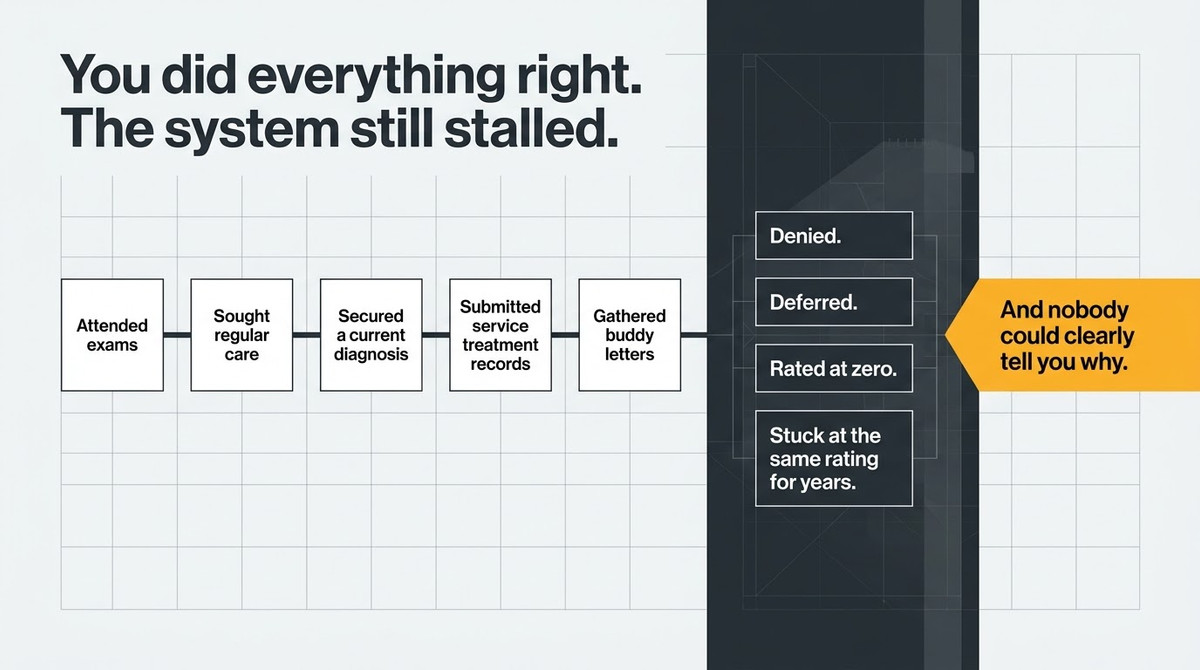
Every claim stands on three legs. Knock one out and the claim falls over, no matter how bad your symptoms are. Before you file, look at your file and find all three. If one is missing, that is the piece to build first. The VA will not build it for you, and filing without it usually just buys you a denial letter and lost time.
 01
01A current diagnosis
A doctor has to say you have it, now, in writing. Not "reports symptoms of", a diagnosis. Without this leg, nothing else in the file matters.
 02
02A link to your service
An event, an injury, an exposure, or an already service-connected condition. Service records, unit records, buddy statements, and your own account all count as evidence.
 03
03A nexus that ties the two together
A medical opinion stating it is at least as likely as not that your service caused or aggravated the condition. That phrase is a legal standard: 50 percent or better. It is the leg most denials break.
Document the problem before you file
• Keep a dated symptom log for at least 30 days. Frequency, severity, and what it stopped you from doing.
• Get statements from people who see it, a spouse, a coworker, a battle buddy. Lay evidence is legal evidence.
• Pull your private treatment records. The VA only has to help; it does not have to go find everything.
• Write down what you have stopped doing. Lost work, lost sleep, lost activities. That is what impairment looks like on paper.
Your Rights in This Process
Most veterans walk into this system without knowing the rules the VA itself has to follow. That is how claims get denied for missing evidence the VA was supposed to help you find, and how exams get done by the wrong clinician. These six rights are written into federal regulation. Know them before you file, and make the VA honor every one of them when it decides your claim.

It costs nothing to file
Filing a VA claim is free. Accredited representatives may only charge for work on an appeal after an initial decision, and those fees are capped by 38 CFR §14.636.

The VA has a Duty to Assist you
Under 38 CFR §3.159 the VA must help you get the evidence it needs, and it must tell you what is missing before it denies you for missing it.

You can ask for a different examiner
You may request a trauma-informed clinician, or a clinician of a specific gender, for a C&P examination. Ask before the exam is scheduled.

You can claim every condition you have
There is no limit and no penalty. Primary conditions, secondary conditions, and conditions made worse by service all get filed.

You can appeal and be re-evaluated
A denial is not the end. You may submit new evidence, request a higher-level review, appeal to the Board, and ask for re-evaluation when your condition worsens.

You must be considered for TDIU
If your service-connected conditions keep you from holding substantially gainful employment, you may be paid at the 100 percent rate without a 100 percent rating.
The Nine Questions Every Veteran Should Be Able to Answer
This is the standard I hold every page on this site to. Before you file anything on a rating increase, you should be able to answer these nine questions. If you cannot answer them yet, you are not ready, and that is exactly what my review is for. This is education first, representation second.

What is this?
An increase asks the VA to raise the percentage on a condition it already service-connected because the disability has worsened. It is about severity, not connection.

What must the VA decide?
Whether your current symptoms meet a higher level in the rating criteria for that diagnostic code.

What must the evidence prove?
That your condition is more severe now and meets the specific criteria for the higher percentage. Rating schedules are written in exact symptom language, and the evidence has to match it.

What is the VA responsible for?
Providing a current, adequate examination that measures your condition against the rating criteria, and considering the entire record, not just the exam-day snapshot.

What are you responsible for?
Keeping treatment current, attending the C&P exam, and describing your worst days and flare-ups honestly, not your best day in the exam room.

What can go wrong?
An exam that catches you on a good day, an examiner who does not measure the criteria that matter, or an increase that nets $0 because of how VA combined math works.

What you should not do
Do not file an increase without knowing whether the higher rating would actually change your combined rating, and do not understate your symptoms to seem stoic.

What I review as your accredited agent
I compare your evidence to the exact rating criteria, model the combined-rating math so I pursue increases that move the needle, and check whether the worsening also raises TDIU or SMC.

What happens next
The VA re-rates the condition. A grant can raise your monthly compensation and, in some cases, trigger a review of unemployability or special monthly compensation.
Representation Means Telling You the Truth
Do Not File Yet If…
Before you take action on a claim for increased rating, check whether any of these apply. Filing at the wrong time can weaken your claim, waste a deadline, or put you on a longer path than necessary. I would rather tell you to wait than watch you lose an effective date or hand the VA a thin file it can deny in a week. A denial is not the end, but it costs you months. Read each item below honestly. If one fits your situation, call us first and we will tell you what to fix before anything gets filed.





A Grant Is Not the End of the Analysis
After a Favorable Decision
A grant does not mean “case closed.” Every favorable decision must be audited. I review each of the following before advising you that the decision is fully correct. The VA makes mistakes in grants too, and a wrong effective date or a missed condition can cost you for years. Pull your decision letter and check it against these points with me.

Was the correct diagnostic code and evaluation assigned?
Compare the assigned code and percentage against the rating schedule criteria. A correct diagnosis with the wrong code can mean the wrong evaluation.

Did VA select the correct effective date?
Check whether VA used your claim date, your Intent to File date, or the date entitlement arose. An incorrect effective date can cost thousands in back pay.

Does VA have the correct family information?
Where dependency compensation applies, verify VA has accurate dependent information. Missing or outdated records reduce your monthly payment.

Does the record raise unemployability?
If service-connected disabilities prevent substantially gainful employment, the record may support Total Disability Based on Individual Unemployability even at a combined rating below 100%.

Does the disability picture raise Special Monthly Compensation?
Certain combinations of disabilities, loss of use, or the need for aid and attendance may qualify for SMC categories that provide compensation above the standard rate.

Is the condition subject to future review?
Unless the rating is static or permanent, VA may schedule a future examination. Know whether your rating is protected and when VA might reassess.

Was P&T established where applicable?
Permanent and Total status unlocks additional benefits including Chapter 35 Dependents' Educational Assistance and exemption from future routine examinations.

Does the family understand the award?
Particularly important for aging veterans. The family should understand the rating, what records to preserve, and what survivor benefits may apply.
Frequently Asked Questions
Asking for an increase can raise your rating, and it can also put your current rating under a fresh look. That is why these questions come up so often. The answers below cover when to file, what evidence moves the number, and what to watch for. Your part is to compare your current symptoms to the rating criteria and file when your records show you have gotten worse.
When should I file for a rating increase?
Will filing for an increase trigger a reduction in my current rating?
Can I file for an increase on a 0% service-connected condition?
How does a rating increase affect my combined rating?
What evidence is most effective for a rating increase?
What are the DeLuca factors and why do they matter for rating increases?
What is the effective date for a rating increase?

When You Are Ready to File
Talk to an accredited representative before you file. It costs nothing to ask, and the order you file in changes what the VA is allowed to award you. Albert L. Thombs Jr. is VA-Accredited Claims Agent #45147. A short conversation now can save you a year spent waiting in the wrong review lane.
Your part starts at the kitchen table. Pull your DD-214, your rating decision if you have one, and the names of every doctor who treats you today. Under 38 CFR 3.159 the VA has to help you gather records, but it can only chase the records you tell it about. Leave a doctor off the 21-4142 and that treatment may never reach your file.

The claim for increase
An increase is filed on the same application. Name the service-connected condition and say it has gotten worse. Under §3.400(o)(2), worsening shown in the year before you file can move the effective date back.
File the claim on VA.govRelease for private records
The treatment notes that show the worsening are the case. If they sit with a private doctor, this release gets them into the file.
Get the records release on VA.govYour worst days, in writing
The exam is one day. Your statement covers flare-ups, missed work, and what you cannot do anymore. Under DeLuca and Sharp, flare-ups count.
Get the lay statement form on VA.govKeep Reading
One page never tells the whole story of a claim. The VA rates every condition on its own evidence, its own exam and its own diagnostic code, and the pieces connect in ways most veterans never see until a decision letter lands. These are the pages that pick up where this one stops. Read them before you file, not after a denial, because the cheapest fix in this process is the mistake you never make.

Secondary Conditions
A worsening primary condition often spawns secondary conditions, each one adds to your combined rating.
Read more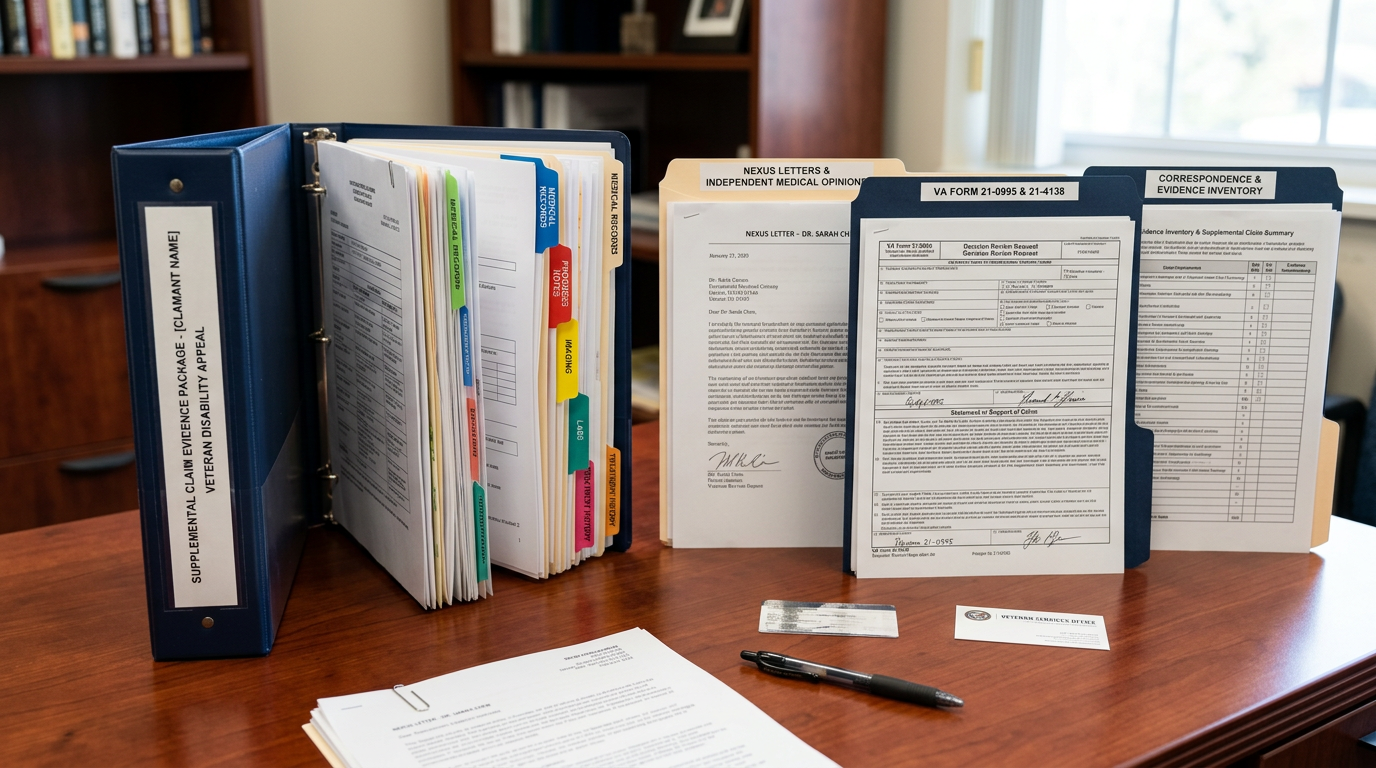
Evidence Strategy
A current DBQ and targeted medical evidence are the keys to a successful rating increase.
Read more
Combined Ratings Formula
See exactly how a single increase affects your total, and where the rounding thresholds fall.
Read more
TDIU
When a worsening condition keeps you from working, a single increase can open the door to unemployability benefits.
Read more