
Veterans Benefits
Proposed Reductions & Severed Claims
The VA is moving to cut or take away a rating you already earned, this is the page that tells you exactly what to do, and why you fight it now.
A proposed reduction or a proposed severance is the VA telling you, in writing, that it intends to lower or strip a disability rating you have already been granted. The clock starts the day that letter is dated. This page names it for what it is, shows you the federal rules the VA is required to follow, and frequently does not, and lays out how to protect the rating you earned before the deadline runs.
Time-critical · Do not wait
Got a proposed reduction or severance? Get help NOW.
If the VA has sent you a notice of proposed reduction or a proposed severance of service connection, you are on a 60-day clock and the burden is on the VA, not you, to prove your condition actually and permanently improved. Do not sit on this letter and do not face it alone. Call today and get an accredited agent fighting it before the deadline runs.
What Is a Rating Modification?
A rating modification means the VA has changed, increased, decreased, or severed, a previously assigned disability rating. Many veterans assume that once a rating is granted it is permanent, but the VA retains authority to propose reductions under specific circumstances set out in §3.105(e) and §3.344.

Why the VA Proposes Reductions
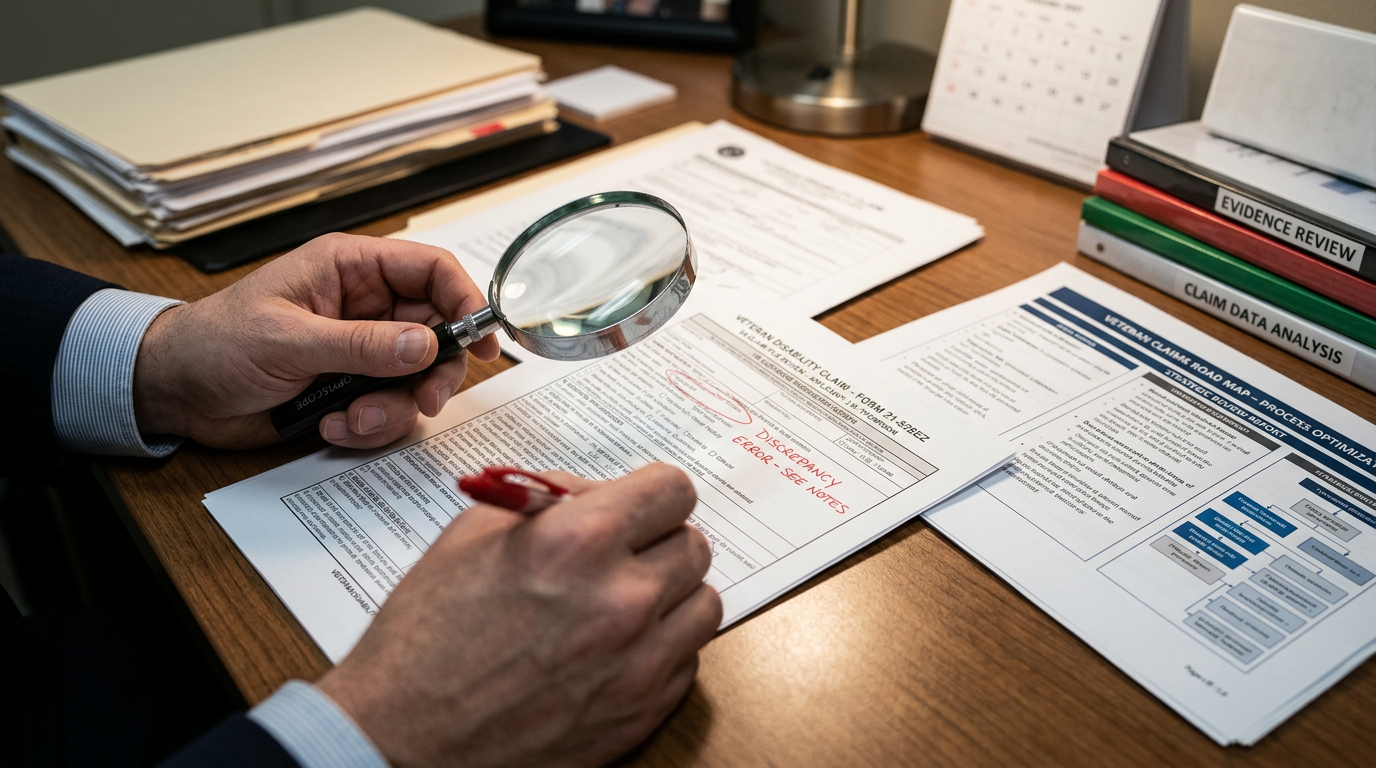
The VA may propose a reduction when a routine future examination shows material improvement. It may also initiate review based on medical evidence already in the file. What matters is what the regulation demands: a single exam showing some improvement does not justify a reduction. The VA must show sustained improvement under the ordinary conditions of life and work, not just on the day of the exam.
Common triggers include scheduled re-examinations, hospitalization records suggesting improvement, and a review following a CUE finding. Under §3.344 the VA also cannot reduce a long-standing rating on an examination less thorough than the one that established it.

The Burden Is on the VA, Not on You
This is the single most important thing to understand, and it is the thing the VA counts on you not knowing: you do not have to prove you are still disabled. When the VA moves to reduce a rating it already granted, the law puts the burden of proof on the VA. It must affirmatively show, on the whole record, that your condition has undergone actual, sustained material improvement, and that the improvement will hold up under the ordinary conditions of life and work, not just for the twenty minutes you sat in a C&P exam room. If the VA cannot carry that burden, the rating stays. Period.
Your earned rating is presumed correct. The VA is not writing on a blank page, it is trying to undo its own prior decision, and it must justify that with a full and complete examination at least as thorough as the one that granted the rating in the first place. A reduction built on a shorter, thinner, one-and-done exam is unlawful under §3.344, and the Court of Appeals for Veterans Claims has thrown out reductions for exactly this reason again and again.
And here is the hard truth from the field: the VA seldom follows its own rules on reductions. Rating specialists cherry-pick a single good-day measurement, ignore the ordinary-conditions-of-life standard, skip the thoroughness comparison §3.344 requires, and fail to even check whether your rating was already protected by the 5, 10, or 20-year rules. Every one of those failures is a procedural error, and every procedural error is a ground to defeat the proposed reduction. That is precisely why you do not face this alone, and precisely why you move now.

The Protections You Already Have

5-Year Rule, §3.344(a)
A rating continuously in effect for 5 years or more cannot be reduced unless sustained material improvement is shown by a full and complete examination at least as thorough as the one that established the rating, and the improvement is reasonably certain to continue under the ordinary conditions of life.

10-Year Rule, §3.957
Service connection continuously in effect for 10 years or more cannot be severed except on a showing of fraud. The percentage can still be reduced, but the connection itself is protected.
20-Year Rule, §3.951(b)
A rating continuously in effect at or above a given level for 20 years or more cannot be reduced below that level except on a showing of fraud. This is the strongest protection in the regulations.

55-Year Age Rule, §3.327
Veterans aged 55 and older are generally exempt from routine future examinations absent unusual circumstances. Also exempt: ratings at the schedular minimum for the diagnostic code, combined ratings that would not change even if one condition improved, and disabilities that are static.

100% total rating, §3.343
A total rating cannot be reduced on a single examination unless all the evidence establishes material improvement in physical or mental condition. TDIU cannot be terminated merely because the veteran is capable of some employment, actual employability must be shown.
What to Do If You Receive a Proposed Reduction
If the VA proposes to reduce your rating, it must send written notice of the proposal with the reasons, give you 60 days to submit additional evidence, and give you 30 days to request a predetermination hearing. That is your due process, and it exists because the VA is not permitted to simply cut your check. Do not ignore this letter, it is one of the most consequential documents you will ever receive from the VA.
Act immediately: request the hearing; gather current medical evidence showing the condition has not improved or has worsened; obtain a private medical opinion addressing the specific rating criteria; submit a detailed personal statement about daily functional impact including bad days and flare-ups; and get an accredited agent or attorney involved before the 60 days run.

How We Fight Proposed Reductions
We attack the proposal on procedure first. Was the required §3.105(e) notice given, with the full 60 days? Was the examination as thorough as the one that established the rating, as §3.344 requires? Did the examiner address every criterion in the diagnostic code, or cherry-pick one measurement on one good day? Was the rating protected by the 5, 10, or 20-year rules, and did the VA even check?
Then we rebuild the evidentiary record: current treatment records, a private opinion tied to the exact rating criteria, and lay statements documenting the condition under ordinary conditions of life rather than in a clinic. The VA frequently cuts corners on reductions, and each shortcut is a ground for reversal.

The Advocate’s Take
A proposed reduction is not a done deal. It is a fight you can win. I have seen veterans panic, stop answering mail, and lose a rating they could have kept. The VA has to follow strict rules before it takes a dollar back, and it cuts corners more often than you would believe.
Here is how the VA looks at it. Under 38 CFR 3.105(e), the VA must send you a proposal, explain why, and give you 60 days to send evidence before it reduces your payment. Ask for a hearing within 30 days and your payments stay at the current rate until the hearing is held. If your rating has been in place five years or more, §3.344 requires the VA to look at your whole history, use an exam at least as full as the one that set the rating, and find that improvement is real and will hold under the ordinary conditions of life. A rating held for 20 years is protected from reduction below that level under §3.951(b), absent fraud. Service connection held for 10 years is protected under §3.957.
What I need from you: the proposal letter, the exam it relied on, your treatment records for the last few years, and a statement of how your condition affects you right now. If your doctor disagrees with the exam, I want that in writing.
Walk through it with me. First, we mark the 30-day and 60-day dates the day the letter arrives. Second, we request the hearing inside 30 days to keep your payment where it is. Third, we compare the reduction exam to the one that set your rating and to your treatment notes. Fourth, we send evidence and a written argument showing every procedural failure. If the VA reduces anyway, we choose the right appeal lane and keep fighting.
The pitfalls: ignoring the letter, missing the 30-day hearing window, walking into the exam and describing a good day, and assuming a doctor's "improved" note means you lost. A reduction that skipped the rules can be restored.
Your part: open every VA envelope the day it arrives and call us the same week. We work WITH you, not FOR you. You earned that rating, and we protect it with the rules the VA has to follow.
A proposed reduction is the VA trying to take back what you earned, and it almost always rests on a single new exam. The protections in §3.105(e) and §3.344 exist because the VA does this too often. Watch the official VA videos below so you know what a proper exam looks like, because a quick exam that does not show sustained improvement is a reduction I can fight.
Straight From the Source
The rating behind this benefit is set at your claim exam. Watch these official VA walkthroughs to understand what that exam involves and how to prepare.
The official overview of the VA claim exam process, what happens, who conducts it, and why it matters for your rating.
What the VA's own guidance covers, what to bring, how to report your symptoms honestly, and the mistakes that cost veterans rating levels.
Building a Proposed Reductions & Severed Claims Claim That Wins
Every claim stands on three legs. Knock one out and the claim falls over, no matter how bad your symptoms are. Before you file, look at your file and find all three. If one is missing, that is the piece to build first. The VA will not build it for you, and filing without it usually just buys you a denial letter and lost time.
 01
01A current diagnosis
A doctor has to say you have it, now, in writing. Not "reports symptoms of", a diagnosis. Without this leg, nothing else in the file matters.
 02
02A link to your service
An event, an injury, an exposure, or an already service-connected condition. Service records, unit records, buddy statements, and your own account all count as evidence.
 03
03A nexus that ties the two together
A medical opinion stating it is at least as likely as not that your service caused or aggravated the condition. That phrase is a legal standard: 50 percent or better. It is the leg most denials break.
Document the problem before you file
• Keep a dated symptom log for at least 30 days. Frequency, severity, and what it stopped you from doing.
• Get statements from people who see it, a spouse, a coworker, a battle buddy. Lay evidence is legal evidence.
• Pull your private treatment records. The VA only has to help; it does not have to go find everything.
• Write down what you have stopped doing. Lost work, lost sleep, lost activities. That is what impairment looks like on paper.
Your Rights in This Process
Most veterans walk into this system without knowing the rules the VA itself has to follow. That is how claims get denied for missing evidence the VA was supposed to help you find, and how exams get done by the wrong clinician. These six rights are written into federal regulation. Know them before you file, and make the VA honor every one of them when it decides your claim.

It costs nothing to file
Filing a VA claim is free. Accredited representatives may only charge for work on an appeal after an initial decision, and those fees are capped by 38 CFR §14.636.

The VA has a Duty to Assist you
Under 38 CFR §3.159 the VA must help you get the evidence it needs, and it must tell you what is missing before it denies you for missing it.

You can ask for a different examiner
You may request a trauma-informed clinician, or a clinician of a specific gender, for a C&P examination. Ask before the exam is scheduled.

You can claim every condition you have
There is no limit and no penalty. Primary conditions, secondary conditions, and conditions made worse by service all get filed.

You can appeal and be re-evaluated
A denial is not the end. You may submit new evidence, request a higher-level review, appeal to the Board, and ask for re-evaluation when your condition worsens.

You must be considered for TDIU
If your service-connected conditions keep you from holding substantially gainful employment, you may be paid at the 100 percent rate without a 100 percent rating.
When You Are Ready to File
Talk to an accredited representative before you file. It costs nothing to ask, and the order you file in changes what the VA is allowed to award you. Albert L. Thombs Jr. is VA-Accredited Claims Agent #45147. A short conversation now can save you a year spent waiting in the wrong review lane.
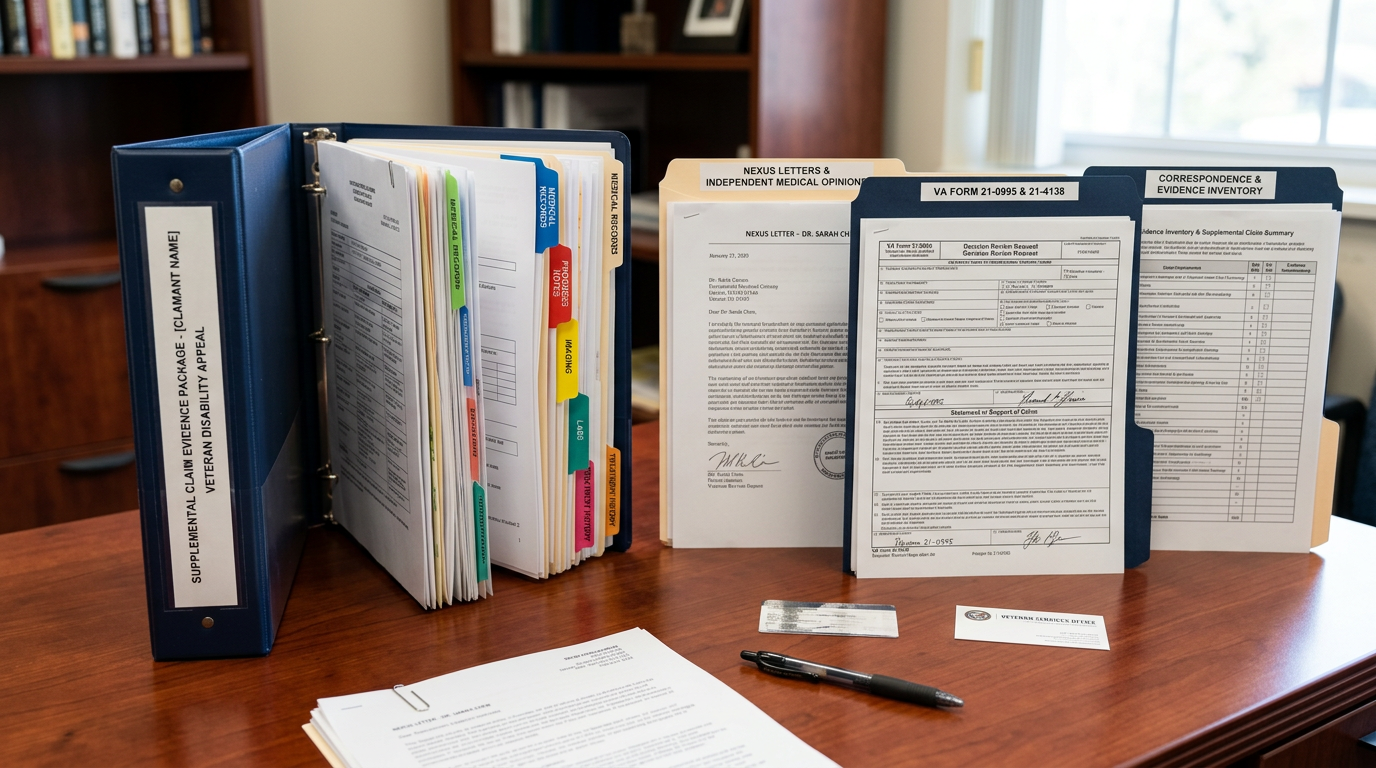
Your part starts at the kitchen table. Pull your DD-214, your rating decision if you have one, and the names of every doctor who treats you today. Under 38 CFR 3.159 the VA has to help you gather records, but it can only chase the records you tell it about. Leave a doctor off the 21-4142 and that treatment may never reach your file.

The application itself
This is the form that opens a disability compensation claim. List every condition you are claiming, and name the secondary conditions explicitly.
Release for private records
Authorises the VA to request records from your private doctors. Without it, treatment outside the VA may never reach your file.
Lay or buddy statement
The official form for your own statement and for statements from people who witnessed the event or the change in you.
What It Takes to Claim This Benefit
Confirm you meet the eligibility rules for this specific benefit, the criteria below and in the governing regulations tell you exactly what the VA is looking for.
Gather the proof that matches those rules, service records, medical evidence, income or dependency documents, and the physician statements the VA weighs.
File the right form the right way, the correct application, fully supported, so the VA cannot deny it on a technicality or delay it for missing evidence.
 Veteran Representation
 Veteran Representation
The Forms & Applications We File For You
These are the applications that drive this benefit. Start any of them on our site and an accredited agent prepares and files it for you, correctly, the first time.
Application for Disability Compensation
The core application that establishes or reopens the service-connected claim behind most benefits.
Start this with usAppoint Us as Your Representative
Authorizes our accredited agent to act on your behalf with the VA on this benefit.
Start this with usSee How Ratings Drive This Benefit
Most benefits scale with your combined disability rating, and the VA does not add your ratings the way you would expect. Work the real math below. The VA uses the combined ratings table in 38 CFR 4.25, which applies each rating to whatever is left of your remaining efficiency, then rounds to the nearest 10. That is why a 50% and a 30% come out to 70%, not 80%. Before you assume you are short of a threshold for this benefit, run your own numbers here and compare them to your rating decision letter.
Why 50% + 30% Does NOT Equal 80%
The VA uses “whole-person” math, not simple addition. This is how ratings really stack.
The VA always begins from a whole, healthy person (100%).
50% of 100 is subtracted. You have 50% “efficiency” left.
30% is taken from the REMAINING 50 (0.30 × 50 = 15). 50 − 15 = 35 left.
100 − 35 = 65, then rounded to the nearest 10 → 70%.
Bottom line: 50% and 30% combine to 65% → rounded to 70%, not 80%. The same math turns two 50% ratings into 75% → rounded to 80%, not 100%. Every rating you add is worth less than the last. That is why which conditions you claim, and in what order, matters as much as how many.
 Veteran Representation
Not sure if you qualify?
An accredited agent reviews your eligibility for this benefit at no cost and tells you straight whether it is worth pursuing. If it is, we prepare and file every form for you.