
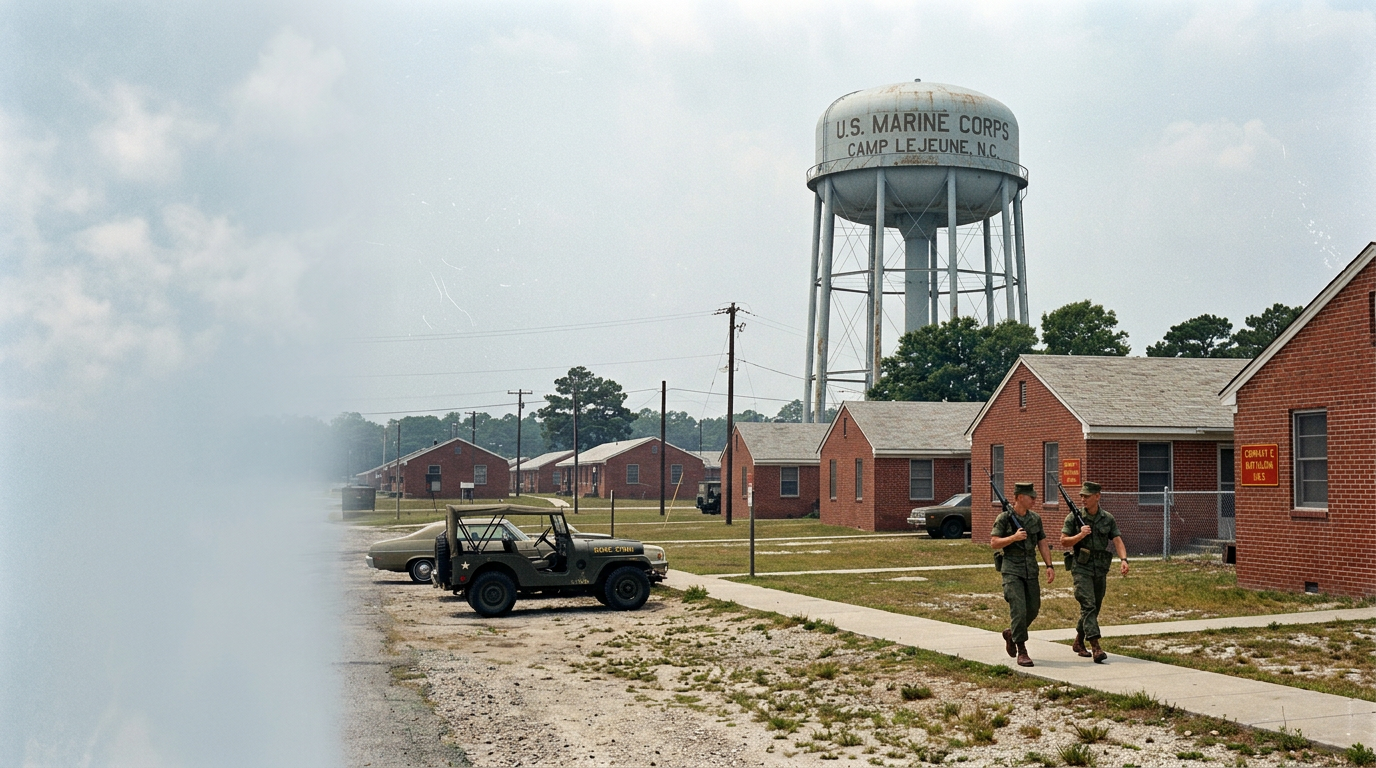
Toxic Exposure
Camp Lejeune Contaminated Water
Presumptive conditions and the separate Camp Lejeune Justice Act claim
Veterans and family members exposed to contaminated water at Camp Lejeune have both VA presumptive disability benefits and a separate legal claim under the Camp Lejeune Justice Act. They are two different systems with different rules and deadlines, and one does not file the other for you. The VA side runs under 38 CFR 3.309(f). Your part is to prove your time at Camp Lejeune with service records, confirm a listed diagnosis, and treat the Justice Act claim as its own separate process.
Two Separate Avenues, Do Not Confuse Them
Veterans stationed at Camp Lejeune between 1953 and 1987 were exposed to drinking water contaminated with trichloroethylene (TCE), perchloroethylene (PCE), benzene, and vinyl chloride. There are two entirely distinct avenues of relief: VA disability compensation under the §3.309(f) presumption, and a separate federal lawsuit under the Camp Lejeune Justice Act filed in the Eastern District of North Carolina.
They run on different tracks, are decided by different bodies, and one does not replace the other. VA compensation is a monthly benefit administered by the VA. The Justice Act claim is civil litigation for damages, open to family members and civilian workers as well as veterans. Pursuing one does not forfeit the other, though a Justice Act award may be offset by VA benefits paid for the same harm.

The VA Presumptive Conditions (§3.309(f))

Adult leukemia
A blood and bone-marrow cancer strongly linked to benzene, one of the solvents in the Lejeune supply. The diagnosis alone establishes the presumption, so file at diagnosis and do not wait for treatment to begin.

Aplastic anemia and myelodysplastic syndromes
Bone-marrow failure that leaves the body unable to make healthy blood cells, tied to benzene exposure. Rated on transfusion dependence and infection risk, and the residuals are frequently under-scored.

Bladder cancer
Tied to trichloroethylene (TCE) in the water. Rated on voiding dysfunction and recurrence, and any residual use of pads or a catheter after treatment is a separate ratable line the VA rarely scores on its own.

Kidney cancer
Renal cell cancer linked to TCE, one of the most solidly established Lejeune associations. Rated on the cancer itself and, after surgery, on any loss of kidney function that remains.

Liver cancer
Associated with vinyl chloride in the contaminated supply. Aggressive and often caught late, so a pathology report naming the diagnosis is what moves the claim quickly.

Multiple myeloma
A cancer of the bone-marrow plasma cells linked to the Lejeune solvents. Often rated high, with anemia, bone pain, and kidney involvement that support secondary claims on top of the primary rating.

Non-Hodgkin’s lymphoma
A family of lymphatic cancers with a strong solvent association. Active disease is rated 100%, and even in remission the follow-up and residuals carry a continued rating the VA will try to cut too soon.

Parkinson’s disease
Added on the strength of the TCE–Parkinson’s link. Rated across tremor, rigidity, speech, and swallowing, each scored separately, so filed as one line it is almost always under-rated.
The Qualifying Service Window
Qualifying exposure requires no less than 30 days, cumulative, not necessarily consecutive, of service at Camp Lejeune or MCAS New River between August 1, 1953 and December 31, 1987. Establishing those dates is usually straightforward with service records, and it unlocks the presumption for the eight listed conditions.
Reservists and National Guard members who trained at Lejeune during the period can qualify. So can civilian employees for Justice Act purposes, though not for VA disability compensation.

Health Care for Family Members
Separate from disability compensation, the 2012 Camp Lejeune families law provides VA health care cost reimbursement to family members who lived at Camp Lejeune for at least 30 days during the contamination period, for 15 covered conditions, including esophageal cancer, breast cancer, renal toxicity, female infertility, miscarriage, scleroderma, neurobehavioral effects, hepatic steatosis, lung cancer, and the cancers listed above. This program is administered under §17.400 and is badly under-used.

Conditions Not on the Presumptive List
The eight presumptive conditions are a floor, not a ceiling. Breast cancer (including male breast cancer), esophageal cancer, lung cancer, scleroderma, hepatic steatosis, neurobehavioral effects, and female infertility are recognized in the health-care program but are not presumptive for disability compensation. Those claims can still be won on a direct, facts-found basis under §3.303(d) with a competent medical nexus opinion tying the condition to documented solvent exposure.

The Advocate’s Take
Do not let anyone tell you a Justice Act lawyer is handling your VA claim. They are two different systems. One is a lawsuit. The other is your VA disability claim, the one that pays every month for the rest of your life. Eligible veterans should know the difference and protect both.
Here is how the VA looks at it. Under 38 CFR 3.309(f), if you served at least 30 days, total, at Camp Lejeune or MCAS New River between August 1, 1953 and December 31, 1987, and you have one of eight listed conditions, the link is presumed. Those eight are adult leukemia, aplastic anemia and other myelodysplastic syndromes, bladder cancer, kidney cancer, liver cancer, multiple myeloma, non-Hodgkin's lymphoma, and Parkinson's disease. Other conditions are not shut out. They go through direct service connection with medical evidence that the water, at least as likely as not, caused them. The Justice Act lawsuit has its own rules and deadlines, and an award there can be reduced by VA benefits paid for the same harm. Your VA benefit does not stop because of the lawsuit.
What I need from you: your DD-214 and personnel records showing your time at Lejeune or New River, your diagnosis in writing, and treatment records. If you lived on base as a dependent, tell me, because family members have a separate VA health care program.
Walk through it with me. First, we file an Intent to File, VA Form 21-0966. Second, we prove your 30 days with orders, training records, or unit assignments. Third, we claim each listed condition on the presumption. Fourth, for anything not listed, we build a direct claim with a medical opinion and the science behind it. Then we look for secondary conditions that flow from the primary, because cancer treatment leaves a trail.
The pitfalls: assuming the lawsuit covers the VA claim, never filing for VA benefits at all, and dropping a non-listed condition because it was not on the list. Shocking, I know, but some veterans spent two years waiting on a law firm while their VA effective date sat unprotected.
Your part: find your records, get your diagnosis on paper, and file your Intent to File now. We work WITH you, not FOR you. The water was not your choice. The claim is.
Evidence That Wins Camp Lejeune Claims

Orders, DD-214, or personnel records establishing 30+ days at Camp Lejeune or MCAS New River

Base housing records or dependent records for family-member claims

Pathology and oncology reports naming the specific diagnosis

Date of diagnosis, relevant to both the VA claim and Justice Act timelines

For non-listed conditions, a medical nexus opinion addressing TCE/PCE exposure
Where the VA Gets This Wrong
We routinely see the 30-day requirement misapplied as though it must be consecutive service, and family-member health-care eligibility ignored entirely because nobody in the file ever raised it.
Building a Camp Lejeune Contaminated Water Claim That Wins
Every claim stands on three legs. Knock one out and the claim falls over, no matter how bad your symptoms are. Before you file, look at your file and find all three. If one is missing, that is the piece to build first. The VA will not build it for you, and filing without it usually just buys you a denial letter and lost time.
 01
01A current diagnosis
A doctor has to say you have it, now, in writing. Not "reports symptoms of", a diagnosis. Without this leg, nothing else in the file matters.
 02
02A link to your service
An event, an injury, an exposure, or an already service-connected condition. Service records, unit records, buddy statements, and your own account all count as evidence.
 03
03A nexus that ties the two together
A medical opinion stating it is at least as likely as not that your service caused or aggravated the condition. That phrase is a legal standard: 50 percent or better. It is the leg most denials break.
Document the problem before you file
• Keep a dated symptom log for at least 30 days. Frequency, severity, and what it stopped you from doing.
• Get statements from people who see it, a spouse, a coworker, a battle buddy. Lay evidence is legal evidence.
• Pull your private treatment records. The VA only has to help; it does not have to go find everything.
• Write down what you have stopped doing. Lost work, lost sleep, lost activities. That is what impairment looks like on paper.
Your Rights in This Process
Most veterans walk into this system without knowing the rules the VA itself has to follow. That is how claims get denied for missing evidence the VA was supposed to help you find, and how exams get done by the wrong clinician. These six rights are written into federal regulation. Know them before you file, and make the VA honor every one of them when it decides your claim.

It costs nothing to file
Filing a VA claim is free. Accredited representatives may only charge for work on an appeal after an initial decision, and those fees are capped by 38 CFR §14.636.

The VA has a Duty to Assist you
Under 38 CFR §3.159 the VA must help you get the evidence it needs, and it must tell you what is missing before it denies you for missing it.

You can ask for a different examiner
You may request a trauma-informed clinician, or a clinician of a specific gender, for a C&P examination. Ask before the exam is scheduled.

You can claim every condition you have
There is no limit and no penalty. Primary conditions, secondary conditions, and conditions made worse by service all get filed.

You can appeal and be re-evaluated
A denial is not the end. You may submit new evidence, request a higher-level review, appeal to the Board, and ask for re-evaluation when your condition worsens.

You must be considered for TDIU
If your service-connected conditions keep you from holding substantially gainful employment, you may be paid at the 100 percent rate without a 100 percent rating.
When You Are Ready to File
Talk to an accredited representative before you file. It costs nothing to ask, and the order you file in changes what the VA is allowed to award you. Albert L. Thombs Jr. is VA-Accredited Claims Agent #45147. A short conversation now can save you a year spent waiting in the wrong review lane.
Your part starts at the kitchen table. Pull your DD-214, your rating decision if you have one, and the names of every doctor who treats you today. Under 38 CFR 3.159 the VA has to help you gather records, but it can only chase the records you tell it about. Leave a doctor off the 21-4142 and that treatment may never reach your file.

The application itself
This is the form that opens a disability compensation claim. List every condition you are claiming, and name the secondary conditions explicitly.
Release for private records
Authorises the VA to request records from your private doctors. Without it, treatment outside the VA may never reach your file.
Lay or buddy statement
The official form for your own statement and for statements from people who witnessed the event or the change in you.
Keep Reading
One page never tells the whole story of a claim. The VA rates every condition on its own evidence, its own exam and its own diagnostic code, and the pieces connect in ways most veterans never see until a decision letter lands. These are the pages that pick up where this one stops. Read them before you file, not after a denial, because the cheapest fix in this process is the mistake you never make.

Vietnam Veterans & Agent Orange
Veterans with qualifying Vietnam-era service are presumed exposed to Agent Orange, and a long list of conditions is presumptively service-connected, no nexus required.
Read more
Blue Water Navy Veterans
The Blue Water Navy Vietnam Veterans Act restored Agent Orange presumptions to veterans who served aboard ships in the offshore waters of Vietnam, reversing years of wrongful denials.
Read more
Brown Water Navy Veterans
Brown Water Navy veterans ran the rivers, canals, and harbors of Vietnam, and they have been inside the Agent Orange presumption from the start. The fight was never about them, but the VA still stalls these claims when the paper does not instantly place the boat on an inland waterway.
Read more
Gulf War & PACT Act Veterans
The PACT Act dramatically expanded presumptive conditions for veterans exposed to burn pits and airborne hazards in the Gulf War and post-9/11 conflicts.
Read more