
TERA · 38 U.S.C. §1168 · Facts-Found Pathway
Your Condition Is Not on a List. That Does Not Mean No Claim.
TERA is the facts-found lane under 38 U.S.C. §1168.
When your condition is not on an automatic list, the Toxic Exposure Risk Activity (TERA) pathway under 38 U.S.C. §1168 can still connect it. A TERA finding concedes the exposure and obligates the VA to provide an exam and a medical opinion. It is not a shortcut, you still need a nexus, but it forces the VA to do its job.
What TERA Actually Is
TERA stands for Toxic Exposure Risk Activity. It is a finding, built on what you actually did in service, that concedes the VA acknowledges you were exposed to a toxic hazard. It is established under 38 U.S.C. §1168.
A TERA finding does not grant service connection by itself. It does not remove the need for a medical nexus. What it does is obligate the VA to provide an exam and a medical opinion when the record shows a TERA and a current disability that may be related.
This matters because the exam-and-opinion obligation is exactly where the VA most often drops the ball. Without a TERA finding on the record, the VA can deny a claim for “insufficient evidence” without ever ordering an exam. With a TERA finding, they are supposed to get the exam. §1168 is the lever.

§1168
The statute that creates the TERA exam-and-opinion obligation
Exposure only
TERA concedes exposure, it does not by itself grant the connection
Nexus required
A medical opinion linking the condition to the exposure is still needed
Any exposure
Applies to any documented toxic-exposure activity during service
The takeaway: a TERA finding will not win your claim by itself, but without it, the VA can deny you for “insufficient evidence” and never order the exam that §1168 requires. Getting the TERA on the record is what forces the process to move.
TERA Exposure-Type Matrix
TERA applies to any documented toxic-exposure activity during service, but most veterans have never seen what that looks like mapped across exposure types, eras, and documentation requirements. This matrix lays it out. Find your exposure and check the documentation column.

| Exposure Type | Era / Location | Typical Duties Affected | What to Document |
|---|---|---|---|
| Burn pit smoke | Post-9/11 · Iraq, Afghanistan, SW Asia | Any personnel on base near open burn pits | Deployment orders, CENTCOM burn pit registry, buddy statements describing proximity and duration |
| Oil-well fire smoke | 1990–1991 · Kuwait, southern Iraq | Ground forces, forward observers, logistics near Kuwaiti oil fields | Unit deployment records, after-action reports, aerial photos, buddy statements |
| Contaminated water | Any era · bases with documented water contamination | Any personnel stationed at affected installations | Installation environmental reports, DoD water-quality records, base assignment orders |
| Industrial solvents, fuels, and degreasers | Any era · motor pool, aircraft maintenance, fuel handling | Mechanics, fuel handlers, aircraft crew chiefs, engine repairers | MOS/rating assignment records, shop orders, Material Safety Data Sheets (MSDS) for the era, buddy statements |
| Radiation exposure | Cold War · nuclear sub bases, radar stations, missile silos, research facilities | Nuclear weapons handling, reactor operations, radar maintenance, decontamination crews | DD-1141 (Record of Occupational Exposure to Ionizing Radiation), dosimetry records, unit records at the installation |
| Asbestos (shipboard and construction) | Any era · Navy ships, base construction, demolition | Hull technicians, pipe fitters, boiler tenders, construction engineers, ship breakers | Ship deck logs, asbestos survey reports, MOS/rating records, VA Asbestos Exposure Questionnaire |
| Pesticides and herbicides | Any era · bases with pest management or agricultural operations | Pest management, perimeter security, agriculture details, base maintenance | Pest management logs, unit TDY/PCS orders to the base, DoD pesticide-use records for the installation |
| PFAS / AFFF (fire-suppression foam) | Any era · airfields, fire-training areas, crash-rescue stations | Firefighters, crash-rescue crew, aircraft maintenance near fire-training pits | Base fire-training area records, AFFF usage logs, environmental assessment reports, MOS/rating records |
| Combined noise and chemical exposure | Any era · flight lines, engine test cells, weapons maintenance, industrial shops | Flight-line crew, artillery, engine mechanics, ordnance handlers exposed to noise + solvents/fuels simultaneously | Audiograms (STS shift data), MOS/rating records, shop chemical inventories, buddy statements describing dual exposure |
Burn pit smoke
Oil-well fire smoke
Contaminated water
Industrial solvents, fuels, and degreasers
Radiation exposure
Asbestos (shipboard and construction)
Pesticides and herbicides
PFAS / AFFF (fire-suppression foam)
Combined noise and chemical exposure
Accuracy safeguard: eligibility for a TERA finding depends on the specific duties and documentation in your individual service record, not just the era or exposure category. This matrix is a reference, not a determination. An accredited records review against your actual file confirms whether §1168 applies.
The Law, Word for Word
Most veterans never read the actual language the VA is bound by. Here it is, the operative text of the three provisions that decide a TERA claim, each followed by a plain-English translation of exactly what it forces the VA to do.

Except as provided in subsection (b), if a veteran submits to the Secretary a claim for compensation for a service-connected disability … with evidence of a disability and evidence of participation in a toxic exposure risk activity during active military, naval, air, or space service, and such evidence is not sufficient to establish a service connection for the disability, the Secretary shall, (A) provide the veteran with a medical examination …; and (B) obtain a medical opinion … as to whether it is at least as likely as not that there is a nexus between the disability and the toxic exposure risk activity.
What it means: This is the entire TERA pathway in one sentence. Show a diagnosed disability and evidence you took part in a toxic-exposure risk activity, and if your file is not yet strong enough to grant the claim, the VA does not get to simply deny it, it MUST send you for a C&P exam and obtain a medical opinion on whether your condition is at least as likely as not linked to that exposure. “At least as likely as not” means 50/50, and at 50/50 the tie goes to you.
In a claim for disability compensation, VA will provide a medical examination or obtain a medical opinion … if VA determines it is necessary to decide the claim. A medical examination or medical opinion is necessary if the … record does not contain sufficient competent medical evidence to decide the claim, but: (A) Contains competent lay or medical evidence of a current diagnosed disability …; (B) Establishes that the veteran suffered an event, injury or disease in service …; and (C) Indicates that the claimed disability or symptoms may be associated with the … service.
What it means: This is the duty-to-assist rule that TERA plugs into. The threshold to trigger an exam is deliberately low: a current diagnosis, an in-service event or exposure, and a mere indication the two “may be associated.” That last phrase does the heavy lifting, “may be” is a low bar, not “definitely is.” When these boxes are checked and the VA still skips the exam, that exam is legally inadequate, and an inadequate exam is a correctable, appealable error.
(a) Service connection … basically … means that the facts, shown by evidence, establish that a particular injury or disease … was incurred coincident with service … Determinations … will be based on review of the entire evidence of record, with due consideration to the policy … to administer the law under a broad and liberal interpretation … (d) Service connection may be granted for any disease diagnosed after discharge, when all the evidence … establishes that the disease was incurred in service.
What it means: You do not need a list to win. §3.303 lets you prove service connection directly on the facts, even for a disease first diagnosed years after you got out, and it orders the VA to read the whole record with a "broad and liberal" eye. TERA and §3.303 are the one-two punch: TERA forces the exam, and §3.303 lets the facts carry the claim.
These excerpts are the operative language, lightly condensed for readability, the full text is at law.cornell.edu. The plain-English notes are our interpretation to help you read the statute, not legal advice. Your outcome turns on the specific facts in your file.
What TERA Does, and What It Does Not
A TERA finding under 38 U.S.C. §1168 is built on what you actually did, your duties, assignments, and locations, not just your primary job code. It establishes that you were exposed to a toxic-exposure risk activity during service. By itself, it does not grant service connection. What it does is obligate the VA to provide an exam and a medical opinion when the record is short of proof.

The TERA Finding Under §1168
- Based on what you actually did, your duties, assignments, and locations, not just your primary job code.
- A TERA finding does not grant service connection by itself. You still need a medical nexus.
- Under 38 U.S.C. §1168 it generally obligates the VA to provide an exam and a medical opinion when there is a current disability and the record is short of proof.
- The VA gets this wrong constantly, they miss the actual exposure, deny the claim, and never order the exam the statute requires.
Four rules that keep a TERA claim alive
A TERA finding alone does not win the claim, you still need a current disability and a medical nexus.
§1168 obligates the VA to provide an exam and opinion when the record is short of proof, make sure they actually order it.
The VA routinely misidentifies exposures by reading only the job code, your actual duties, assignments, and locations are what matter.
A documented hazard plus a current condition plus a medical link, that is the facts-found formula.
Which Era, Which Exposure
TERA is fact-based, so the starting point is what you were actually exposed to, and that tracks closely with when and where you served. Find your era below for the toxic exposures the facts-found lane most often applies to and the records that usually document them.

Vietnam Era
1961–1975Common toxic exposures: Industrial solvents and degreasers (TCE/PCE) in motor pools, jet fuel, asbestos aboard ship, CARC paint, and base pesticides.
Documentation that usually exists: DD-214, MOS/rating, unit history, ship deck logs, PCS/TDY orders.
Cold War / Garrison
1953–1990Common toxic exposures: Fuels and solvents on flight lines and in motor pools, leaded fuels, AFFF/PFAS firefighting foam, radar/RF energy, and radiation at reactor and research facilities.
Documentation that usually exists: MOS/rating, duty-station history, DD-1141 dosimetry records, installation environmental reports.
Southwest Asia
1990–1991Common toxic exposures: Oil-well fire smoke, depleted uranium (DU), CARC paint, pesticides, diesel exhaust in enclosed spaces, and sand/particulate.
Documentation that usually exists: Deployment orders, unit location records, after-action reports, buddy statements.
Post-9/11 (OEF/OIF/OND)
2001–2021Common toxic exposures: Burn-pit particulate, JP-8 fuel, blast overpressure, and industrial solvents and dust at forward operating bases.
Documentation that usually exists: Deployment records, Individual Longitudinal Exposure Record (ILER), burn pit registry, buddy statements.
Korea & DMZ
1950–1953 · DMZ 1966–1971Common toxic exposures: Cold-weather fuel and solvent exposure, asbestos, decontamination agents, and industrial chemicals at fixed installations.
Documentation that usually exists: Unit assignment records, DMZ service documentation, ship logs, buddy statements.
Recent Garrison & Training
1990–presentCommon toxic exposures: AFFF/PFAS firefighting foam, range and lead exposure, jet fuel, solvents, and training-area contaminants at stateside installations.
Documentation that usually exists: MOS/rating, installation records, occupational-health files, base environmental assessments.
Eligibility depends on your specific duties, MOS, and documented record, not your era alone. Two veterans from the same era can have completely different exposure profiles. Use this as a starting map, not a rule: the facts in your service records decide the claim.
What the VA Owes You Under TERA
Under 38 U.S.C. §1168, the VA does not get to shrug at a toxic-exposure claim just because your condition is not on a presumptive list. When your service included a toxic exposure risk activity, the law puts real duties on the VA to look at your exposure and get a medical opinion. Too often those duties get done halfway. Your part is to know what a proper review must include, so you can tell when yours fell short.

What a TERA assessment must capture
The VA is expected to review your entire record, every deployment location, every assignment, and the duties you actually performed, not just your primary MOS. Too often a TERA is built off a single job code and misses the exposure entirely.
If your TERA is wrong or missing
A missing or thin TERA assessment is a correctable error. Supply the deployment orders, unit records, and buddy statements that document what you did, and, on appeal, point directly to the §1168 exam-and-opinion obligation the VA skipped.
The exam obligation
When the record shows a TERA and a current disability, the VA must generally provide an exam and obtain a medical opinion. Skipping this step is a correctable procedural error.
Your full service record
The TERA assessment must account for every deployment, assignment, and duty, not just the job code on your DD-214. A narrow review misses exposure and costs veterans grants.
A competent nexus opinion
The medical opinion must address the specific exposure documented in the TERA finding. A boilerplate opinion that ignores the veteran’s actual exposure history is inadequate and can be challenged.
Case Snapshot
Theory is nice. Here is how the facts-found lane plays out on a real kind of file. The pattern is always the same: the service record shows the exposure activity, that finding forces the VA to provide an exam and a medical opinion, and the claim rises or falls on what the record proves. Look at your own records for the same three pieces before you assume TERA does not apply to you.
Respiratory Condition, TERA Facts-Found
Facts-found → connected
The service record documented a toxic-exposure activity, so we pursued the TERA facts-found path, secured the exam and medical opinion the VA owed under 38 U.S.C. §1168, and won service connection.

Anonymized illustration. Individual results depend on the specific file and evidence.
TERA in Practice: Condition Examples
Each condition below connected, because the record documented a toxic-exposure risk activity, which forced the exam and the medical opinion the VA owes under 38 U.S.C. §1168, and the facts carried the claim. These are the kinds of claims the facts-found lane is built for.

Bladder & renal cancer
Industrial solvents and degreasers (TCE/PCE) in a motor-pool assignment.
The documented solvent work established the toxic-exposure risk activity, which triggered the §1168 exam and opinion. The nexus carried the grant, service connection on the facts.

Restrictive lung disease / pulmonary fibrosis
Oil-well fire smoke and fine particulate during a deployment.
The deployment records established the exposure activity, the VA owed the exam it had skipped, and the opinion linked the two at "at least as likely as not." Connected on the facts.

Cardiomyopathy / arrhythmia
Chemical and solvent exposure on a flight line and in enclosed maintenance bays.
The service and occupational-health records documented the risk activity, so the claim moved on the facts and the medical opinion. Connected through the TERA lane.

Peripheral neuropathy
Degreasers and heavy-metal contact in a repair and overhaul role.
The duty history proved the exposure, the exam it triggered was obtained, and the nexus opinion tied the neuropathy to the work. Connected on the record.
Chronic rhinosinusitis
Continuous dust and particulate at a forward operating base.
The location and unit records established the particulate exposure, and the facts-found path secured the exam and the service-connection grant.

Chronic skin condition
CARC paint and chemical contact during vehicle preparation and maintenance.
The documented chemical work was the risk activity, the VA provided the opinion the statute requires, and the condition was connected on the record.
Anonymized, composite illustrations, not guarantees. Each example combines common fact patterns to show how the facts-found lane works; it is not a specific client, and no outcome is promised. Whether TERA fits your condition depends entirely on your record and evidence, which is exactly what a free review is for.
How to File a TERA-Based Claim
Strip away the paperwork and every TERA facts-found claim stands on three legs. Your job, and ours, is to document all three. The VA will not go digging through your deployment history to find the exposure for you. Pull your orders, your unit records, and your treatment notes, and get a buddy statement from someone who was there. When all three legs are on paper before you file, the exam the VA owes you under §1168 has something solid to stand on.
A documented exposure
Service records that show the toxic-exposure risk activity, deployment orders, unit records, and buddy statements. This is what establishes the TERA finding.
A current disability
A present-day condition, diagnosed by a clinician, that may be linked to that exposure. Without a current disability there is nothing to connect.
A medical nexus
A medical opinion tying the condition to the documented exposure. TERA does not remove this, but §1168 obligates the VA to provide the exam and opinion.
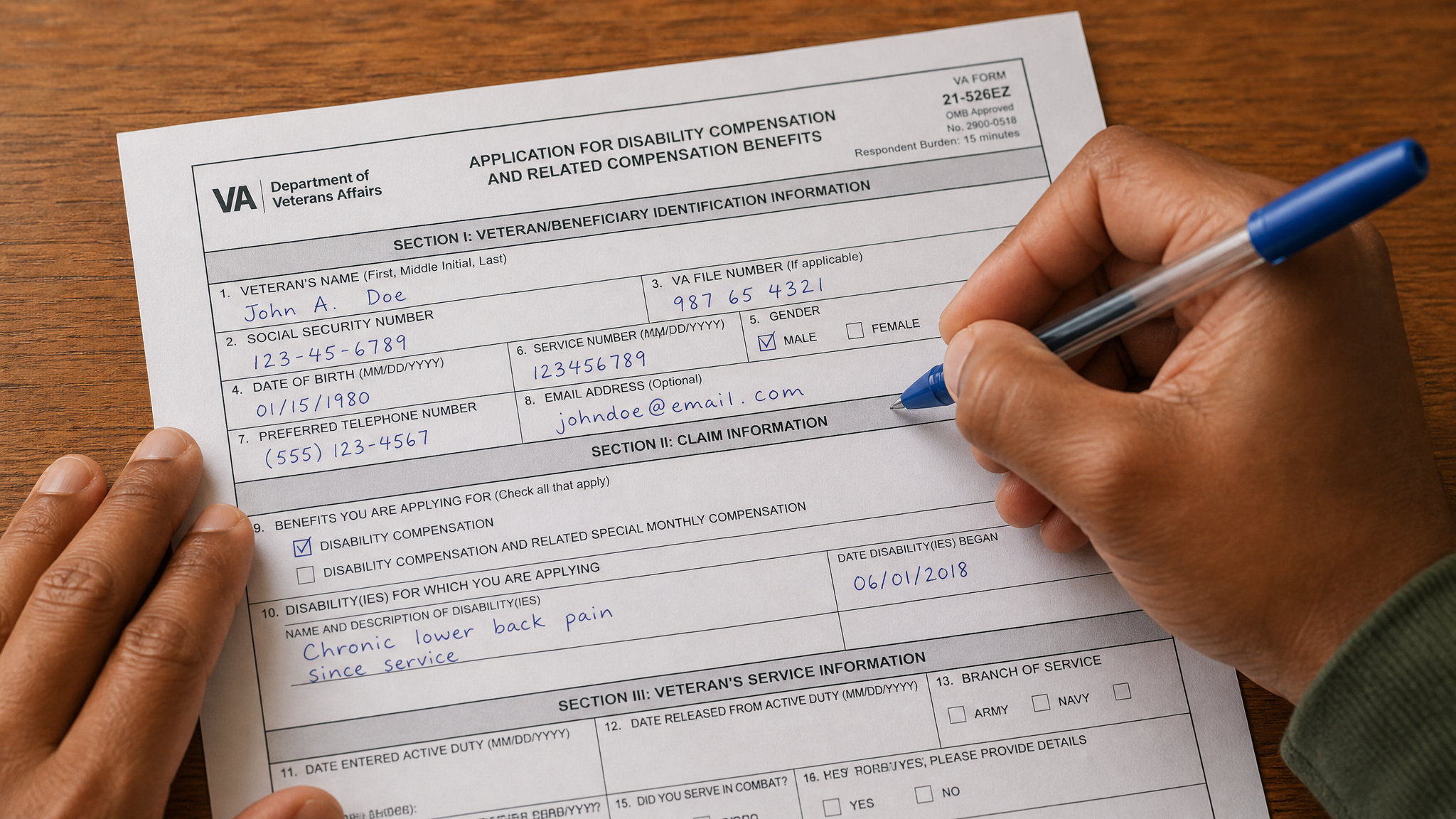
The application itself
Opens a disability compensation claim. Describe the toxic-exposure activity and the condition you are connecting to it.
Intent to File
Locks in your effective date for up to a year while you gather documentation. File this today if you suspect you qualify.
Prove the exposure
Deployment orders, unit records, and buddy statements document the toxic-exposure activity. This is the foundation of the TERA finding.

How Strong Is My TERA Claim Right Now?
Check whatever is true for you. Nothing here is saved, sent, or seen by anyone, it stays in your browser and disappears when you close the page. This is not a VA decision; it is a way to see, in plain terms, what your file already has and what is worth gathering.
A documented exposure
Proof of the toxic-exposure risk activity during your service.
A current disability
A present-day condition, diagnosed by a clinician.
A medical nexus
A medical link between the condition and the exposure.
You checked 0 of 10. Every box you checked is a piece of evidence your TERA claim may already stand on, and the blanks are exactly what an accredited records review helps you go find. Nothing here is saved or sent.
A Denial Is Not the End, It Is the Start of the Appeal
A wrong denial is not the final word, the regulations give you a specific way to answer each one. Here is how the most common TERA denials get fixed: the rule that was broken, and the move that fixes it. You generally have one year from the date on your decision letter to act, so if a letter is sitting in a drawer, pull it out now.

They denied you without ever ordering an exam
When the record shows a TERA and a current disability, the statute obligates the VA to provide an exam and a medical opinion. A denial for “insufficient evidence” with no exam skipped a step the law requires, a Supplemental Claim or Higher-Level Review puts that error in front of them.
The C&P exam or opinion was inadequate
The VA owes you an adequate exam. One that was rushed, speculative, or ignored your documented exposure is inadequate as a matter of law. You can request a new exam, and a private nexus opinion carries real weight in rebutting a bad one.
Your TERA was built off a single job code
The assessment must account for every deployment, assignment, and duty, not just the MOS on your DD-214. A narrow TERA that missed the exposure is a correctable error. Supply the orders, unit records, and buddy statements that document what you actually did.
The rating ignored how much the condition limits you
A condition is rated on how much it impairs your work and daily life. If the percentage does not match the life you are actually living, an appeal for an increased rating exists to correct exactly that.
You do not have to figure out which appeal lane to file. Supplemental Claim, Higher-Level Review, or a Board appeal, the right one depends on what went wrong and what new evidence you have. An accredited claims agent (#45147) reads the decision letter, finds the error, and files the appeal that fits, with no upfront cost for representation.
Questions Veterans Ask About TERA
These are the questions veterans ask me about a Toxic Exposure Risk Activity. TERA is easy to misunderstand, and the VA does not always explain it. Your part is to read these answers, then write down every place and job in service where you were around toxic substances, even if no one called it an exposure at the time.
What is TERA?
TERA is a finding about what you actually did in service. A Toxic Exposure Risk Activity (TERA) finding concedes that your duties, assignments, or locations exposed you to a hazard. It is used to support a facts-found claim. It does not by itself grant service connection, you still need a current disability and a medical nexus, but under 38 U.S.C. §1168 it generally obligates the VA to provide an exam and a medical opinion when the record is short of proof.
What does the VA owe me under §1168?
An exam and a medical opinion when the record shows a TERA and a current disability. Under 38 U.S.C. §1168, when the record contains evidence of a toxic-exposure risk activity and a current disability that may be related, the VA is generally obligated to provide a medical examination and obtain a medical opinion. This is the single most important obligation the statute creates, and the one the VA most often ignores.
What evidence do I need for a TERA claim?
Deployment records that document the exposure plus a medical nexus opinion. TERA does not eliminate the nexus requirement. You need (1) service records that document the toxic-exposure activity, deployment orders, unit records, buddy statements, and (2) a medical opinion linking the current disability to that documented exposure. The VA is supposed to provide the exam once the TERA is established, but having your own nexus evidence is a safeguard.
What if my TERA assessment is wrong or missing?
A missing or thin TERA is a correctable error. Supply the deployment orders, unit records, and buddy statements that document what you did, and on appeal, point directly to the §1168 exam-and-opinion obligation the VA skipped. A thin TERA built off a single job code instead of the full record is a common problem, and a winnable issue.
How long does a TERA claim take?
Timelines vary, but filing an Intent to File today protects your effective date now. TERA claims often involve an exam and a records review, which can take time. What you control is your filing date. Filing VA Form 21-0966 (Intent to File) locks in your effective date for up to a year while evidence is gathered.
Is there any cost to have you review my claim?
No, asking a question and an initial review are free, and there is never a fee on a first-time claim. You can ask a question or get a free review at no cost and with no obligation. If you choose to have us represent you, representation begins free, fees are recovery-only and apply only to past-due benefits won on an appeal (never on a first-time claim), governed by 38 CFR §14.636. By federal law we cannot access your file or act on a claim until you sign VA Form 21-22a appointing us, so nothing happens, and nothing is owed, until you decide.
Does TERA apply to Vietnam-era veterans?
Yes, TERA applies to any era, including Vietnam. Vietnam-era veterans who were exposed to toxins during their service, for example, asbestos on Navy ships, industrial solvents in motor pools, or pesticides at military bases, can use the TERA facts-found lane. TERA is based on the documented exposure activity and applies regardless of era.
Does TERA apply to Cold War veterans?
Yes, Cold War service often involved exposures with no automatic coverage at all. Cold War veterans stationed at nuclear facilities, radar installations, missile silos, or research labs may have been exposed to radiation, industrial chemicals, solvents, or experimental materials. TERA is often the only lane available for these exposures. Documentation may include DD-1141 dosimetry records, installation environmental reports, and unit assignment orders.
Does TERA apply to Korean War veterans?
Yes, Korean War veterans can use TERA for documented toxic exposures. Korean War veterans may have been exposed to industrial chemicals, asbestos, cold-weather fuel additives, or decontamination agents. TERA applies to any documented toxic-exposure activity regardless of the era of service. The challenge is documentation, but unit records, ship logs, and buddy statements can establish the exposure even decades later.
Can peacetime veterans use TERA?
Yes, toxic exposure does not require a combat deployment. TERA is based on what you were exposed to during service, not whether you deployed to a combat zone. A mechanic at a stateside motor pool who spent years handling degreasers, a firefighter at a training facility using AFFF foam, or a sailor in an asbestos-lined engine room all have documented toxic-exposure risk activities. Peacetime service records, MOS assignments, and installation environmental data can establish the TERA finding.
Can TERA connect a cancer to toxic exposure?
Yes, TERA exists for exactly this situation. If your cancer developed after documented toxic exposure during service, chemical solvents, PFAS/AFFF, radiation, or other hazards, the TERA facts-found lane lets you pursue the claim. You will need a medical nexus opinion linking the cancer to the specific exposure.
Can TERA connect a cardiac condition to toxic exposure?
Yes, cardiac conditions caused by toxic exposure are claimable under TERA. Cardiac conditions, arrhythmias, cardiomyopathy, valvular disease, caused by chemical, solvent, or radiation exposure can be connected through the TERA facts-found lane. A TERA finding documents the exposure, and a cardiology nexus opinion connects it to the condition. The key is the specificity of the nexus: a cardiologist must address the particular toxin and its known cardiovascular effects.
Can TERA connect a neurological condition?
Yes, neurological conditions linked to toxic exposure can go through TERA. Peripheral neuropathy, cognitive impairment, tremors, and other neurological conditions caused by solvent exposure, heavy metals, pesticides, or other neurotoxins can be claimed through the TERA facts-found lane. Neurotoxic exposure is well-documented in military settings, motor pools, paint shops, weapons maintenance, and medical literature supports the connection. A neurologist nexus opinion is the key evidence.
Can a respiratory condition go through TERA?
Yes, respiratory conditions linked to toxic exposure are claimable under TERA. Chronic rhinosinusitis, restrictive lung disease, or pulmonary fibrosis caused by burn pit smoke, oil-well fire smoke, asbestos, or industrial dust can be pursued through the TERA facts-found lane. The exposure is documented, and a pulmonary nexus opinion ties the specific diagnosis to it.
What if I already have a TERA finding on file but it was built wrong?
A defective TERA can be corrected, it is not a permanent mark. If the VA built your TERA off a single job code and missed the actual duties that exposed you, that is a correctable error. Submit the additional deployment orders, unit records, and buddy statements that document what you actually did. On a Supplemental Claim, this new evidence forces a fresh TERA assessment against the full record.
Can I request my own TERA assessment?
You cannot request a standalone TERA, it is part of the claims process. A TERA finding is generated during the adjudication of a disability claim, not as a separate filing. When you submit a claim on VA Form 21-526EZ describing the toxic-exposure activity and the condition, the VA is supposed to assess whether a TERA exists on your record. What you control is the evidence you submit to support that assessment, deployment records, unit records, buddy statements, and any environmental documentation from the installation.
What does a buddy statement need to say to establish a TERA?
It needs to describe the specific exposure, what, where, when, and how often. A strong buddy statement for a TERA claim describes the toxic hazard (chemicals, smoke, dust, radiation), the location, the approximate dates, and the frequency and duration of exposure. It should be written by someone who served with you and personally witnessed the conditions. Generic statements like "we were exposed to hazards" are too vague. The statement should read like a firsthand account: what was in the air, what was on the ground, how close you were, and how often it happened.
Should I file an Intent to File before gathering TERA evidence?
Yes, always. It protects your effective date. VA Form 21-0966 (Intent to File) locks in your effective date for up to one year. If you suspect you have a TERA claim but need time to gather deployment records, buddy statements, or a medical nexus opinion, filing the Intent to File today means the VA calculates your back pay from today if the claim is eventually granted, not from the date you finally submit the full application.
If TERA gets me service connection, how is the condition rated?
The same way as any service-connected condition, by the VA rating schedule for that body system. A TERA finding only establishes the exposure and triggers the exam obligation. Once service connection is granted, the condition is rated under the standard VA rating schedule (38 CFR Part 4) for the relevant body system, respiratory, neurological, cardiac, musculoskeletal, and so on. The rating percentage is based on how much the condition impairs your work and daily life, not on the pathway that established the connection.
Can I get a higher rating if my TERA condition worsens?
Yes, file for an increased rating whenever the condition gets worse. Once a TERA condition is service-connected and rated, you have the same right to file for an increased rating as any other service-connected veteran. If the condition worsens, submit a claim for increase on VA Form 21-526EZ with current medical evidence showing the decline. The VA should schedule a new C&P exam to assess the current severity.
Can a TERA-connected condition have secondary conditions?
Yes, secondary service connection under 38 CFR §3.310 applies to TERA primaries. Once a condition is service-connected through TERA, any secondary condition caused or aggravated by that primary is claimable under 38 CFR §3.310, the same secondary-connection regulation that applies to all service-connected conditions. For example, if TERA establishes service connection for a respiratory condition, and that respiratory condition causes or worsens a cardiac condition, the cardiac condition can be claimed as a secondary.
How do secondary conditions work with the rating math?
Each secondary is rated separately and combined using VA math, not simple addition. The VA uses combined ratings, not additive. A 30% primary respiratory condition plus a 20% secondary cardiac condition does not equal 50%, it equals 44%, which rounds to 40% under the combined ratings table. Each secondary condition is rated on its own schedule criteria, and all ratings are combined under 38 CFR §4.25. The more conditions you have service-connected, the higher the combined rating climbs, but the math is non-linear, so each new condition adds less than the last.
What does signing a 21-22a actually authorize?
It appoints an accredited representative to access your VA file and act on your claim, nothing more. VA Form 21-22a is the Appointment of Individual as Claimant's Representative. Signing it authorizes an accredited claims agent or attorney to access your VA claims file, submit evidence, and communicate with the VA on your behalf. It does not give anyone power of attorney over your finances, your benefits, or your medical decisions. You can revoke the 21-22a at any time by submitting a written request to the VA.
What does Agent #45147 do that I cannot do myself?
An accredited agent reads the file the way the VA reads it, and knows the procedural errors to exploit. You have every legal right to file your own claim. What an accredited claims agent brings is pattern recognition: knowing which denial language maps to which regulatory error, knowing when a C&P exam was inadequate as a matter of law, knowing how to frame a buddy statement so it survives review, and knowing which appeal lane (Supplemental Claim, Higher-Level Review, or Board) fits the specific error in your case. Accreditation number 45147 means the agent is certified by the VA Office of General Counsel to represent veterans before the VA.
What does representation cost?
Asking a question and the initial review are free. Representation fees are recovery-only and never apply to a first-time claim. There is never a fee on a first-time claim, that is federal law. If you proceed to representation on an appeal (Supplemental Claim, Higher-Level Review, or Board), fees are governed by 38 CFR §14.636 and apply only to past-due benefits awarded as a result of the appeal. No award, no fee. There is no retainer, no hourly rate, and no upfront cost. On Standard Direct-Pay, the VA pays the representative directly from the back-pay award by law, so you never write a check.

Not sure if TERA fits your case?
Most veterans who think they have no claim have simply never had their deployment record reviewed against §1168. That review is free.
The Facts-Found Lane Is Open
If the VA denied your claim or never ordered an exam, that does not mean the door is closed. A TERA finding under §1168 exists for exactly this situation: your service record documents the exposure, and the statute obligates the VA to get an exam and a medical opinion.
First, know what TERA is and what it is not. TERA, the Toxic Exposure Risk Activity, is built on what you actually did: the jobs you worked, the places you were sent, the substances you handled. It is not a presumption, and there is no presumptive list under TERA. A presumption says place plus dates plus listed diagnosis equals service connection. TERA says your record shows you were exposed, so under 38 U.S.C. §1168 the VA must order an exam and get a medical opinion on whether your condition is at least as likely as not related to that exposure. You still need a current diagnosis and a nexus. TERA makes the VA do the work of developing that nexus instead of ignoring it.
How the VA looks at it. The rater looks for documentation of the activity in your service records and then for a medical opinion. Here is the trap: the VA often looks at one job code and stops. Your exposure was never limited to your primary MOS. It was driven by your unit, every location you were sent, and every job you were actually given. The mechanic who burned trash, the clerk who lived next to the pit, the Marine who drank the water at Camp Lejeune, none of that shows up on a job code.
What you need to bring. Your personnel file and DD-214. A written statement in your own words describing exactly what you did, where, how often and for how long: the smoke, the fuel, the solvents, the water. Buddy statements from people who did it with you. Unit histories or photos that place you there. And a current diagnosis from your doctor.
Walk through it with me. Step one: file an Intent to File, VA Form 21-0966, to lock the date. Step two: document the activity with records and statements. Step three: file the claim and name the exposure specifically on the 21-526EZ. Step four: when the exam is scheduled, make sure the examiner had the exposure facts in front of them. Step five: if the VA denied without an exam, or the examiner wrote "no literature supports" without explaining why, that is a Duty to Assist failure under 38 CFR §3.159 and an inadequate opinion under Nieves-Rodriguez.
The VA gets this wrong constantly. They build a TERA off a single job code, miss the actual exposure, and deny the claim. That is a correctable error. An accredited records review shows whether §1168 applies to your file, and what evidence the VA missed.
Your part: write down what you did in your own words, track down the people who did it with you, get the diagnosis, and keep every letter the VA sends. I read the record behind the job code, hold the VA to its exam obligation, and challenge the lazy opinion. We work WITH you, not FOR you.

TERA is the VA admitting your service put you in harm’s way, and §1168 obligates the VA to back that up with an exam and a medical opinion. That exam is where a TERA claim is proven or lost. Watch the official VA videos below so you know what a proper toxic-exposure exam looks like, then hold the VA to it.
Know What the C&P Exam Should Look Like
TERA claims almost always require a C&P exam, the statute is built around the exam-and-opinion obligation. These are produced by the VA itself, including an official update on toxic-exposure benefits.
Your VA Claim Exam: What to Expect
Tips to Prepare for Your VA Claim Exam
VA Benefits: Toxic Exposure Update