Special Monthly Compensation · 38 CFR §3.350
Special Monthly Compensation (SMC)
38 CFR §3.350, The compensation paid above 100%, for losses the percentage schedule cannot price
The rating schedule stops at 100%. Special Monthly Compensation is what the law pays after that, for the losses a percentage cannot honestly price. It is also the benefit the VA misses most often, which is why an SMC audit of an existing file so frequently produces a retroactive award.
What SMC Actually Is
The VA rating schedule stops at 100%. Special Monthly Compensation is what the law does after that. It exists because some losses, a hand, a foot, sight, the ability to bathe or dress yourself, the need for another human being to keep you safe in your own home, are not adequately compensated by a percentage. The schedule has no honest way to price them. SMC is how the statute prices them.
SMC is set by statute at 38 U.S.C. §1114(k)–(t) and implemented at 38 CFR §3.350. It is not a percentage. Each level is a fixed monthly dollar figure that replaces or supplements the regular rate.

You Do Not Have to Apply for SMC
You are not required to apply for SMC. The VA is obligated to consider it whenever the evidence already in your file raises entitlement. It frequently does not. That failure is not a closed door, it is a retroactive award waiting to be claimed.
The Rating Schedule, Spelled Out
The entire Special Monthly Compensation ladder at 38 CFR §3.350, in statutory order. Every level that exists appears here. Read it with your own code sheet open, find the level that matches what your records already document, and mark any level where your evidence seems to fit but the VA never addressed it.
SMC-K is not a step on the ladder. It is a flat monthly amount paid on top of your regular combined rating, and on top of any other SMC level you hold. It can be awarded more than once for separate qualifying losses. The graduated ladder that follows, L through T, works differently. Each level replaces the regular 100% rate with a higher fixed amount. The levels ascend in severity, you are paid at one level, plus any SMC-K awards you hold.
Aid & Attendance / Loss of Both Feet, §3.350(b). Anatomical loss or loss of use of both feet; Anatomical loss or loss of use of one hand and one foot; Blindness in both eyes with visual acuity of 5/200 or less; Permanently bedridden; So helpless as to be in need of regular aid and attendance.
Intermediate Rate, §3.350(f)(1). An intermediate rate between L and M, awarded where the disability picture falls between the two statutory levels.
Loss of Use of Both Hands, §3.350(c). Anatomical loss or loss of use of both hands; Anatomical loss or loss of use of both legs at a level, or with complications, preventing natural knee action with prosthesis in place; Anatomical loss or loss of use of one arm and one leg at levels preventing natural elbow and knee action with prostheses in place; Blindness in both eyes having only light perception; Blindness in both eyes leaving the veteran so helpless as to be in need of regular aid and attendance.
Intermediate Rate, §3.350(f)(1). An intermediate rate between M and N.
Loss of Use of Both Arms, §3.350(d). Anatomical loss or loss of use of both arms at levels preventing natural elbow action with prostheses in place; Anatomical loss of both legs so near the hip as to prevent the use of prosthetic appliances; Anatomical loss of one arm and one leg so near the shoulder and hip as to prevent the use of prosthetic appliances; Blindness in both eyes without light perception.
Intermediate Rate, §3.350(f)(1). An intermediate rate between N and O.
Statutory Maximum Combinations, §3.350(e). Anatomical loss of both arms so near the shoulder as to prevent the use of prosthetic appliances; Conditions entitling the veteran to two or more of the rates provided at 38 U.S.C. §1114(l) through (n), no condition being considered twice; Bilateral deafness rated at 60% or more (with service connection for total deafness in one ear) in combination with service-connected blindness with light perception only; Service-connected total deafness in one ear with blindness of both eyes having only light perception or less; Complete helplessness from paraplegia with loss of anal and bladder sphincter control.
Intermediate Rates Above O, §3.350(f)(2). Intermediate rates between the levels at O and R, awarded where a disability picture exceeds O but does not meet R.
Aid & Attendance at the Maximum, §3.350(h)(1). Entitled to the maximum rate under O (or the maximum intermediate rate under P) and, in addition, in need of regular aid and attendance.
Higher Level of Care, §3.350(h)(2). Entitled to R.1 and, in addition, in need of a higher level of care, personal health-care services provided in the home by a person under the regular supervision of a licensed health-care professional; The care must be such that, without it, the veteran would require hospitalization, nursing home care, or other residential institutional care.
Housebound, §3.350(i). A single service-connected disability rated 100%, plus additional service-connected disability or disabilities independently ratable at 60% or more, separate and distinct, involving different anatomical segments or bodily systems; OR permanently housebound by reason of service-connected disability, substantially confined to the dwelling and immediate premises, and reasonably certain the confinement will continue throughout the veteran’s lifetime.
Traumatic Brain Injury, §3.350(j). A service-connected traumatic brain injury with residuals requiring regular aid and attendance; Not otherwise eligible for the higher level of aid and attendance under R.2; In the absence of that regular aid and attendance, the veteran would require hospitalization, nursing home care, or other residential institutional care; Paid at the same rate as R.2.
Anatomical loss or loss of use of one or more creative organs
Anatomical loss or loss of use of one hand
Anatomical loss or loss of use of one foot
Blindness of one eye having only light perception
Deafness of both ears, having absence of air and bone conduction
Complete organic aphonia with constant inability to communicate by speech
Anatomical loss of both buttocks
In women, loss of 25% or more of tissue from a single breast or both breasts in combination, or acquired complete absence of one or both breasts
The Half-Step Rules, How You Move Up the Ladder
Most veterans do not realize the ladder has escalators built into it. Under 38 CFR §3.350(f)(3) and (f)(4), additional service-connected disabilities can push you to a higher SMC level even when the qualifying loss itself has not changed. Check every separate rating you hold against these two rules.

The 50% Escalator, §3.350(f)(3)
If you are entitled to a level between L and O and have additional service-connected disability independently ratable at 50% or more, you move to the next higher intermediate rate, the half-step. The additional disability cannot be one already used to establish the underlying SMC level.
The 100% Escalator, §3.350(f)(4)
If that additional independent disability is ratable at 100%, you move up a full step, L becomes M, M becomes N, and so on up the ladder. Again, the disability must be separate and distinct from the loss that established your level.
Aid & Attendance Is Proven in a Doctor’s Office, Not on a Form
Every SMC level above K turns on a clinical finding, loss of use, the need for regular aid and attendance, housebound status, the need for a higher level of care. None of that is established by describing it in a personal statement. It is established when a clinician documents it. If you cannot dress yourself, cannot bathe without help, cannot safely be left alone, or have not left your home in months, that needs to be in your medical record.
Where to start: MyVA411 at 800-698-2411 is available 24/7, ask to be transferred to your medical center’s scheduling line. VA Health Benefits at 877-222-8387 runs Mon–Fri 8 a.m.–8 p.m. ET for enrollment and eligibility. The Veterans Crisis Line is 988, then press 1, available 24/7, or text 838255, with no enrollment required.
A clinician decides what your record says, this page describes what to ask for, not a diagnosis. If this is an emergency, call 911.

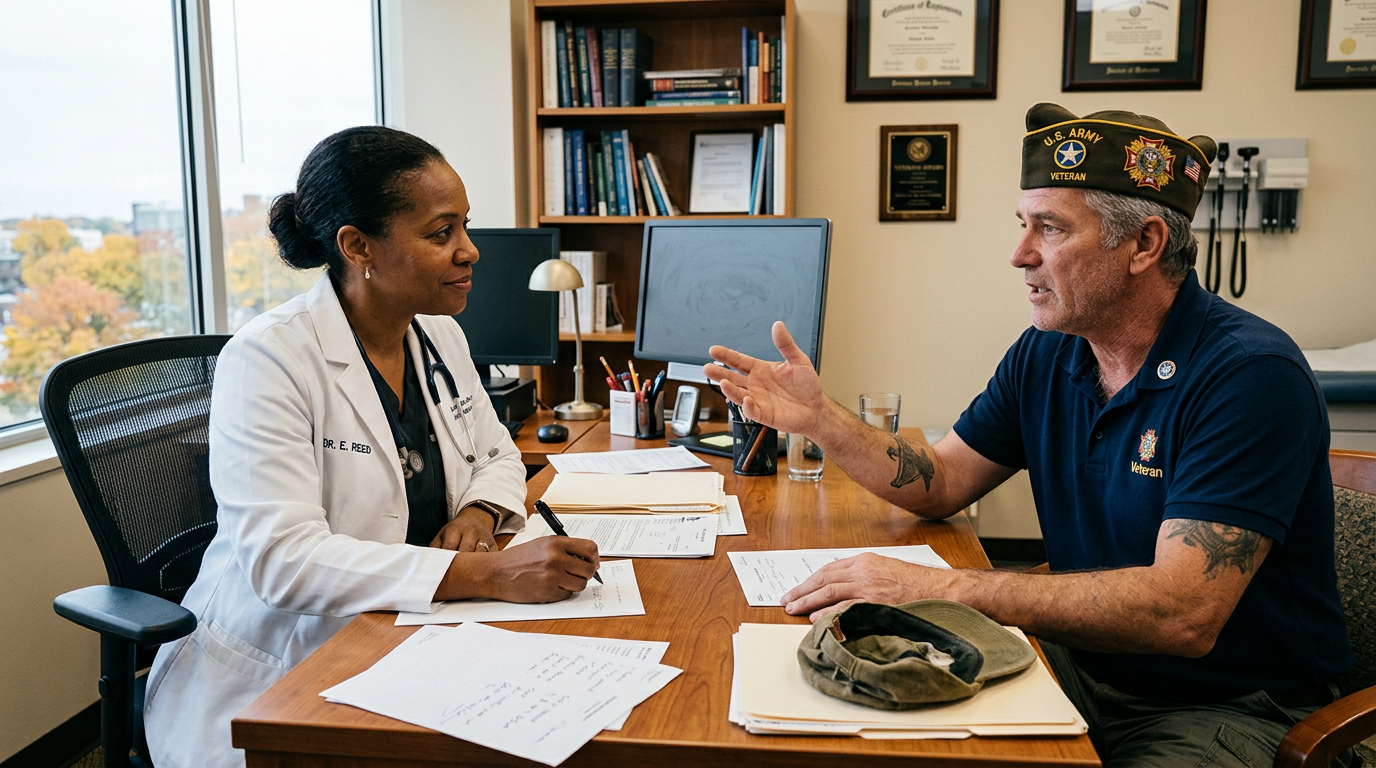
Ask your primary care provider to complete VA Form 21-2680 (Examination for Housebound Status or Permanent Need for Regular Aid and Attendance), it is the single most important document for SMC-L through R.

Ask for the specific functions to be documented by name: dressing, bathing, feeding, toileting, prosthetic adjustment, and protection from the hazards of your daily environment.

If a family member provides your care, ask that the caregiver’s role and hours be recorded in the visit note.

If you have a service-connected TBI and need regular aid and attendance, say so explicitly, SMC-T exists for exactly that and is almost never granted on the VA’s own initiative.
Where the VA Gets This Wrong
SMC errors are some of the most expensive mistakes in the whole system, because each one can mean years of a higher monthly rate that was earned and never paid. These are the errors I look for first. Lay your rating decisions next to this list and check every one.
Never screening for SMC at all, the duty to maximize benefits under Akles v. Derwinski (1991) requires the VA to consider SMC whenever the record raises it, with or without an application. Most files are never checked.

Treating "loss of use" as though it requires amputation, §3.350(a)(2) defines it functionally: no effective function remaining beyond what an amputation stump with a prosthesis would provide.

Missing SMC-K for erectile dysfunction, which is loss of use of a creative organ and one of the most frequently overlooked awards in the system, including where it arises secondary to PTSD medication, diabetes, or prostate treatment.

Failing to apply Bradley v. Peake (2008), a TDIU award based on a single condition can satisfy the 100% requirement for SMC-S housebound when other conditions combine to 60% or more.

Ignoring the half-step escalators at §3.350(f)(3) and (f)(4), which raise the SMC level based on additional independent disabilities the veteran already has rated.
Granting SMC-R.1 where the evidence supports R.2, the higher level of care standard turns on whether, without in-home care, the veteran would require institutional care. That question often goes unasked.

Overlooking SMC-T entirely for veterans with service-connected TBI residuals requiring regular aid and attendance.

Assigning the correct level but the wrong effective date, where the evidence establishing entitlement was already of record, the effective date runs from that evidence, not from the day the VA finally noticed.
The Math Behind SMC-S (Housebound)
SMC-S requires a single disability at 100% plus other conditions combining to 60% or more. This diagram shows how VA combined-rating math works, and why the 60% side is more reachable than most veterans assume. The 60% has to come from conditions separate and distinct from the 100% disability, so I look at every rating on your decision, not just the big one. Run your own numbers below, then check whether the VA ever considered SMC-S on its own. It often does not.
Why 50% + 30% Does NOT Equal 80%
The VA uses “whole-person” math, not simple addition. This is how ratings really stack.
The VA always begins from a whole, healthy person (100%).
50% of 100 is subtracted. You have 50% “efficiency” left.
30% is taken from the REMAINING 50 (0.30 × 50 = 15). 50 − 15 = 35 left.
100 − 35 = 65, then rounded to the nearest 10 → 70%.
Bottom line: 50% and 30% combine to 65% → rounded to 70%, not 80%. The same math turns two 50% ratings into 75% → rounded to 80%, not 100%. Every rating you add is worth less than the last. That is why which conditions you claim, and in what order, matters as much as how many.
The Advocate’s Take
SMC is where the money is, and it is the last place veterans look, because nobody tells them it exists. I have reviewed files where a veteran sat at 100% for years while the medical records plainly documented a loss that entitled them to SMC-K, or a spouse who had been bathing and dressing them the entire time. That is not a close call. That is a benefit that was earned, documented, and never paid.
Here is how the VA looks at it. SMC lives at 38 U.S.C. §1114(k) through (t) and 38 CFR §3.350. It is not a percentage, it is a ladder of fixed monthly rates. SMC-K is paid on top of your regular rating for the loss, or loss of use, of a creative organ, a hand, a foot, or an eye, and that includes erectile dysfunction that is service connected. SMC-L covers conditions like loss of use of both feet, blindness in both eyes at a defined level, being permanently bedridden, or needing regular aid and attendance under 38 CFR §3.352. SMC-S is the housebound rate: one condition rated 100% plus additional disabilities independently ratable at 60% or more, or being substantially confined to your home. Levels M, N, O, R and T stack higher for more severe combinations, with half-steps in between. The VA is supposed to consider SMC on its own whenever the record raises it. It often does not.
What you need. Medical records that describe function, not just diagnoses: can you dress, bathe, feed yourself, use the toilet, protect yourself from the hazards of daily living? A VA Form 21-2680 examination for housebound status or aid and attendance, completed by your doctor. A statement from your spouse or caregiver describing exactly what they do for you each day and how often. And for loss of use, an opinion that no effective function remains other than what an amputation stump with a prosthesis would provide.
Walk through it with me. Step one: I read your code sheet and every rating decision to see what the VA already found. Step two: I check your file against the full §3.350 ladder, K through T, including the half-steps. Step three: for anyone on TDIU, I ask the Bradley question: is there one disability that alone supports TDIU, with separate disabilities rated 60% or more, which can open SMC-S? Step four: I check the effective date, because if the evidence of entitlement was in the record years ago, the effective date can run from that evidence. Step five: we file the right claim, in the right lane, with the caregiver statements and medical evidence attached from the start.
The pitfalls: assuming 100% is the ceiling, letting pride keep you from documenting that someone helps you dress, and missing SMC-K for a condition everyone is embarrassed to mention. Embarrassment has cost veterans thousands of dollars.
Your part: tell your doctor and me the truth about what you can no longer do, and have your caregiver write it down in plain words. I audit the ladder, I build the evidence, and if the entitlement was sitting in the record and the VA missed it, we go get the back pay too. We work WITH you, not FOR you.

Special Monthly Compensation is paid on top of your schedular rating, and the VA rarely awards it unless someone forces the issue. The evidence for SMC comes out of the same exams and records as the rest of your claim. Watch the official VA videos below, then look at your file for the loss of use, housebound, or aid and attendance facts the VA left on the table.
Beyond 100%, How the Rating Math Builds to SMC
Special Monthly Compensation sits on top of the schedular system. These official VA videos show how the combined rating and compensation are built, the foundation SMC is added to. Watch them first, then check your own decision letter for any loss of use, housebound status, or need for daily help the VA never addressed.
How Your Combined Rating Is Calculated
How VA Disability Compensation Works
Questions Veterans Ask About SMC
These are the questions veterans and their families ask me most once they learn SMC exists. Read through them before you call anyone, and write down the ones that match your situation. The more of your own facts you bring to the conversation, the faster we can tell whether a level was missed.
Do I have to apply for SMC separately?
No, and this is where most veterans lose money. SMC is supposed to be granted whenever the evidence of record raises entitlement. Under the VA’s duty to maximize benefits (Akles v. Derwinski, 1991), the VA must consider SMC without a separate application whenever the record shows a qualifying loss. In practice the VA routinely fails to do this, which is why an SMC audit of an existing file so often produces a retroactive award.
What does "loss of use" actually mean?
Loss of use does not require amputation. Under 38 CFR §3.350(a)(2), loss of use of a hand or foot exists when no effective function remains other than that which would be equally well served by an amputation stump at the site of election with a suitable prosthesis. The test is functional, not anatomical: if the remaining function is no better than what a prosthesis would give you, that is loss of use. Erectile dysfunction, for example, is loss of use of a creative organ and qualifies for SMC-K even though nothing was removed.
Can I receive SMC-K more than once?
Yes. SMC-K is payable for each separate qualifying loss, subject to statutory limits on the total combined payment. A veteran with loss of use of a creative organ and deafness of both ears may be entitled to two K awards. Each is a flat monthly amount added on top of the underlying compensation.
What is the half-step rule?
Under 38 CFR §3.350(f)(3) and (f)(4), additional independent disabilities can raise your SMC level. If you are entitled to a level between L and O and have additional service-connected disability independently ratable at 50% or more, you move to the next higher intermediate rate. If that additional disability is independently ratable at 100%, you move up a full step. Those disabilities cannot be the same ones already used to establish the underlying SMC level.
Does TDIU count as the 100% rating for SMC-S housebound?
It can. Under Bradley v. Peake (2008), a TDIU award based on a single service-connected disability can satisfy the "single disability rated 100%" requirement for SMC-S, provided the TDIU was granted on the basis of that one condition and other service-connected disabilities independently combine to 60% or more. This is one of the most commonly missed awards in the entire system, veterans on TDIU are almost never screened for SMC-S.
What evidence proves aid and attendance?
The controlling factors are at 38 CFR §3.352(a): inability to dress or undress, to keep yourself ordinarily clean and presentable, frequent need of adjustment of a prosthetic device, inability to feed yourself, inability to attend to the wants of nature, or incapacity that requires care or assistance on a regular basis to protect you from the hazards of your daily environment. It is not necessary that all of these exist. The strongest evidence is a completed VA Form 21-2680 from your treating physician documenting the specific functions you cannot perform, supported by treatment records and a caregiver statement.
How far back can SMC be paid?
SMC follows the same effective-date rules as any other benefit under 38 CFR §3.400. If the VA failed to grant SMC when the evidence in the file already established entitlement, the correct effective date is the date that evidence was received, not the date someone finally noticed. Where a prior final decision misapplied §3.350 on evidence already of record, a Clear and Unmistakable Error motion can reach back to the original decision date.
The Fine Print
SMC levels and criteria are reproduced from 38 CFR §3.350. Payment amounts change annually with the cost-of-living adjustment; any figure discussed on this site is an estimate. This page is general information, not legal or medical advice, and this office is not the Department of Veterans Affairs.

Every Level the VA Can Assign You
These percentages come straight out of the rating schedule that governs special monthly compensation (smc), the governing diagnostic code. Read them slowly. If your current rating does not match what your records actually show, that gap is exactly what an appeal exists to correct.
L
**Aid & Attendance / Loss of Both Feet**, §3.350(b).
L½
**Intermediate Rate**, §3.350(f)(1).
M
**Loss of Use of Both Hands**, §3.350(c).
M½
**Intermediate Rate**, §3.350(f)(1).
N
**Loss of Use of Both Arms**, §3.350(d).
N½
**Intermediate Rate**, §3.350(f)(1).
O
**Statutory Maximum Combinations**, §3.350(e).
P
**Intermediate Rates Above O**, §3.350(f)(2).
R.1
**Aid & Attendance at the Maximum**, §3.350(h)(1).
R.2
**Higher Level of Care**, §3.350(h)(2).
S
**Housebound**, §3.350(i).
T
**Traumatic Brain Injury**, §3.350(j).
Building a Special Monthly Compensation (SMC) Claim That Wins
Every claim stands on three legs. Knock one out and the claim falls over, no matter how bad your symptoms are. Before you file, look at your file and find all three. If one is missing, that is the piece to build first. The VA will not build it for you, and filing without it usually just buys you a denial letter and lost time.
 01
01A current diagnosis
A doctor has to say you have it, now, in writing. Not "reports symptoms of", a diagnosis. Without this leg, nothing else in the file matters.
 02
02A link to your service
An event, an injury, an exposure, or an already service-connected condition. Service records, unit records, buddy statements, and your own account all count as evidence.
 03
03A nexus that ties the two together
A medical opinion stating it is at least as likely as not that your service caused or aggravated the condition. That phrase is a legal standard: 50 percent or better. It is the leg most denials break.
Document the problem before you file
• Keep a dated symptom log for at least 30 days. Frequency, severity, and what it stopped you from doing.
• Get statements from people who see it, a spouse, a coworker, a battle buddy. Lay evidence is legal evidence.
• Pull your private treatment records. The VA only has to help; it does not have to go find everything.
• Write down what you have stopped doing. Lost work, lost sleep, lost activities. That is what impairment looks like on paper.
Your Rights in This Process
Most veterans walk into this system without knowing the rules the VA itself has to follow. That is how claims get denied for missing evidence the VA was supposed to help you find, and how exams get done by the wrong clinician. These six rights are written into federal regulation. Know them before you file, and make the VA honor every one of them when it decides your claim.

It costs nothing to file
Filing a VA claim is free. Accredited representatives may only charge for work on an appeal after an initial decision, and those fees are capped by 38 CFR §14.636.

The VA has a Duty to Assist you
Under 38 CFR §3.159 the VA must help you get the evidence it needs, and it must tell you what is missing before it denies you for missing it.

You can ask for a different examiner
You may request a trauma-informed clinician, or a clinician of a specific gender, for a C&P examination. Ask before the exam is scheduled.

You can claim every condition you have
There is no limit and no penalty. Primary conditions, secondary conditions, and conditions made worse by service all get filed.
You can appeal and be re-evaluated
A denial is not the end. You may submit new evidence, request a higher-level review, appeal to the Board, and ask for re-evaluation when your condition worsens.

You must be considered for TDIU
If your service-connected conditions keep you from holding substantially gainful employment, you may be paid at the 100 percent rate without a 100 percent rating.
When You Are Ready to File
Talk to an accredited representative before you file. It costs nothing to ask, and the order you file in changes what the VA is allowed to award you. Albert L. Thombs Jr. is VA-Accredited Claims Agent #45147. A short conversation now can save you a year spent waiting in the wrong review lane.
Your part starts at the kitchen table. Pull your DD-214, your rating decision if you have one, and the names of every doctor who treats you today. Under 38 CFR 3.159 the VA has to help you gather records, but it can only chase the records you tell it about. Leave a doctor off the 21-4142 and that treatment may never reach your file.

The aid and attendance exam
This is the exam form your doctor completes to show you need regular help with daily living or are housebound. It feeds SMC-L and the housebound rate under §3.350 and §3.352.
Get the exam form on VA.govRaise the SMC issue
SMC is often owed without being asked for, but I never count on the VA to find it. Name the loss of use, the need for aid, or the housebound status on the claim.
File the claim on VA.govThe caregiver's statement
The person who helps you dress, bathe, or take your medications describes it best. Their statement on this form shows the need the exam form summarizes.
Get the lay statement form on VA.govKeep Reading
One page never tells the whole story of a claim. The VA rates every condition on its own evidence, its own exam and its own diagnostic code, and the pieces connect in ways most veterans never see until a decision letter lands. These are the pages that pick up where this one stops. Read them before you file, not after a denial, because the cheapest fix in this process is the mistake you never make.