Family & Survivors
Survivors’ Benefits (DIC)
Dependency and Indemnity Compensation for surviving spouses and children
Dependency and Indemnity Compensation (DIC) is a monthly benefit for survivors of veterans who died from a service-connected condition, or who held a total rating for a qualifying period. Survivors often do not know DIC exists, or they assume the cause of death rules them out without checking. The VA will not come looking for you. Your part is to gather the death certificate, the veteran's rating history, and your marriage or birth records, and apply.
Two Paths to DIC
Dependency and Indemnity Compensation is payable to eligible survivors on either of two independent theories. The first: the veteran died from a service-connected condition. The second, under §3.22: the veteran was rated totally disabled, schedular or TDIU, for at least 10 continuous years immediately preceding death, or for at least 5 years from the date of discharge, or for at least 1 year if the veteran was a former prisoner of war who died after September 30, 1999. Under the second path the cause of death does not matter at all.
The second path is widely unknown, and it is the one most often left unclaimed. A spouse told “he died of cancer, not his PTSD” may still be entitled to DIC purely because of how long the total rating had been in place.

Who May Qualify
Surviving spouse
Married to the veteran for at least one year before death, or married before the expiration of 15 years after the end of the period of service in which the fatal condition began or was aggravated, or a child was born of the marriage. Remarriage at age 57 or older does not end DIC, and for remarriages on or after January 5, 2021, the protected age is 55.

Dependent children
Unmarried children under 18, under 23 if attending an approved school, or of any age if permanently incapable of self-support before age 18 (a “helpless child” claim under §3.356).

Dependent parents
Income-based DIC is available to a veteran’s parents who were dependent on the veteran. Filed on VA Form 21P-535.

Survivors claiming accrued benefits
Separate from DIC, under §3.1000 a survivor may claim benefits the veteran was owed but had not been paid at death, including on a claim still pending when the veteran died. There is a one-year filing deadline from the date of death.
The Cause-of-Death Fight
Whether a service-connected condition caused or contributed to death is governed by §3.312, and the standard is far more generous than survivors are usually told. A principal cause is one that singly or jointly with another condition was the immediate or underlying cause of death. A contributory cause is one that contributed substantially or materially, combined to cause death, or aided or lent assistance to the production of death.
That means the service-connected condition does not have to be on the death certificate, and it does not have to be the sole cause. Service-connected diabetes that accelerated fatal cardiac disease is a contributory cause. Service-connected PTSD that drove the substance abuse that destroyed the liver is arguable. Establishing it usually requires the same forensic medical review as a disability claim, a physician reading the terminal records and writing the opinion the death certificate never contained.

What DIC Actually Pays in 2026
For a veteran who died on or after January 1, 1993, every eligible surviving spouse receives the same flat base rate: $1,699.36 a month, effective December 1, 2025. It is tax-free, it is not reduced by your income, and it rises every year with the cost-of-living adjustment. DIC is not a needs-based benefit. A widow with a good job and a widow with nothing receive the same base amount.
The add-ons stack on top of that base. $421.00 for each dependent child under 18. $360.85 if the veteran was rated totally disabled for the 8 continuous years before death and you were married that entire time. $421.00 if you yourself need the regular aid and attendance of another person, or $197.22 if you are housebound (one or the other, not both). And a $359.00 transitional benefit for the first two years when there is a child under 18 on the award.
Those add-ons are where survivors get shorted. The VA pays what is on the claim. If nobody tells them you are housebound, or that the total rating ran for eight years, the add-on never shows up. Read your award letter line by line against this list, and run your numbers through the DIC calculator on this site to see the total your family should be receiving.

Remarriage, SBP, and the End of the Widow’s Tax
Remarrying used to end DIC, full stop. That is no longer the rule. Under 38 U.S.C. §103(d), a surviving spouse who remarries at age 57 or older keeps DIC, and for remarriages on or after January 5, 2021, the protected age dropped to 55. If your DIC was stopped after a remarriage that should have been protected, ask the VA to reinstate it. That happens more often than it should.
The other change families miss is the Widow’s Tax. For decades, a surviving spouse receiving both a military Survivor Benefit Plan (SBP) annuity and VA DIC had the SBP cut dollar for dollar by the DIC. Congress phased that offset out, and since January 1, 2023, survivors receive both in full. If your SBP is still being reduced by your DIC amount, that is a pay-record problem at DFAS, not the law, and the difference can add up to years of money.

Deaths Before 1993 Are Paid on a Different Scale
The flat base rate only applies to deaths on or after January 1, 1993. For a veteran who died before that date, surviving-spouse DIC is set by the veteran’s military pay grade, and the surviving spouse receives the flat rate or the pay-grade rate, whichever is greater. Junior enlisted grades pay the same as the flat rate. Senior NCO and officer grades pay more.
If you are the widow of a career senior NCO or officer who died before 1993 and your award letter shows the flat rate, that is worth a second look. Have your veteran’s final pay grade from the DD-214 in hand and compare it to the VA’s pay-grade table for the current year.

Children: Under 18, in School to 23, and the Helpless Child
A child under 18 is normally carried on the surviving spouse’s award as an add-on rather than paid separately. Between 18 and 23, a child attending an approved school can keep receiving DIC, and the school attendance is reported to the VA on VA Form 21-674. Do not let that payment lapse at the 18th birthday because nobody filed the form.
A child who became permanently incapable of self-support before age 18, what the regulation calls a helpless child under 38 CFR §3.356, can be carried on DIC with no age cap. Adults in their forties and fifties still qualify under this rule, and it gets missed for decades. The proof is medical: records showing the disabling condition existed before the 18th birthday and has kept the child from supporting themselves since.

Parents’ DIC Is a Completely Different Benefit

A surviving parent of a veteran whose death was service-connected can also receive a monthly benefit, but unlike a spouse’s DIC, Parents’ DIC is income-based. When countable income goes over the limit set by law, nothing is payable, and both the rates and the limits change every year. If the parent lives with a spouse, that spouse’s income counts too.
What brings many parents under the limit is unreimbursed medical expenses, which reduce countable income. Insurance premiums, prescriptions, in-home care, and assisted living costs all belong on the claim. A parent files on VA Form 21P-535, and a parent who was told no years ago because of income should run the numbers again with the medical expenses included.
The One-Year Clock That Decides How Far Back the Money Goes
Under 38 CFR §3.400(c), a DIC claim the VA receives within one year of the date of death is paid back to the first day of the month the veteran died. File on day 366 and the award generally starts from the date the VA receives the claim. Every month in between is gone, and no appeal brings it back.
A second clock runs at the same time. If the veteran died with a claim or appeal still pending, 38 U.S.C. §5121A and 38 CFR §3.1010 give an eligible survivor one year to request substitution and step into that case with the veteran’s original effective date. That pending claim is often where the largest retroactive payment lives. Both clocks start on the date of death, and both run quietly. If you are anywhere near either one, call this week, not next month.

When the Death Was Not Service-Connected: Survivors Pension
If your veteran served during wartime and the death had nothing to do with service, DIC may not be your door. Survivors Pension is. It is a tax-free, needs-based monthly benefit for an unmarried surviving spouse or an unmarried dependent child of a wartime veteran, and under 38 CFR §3.3(b)(4) the cause of death does not matter at all.
The veteran needs the same wartime service the veterans pension requires under §3.2: generally 90 days of active duty with at least one day in a war period (or 24 months of continuous duty for someone who entered on or after September 8, 1980), and a discharge other than dishonorable. Combat is not required. A cook stateside in 1968 meets the test. The dates are on the DD-214.
Survivors Pension is not a flat check. The VA sets a Maximum Annual Pension Rate (MAPR) and pays the gap between your countable income and that rate, split into twelve payments. The 2026 ceilings, effective December 1, 2025, for a surviving spouse:

Basic: $11,699 a year, or $15,311 with one dependent child

Housebound: $14,298 a year, or $17,902 with one dependent child

Aid and Attendance: $18,697 a year, or $22,304 with one dependent child

Each additional dependent child adds $2,984 a year

Net worth limit: $163,699 (December 1, 2025 through November 30, 2026), counting assets plus annual income. Your home and your vehicle do not count.
The Medical-Expense Deduction That Decides Most Survivor Pension Claims
Most widows who tell me they "make too much" for pension have never run the math with their medical costs taken out. Under 38 CFR §3.272, unreimbursed medical expenses above 5 percent of the MAPR come off your income before the VA compares you to the ceiling. That covers Medicare and supplemental premiums, prescriptions, in-home aides, adult day care, and in many cases the care portion of an assisted living or memory care bill.
Here is a worked example. A surviving spouse lives on $15,000 a year from Social Security and a small pension, pays $20,000 a year for daily help, and needs Aid and Attendance. The ceiling is $18,697. Her care costs above the $585 threshold wipe out her countable income, which drops to $0. The VA pays the full gap: $18,697 a year, about $1,558 a month, tax-free.
Leave those care costs off the claim and the same woman gets about $308 a month. Same person, same income, same needs. The deduction is the whole game, and the VA is not going to compute it for you. The burden of proving every expense is on you, so keep every receipt, statement and premium notice.
If you need hands-on help with bathing, dressing, eating, toileting or medication, the Aid and Attendance rate applies. If a permanent disability keeps you substantially confined to home, Housebound applies. You cannot get both at once; the VA pays the higher. Your doctor documents the need on VA Form 21-2680, and a vague form gets denied while one that describes the real daily help gets granted.

The Three-Year Look-Back That Catches Good Families
Under 38 CFR §3.276, the VA looks back 36 months from the date of your claim at any asset you gave away or sold for less than fair value. If that transfer would have put you over the net worth limit, the VA can impose a penalty period of up to five years with no pension paid.
This is the trap that catches families who moved the house or the savings account to a child "to protect it." Do not sign anything over to family before you talk to someone who knows the pension rules. If a transfer already happened, still ask. The penalty is figured only on the portion that went over the limit, and some transfers can be undone.
DIC or Survivors Pension: One Form, and the VA Pays the Greater
DIC is for a death tied to service, or a veteran who was rated totally disabled long enough before death. It is not means-tested. Survivors Pension is for a wartime veteran whose death had nothing to do with service, and it is means-tested. You cannot be paid both for the same period. The VA pays the greater benefit, and in almost every case that is DIC at $1,699.36 a month base. That is why I test DIC eligibility first, even when the death looks unrelated to service.
One form, VA Form 21P-534EZ, applies for DIC, Survivors Pension and accrued benefits. Filing it protects your date on whichever benefit turns out to be the right one. There is no reason to guess before you file. Get it in, and we sort out the right door after the date is locked.

Accrued Benefits and Substitution Are Not the Same Thing
When a veteran dies with a claim still sitting at the VA, that claim does not have to die with him. There are two different ways to collect, and the difference is real money.
An accrued benefits claim under 38 U.S.C. §5121 and 38 CFR §3.1000 pays what the VA already owed, or could have awarded, based only on the evidence in the file on the date of death. You cannot build the case further. VA medical center records count as constructively in the file even if nobody physically added them, but a private medical opinion obtained after the death does not count.
Substitution under 38 U.S.C. §5121A and 38 CFR §3.1010, for deaths on or after October 10, 2008, lets an eligible survivor step into the veteran’s pending claim or appeal and keep developing it: new exams, new opinions, new evidence, with the veteran’s original effective date. If the veteran died before a needed exam or a private opinion came in, substitution is the route that can still win.
My practical answer is almost always the same: request substitution first, and claim accrued benefits as the backstop. You keep the stronger route and lose nothing.

Who Gets Paid, the Forms, and the Deadlines
The line of succession is set by law, and the VA pays the first living person on the list, not everyone on it. First the surviving spouse, who receives the full amount. Then the veteran’s children in equal shares, including children 18 to 23 in school and a helpless child of any age. Then dependent parents. If no eligible survivor exists, the VA can reimburse whoever paid the last illness and burial expenses, a route funeral-paying adult children almost never hear about.

VA Form 21P-534EZ: a surviving spouse or child applying for DIC, Survivors Pension and accrued benefits on one form. This is the usual starting point.
VA Form 21P-0847: the request to be substituted into a pending claim or appeal. If a case was open at death, this is the form that keeps it alive.

VA Form 21P-601: a standalone accrued claim, or reimbursement of last illness and burial expenses.

VA Form 21P-535: a surviving parent applying for DIC and accrued benefits.
The deadline: accrued benefits and substitution must each be filed within one year of the date of death. The one narrow exception is a lump sum of pension withheld from a competent veteran during hospital, institutional or domiciliary care, which reaches back five years.

Your first month: get the claims file, look for any pending claim, Supplemental Claim, Higher-Level Review or Board appeal, and file 21P-534EZ and 21P-0847 together. There is no penalty for filing both.
Burial Allowances: Pay First, Claim It Back
Burial benefits are a reimbursement, so the order matters. The family generally pays the funeral home first and then files VA Form 21P-530EZ to claim the allowance back. Keep every invoice: funeral home, burial and transportation. For deaths on or after October 1, 2025, the maximums are:

Service-connected death: up to $2,000.00, and there is no deadline to file.

Non-service-connected death: up to $1,002.00 toward burial and funeral costs, plus up to $1,002.00 toward a plot when the veteran is not buried in a national cemetery. File within two years of the burial.

Private headstone or marker: up to $441.00 when the family buys one instead of using the government headstone.

You may not have to file at all. If a surviving spouse is already on the veteran’s VA records, the VA often pays the burial allowance automatically.
National Cemetery Honors and the Memorial Items Families Forget
Burial in a VA national cemetery costs the family nothing for the gravesite, the opening and closing of the grave, a government headstone or marker, a burial flag and perpetual care. A spouse and dependent children can usually be buried there too. The family typically pays only for the funeral-home services it chooses.
In the rush of arrangements, families miss the free honors constantly. Ask for every one your veteran earned:

Burial flag: to drape the casket and then keep, requested through the funeral director or on VA Form 27-2008.

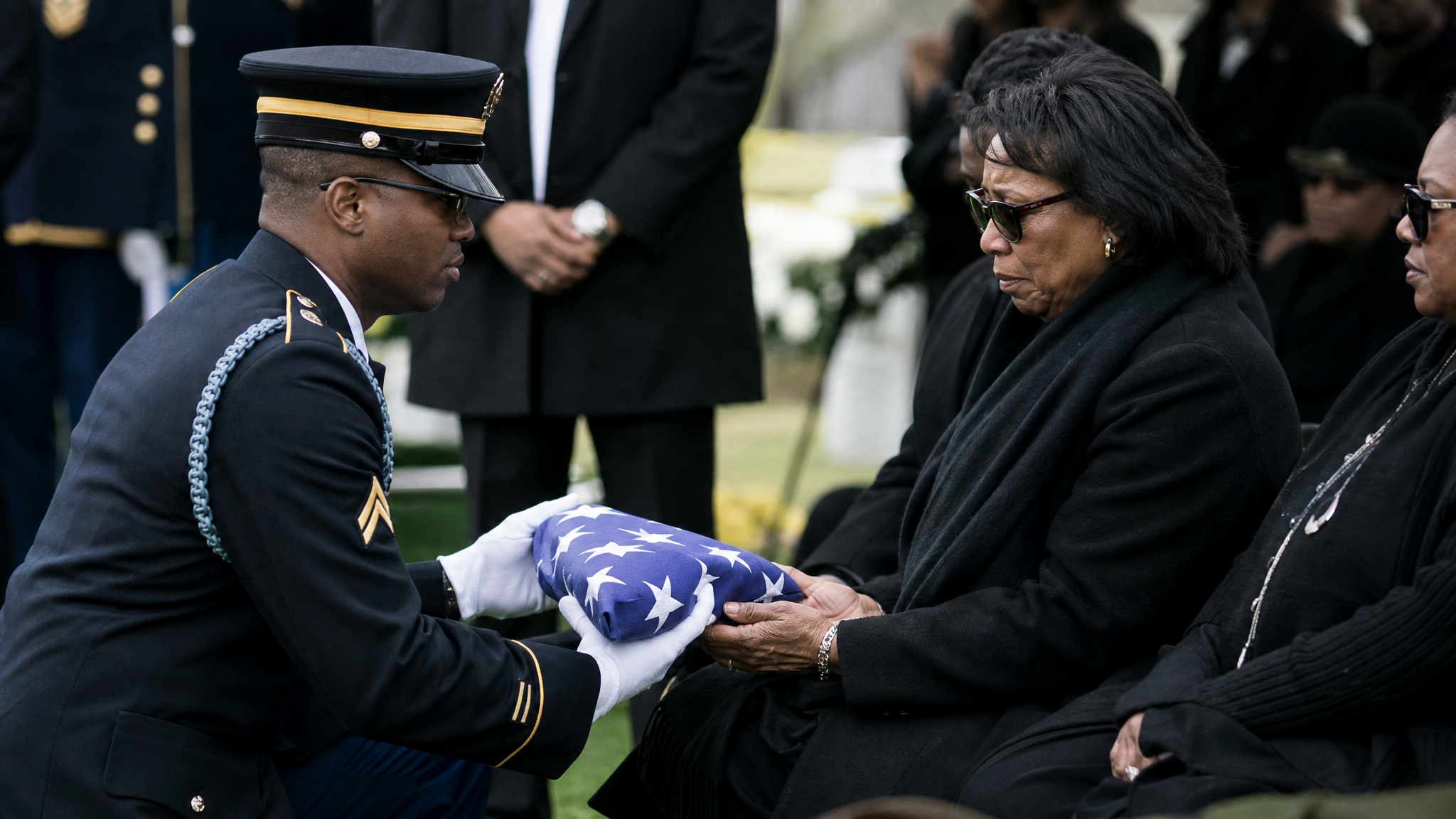
Military funeral honors: at least two uniformed service members, the folding and presentation of the flag, and Taps.

Presidential Memorial Certificate: signed by the President and mailed to the family at no cost.
Headstone, marker or medallion: free for an eligible veteran’s grave even in a private cemetery, on VA Form 40-1330, or a bronze medallion for a headstone the family already bought, on VA Form 40-1330M.
Bereavement counseling: available to grieving family members at no cost.
The Home Loan Benefit Did Not End With Your Veteran
Most surviving spouses are never told this, so I will say it plainly. The VA home loan guaranty can pass to you in your own right under 38 U.S.C. 3701(b)(2). That means a VA-backed loan to buy, build, improve or refinance a home, usually with no down payment and never any private mortgage insurance.
You can qualify as a surviving spouse when your veteran died in service or died of a service-connected condition, or was missing in action or a prisoner of war for at least 90 days.
There is a third door most people never hear about. If your veteran was rated totally disabled long enough before death to meet the same time rules that make a spouse eligible for DIC under 38 U.S.C. 1318, you can qualify even when the death itself was not service-connected.
None of this is automatic, and none of it is announced. The VA will not start it for you. It has to be established with a Certificate of Eligibility, which I cover next.

Remarriage, the Certificate of Eligibility, and the Fee You Should Never Pay
The general rule is that you must have stayed unmarried. The exception has two tests, and you have to pass both: the remarriage happened on or after December 16, 2003, and you were at least 57 when it happened. Remarry at 58 in 2001 and you do not qualify. Remarry at 52 in 2010 and you do not qualify. Do not borrow the DIC remarriage rule here. DIC protects a remarriage at 55 or older on or after January 5, 2021. They are separate tests for separate benefits.
Nothing moves without a Certificate of Eligibility (COE). If you already receive DIC, request it on VA Form 26-1817 with the veteran's DD-214. You can apply online, by mail, or have a VA-approved lender pull it for you, which is usually the fastest. If you are not receiving DIC yet, the DIC claim on VA Form 21P-534EZ usually has to come first, because the DIC award is what proves the service-connected death.
Now the money. Most VA borrowers pay a one-time funding fee. Under 38 U.S.C. 3729(c), a surviving spouse receiving DIC pays none of it. On a $400,000 first-time purchase with less than 5% down, the fee is 2.15%, or $8,600. For you, that is $8,600 that stays in your pocket instead of being rolled into the loan and charged interest for thirty years. The exemption covers purchases, cash-out refinances and Interest Rate Reduction Refinance Loans.
Here is the trap. If the fee was charged before your exemption was on file, or your DIC was later granted with an effective date before closing, a refund is possible, but it is not automatic. You have to ask the lender or the VA Regional Loan Center for it in writing.
Your part: before closing day, look at your COE and your closing disclosure and make sure both show the funding fee as exempt. If you already closed and paid it, bring me the closing disclosure and your DIC award letter, and we will line up the dates. And if payments ever start slipping, contact the VA about loan help before the second missed payment, not after the third. Options shrink fast once a foreclosure referral is made.

The Free Financial Planner and Will Every Insurance Beneficiary Is Owed
When a life insurance check lands in the middle of grief, the people who show up first are usually selling something. So here is what the VA already pays for. If you were the beneficiary of a Servicemembers' Group Life Insurance (SGLI), Veterans' Group Life Insurance (VGLI) or Family SGLI payout, or you received a Traumatic Injury Protection (TSGLI) payment, you are entitled to the Beneficiary Financial Counseling Service (BFCS) at no cost to you.
The counseling comes from FinancialPoint, an independent company that sells no products and earns no commissions. You get up to 40 hours of one-on-one help with budgeting, debt, taxes, investing and planning what the money has to do for your family over the next decade. Most of it happens by phone or online, and face-to-face meetings are available if you ask for them.
The service also includes a free online will through EstateGuidance. It is valid in every state and you do not need an attorney to complete it. After a death in the family, that is often the single most overdue piece of paper in the house.
Here is the trap. The clock starts the day the claim is paid, and the service is available for two years from that date. Families who wait until the money is half gone find the window has closed. And this covers the group insurance programs above. It does not cover VA Life Insurance (VALife) payouts.
To register online you use the organization web ID BFCSVA together with the 8-digit claim number from your insurance claim paperwork.
Your part: pull the SGLI, VGLI, FSGLI or TSGLI payment letter, note the payment date and the claim number, and register before you make any big decision with that money. If a salesperson calls first, tell them you already have a counselor who works for free and answers only to you.

Related Survivor Benefits Worth Claiming

Survivors Pension, a needs-based benefit for low-income surviving spouses and children of wartime veterans

Chapter 35 Dependents’ Educational Assistance for the spouse and children

CHAMPVA health coverage for survivors of veterans who died of a service-connected condition or were rated P&T at death

Burial and plot allowances, and a government headstone or marker

Accrued benefits under §3.1000, one-year deadline from the date of death

Substitution of the survivor into the veteran’s pending claim or appeal, preserving its effective date
The Advocate’s Take
Surviving spouses are routinely told there is nothing there. That is wrong more often than it is right. I have watched families walk away from DIC because someone glanced at a death certificate and said no. Grief is hard enough. Losing benefits your veteran earned should not be part of it.
Here is how the VA looks at it. Dependency and Indemnity Compensation (DIC) is paid when a service-connected condition caused or contributed to the death under 38 CFR 3.312. It does not have to be the main cause on the certificate. A heart condition that weakened the body, a mental health condition, a toxic-exposure presumptive, any of them can be contributory. And under 38 U.S.C. 1318, DIC is payable when the veteran was rated totally disabled for 10 continuous years before death, even if the death had nothing to do with service. Five years from discharge, or one year for a former POW, also qualifies.
If a claim or appeal was pending when your veteran died, substitution under §3.1010 lets you step into that claim and keep the original effective date. You must ask within one year of the death. Miss that window and years of back pay can disappear.
What I need from you: the death certificate, your marriage certificate, the veteran's DD-214, every VA decision and code sheet, and any pending claim paperwork. Medical records from the final years matter, because they show how the service-connected conditions affected the body.
Walk through it with me. We file VA Form 21P-534EZ, which covers DIC, survivors pension, and accrued benefits, and we request substitution on it if a claim was pending. We check the 10-year rule. We check every service-connected condition against the cause of death and get a medical opinion if the link is not obvious. If the VA denies, we choose the right appeal lane.
Your part: do not throw away a single VA letter, and call us before the one-year mark. We work WITH you, not FOR you. You bring the paperwork, and we will make the VA look at the whole record, not just one line on a certificate.
DIC for a surviving family often turns on whether the veteran's death is tied to service, and that link is built from the same exams, ratings, and medical records the veteran left behind. I want you to understand how the VA builds that record. Watch the official VA videos below, then let me look at the file for the connection the VA may have missed.
Straight From the Source
The rating behind this benefit is set at your claim exam. Watch these official VA walkthroughs to understand what that exam involves and how to prepare.
The official overview of the VA claim exam process, what happens, who conducts it, and why it matters for your rating.
What the VA's own guidance covers, what to bring, how to report your symptoms honestly, and the mistakes that cost veterans rating levels.
Where the VA Gets This Wrong
Denying DIC because the service-connected condition was not listed on the death certificate, which §3.312 does not require, and failing to inform survivors of the §3.1000 accrued-benefit and substitution rights before the one-year deadline runs out.
Building a Survivors’ Benefits (DIC) Claim That Wins
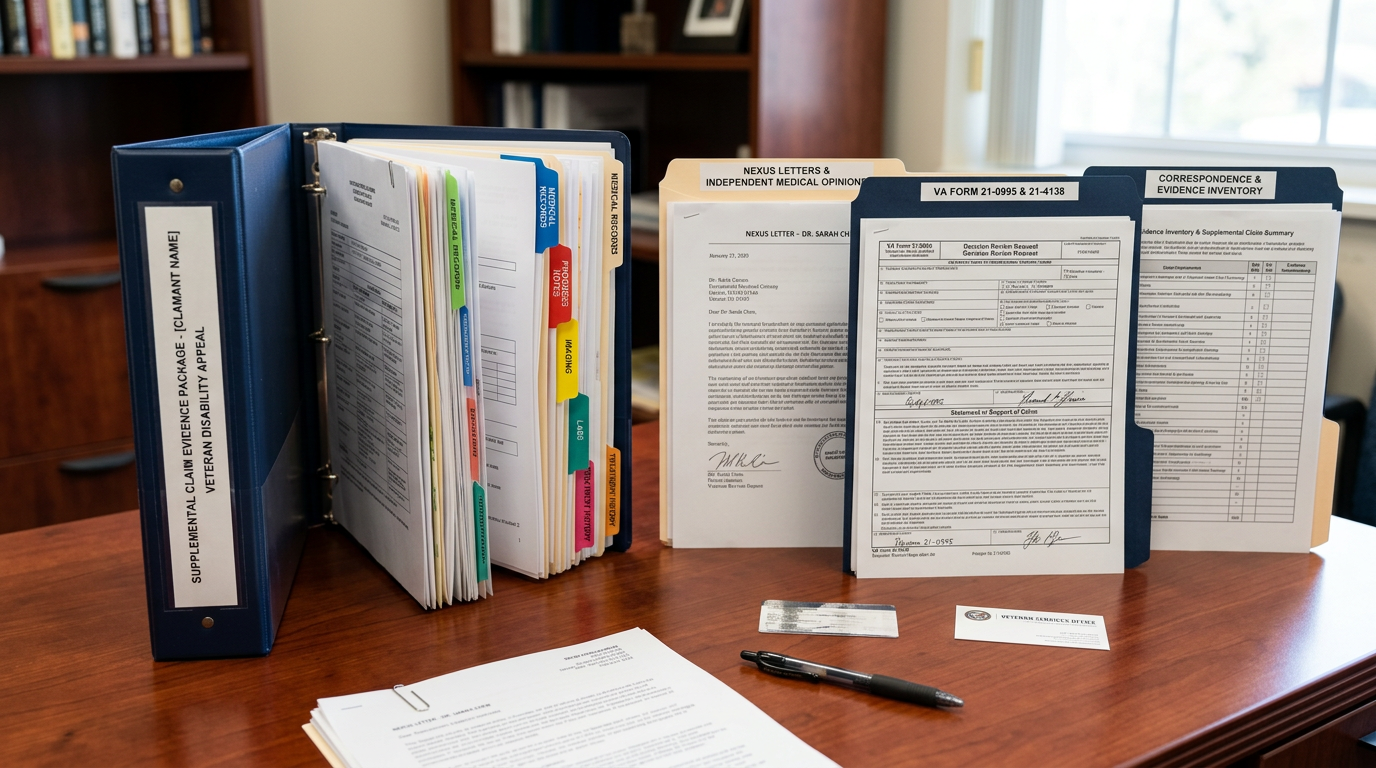
Every claim stands on three legs. Knock one out and the claim falls over, no matter how bad your symptoms are. Before you file, look at your file and find all three. If one is missing, that is the piece to build first. The VA will not build it for you, and filing without it usually just buys you a denial letter and lost time.
 01
01A current diagnosis
A doctor has to say you have it, now, in writing. Not "reports symptoms of", a diagnosis. Without this leg, nothing else in the file matters.
 02
02A link to your service
An event, an injury, an exposure, or an already service-connected condition. Service records, unit records, buddy statements, and your own account all count as evidence.
 03
03A nexus that ties the two together
A medical opinion stating it is at least as likely as not that your service caused or aggravated the condition. That phrase is a legal standard: 50 percent or better. It is the leg most denials break.
Document the problem before you file
• Keep a dated symptom log for at least 30 days. Frequency, severity, and what it stopped you from doing.
• Get statements from people who see it, a spouse, a coworker, a battle buddy. Lay evidence is legal evidence.
• Pull your private treatment records. The VA only has to help; it does not have to go find everything.
• Write down what you have stopped doing. Lost work, lost sleep, lost activities. That is what impairment looks like on paper.
Your Rights in This Process
Most veterans walk into this system without knowing the rules the VA itself has to follow. That is how claims get denied for missing evidence the VA was supposed to help you find, and how exams get done by the wrong clinician. These six rights are written into federal regulation. Know them before you file, and make the VA honor every one of them when it decides your claim.

It costs nothing to file
Filing a VA claim is free. Accredited representatives may only charge for work on an appeal after an initial decision, and those fees are capped by 38 CFR §14.636.

The VA has a Duty to Assist you
Under 38 CFR §3.159 the VA must help you get the evidence it needs, and it must tell you what is missing before it denies you for missing it.

You can ask for a different examiner
You may request a trauma-informed clinician, or a clinician of a specific gender, for a C&P examination. Ask before the exam is scheduled.

You can claim every condition you have
There is no limit and no penalty. Primary conditions, secondary conditions, and conditions made worse by service all get filed.

You can appeal and be re-evaluated
A denial is not the end. You may submit new evidence, request a higher-level review, appeal to the Board, and ask for re-evaluation when your condition worsens.

You must be considered for TDIU
If your service-connected conditions keep you from holding substantially gainful employment, you may be paid at the 100 percent rate without a 100 percent rating.
When You Are Ready to File
Talk to an accredited representative before you file. It costs nothing to ask, and the order you file in changes what the VA is allowed to award you. Albert L. Thombs Jr. is VA-Accredited Claims Agent #45147. A short conversation now can save you a year spent waiting in the wrong review lane.
Your part starts at the kitchen table. Pull your DD-214, your rating decision if you have one, and the names of every doctor who treats you today. Under 38 CFR 3.159 the VA has to help you gather records, but it can only chase the records you tell it about. Leave a doctor off the 21-4142 and that treatment may never reach your file.

The application itself
This is the form that opens a disability compensation claim. List every condition you are claiming, and name the secondary conditions explicitly.
Release for private records
Authorises the VA to request records from your private doctors. Without it, treatment outside the VA may never reach your file.
Lay or buddy statement
The official form for your own statement and for statements from people who witnessed the event or the change in you.
What It Takes to Claim This Benefit
Confirm you meet the eligibility rules for this specific benefit, the criteria below and in the governing regulations tell you exactly what the VA is looking for.
Gather the proof that matches those rules, service records, medical evidence, income or dependency documents, and the physician statements the VA weighs.
File the right form the right way, the correct application, fully supported, so the VA cannot deny it on a technicality or delay it for missing evidence.
 Veteran Representation
 Veteran Representation
The Forms & Applications We File For You
These are the applications that drive this benefit. Start any of them on our site and an accredited agent prepares and files it for you, correctly, the first time.
DIC, Survivors Pension & Accrued Benefits
The survivor application for Dependency and Indemnity Compensation and related benefits.
Start this with usAid & Attendance / Housebound Exam
Documents a surviving spouse or parent who needs the regular help of another person.
Start this with usAppoint Us as Your Representative
Authorizes our accredited agent to act on your behalf with the VA on this benefit.
Start this with usSee How Ratings Drive This Benefit
Most benefits scale with your combined disability rating, and the VA does not add your ratings the way you would expect. Work the real math below. The VA uses the combined ratings table in 38 CFR 4.25, which applies each rating to whatever is left of your remaining efficiency, then rounds to the nearest 10. That is why a 50% and a 30% come out to 70%, not 80%. Before you assume you are short of a threshold for this benefit, run your own numbers here and compare them to your rating decision letter.
Why 50% + 30% Does NOT Equal 80%
The VA uses “whole-person” math, not simple addition. This is how ratings really stack.
The VA always begins from a whole, healthy person (100%).
50% of 100 is subtracted. You have 50% “efficiency” left.
30% is taken from the REMAINING 50 (0.30 × 50 = 15). 50 − 15 = 35 left.
100 − 35 = 65, then rounded to the nearest 10 → 70%.
Bottom line: 50% and 30% combine to 65% → rounded to 70%, not 80%. The same math turns two 50% ratings into 75% → rounded to 80%, not 100%. Every rating you add is worth less than the last. That is why which conditions you claim, and in what order, matters as much as how many.
 Veteran Representation
Not sure if you qualify?
An accredited agent reviews your eligibility for this benefit at no cost and tells you straight whether it is worth pursuing. If it is, we prepare and file every form for you.
Keep Reading
One page never tells the whole story of a claim. The VA rates every condition on its own evidence, its own exam and its own diagnostic code, and the pieces connect in ways most veterans never see until a decision letter lands. These are the pages that pick up where this one stops. Read them before you file, not after a denial, because the cheapest fix in this process is the mistake you never make.