

Sciatica, Sciatic Nerve Radiculopathy of the Lower Extremity
A nerve root pinched in your low back sends pain, numbness and weakness down the buttock, the back of the thigh, the calf and into the foot.
Sciatica is not part of your low back rating. The lumbar spine is rated on degrees of forward flexion under 38 CFR §4.71a, Diagnostic Codes 5235–5243. The sciatic nerve running out of that spine and down your leg is a separate disability rated under 38 CFR §4.124a, Diagnostic Code 8520, and Note (1) to the General Rating Formula for Diseases and Injuries of the Spine says it in the regulation’s own words: evaluate any associated objective neurologic abnormalities separately, under an appropriate diagnostic code. Two ratings, not one. Each leg is its own rating, and when both legs are involved the bilateral factor at 38 CFR §4.26 is added on top of the combined value. A veteran carrying a low back rating and nothing else is, more often than not, missing two evaluations.
The Diagnostic Codes
Conditions Rated In Radiculopathy
These are the codes the VA will actually stamp on a decision in this group. The code you are granted under decides which formula is used, and that decides your percentage. Sciatica (Sciatic Nerve) is highlighted below.
DC 8510–8513
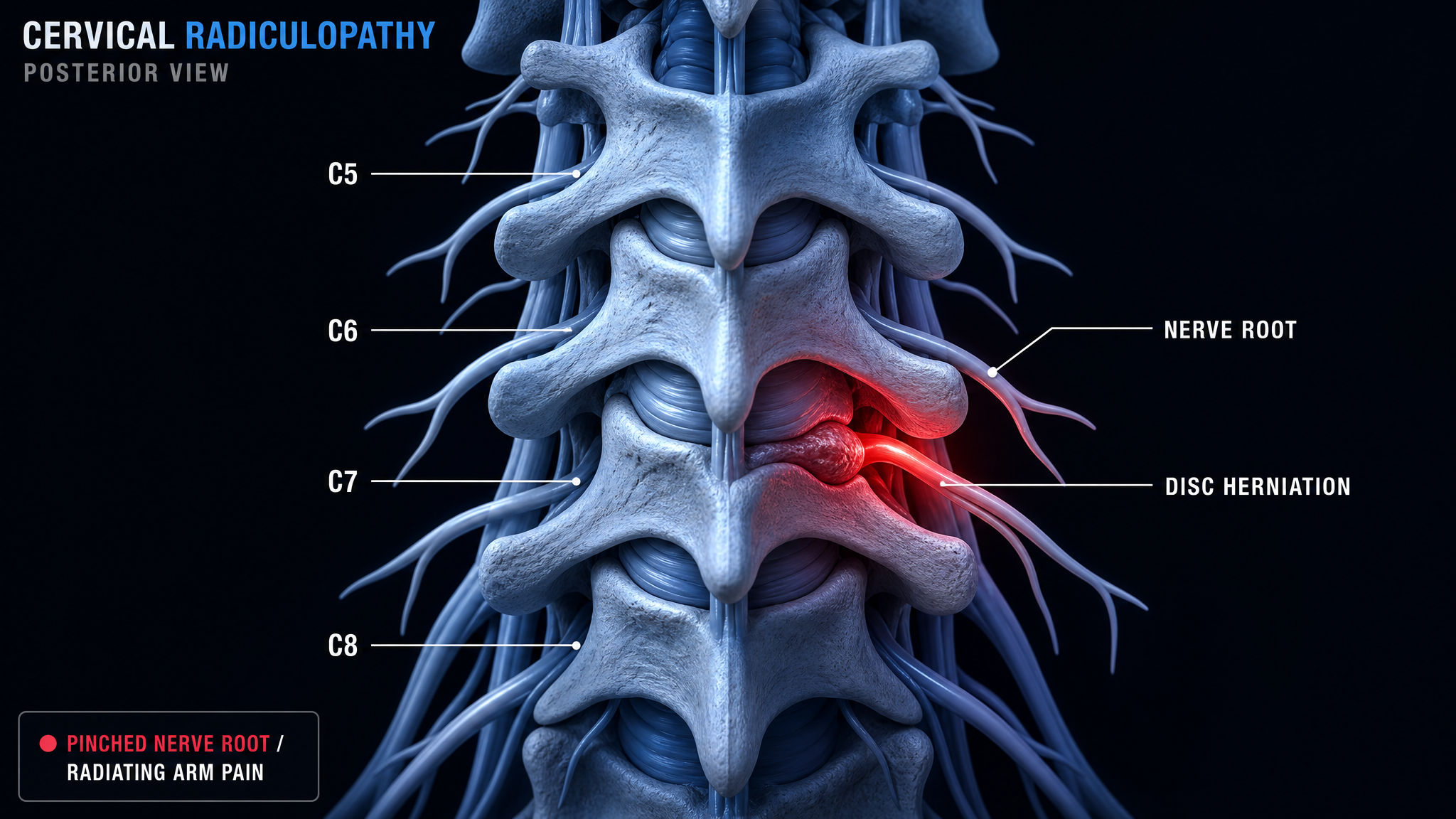
Cervical Radiculopathy, Upper Extremity Nerve Root Compression
A nerve root pinched in your neck sends pain, numbness and weakness down the shoulder, arm and into the hand.
Read the full page
DC 8520
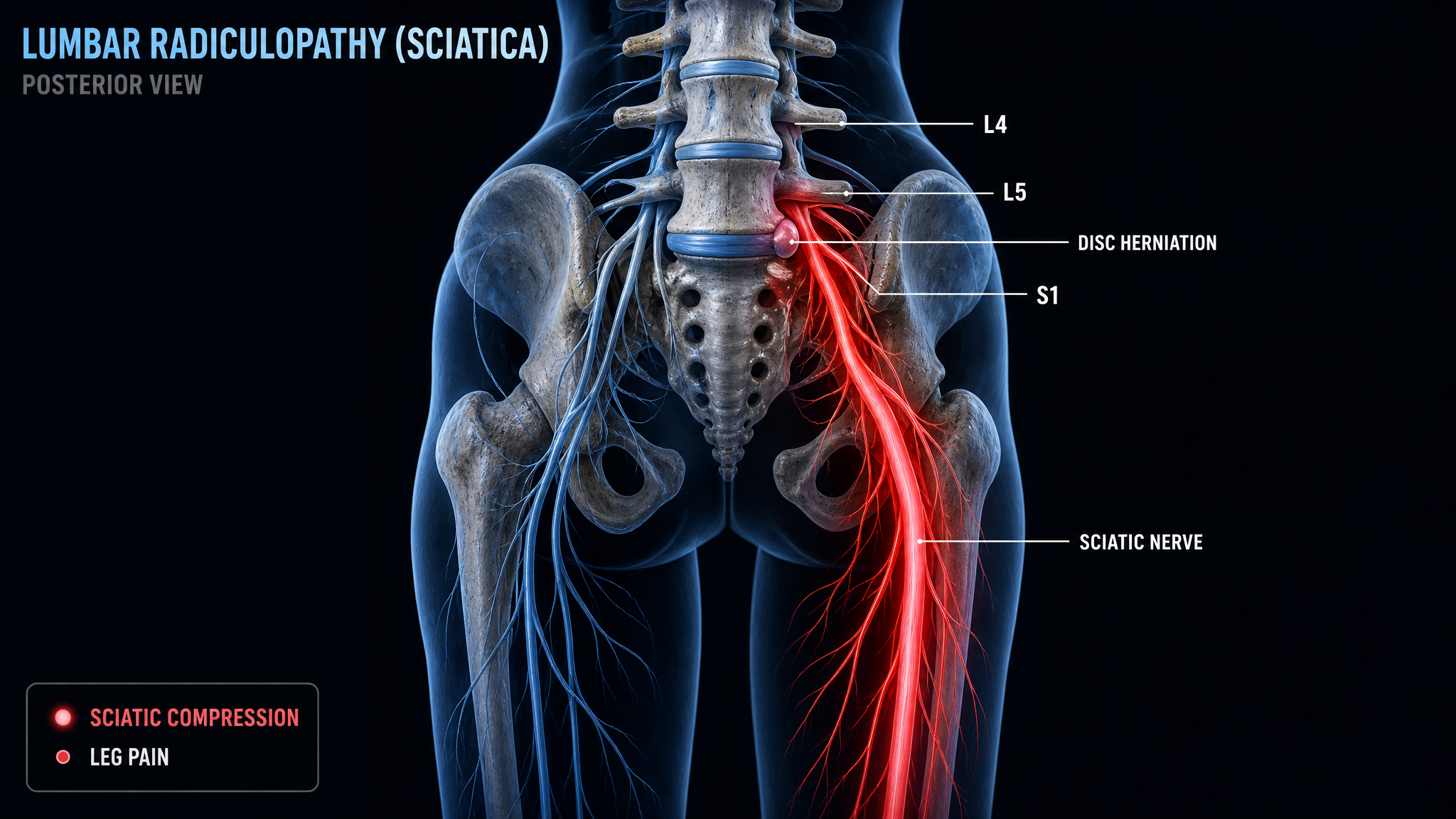
Sciatica, Sciatic Nerve Radiculopathy of the Lower Extremity
A nerve root pinched in your low back sends pain, numbness and weakness down the buttock, the back of the thigh, the calf and into the foot.
You are reading this page
DC 8526
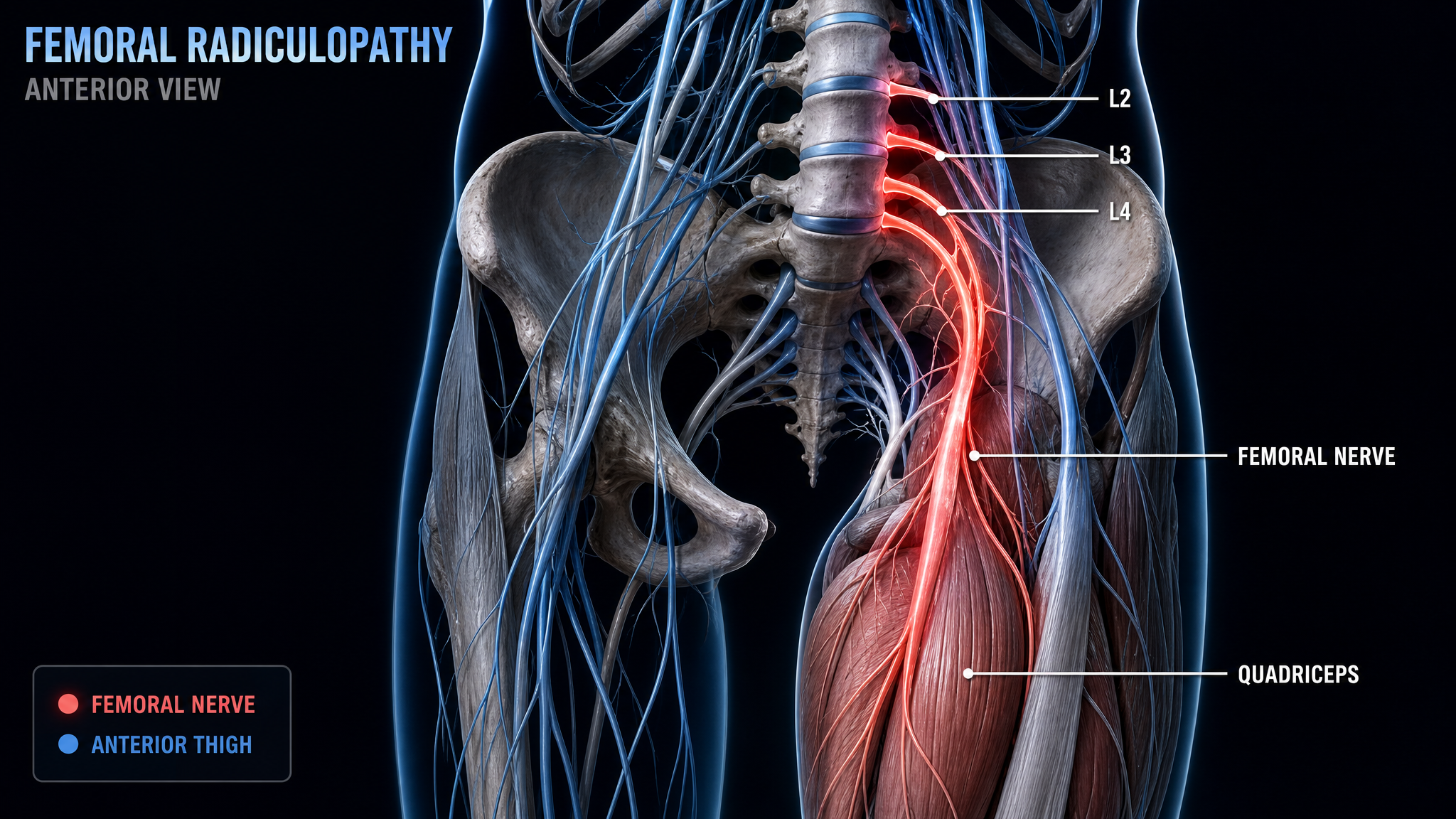
Femoral Radiculopathy, Anterior Crural Nerve Involvement of the Lower Extremity
A nerve root pinched at L2, L3 or L4 sends pain, numbness and quadriceps weakness down the FRONT of the thigh to the knee, and almost nobody asks about it.
Read the full page
Before Anything Gets Rated
What The VA Is Actually Looking For, And What Service Connection Really Means
Before the VA ever opens the rating schedule, it asks one question: is this disability the government’s responsibility? That is what “service connection” means. It is not a diagnosis, it is not sympathy, and it is not a reward for having served. It is a legal finding that a current, diagnosed disability is linked to something that happened to you in uniform. Percentages come later. If service connection is not established, there is nothing to rate and the claim is denied, no matter how bad the sciatica (sciatic nerve) is.

For Sciatica (Sciatic Nerve) Specifically
The VA needs a physician to have documented sciatic nerve radiculopathy, not just 'low back pain radiating to the leg', with objective findings such as positive straight-leg raise, dermatomal sensory loss, diminished reflexes, or EMG/nerve conduction study results confirming sciatic nerve involvement. Service connection is won most often secondary to a service-connected lumbar spine condition under 38 CFR §3.310, because the herniated disc or degenerative disease in the spine is the mechanical cause of the nerve root compression; the sciatic nerve claim rides on the back rating but must be filed and rated separately under DC 8520. Direct service connection is also viable when in-service records document a specific injury, a fall, heavy lifting event, vehicle accident, or prolonged load-bearing, that produced documented leg symptoms at the time. What the rater and the C&P examiner are actually keying on under DC 8520 is the severity of neuromuscular deficit: mild incomplete paralysis, moderate incomplete paralysis, moderately severe incomplete paralysis, severe incomplete paralysis with marked muscular atrophy, or complete paralysis with the foot dangling and dropping. M21-1, Part III, Subpart iv, Chapter 4, Section N (Neurological Conditions) requires the examiner to document muscle strength by muscle group, reflex changes, sensory deficits, and any atrophy, if those objective findings are absent from the exam, the rater has no basis to go above 10 percent.
The three elements the VA must find. All three. Every time.
These come out of Caluza v. Brown and Shedden v. Principi, and they are the checklist a rating officer works through on your file. Miss one and the claim fails on that element alone.
A current, diagnosed disability
A doctor has to have written a diagnosis in a medical record, left sciatic nerve radiculopathy, L5-S1, moderate incomplete paralysis; right sciatic neuropathy secondary to lumbar disc herniation at L4-5; bilateral sciatic nerve radiculopathy with foot drop, moderately severe. Symptoms by themselves are not a disability the VA can rate. Saunders v. Wilkie held that pain causing functional impairment can be a disability, but you still need a clinician to document it as diagnosed and impairing. The diagnosis must exist now, during the claim period, not only years ago.
An in-service event, injury, illness or aggravation
Something in service had to have happened, an injury, an exposure, a documented sick call, or steady wear over a career. It does not have to be one dramatic moment and it does not have to be spelled out in your service treatment records: buddy statements, unit records, performance evaluations and your own competent lay testimony can establish it.
A medical nexus linking the two
A qualified medical opinion that says the current diagnosis is at least as likely as not related to the in-service event. That phrase matters: at least as likely as not means 50 percent or better. Under 38 C.F.R. §3.102, when the evidence is evenly balanced, the benefit of the doubt goes to you and the claim must be granted.
The five ways service connection is established
Most veterans only know the first one. The other routes are lower-effort paths to the same grant, and the secondary route is the one most often left on the table.
Direct, 38 C.F.R. §3.303(a)
The injury or disease began in service and never went away. The classic route: three elements, one nexus opinion.
Chronicity and continuity, §3.303(b)
A chronic condition shown in service, plus continuity of the same symptoms from separation to now, can establish the link without a formal nexus opinion. Your own testimony about symptoms you can observe is competent evidence.
Presumptive, §3.307 and §3.309
Certain chronic diseases are presumed service connected if they manifest to a compensable degree within a set window after separation. You do not have to prove causation at all.
Secondary, §3.310(a) and (b)
A disability proximately due to, or aggravated by, an already service-connected condition is itself service connected. This is how sciatic nerve radiculopathy causing foot drop, gait abnormality, falls, knee instability secondary to altered gait mechanics, hip bursitis from compensatory posture, and sleep impairment from neuropathic pain get on the rating sheet, or, working the other direction, the service-connected lumbar spine condition causes the sciatic radiculopathy itself under §3.310 get on the rating sheet.
Aggravation of a pre-service condition, §3.306
If you entered service with a condition and service made it permanently worse, the increase is compensable. The VA must rebut the presumption of soundness by clear and unmistakable evidence, a bar it frequently fails to meet.
VA medical care, 38 U.S.C. §1151
An additional disability caused by VA treatment, surgery, or a failure to diagnose is compensated as if it were service connected.
The bottom line, there is no way around this
No diagnosis, no rating. It has to be chronic. It has to cause impairment.
Without a diagnosis, the VA will not rate your claim.
If the medical record says 'leg pain' or 'radiating low back pain' but never names sciatic nerve radiculopathy or sciatic neuropathy, the VA will rate the low back and stop there. Veterans lose this claim constantly because their primary care provider documented symptoms without ordering the EMG or performing the neurological exam that would have produced an actual nerve diagnosis. Without the word 'radiculopathy' or an equivalent clinical finding tied to the sciatic nerve in a physician's note, DC 8520 does not get opened.
The condition must be chronic.
A single emergency room note or one mention of leg pain after an injury is not enough, the VA needs a documented history of recurring or persistent sciatic symptoms across multiple visits to establish that the condition is chronic rather than a resolved episode. If there is a gap of years in the medical record with no treatment for leg symptoms, the rater will argue the condition resolved and deny continuity of symptomatology. Private treatment records, buddy statements describing ongoing limitations, and a nexus opinion that explicitly addresses the chronic and continuous nature of the nerve involvement are what close that gap.
It must cause actual impairment.
DC 8520 rates on degree of paralysis, mild, moderate, moderately severe, severe, or complete, and a C&P examiner who checks 'mild incomplete paralysis' without documenting the specific deficits that justify it gives the rater cover to assign 10 percent and close the file. The zero-percent trap is a C&P exam that finds subjective complaints only, with normal strength testing and intact reflexes, because without objective neuromuscular deficit the rating formula has nothing to measure; §4.1 and §4.10 require the rating to reflect actual industrial impairment, and a normal neuro exam produces a noncompensable rating even when the veteran is in daily pain.
What this means for you before you file: Before you file, get an EMG/nerve conduction study in your hands and make sure at least one physician's note uses the words sciatic nerve radiculopathy with a description of the specific deficits, reflex loss, sensory distribution, muscle weakness, because that language is what forces the rater to open DC 8520 and rate it separately from your lumbar spine. Under Sharp v. Shulkin, the examiner cannot dismiss flare-up functional loss without a reasoned explanation. Esteban v. Brown confirms separate ratings for limitation of motion (DC 5201), impairment of the clavicle (DC 5203), and any associated nerve damage.
The Percentages
Rating Schedule, Sciatic Nerve, Diagnostic Codes 8520 and 8521
Reproduced from 38 CFR §4.124a, Diseases of the Peripheral Nerves. Each lower extremity is rated separately and the two ratings combine under 38 CFR §4.25, with the bilateral factor at §4.26 added when both legs are involved. The parallel codes 8620 / 8621 rate the same nerves as neuritis and 8720 / 8721 as neuralgia; under 38 CFR §4.124 neuralgia is rated at a maximum equal to moderate incomplete paralysis.

Note
The wholly-sensory cap, §4.124a, preamble. "The term *incomplete paralysis* ... indicates a degree of lost or impaired function substantially less than the type picture for complete paralysis given with each nerve, whether due to varied level of the nerve lesion or to partial regeneration. When the involvement is wholly sensory, the rating should be for the mild, or at most, the moderate degree."
80%
Sciatic nerve, DC 8520. Complete paralysis: the foot dangles and drops, no active movement possible of muscles below the knee, flexion of knee weakened or (very rarely) lost.
60%
DC 8520, Severe incomplete paralysis, with marked muscular atrophy.
40%
DC 8520, Moderately severe incomplete paralysis.
20%
DC 8520, Moderate incomplete paralysis.
10%
DC 8520, Mild incomplete paralysis.
40%
External popliteal (common peroneal) nerve, DC 8521. Complete paralysis: foot drop and slight droop of first phalanges of all toes, cannot dorsiflex the foot, extension (dorsal flexion) of proximal phalanges of toes lost; abduction of foot lost, adduction weakened; anesthesia covers entire dorsum of foot and toes.
30%
DC 8521, Severe incomplete paralysis.
20%
DC 8521, Moderate incomplete paralysis.
10%
DC 8521, Mild incomplete paralysis.
Note
Two legs, two ratings. Sciatic involvement on the right and on the left are rated separately and combined under §4.25; the bilateral factor at §4.26 then adds 10 percent of the combined value of the paired-extremity ratings before the rest of the ratings are combined. And the femoral nerve, DC 8526, is a different nerve, if the pain also runs down the front of the thigh, that is a separate evaluation on top of this one.
Service Connection
Advice from the Advocate
This is where I stop explaining the rules and tell you how I would build your Sciatica (Sciatic Nerve) claim if you were sitting across my desk. Read the causation notes below twice. The VA will not connect the dots for you, even though 38 CFR 3.159 says it has a duty to assist. Your job is to put the in-service event, the current diagnosis and the medical link on paper, then make the examiner deal with all three.

The advocate's notes on causation, Sciatica (Sciatic Nerve)
The separate arguments that decide this code: where the VA will attack, the regulation that answers it, and the evidence that closes the gap.
1Secondary to the low back you are already rated for, §3.310(a) and §3.310(b)
This is the largest pool of unclaimed compensation in the musculoskeletal system. 38 CFR §3.310(a) grants service connection for any disability proximately due to or the result of a service-connected condition, and §3.310(b) grants it for aggravation of a nonservice-connected condition. If your lumbar strain, degenerative disc disease, stenosis or IVDS is service-connected and it is compressing a root, the leg symptoms are service-connected the moment a clinician says so. You are not starting a new claim from zero, you are collecting on one you already won.
2The rating schedule orders a separate evaluation, Note (1), §4.71a
The VA folds leg pain into the back percentage as a matter of routine. The regulation forbids it. Note (1) to the General Rating Formula for Diseases and Injuries of the Spine instructs the adjudicator to "evaluate any associated objective neurologic abnormalities ... separately, under an appropriate diagnostic code." And 38 CFR §4.14 does not apply, because a back rated on degrees of forward flexion and a nerve rated on impaired motor and sensory function are compensating different disabilities.
3Direct service connection with a post-service diagnosis, §3.303(a) and §3.303(d)
38 CFR §3.303(a) covers disability resulting from injury incurred in the line of duty, and §3.303(d) expressly allows service connection when the disease is first diagnosed after discharge if the evidence establishes it was incurred in service. The rucks, the jumps, the lifts and the documented sick-call visits are the in-service injury. The MRI and EMG you got twenty years later are the current diagnosis. A nexus opinion using the "at least as likely as not" standard closes it.
4Lay evidence carries a thin record, §3.303(b) and Buchanan v. Nicholson
38 CFR §3.303(b) allows service connection on continuity of symptomatology, and Buchanan v. Nicholson, 451 F.3d 1331 (Fed. Cir. 2006) holds that the absence of contemporaneous medical records cannot be the sole basis for rejecting competent lay testimony. You are competent to describe a leg that has gone numb since 2004. Your spouse is competent to describe watching you catch your toe on the carpet.
5Combat service relaxes the proof of the injury, 38 U.S.C. §1154(b) and §3.304(d)
If the back was hurt in combat, 38 U.S.C. §1154(b) and 38 CFR §3.304(d) require the Secretary to accept satisfactory lay or other evidence of the in-service injury as sufficient proof, even without an official record, so long as it is consistent with the circumstances of your service. The rebuttal standard on VA is clear and convincing evidence, a far higher bar than the one you carry.
6Functional loss and flare-ups must be accounted for, §4.40, §4.45, DeLuca and Sharp
A nerve that behaves at 9 a.m. in a cold exam room is not the nerve you live with. 38 CFR §4.40 requires evaluation of functional loss due to pain and weakness, §4.45 requires consideration of weakened movement, excess fatigability and incoordination, DeLuca v. Brown, 8 Vet. App. 202 (1995) requires those factors to be addressed, and Sharp v. Shulkin, 29 Vet. App. 26 (2017) requires the examiner to estimate functional loss during flare-ups based on your reported history when a flare is not observed. "Not observed at this exam" is not an adequate answer, and 38 CFR §4.2 makes such a report returnable.
7If it stops you from working, §4.16 and TDIU
Bilateral sciatic involvement with foot drop, atrophy and an unreliable leg is disabling in a way percentages understate. 38 CFR §4.16(a) permits a total rating based on individual unemployability where a single disability is rated at 60 percent, or where there are two or more disabilities with one at 40 percent and a combined 70 percent, and disabilities of both lower extremities are treated as one disability for that threshold. §4.16(b) permits extraschedular referral even below those figures.
Exposure & Aggravation
How Sciatica (Sciatic Nerve) Happens In Service, And How It Gets Worse

The VA wants an in-service event, and most veterans think that means one dramatic injury. It does not. Years of duty that wore the body down count too, and under 38 CFR 3.306 a condition service made worse can still be connected. Find yourself in the list below, then put that duty in writing with dates, units and names. The board only weighs what you put on paper.
How veterans pick this up in uniform, Sciatica (Sciatic Nerve)
Sciatica (Sciatic Nerve) rarely announces itself with one dramatic moment. It is built by what service asked of your body over months and years, and once it is service-connected, it is compensated for how it keeps getting worse, not for how it started. Below is how veterans pick this up in uniform, and who is most prone to it.
- Ruck marches under 60 to 100 pounds with the load transferred straight through L4–L5 and L5–S1
- Parachute landing falls, fast-roping and helocast entries compressing the lumbar discs on impact
- Lifting ammunition cans, generators, engine components, litters and casualties without a second man
- Years seated on an unsprung steel bench in the back of a truck or a track vehicle over broken ground
- IED blasts and vehicle rollovers transmitting axial load through the seat pan into the low back
- Digging fighting positions, filling sandbags, and moving HESCO barriers by hand
- Sick-call entries reading "low back pain, Motrin, quarters, RTD" with no imaging ever ordered
- Shipboard work in tight spaces, ladder wells and bilges with the back in constant flexion
Who is most prone to it
Infantry, airborne and air assault, artillery and mortar crews, combat engineers, motor transport and heavy-equipment operators, armor crewmen, aviation and vehicle mechanics, Seabees, corpsmen and medics carrying aid bags, supply and transportation specialists, and anyone whose job description started with the word "lift".
The Symptoms
What Sciatica (Sciatic Nerve) Actually Feels Like
Read this list the way the examiner will. Every symptom you live with but never report is a symptom the VA treats as if it does not exist. The rating schedule pays for how Sciatica (Sciatic Nerve) affects your daily life and your work, so the details matter. Check off what matches your day, tell your doctor in those words, and make sure it lands in your treatment record before the exam.

- Sharp, electric or burning pain running from the low back through the buttock and down the back of the leg
- Numbness or tingling in the outer calf, the top of the foot, the heel or the sole
- The foot slaps the ground, catches on carpet or curbs, or the toes drag, foot drop
- The leg gives out on stairs or when you push off
- Pain that worsens with sitting, coughing, sneezing or straining
- Calf that is visibly smaller than the other side
- You cannot stand or walk for more than a short period without the leg going hot, then numb
- A dead, heavy feeling in the leg after a short walk that eases only when you sit
How this one is rated
Sciatica is rated as incomplete paralysis of the sciatic nerve under 38 CFR §4.124a, Diagnostic Code 8520, graded mild, moderate, moderately severe or severe, up to complete paralysis at 80 percent. Lower extremity codes carry no major/minor distinction, a leg is a leg. But the wholly-sensory cap applies: "when the involvement is wholly sensory, the rating should be for the mild, or at most, the moderate degree." The findings that break that cap are graded strength loss, absent or diminished reflexes, and marked muscular atrophy measured with a tape. Note also that §4.124a rates the same nerve as paralysis (8520), neuritis (8620) or neuralgia (8720), and under 38 CFR §4.124 neuralgia characterized by a dull and intermittent pain is capped at moderate.
What you are measured against
The root level is identified by the dermatome that is numb, the reflex that is lost (Achilles S1), and the myotome that is weak (ankle dorsiflexion L4–L5, great-toe extension L5, plantar flexion S1), then confirmed against the EMG and the MRI level. The straight-leg raise is the provocative test, and the angle in degrees at which symptoms reproduce belongs in the report.
Each One On Its Own Page
Secondary Conditions, Aggravated or Caused by a Current Service-Connected Condition
Under 38 CFR §3.310(a), a disability that is proximately due to a service-connected condition is service-connected in its own right, and under §3.310(b), so is any additional disability caused when a service-connected condition aggravates a problem you already had. Each condition below is a separate evaluation with its own diagnostic code and its own percentage. They do not fold into the sciatica (sciatic nerve) rating, they stack on top of it. A veteran who claims only the primary condition leaves these ratings on the table.

Femoral nerve, pain down the FRONT of the thigh (DC 8526)
The sciatic nerve runs down the back of the leg; the femoral nerve runs down the front of the thigh and is a different disability under DC 8526. If your pain also runs down the front, raise it in the same appointment, it is a separate rating that stacks on top of the sciatic evaluation.

Sleep disturbance and depression from chronic pain
A leg that goes hot then numb every night wrecks sleep, and chronic pain that will not let you work or sleep drives depression and anxiety. Both are separately service-connectable as secondary to the pain under §3.310, mention the sleepless nights and the mood, because nobody rates what is not in the record.

Falls and new injuries from foot drop
When the foot drops the trips and falls follow, and the sprained ankles, wrenched knees and hip injuries that come from catching yourself are themselves secondary to the nerve. Report every fall, a documented fall history is both evidence of severity and the seed of a further secondary claim.
Accredited Claims Agent #45147
Ready To Get This Rated Correctly?
You have read how the VA rates Sciatica (Sciatic Nerve). Now the question is whether your file proves it. We represent veterans on a No Win, No Fee basis: 20% Direct-Pay paid by the VA from back pay, or 30% High-Complexity, and you owe nothing for representation if your rating does not increase. If you only need the roadmap, the Mission 5 Brief is a separate $750 flat fee. You bring the records, we build the argument.
Radiculopathy, In Detail
Radiculopathy, Service Connection In Depth
Here is each claimable condition in this group on its own terms, what it is, what service did to it, and what the VA requires before it will connect it.

Cervical Radiculopathy, Upper Extremity Nerve Root Compression
Cervical radiculopathy is not part of your neck rating. The neck itself is rated on range of motion under 38 CFR §4.71a, Diagnostic Codes 5235–5243. The nerve running out of that neck and down your arm is a separate disability rated under 38 CFR §4.124a, and Note (1) to the General Rating Formula for Diseases and Injuries of the Spine says it in the regulation’s own words: rate any associated objective neurologic abnormalities separately, under an appropriate diagnostic code. Two ratings, not one. Each arm is its own rating, and if both arms are involved the bilateral factor at 38 CFR §4.26 is added on top. Veterans carrying a neck rating and nothing else are, more often than not, missing two evaluations.
Read the full Cervical Radiculopathy page
Sciatica, Sciatic Nerve Radiculopathy of the Lower Extremity
Sciatica is not part of your low back rating. The lumbar spine is rated on degrees of forward flexion under 38 CFR §4.71a, Diagnostic Codes 5235–5243. The sciatic nerve running out of that spine and down your leg is a separate disability rated under 38 CFR §4.124a, Diagnostic Code 8520, and Note (1) to the General Rating Formula for Diseases and Injuries of the Spine says it in the regulation’s own words: evaluate any associated objective neurologic abnormalities separately, under an appropriate diagnostic code. Two ratings, not one. Each leg is its own rating, and when both legs are involved the bilateral factor at 38 CFR §4.26 is added on top of the combined value. A veteran carrying a low back rating and nothing else is, more often than not, missing two evaluations.
You are reading this page now

Femoral Radiculopathy, Anterior Crural Nerve Involvement of the Lower Extremity
Ask a veteran about leg pain from the back and he will point to the back of his leg. That is sciatica, DC 8520. The anterior crural (femoral) nerve, Diagnostic Code 8526, carries pain down the front of the thigh to the knee from the L2, L3 and L4 roots, and it is missed constantly for one reason: the examiner performs a straight-leg raise, which tests the back of the leg, and never performs the femoral nerve stretch test, which is the only maneuver that tests the front. They are separate nerves with separate codes. A veteran can hold a lumbar spine rating, a sciatic rating and a femoral rating, in each leg, and Note (1) to the General Rating Formula at 38 CFR §4.71a does not make it optional: associated objective neurologic abnormalities are evaluated separately.
Read the full Femoral Radiculopathy pageThe C&P Exam
What To Expect At The Sciatica (Sciatic Nerve) Exam
This is the encounter your rating is built on. The examiner has a checklist and a limited window, what follows is exactly what happens in that room, so none of it surprises you.
Clinical Section, What To Expect at the Exam
What to Expect at Your Sciatica C&P Examination
Diagnostic Code 8520, the exam that decides whether your leg is "wholly sensory" or something the schedule pays for
The failure in this exam is almost always the same one. The report records that your leg is numb, does not record **graded strength**, does not record **graded reflexes**, and does not record a **calf circumference measured with a tape**, and the moment it reads as sensation-only, the **wholly-sensory cap** in the preamble to **38 CFR §4.124a** holds you at **mild, or at most moderate**, no matter how the leg actually behaves. Everything below exists to make sure the objective findings that break that cap end up in writing.
Condition
Sciatica (Sciatic Nerve), DC 8520
Governing questionnaire
VA Form 21-0960C-8, Peripheral Nerves Conditions (Not Including Diabetic Sensory-Motor Peripheral Neuropathy) Disability Benefits Questionnaire, completed separately for the left and the right lower extremity
Click the form number to open the official questionnaire on VA.gov.
01In The Room
What happens during the exam
The tests and maneuvers for this condition
- Straight-leg raise, both legs, with the degree of reproduction recorded
- Crossed straight-leg raise
- Achilles and patellar reflexes, both legs, graded 0 to 4+
- Manual muscle testing 0–5 through L4 to S1, both legs
- Light-touch and pinprick mapping of L4 through S2
- Thigh and calf circumference in centimeters, both legs, at a stated landmark
- Heel walk and toe walk
- Review of the lumbar MRI and the EMG / nerve-conduction study, correlated to a specific root level
What gets measured, and to what number
Muscle strength, graded 0 to 5
Ankle dorsiflexion (L4–L5), great-toe extension (L5), ankle plantar flexion (S1) and knee flexion, both legs, graded, not described.
Deep tendon reflexes, graded 0 to 4+
Achilles (S1) and patellar (L4), compared side to side. An absent Achilles reflex is objective evidence, not a symptom report.
Dermatome-by-dermatome sensory testing
Light touch and pinprick scored normal, decreased or absent at L4, L5, S1 and S2 individually, posterior thigh, lateral calf, dorsum of foot and sole.
Limb circumference for atrophy
Thigh and calf measured in centimeters at a fixed landmark on both legs. Marked muscular atrophy is what supports 60% under DC 8520, and it only exists on paper if someone used a tape.
Provocative testing with the angle recorded
Straight-leg raise with the degree of symptom reproduction, and the crossed straight-leg raise, recorded separately for each leg.
Gait, heel walk and toe walk
Observed over a walked distance, not two steps across the room, with any foot drop, antalgic pattern, brace, AFO or assistive device noted.
Severity stated in the regulation’s language
For each lower extremity: paralysis, neuritis or neuralgia; wholly sensory or not; and mild, moderate, moderately severe or severe.
02Orientation
What to expect during this exam
What makes this exam different from every other C&P exam
1The wholly-sensory cap is the ceiling you have to break
Numbness alone is capped. Graded weakness (0–5), a diminished or absent Achilles reflex, and marked muscular atrophy measured in centimeters are the three findings that lift the evaluation above moderate. If none of them are in the report, the report has already decided your percentage.
2Each leg is a separate rating, and the bilateral factor rides on top
Two legs means two evaluations combined under §4.25, plus the bilateral factor at §4.26. An examiner who tests only the worse leg leaves the second rating unwritable.
3Foot drop is the finding that changes the tier
Weak or absent ankle dorsiflexion, toes that drag, and a slapping gait are the objective picture of peroneal and severe sciatic involvement. Ask that heel walking and toe walking be attempted and the result recorded, a lot of exams skip both.
4The straight-leg raise needs a number, not a word
"Positive straight-leg raise" tells an adjudicator nothing. The angle in degrees at which your symptoms reproduce, and whether the crossed straight-leg raise on the opposite side also reproduces them, is what makes the finding usable.
See it before you sit in the room
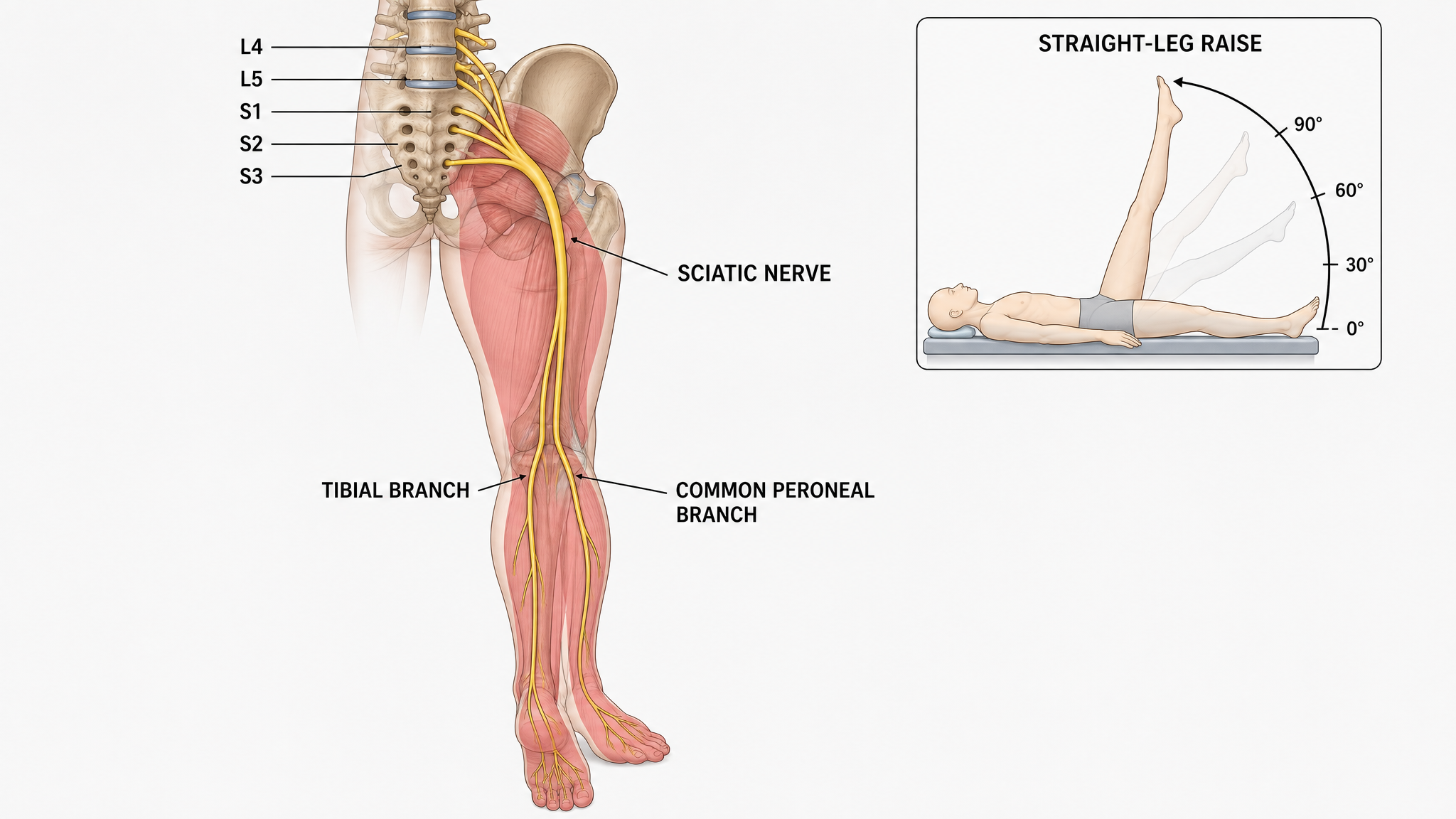
03Preparation
Know your symptoms and secondary factors
What the report must actually say about sciatica (sciatic nerve), dc 8520
- "My leg is **weak**, not just numb", weakness is what breaks the wholly-sensory cap.
- "My foot catches / slaps / drags", describe the surface and how often it happens.
- "Both legs are affected" if they are, and ask that **each be rated separately**.
- "This calf is smaller than the other one", and ask for **both** to be measured with a tape.
- "On a bad week I cannot stand for more than X minutes", give a number, and describe a flare, because **Sharp** requires the examiner to estimate loss during flares.
- "Please record the **angle in degrees** at which the straight-leg raise reproduced my symptoms."
- "The pain also runs down the **front** of my thigh", if it does, that is the **femoral nerve, DC 8526**, and it is a separate rating.
Pain level, frequency, lost work and functional loss, how to say them

Say "weak," not only "numb"
The wholly-sensory cap in the preamble to §4.124a holds a numbness-only leg at mild, or at most moderate. The word that breaks the ceiling is weakness, an examiner has to grade motor strength before a rating above moderate is even on the table.
Describe what the weakness actually does: the leg buckles on stairs, the foot will not push off, you cannot rise on your toes or your heel. That is motor loss, and motor loss is gradable on the 0–5 scale the schedule pays on.
"It is not just numb, the leg is weak. It gives out on stairs and I cannot push off with that foot."
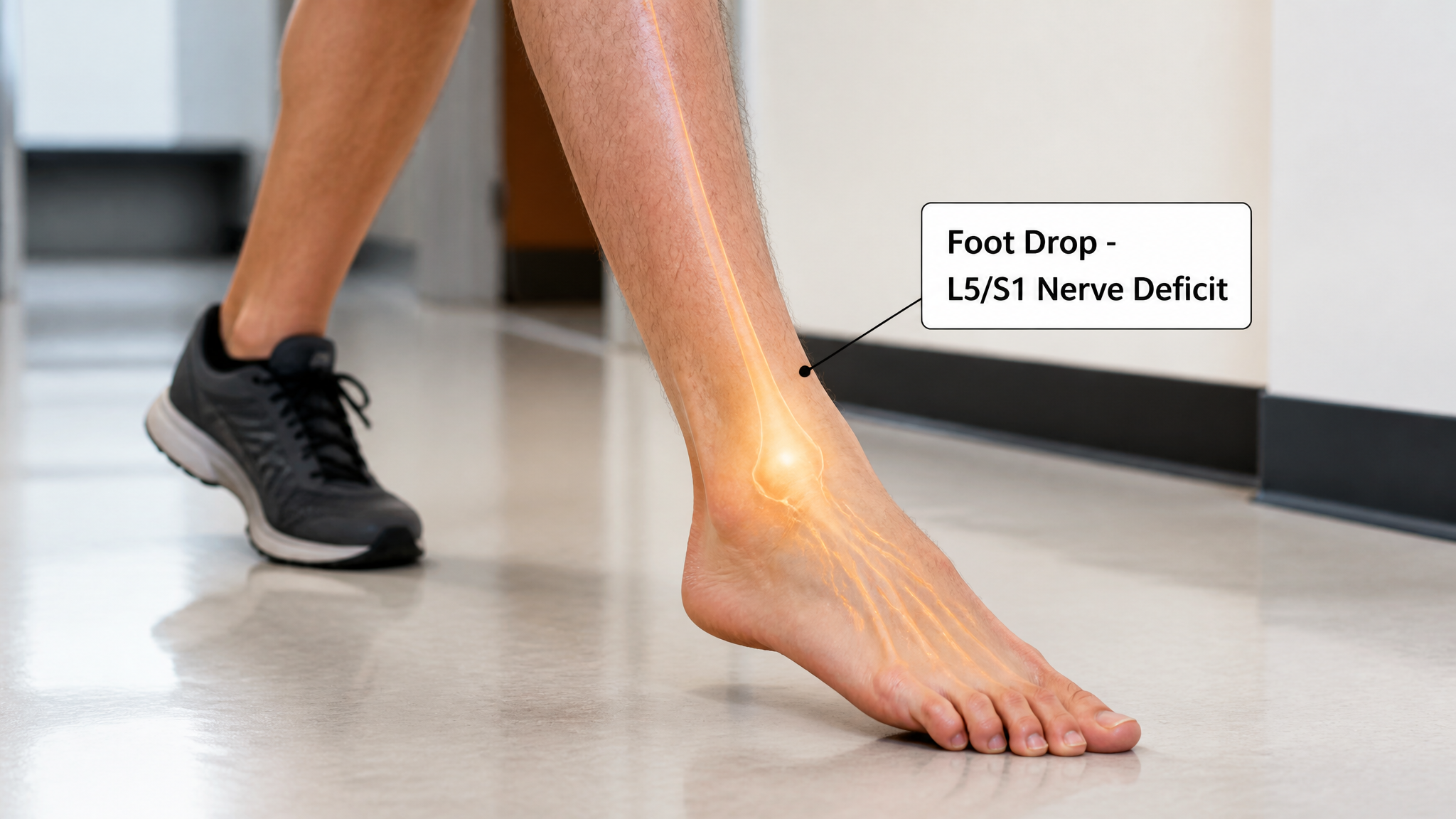
Describe the foot drop by what it catches on
Foot drop is the finding that moves you out of the mild tier, but examiners record it only when it is described concretely. A slapping gait, toes that drag, a foot that catches on carpet or a curb, that is the objective picture of peroneal and severe sciatic involvement.
Name the surface and the frequency. "I trip on the carpet edge two or three times a day" is a functional fact an examiner can write down; "my foot feels weird" is not.
"My foot slaps the floor and catches on the carpet and curbs, it happens several times a day."
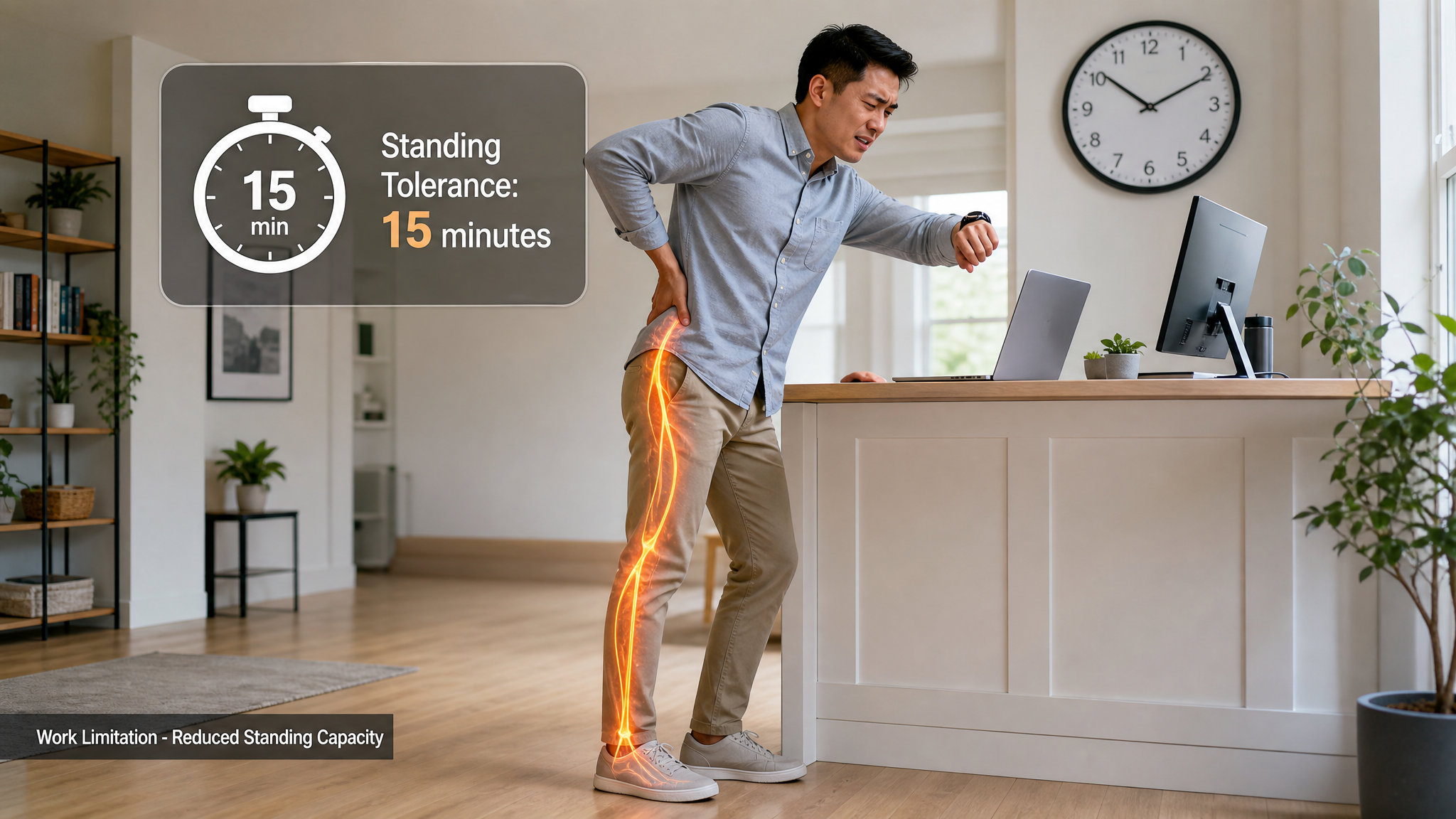
Put a number on standing, walking and lost work
Section 4.10 makes the exam about functional loss, and Sharp requires the examiner to estimate what a flare costs you. A range with numbers is evidence; "it hurts a lot" is discarded as subjective complaint.
Give minutes, blocks and days: how long you can stand before the leg goes hot then numb, how far you can walk before it gives out, how many days of work you have lost this year to it.
"I can stand about fifteen minutes and walk about two blocks before the leg goes numb. I have missed nine days of work this year."
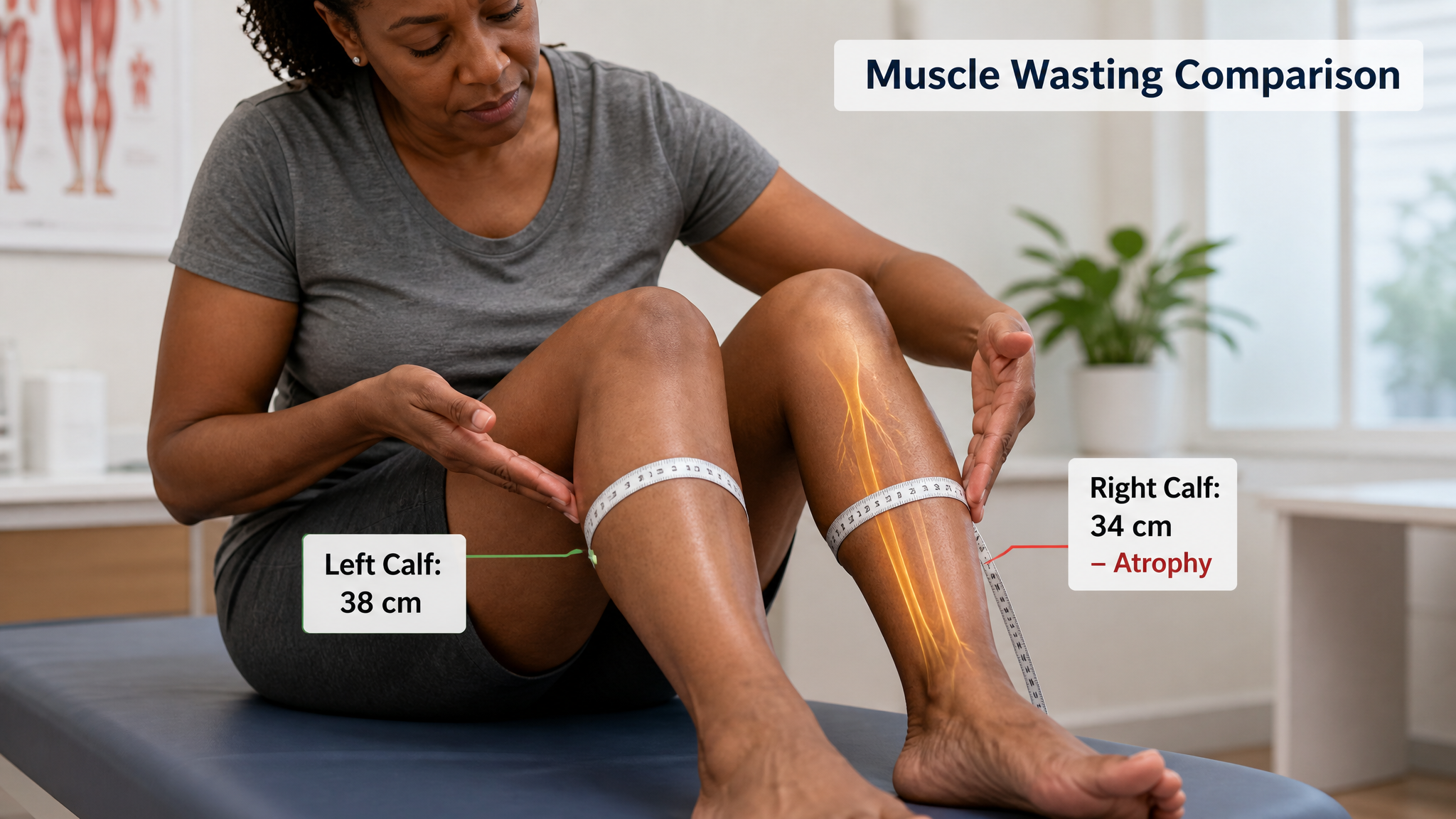
Ask that BOTH calves be measured with a tape
Marked muscular atrophy measured in centimeters is one of the three findings that lift the rating above moderate, and it only exists on paper if someone used a tape at a marked landmark on both legs. A visibly smaller calf that is never measured is a rating you will not get.
If both legs are involved, say so and ask that each be rated separately, two evaluations combine under §4.25 and the bilateral factor at §4.26 rides on top.
"This calf is smaller than the other one, please measure both with a tape and record the centimeters."
Secondary conditions to raise in the same appointment
Every secondary condition laid out in the Secondary Conditions section above belongs in this same appointment. Name each one out loud, tell the examiner how the primary condition caused it or made it worse, and ask that it be noted in the report. Under 38 CFR 3.310, a secondary condition the examiner never hears about is a secondary condition the VA never rates. Bring your list on paper so nothing gets left in the parking lot.
What to expect at this specific exam
- Bring the lumbar MRI report and the EMG / nerve-conduction study, the level in the imaging is what ties the nerve to the back.
- Bring the note from any provider who has already connected the leg symptoms to your lumbar spine.
- Write down which parts of which leg go numb, back of thigh, outer calf, top of foot, heel, sole.
- Keep a 90-day log of flares, falls, trips, missed work and days you could not walk the dog.
- Bring the cane, brace or AFO you actually use, plus the prescription for it.
- Do not take extra pain medication before the appointment to get through it comfortably, you will be measured on the version of you that shows up.
04The Protocol
What procedures are required during the exam
These are not courtesies. Each comes out of the regulation or out of binding case law. Take this list in with you and tick them off as they happen.
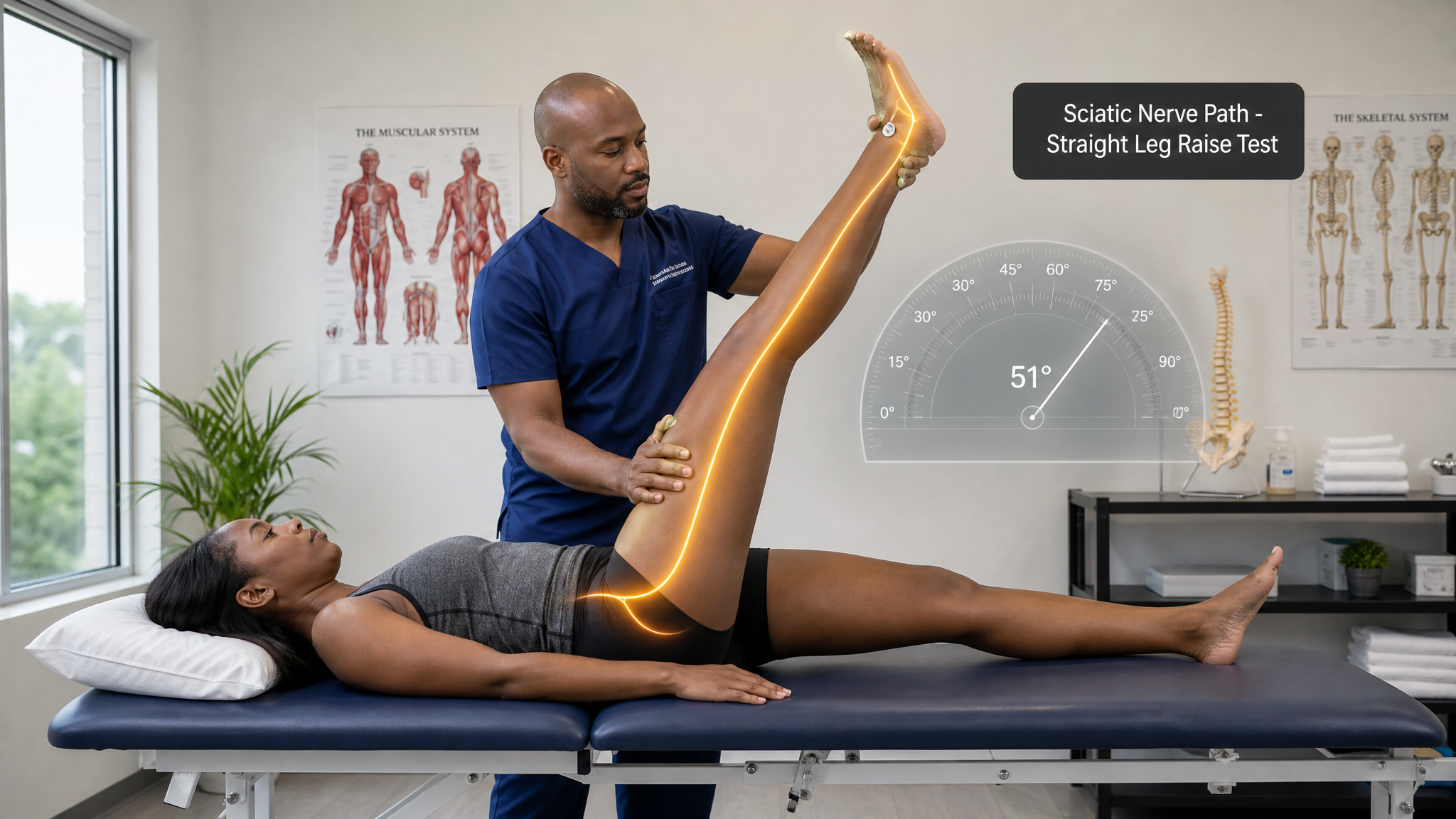
01A straight-leg raise with the angle recorded in degrees
38 CFR §4.124a
The straight-leg raise is the provocative test that ties the nerve to the low back, and the examiner must record the angle in degrees at which your symptoms reproduce, plus the crossed straight-leg raise on the opposite side. "Positive" is not a finding; the degree is.
A report that says only "positive straight-leg raise" tells the adjudicator nothing usable. The number is the finding: symptoms reproduced at, say, 35 degrees is objective evidence of nerve-root tension, and a positive crossed raise on the good side is highly specific for a real disc lesion. Watch for the exam that reproduces your leg pain and then records the single word "positive," or omits the test entirely on the leg that is not the worst one, that omission is how a second, ratable leg goes unwritten.
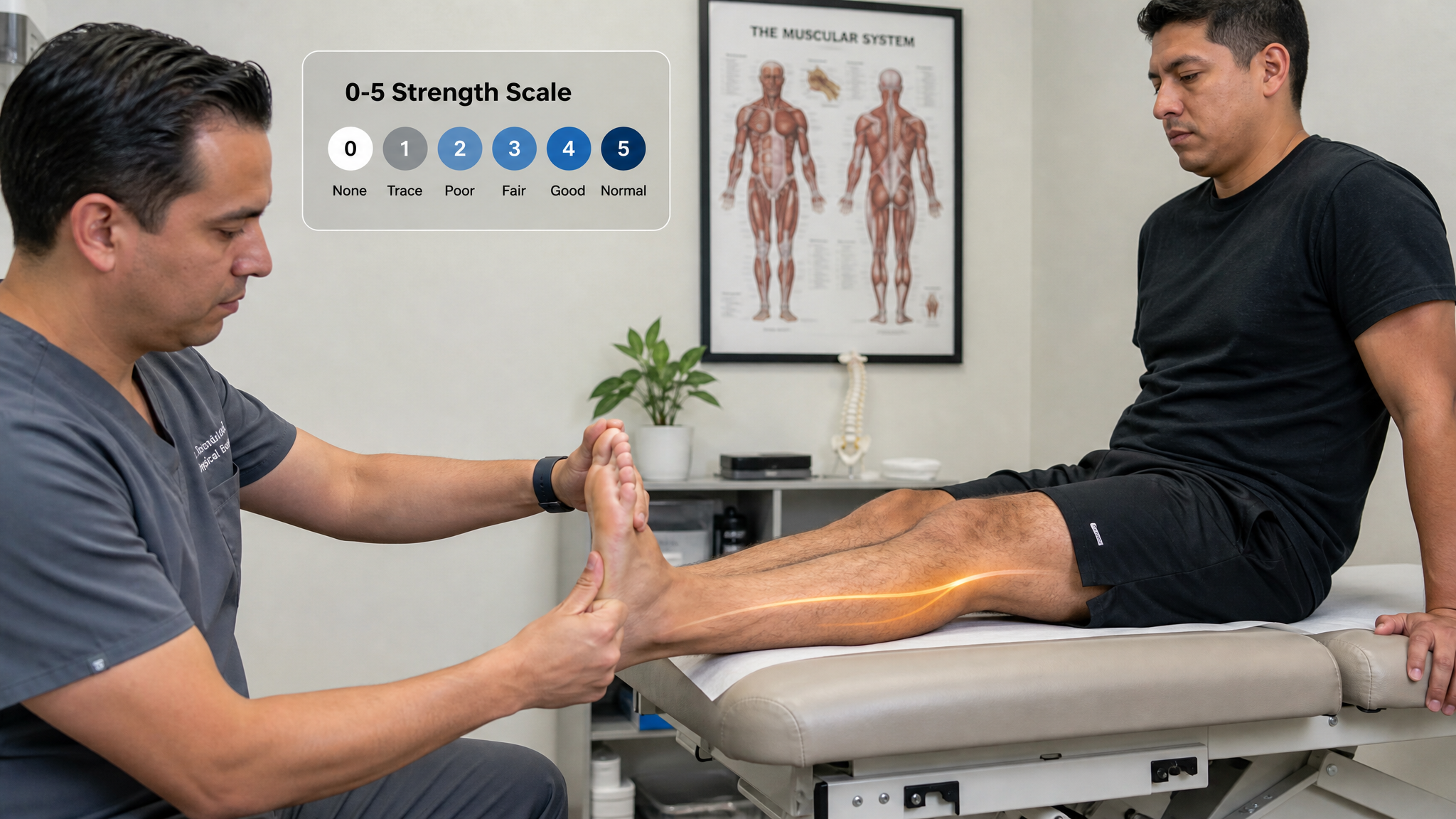
02Manual muscle strength testing graded 0 to 5
38 CFR §4.124a, preamble
Ankle dorsiflexion (L4–L5), great-toe extension (L5), ankle plantar flexion (S1) and knee flexion, tested on BOTH legs and graded 0 to 5, not described in words. Graded weakness is one of the three findings that break the wholly-sensory cap.
The preamble to §4.124a holds a sensation-only leg at mild or moderate no matter how it behaves. Graded motor loss is what lifts it. So the examiner has to resist each movement and write a grade, and has to do it on both legs, because a leg that is never tested is a rating that is never written. A report that describes the leg as "numb" and leaves the strength fields blank has quietly capped your evaluation before the rater ever sees it.
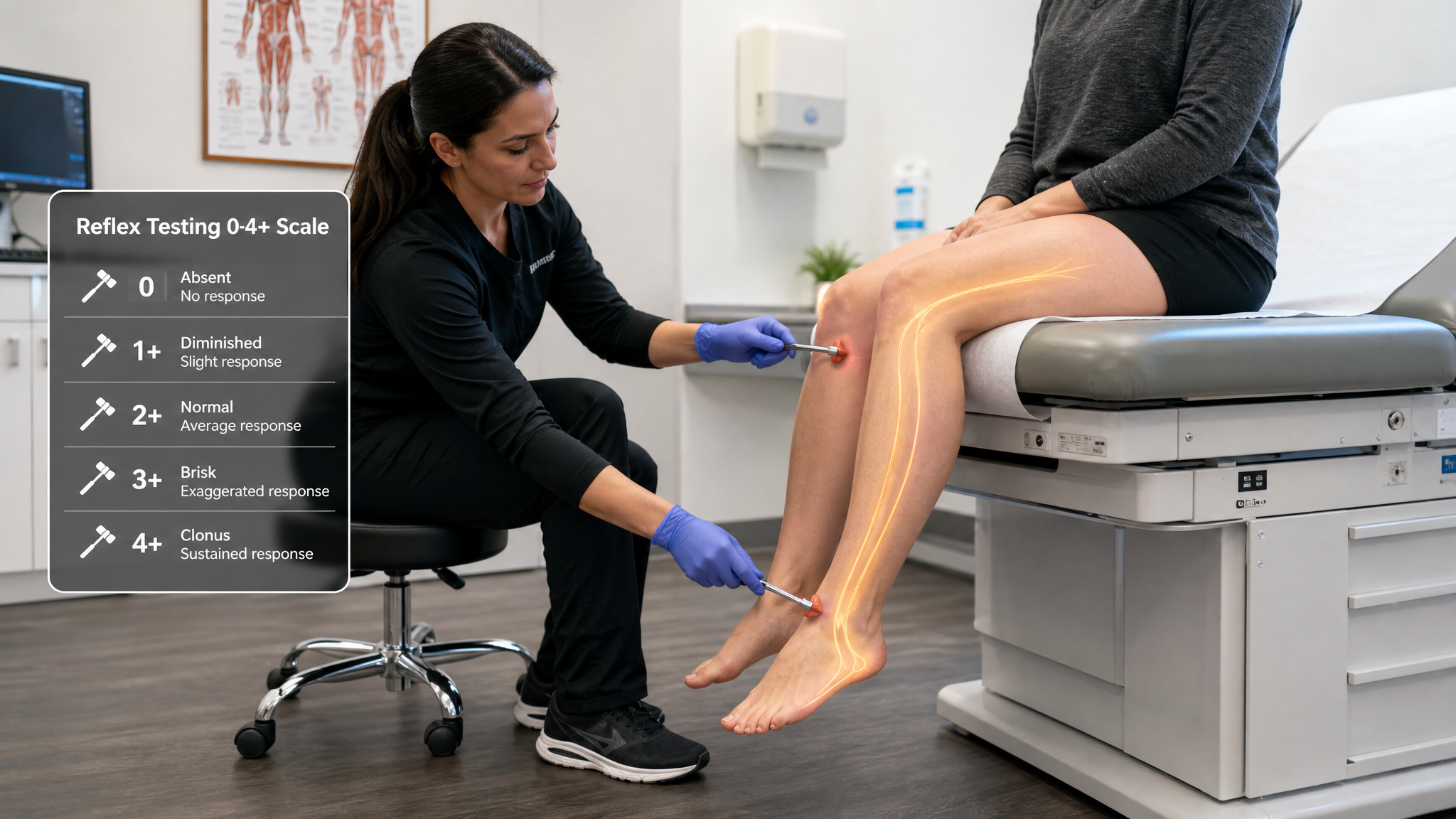
03Deep tendon reflexes graded and compared side to side
38 CFR §4.124a
The Achilles (S1) and patellar (L4) reflexes, graded 0 to 4+ and compared between the two legs. A diminished or absent Achilles reflex is objective evidence, not a symptom you reported.
Reflexes cannot be faked and cannot be exaggerated, which is exactly why they carry weight. An absent Achilles on the symptomatic side, next to a normal one on the other, is hard, gradable proof of S1 root involvement, the kind of finding that survives a rater who is inclined to call everything mild. The failure to watch for is a report that grades reflexes on the good leg, calls them "2+ and symmetric," and never actually tested the leg that is numb.

04Dermatome-by-dermatome sensory mapping
38 CFR §4.124a
Light touch and pinprick scored normal, decreased or absent at L4, L5, S1 and S2 individually, posterior thigh, lateral calf, dorsum of the foot and the sole, not a single global "sensation intact."
The dermatome that is numb is what identifies the root level, and the level is what ties the leg to a specific disc on your MRI. An examiner who checks one spot and writes "sensation intact distally" has skipped the step that makes the finding usable. Ask for each territory to be tested and scored separately, because a numb lateral calf and dorsum of foot points to L5, a numb sole and heel points to S1, and the rating record should say which.
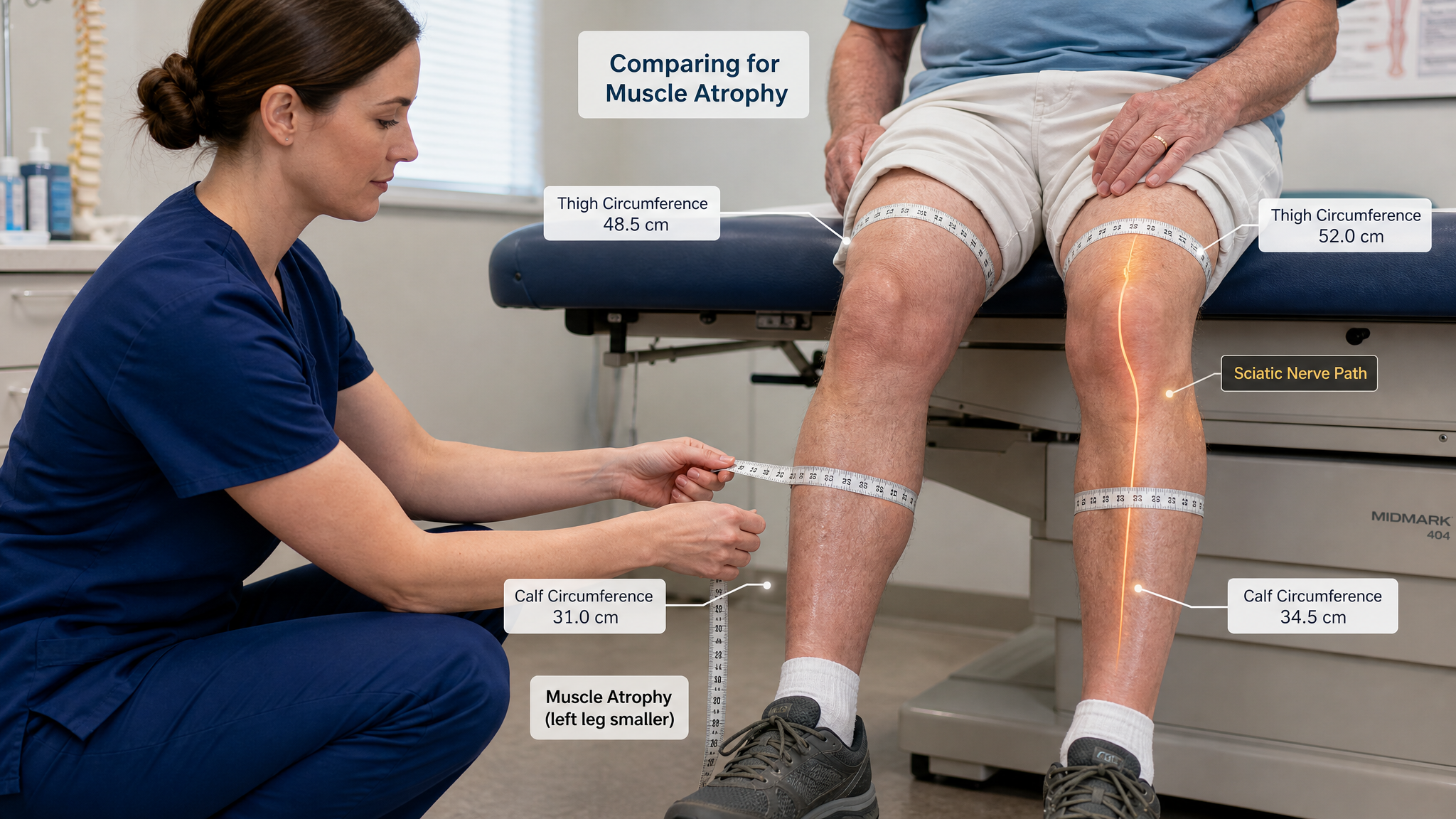
05Thigh and calf circumference measured with a tape
38 CFR §4.124a, DC 8520
Both legs measured in centimeters at a fixed, stated landmark. Marked muscular atrophy is what supports 60% under DC 8520, and it only exists in the record if someone used a tape.
Atrophy is the difference between a leg the schedule calls moderate and one it calls severe, and it is the single finding examiners most often eyeball instead of measure. A visibly wasted calf recorded as "no atrophy noted" is a defect you can point to. Insist the measurement be taken at the same landmark on both legs and written in centimeters, because a two-centimeter difference on paper is worth far more than a paragraph describing a smaller leg.
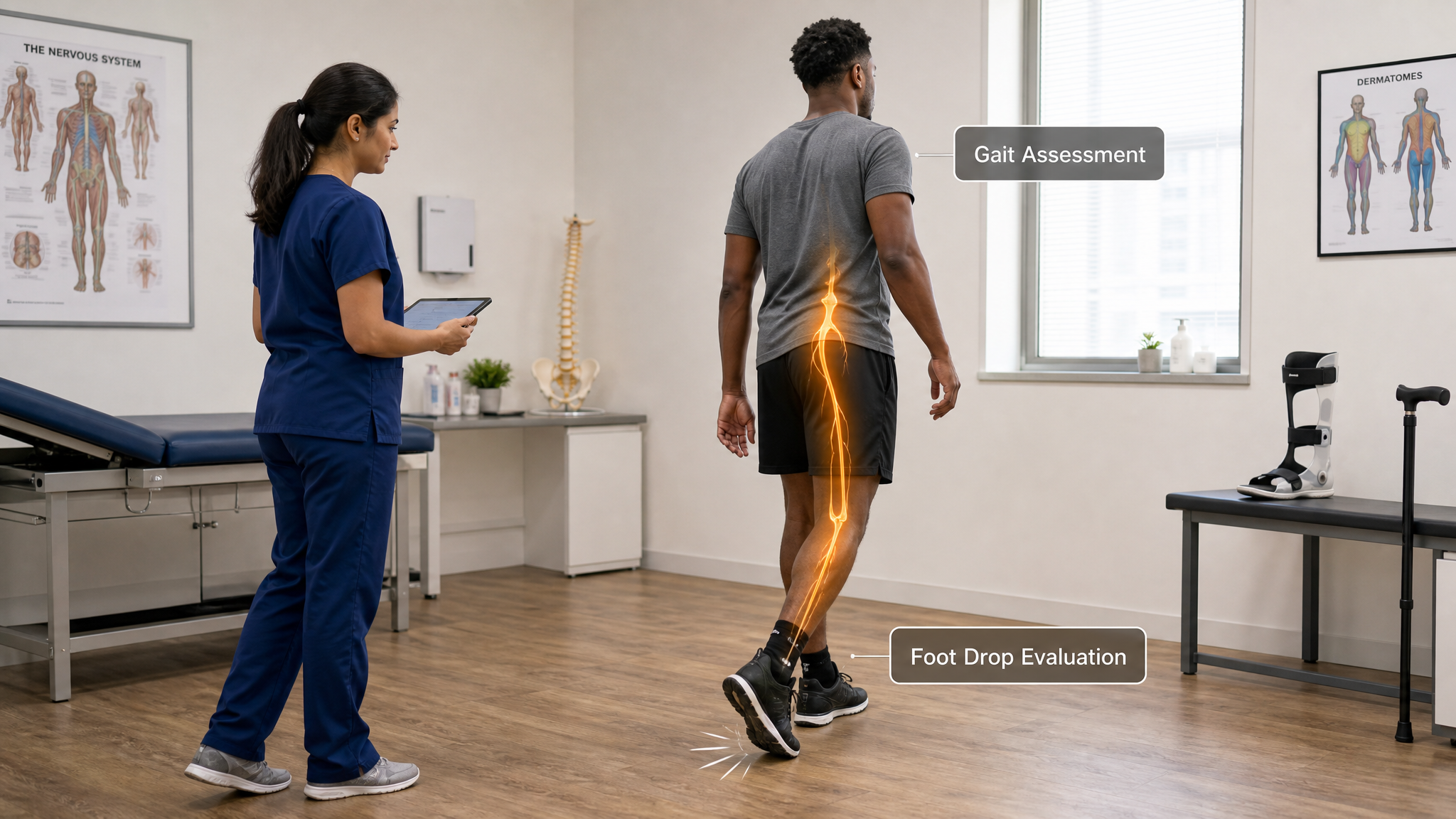
06Gait observation with heel walk and toe walk
38 CFR §4.124a
Gait observed over a walked distance, not two steps across the room, with heel walking and toe walking attempted and the result recorded, and any foot drop, antalgic pattern, cane, brace or AFO noted.
Heel walk isolates the L4–L5 dorsiflexors and toe walk isolates the S1 plantar flexors, so a veteran who cannot heel-walk or toe-walk has just demonstrated the motor loss the schedule pays for, without a single number being argued. Many exams skip both. Ask for them by name, use the cane or AFO you actually rely on walking in, and make sure the device is written into the report, because a documented assistive device is objective functional loss the rater cannot wave off.

07A flare-up estimate for the leg
Sharp v. Shulkin
Where you report flares, the examiner must ask about frequency, duration, severity and what you cannot do during a flare, and estimate the additional functional loss, or explain specifically why an estimate cannot be made. "Not observed at this exam" is not an adequate answer.
Sharp v. Shulkin closed the old loophole of writing "cannot estimate without resorting to speculation" and walking away. The examiner has to use your reported history and give an estimate. Come with specifics: how many bad days a month, how long the leg is unusable, what triggers it, sitting, a long drive, standing too long, and what you had to stop doing. A flat refusal to estimate, with no reasoning, makes the exam inadequate and returnable under §4.2.
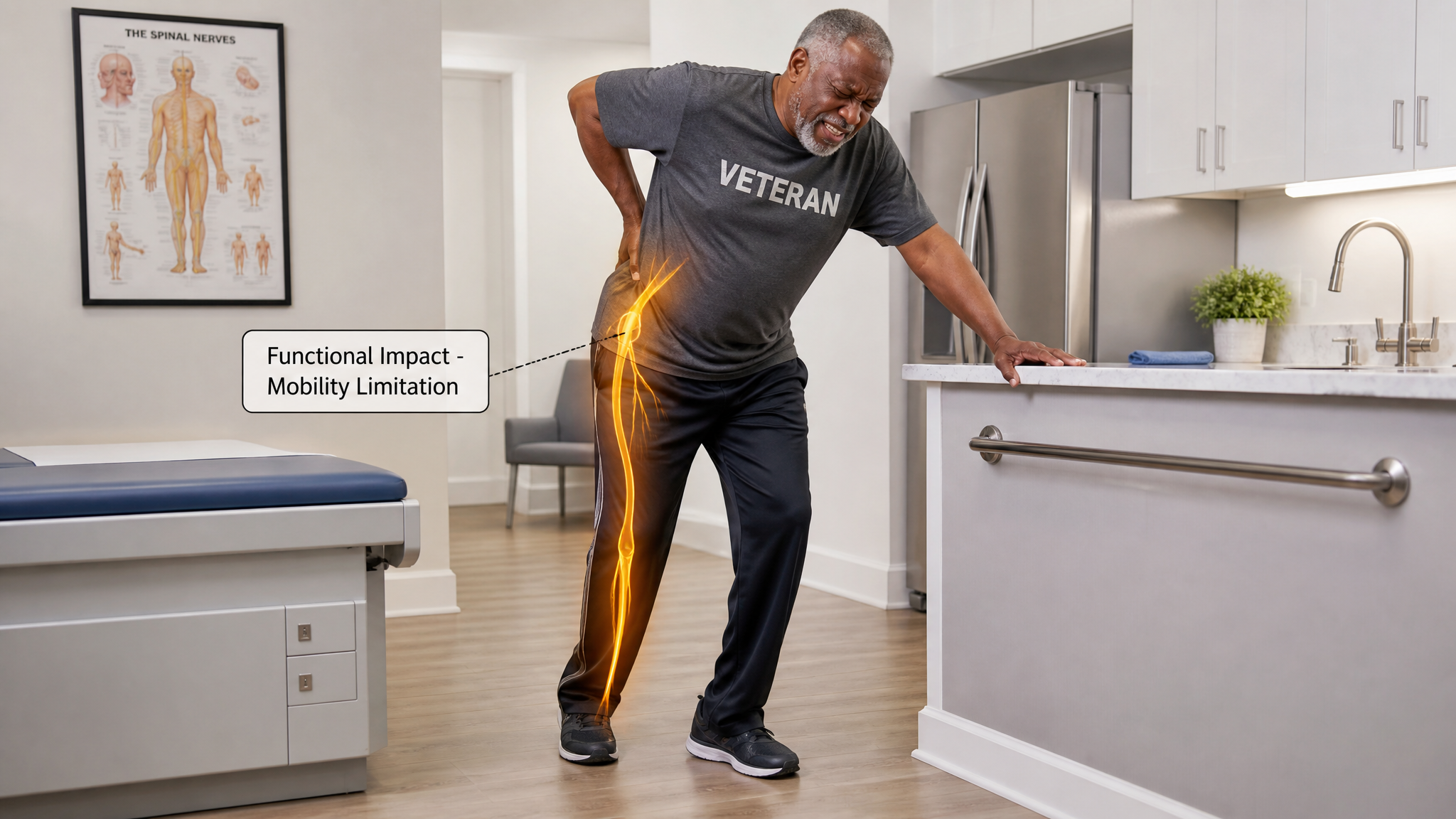
08A functional impact statement, and severity in the schedule's language
38 CFR §4.10
The report must describe what the leg stops you doing, standing, walking, working, driving, sleep, and must state, for EACH leg, whether the picture is paralysis, neuritis or neuralgia, whether it is wholly sensory, and whether it is mild, moderate, moderately severe or severe.
Section 4.10 makes functional loss the whole point of the examination, and it is the field examiners most often fill with the word "none." Answer it in concrete terms, how far you can walk before the leg gives out, how long you can sit or drive, how many days of work you have lost. Then make sure the examiner grades severity in the exact words of the schedule for each leg separately, because a report that grants the back and describes the leg only as "radiculopathy" leaves the rater no language to assign a percentage, and the separate leg rating, the most valuable part of the claim, goes unwritten.
05The Standard
What makes an exam adequate
Read your exam report against these. An exam that fails the standard is legally inadequate, and an inadequate exam is something you challenge rather than accept.
The range of motion has to be MEASURED, not estimated
38 CFR §4.46 states that the use of a goniometer in the measurement of limitation of motion is indispensable in examinations conducted within the Department of Veterans Affairs. An examiner who eyeballs your bend and writes a number has not complied with the regulation. This is the most common defect in a spine exam and it is the easiest one to spot from the chair.
Joints must be tested in every required condition
Under Correia v. McDonald, a joint examination for pain must, wherever possible, record active motion, passive motion, motion in weight-bearing and motion in non-weight-bearing, and where relevant, the range of the opposite undamaged joint. An exam that records one set of numbers and stops is incomplete on its face, and that incompleteness is grounds to challenge it.
Flare-ups have to be addressed, not dodged
Under Sharp v. Shulkin, when a veteran describes flare-ups, the examiner is obligated to estimate the additional loss of motion during a flare based on all the available evidence, including your own account of it. "I cannot opine without resorting to mere speculation" is not automatically acceptable; the examiner has to have actually sought the information first and explained why an estimate is impossible.
Repetitive use and functional loss must be factored in
Sections 4.40 and 4.45, and the DeLuca line of cases, require that pain, weakness, fatigability, incoordination and lack of endurance after repeated use be considered, and expressed in additional degrees of lost motion where that is feasible. Your rating is supposed to reflect what you can do on the fifth repetition and on a bad day, not just the first careful bend of the morning.
Neurological findings must be separately documented
Note (1) to the General Rating Formula requires that any associated objective neurologic abnormality be evaluated separately under an appropriate diagnostic code. If your leg symptoms were mentioned in the narrative but never tested and never assigned, the exam did not do what the schedule requires of it.
The examiner must review the record when the question requires it
Where a medical opinion on cause, aggravation or a secondary relationship was requested, the examiner is expected to review the relevant evidence and give a reasoned explanation. A bare conclusion, "less likely than not related to service" with no reasoning attached, carries little weight, and an opinion with no rationale is challengeable.
The examiner has to be qualified for the body system
The VA may use its own clinicians or a contract vendor. Either way, the examiner is expected to have the competence to evaluate the system being examined. If a spinal exam with a neurological component was performed by someone who never tested a reflex, that is a problem worth raising.
The exam has to be CURRENT
A rating is supposed to reflect your condition now. An exam performed before a documented worsening, or years before the decision, may not support the current evaluation, and you can request a new one on that basis.
06Afterward
What happens after your exam is complete
The examiner writes the report and submits it, it is reviewed for completeness, and only then does the claim move toward a rating decision. Here is what actually controls the clock.
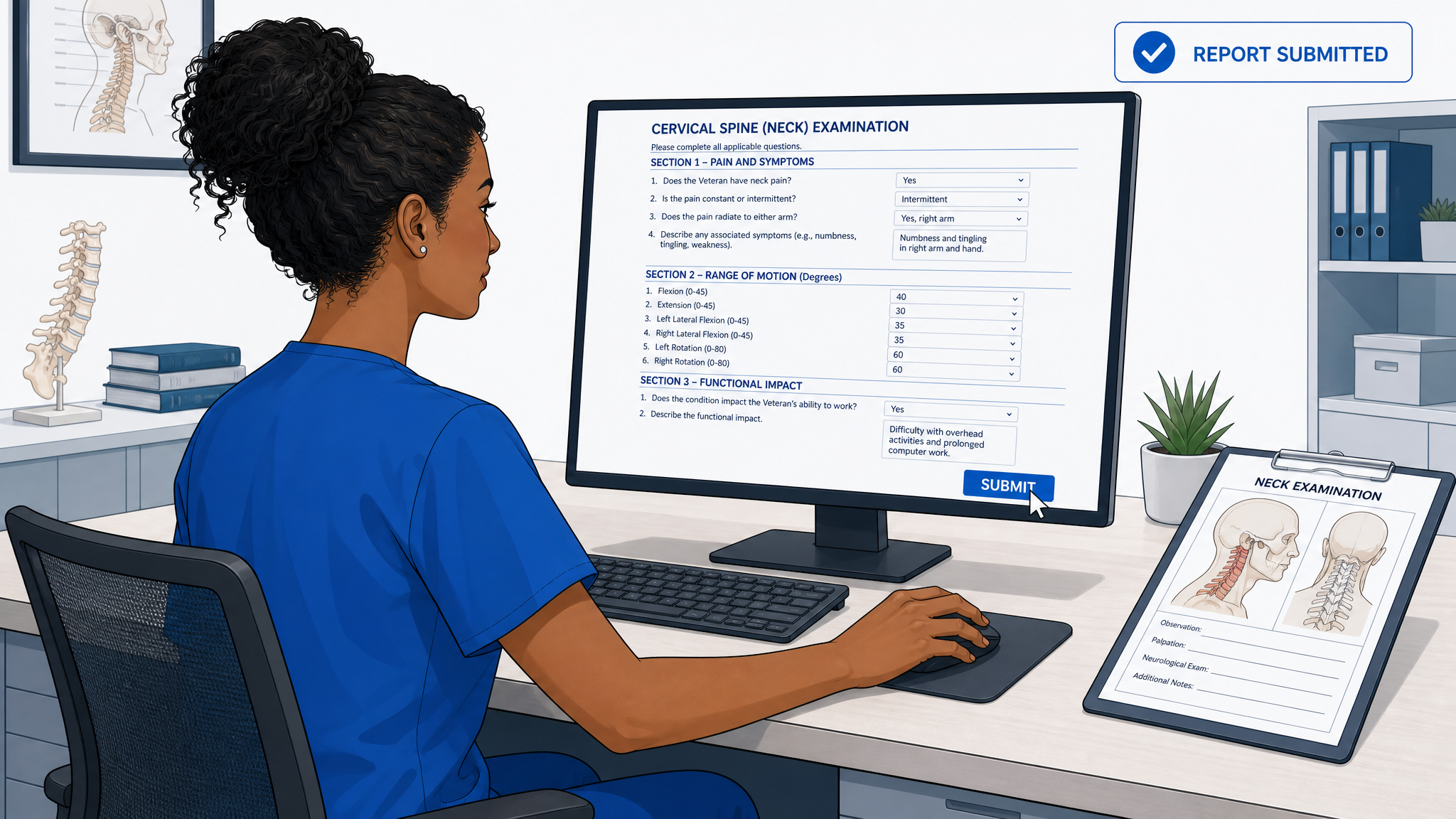
The examiner writes and submits the report
Days 1–5 after the exam
The examiner compiles the history, the physical findings, the measurements and any testing into the questionnaire, adds any requested medical opinion, and submits it. Contract vendors typically have a turnaround requirement measured in days, not weeks.
Nothing about your claim moves while this is happening, and nothing you do speeds it up. What matters is that the report is written from notes taken in the room, which is exactly why what you said, and how the examiner recorded it, is already locked in by the time you get to your car. Request your copy now rather than later.
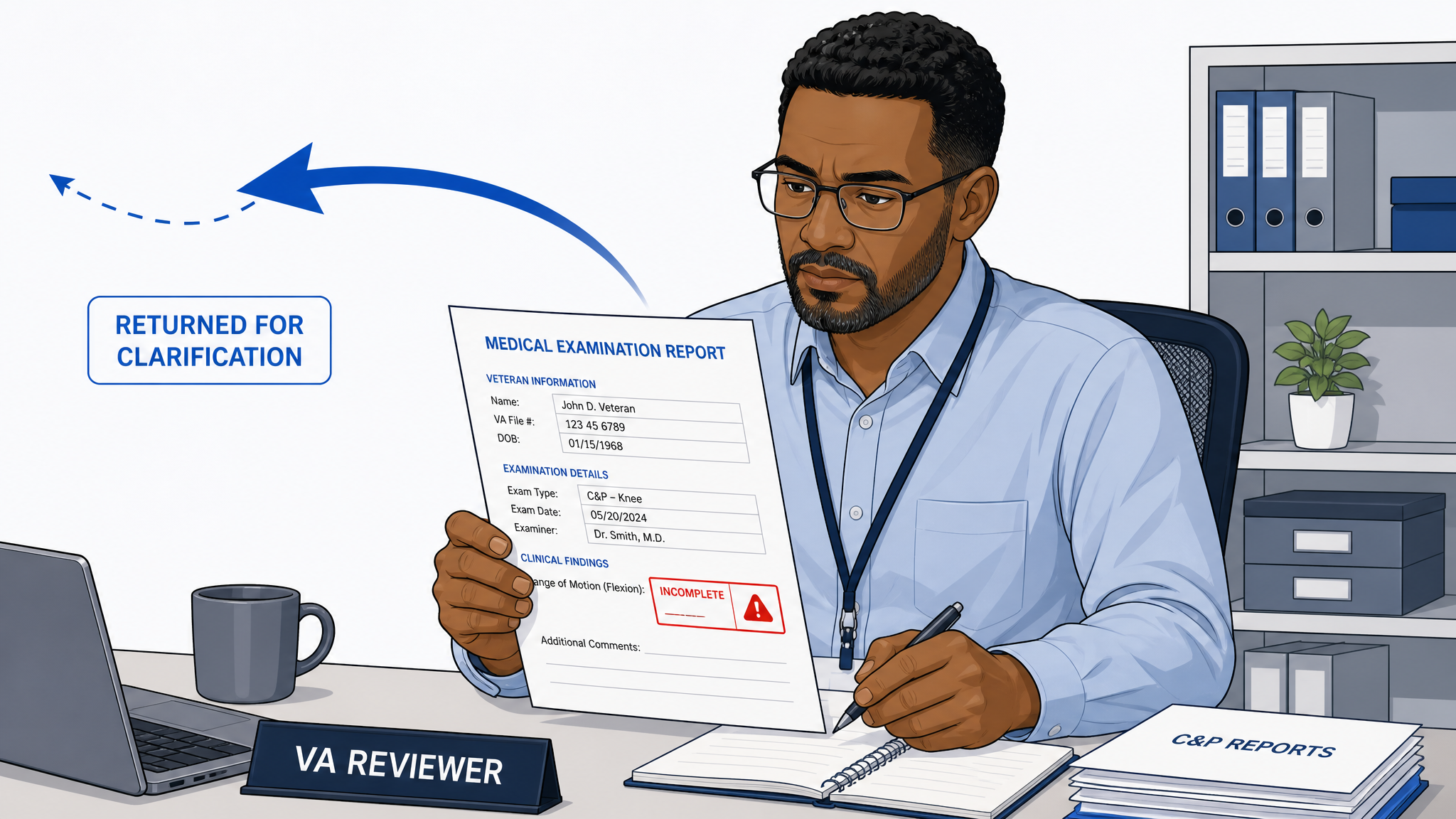
Quality review, and the request for clarification
Days 3–30
The report is reviewed for completeness. If it is internally inconsistent, missing a required field or missing the opinion the VA asked for, it goes back for correction or a second opinion. This is the single most common cause of a claim appearing to stall after the exam.
Understand what a finished exam actually means: it means the appointment happened, not that your claim is ready for a decision. If the reviewer finds a blank range-of-motion field, an opinion that does not answer the question that was asked, or findings that contradict each other, the file goes back out for more information. That is a normal quality control step, not a rejection of your claim, and it is not a sign that you did something wrong, but it does add weeks, and it is the reason so much of what you read online sounds like the system is broken.
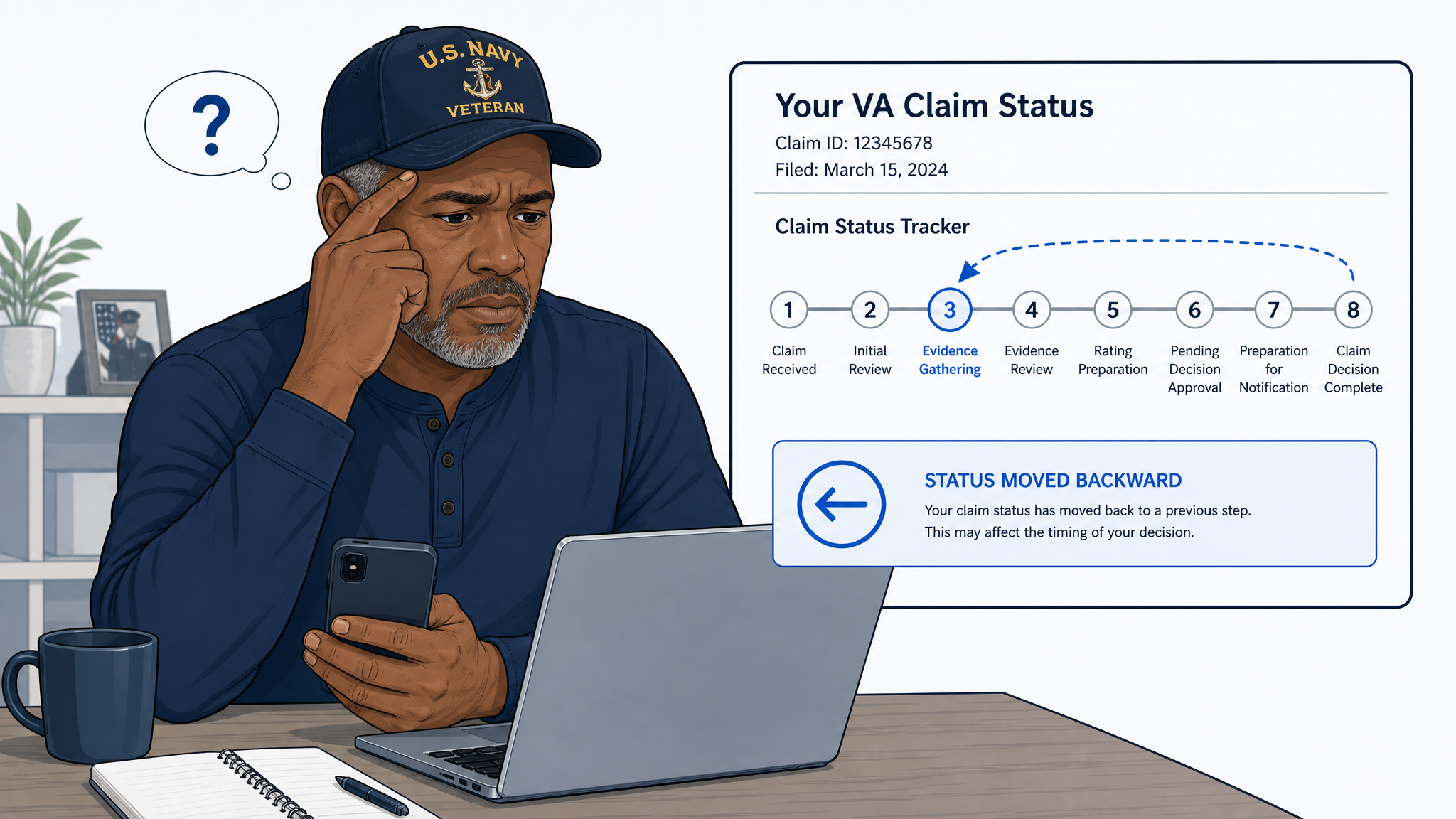
Your status tracker moves backward, and it is usually not bad news
Any time after the exam
The online tracker shows eight steps. Veterans watch it reach step 7 or 8, then find it back at step 3 or 4 a week later. That regression almost always means one thing: the file went back for additional information, most often a returned or clarified exam.
This is the number one thing veterans panic about, and it is misread constantly. The tracker is not a countdown, it is a location marker. When the VA decides it needs one more piece of evidence, a corrected exam, a clarifying medical opinion or an outstanding record, the claim is routed back to the evidence gathering step and the bar redraws itself where the file physically is. It does not mean a denial. It does not mean your case was thrown out or restarted. It does not erase anything already in the file, and it does not change your effective date. What it does mean is that something in the record was not good enough to decide on yet, which is worth knowing, because if the weak link is the exam, this is the window where a corrective statement or a private opinion from your own doctor does the most good.

Evidence gathering closes
Varies
Before anyone rates your claim, the file has to be built. This is the stretch where the Regional Office pulls together everything the decision will rest on: your service treatment records, your VA medical records, any federal records, the C&P exam report, and any private records it has requested on your behalf. The claim sits here until the VA is satisfied the record is complete enough to decide, which is exactly why a status tracker can appear to stall or slide backward at this step. You are not powerless while it sits here. Anything you put into the file yourself lands the day you send it, and every relevant record you add now is one less thing the rater can later say was missing.
A VA request to a private provider is a letter that may or may not be answered, and the VA will wait on it for weeks before moving on, sometimes without ever getting a response. A record you walk in yourself, or upload through your claim, is in the file the day you send it. So do not sit and wait to be asked. If you know a treatment record, an imaging report, a surgical note or a buddy statement exists and it matters, send it now, with a VA Form 21-4138 statement that explains in plain words what the document is and what it shows. This is also the window where a corrective statement or a private medical opinion from your own doctor does the most good, before the rater has locked in a decision, not after. Once the evidence gathering step closes, the file goes to a rating specialist, and your chance to shape the record cheaply and quickly closes with it.

Rating decision and promulgation
Typically several weeks after the last piece of evidence lands
This is the stage where your evidence finally becomes a number. A rating specialist, not the examiner, and not a doctor, takes everything in the file and applies the rating schedule to it: the exam findings, your range-of-motion measurements, your lay statements, your private records and any medical opinions. They assign a diagnostic code to each condition, pull a percentage from the schedule, set your effective date, and either grant, deny or defer each issue. The decision is then reviewed and authorized, promulgation is simply the VA’s word for making it official, and the decision letter and code sheet are generated and mailed. Where an award is made, payment follows the effective date rules, and back pay is calculated to that date.
Read the code sheet, not just the percentage. It names the diagnostic code used, the exact measurements relied on and the effective date assigned, and that is where most mistakes live. This is a human being reading a file under a production quota, and the two things that go wrong most often are a rater using the pre-repetition range-of-motion numbers instead of the worst-case figures §4.59 and §4.40 require, and a claimed condition being decided on a thin record or quietly left out. Check whether painful motion was accounted for, whether your radiculopathy was rated separately under Note (1) or folded into the spine rating, and whether every condition you claimed was actually addressed. A decision you do not read is a decision you cannot challenge, and the deadline to challenge it starts the day the letter is dated, not the day you understand it.
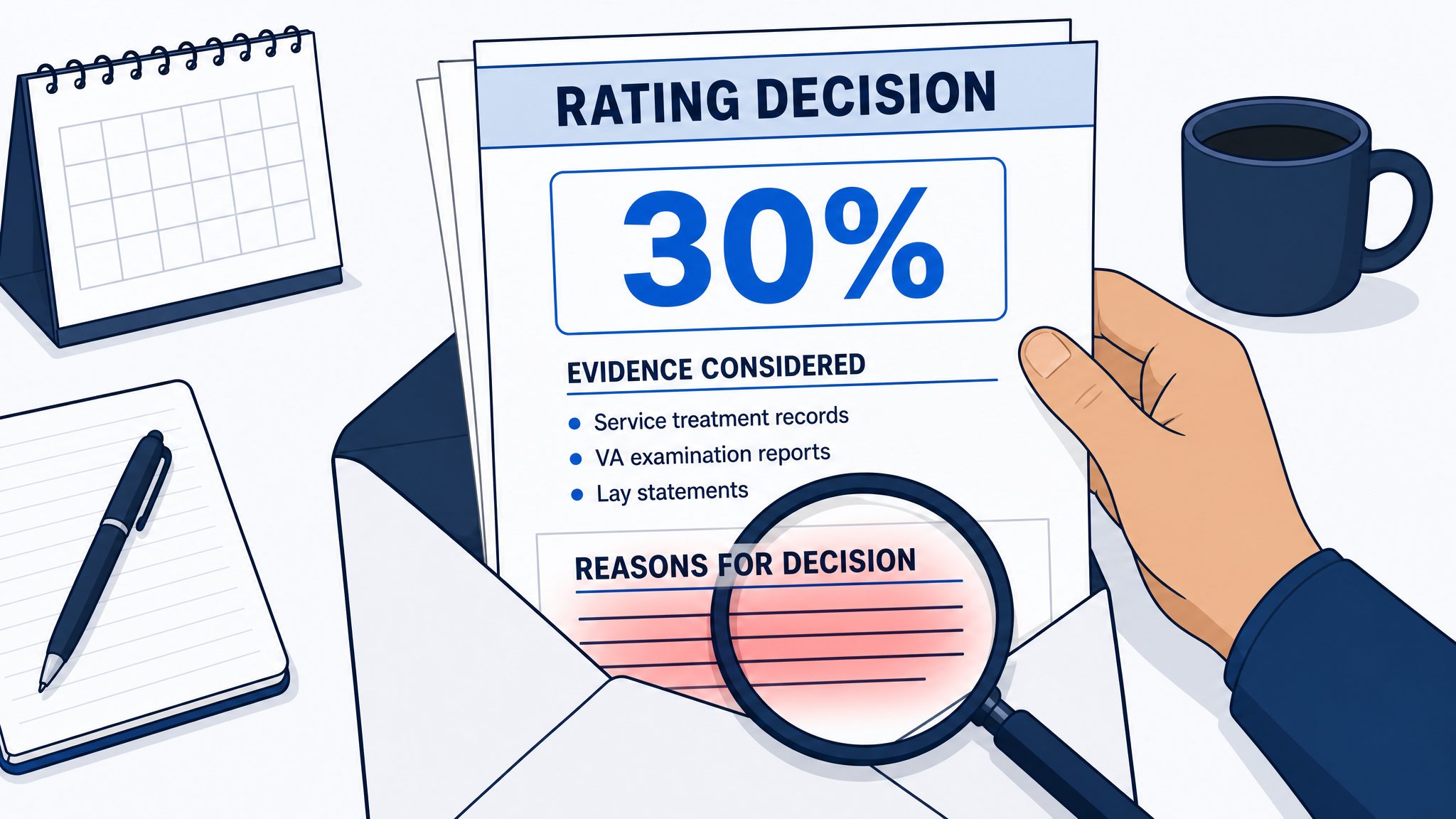
C&P examination is the decision letter
The day it lands in your mailbox
The envelope holds two different documents: the narrative decision letter, and the code sheet. Together they are the single most important piece of paper in your claim, because every deadline, every appeal option and every dollar of back pay is set by what is printed on them, not by what you were told at the exam.
Most veterans read one thing on that letter: the percentage. Then they either celebrate it or get angry at it, and file it in a drawer. That is the mistake. The percentage is the conclusion; the reasons section is the reasoning, and the reasoning is what you attack. It tells you which diagnostic code the rater used, which range-of-motion figures they relied on and which they ignored, whether painful motion under §4.59 was accounted for, whether your neurological findings were rated separately under Note (1) or folded into the spine rating, which conditions were decided, which were deferred, and which were never addressed at all. It also assigns your effective date, which controls back pay. A rating that looks low is very often not a disagreement about how bad your neck is, it is a rater who used the pre-repetition numbers, or missed the radiculopathy, or rated one side and not both. You cannot see any of that from the percentage. Do not go by the percentage alone, and do not decode it by yourself if you are not sure what you are looking at, have someone who reads these for a living read it with you before the clock runs out. You have one year from the date on that letter to file a Higher-Level Review (VA Form 20-0996), a Supplemental Claim (VA Form 20-0995) or a Board appeal, and the deadline runs from the date printed on the letter, not the date you opened it. Bring it to this office and we will go through it line by line, at no cost, and tell you plainly whether it is right.
What normal looks like: 30 to 60 days for a simple claim, longer for a complex one
After your exam you should expect some kind of notification from the VA, a decision, a request for more information, or a notice that another exam has been scheduled. For a straightforward, single-issue claim that often lands within 30 to 60 days. But 30 to 60 days is a rough guide, not a rule, and it is not a ceiling. A claim with several conditions, a toxic-exposure or presumptive question, a returned exam, or missing records routinely takes 90 days or more, and that alone does not mean anything is wrong, the more moving parts your case has, the longer the VA takes to work it. Inside the window that is normal for a case like yours, silence is expected and there is nothing to fix, and a tracker that jumps backward is normal too.
What matters is not a fixed number of days, it is whether the claim is still moving and whether you can get a straight answer about where it is. Once you are well past what is normal for a case like yours and the VA either goes silent or cannot tell you what the claim is waiting on, stop waiting. That is usually where the real trouble hides, an exam that came back twice, a records request that was never answered, a claimed condition that got dropped, or a file sitting in the wrong queue. Call the VA at 800-827-1000, ask specifically what the claim is waiting on and who it is assigned to, and write down the answer. If you cannot get a straight answer, or the answer tells you the exam is the problem, that is the moment to bring it to this office rather than sitting on it for another three months. Problems raised early get fixed inside the claim. Problems discovered in a denial letter get fixed on appeal, and that costs you a year.
Other things that control the clock
Six things decide how long you wait, and none of them are visible from the tracker alone.

The average is a moving number
Check it at the source, not second-hand
The VA publishes an average days-to-complete figure for disability claims that moves month to month; check the current number on the VA’s own claim status page rather than relying on any second-hand figure. In practice, most veterans see a decision somewhere between roughly three and eight months from the date the claim was filed, with the exam usually falling in the middle of that window.
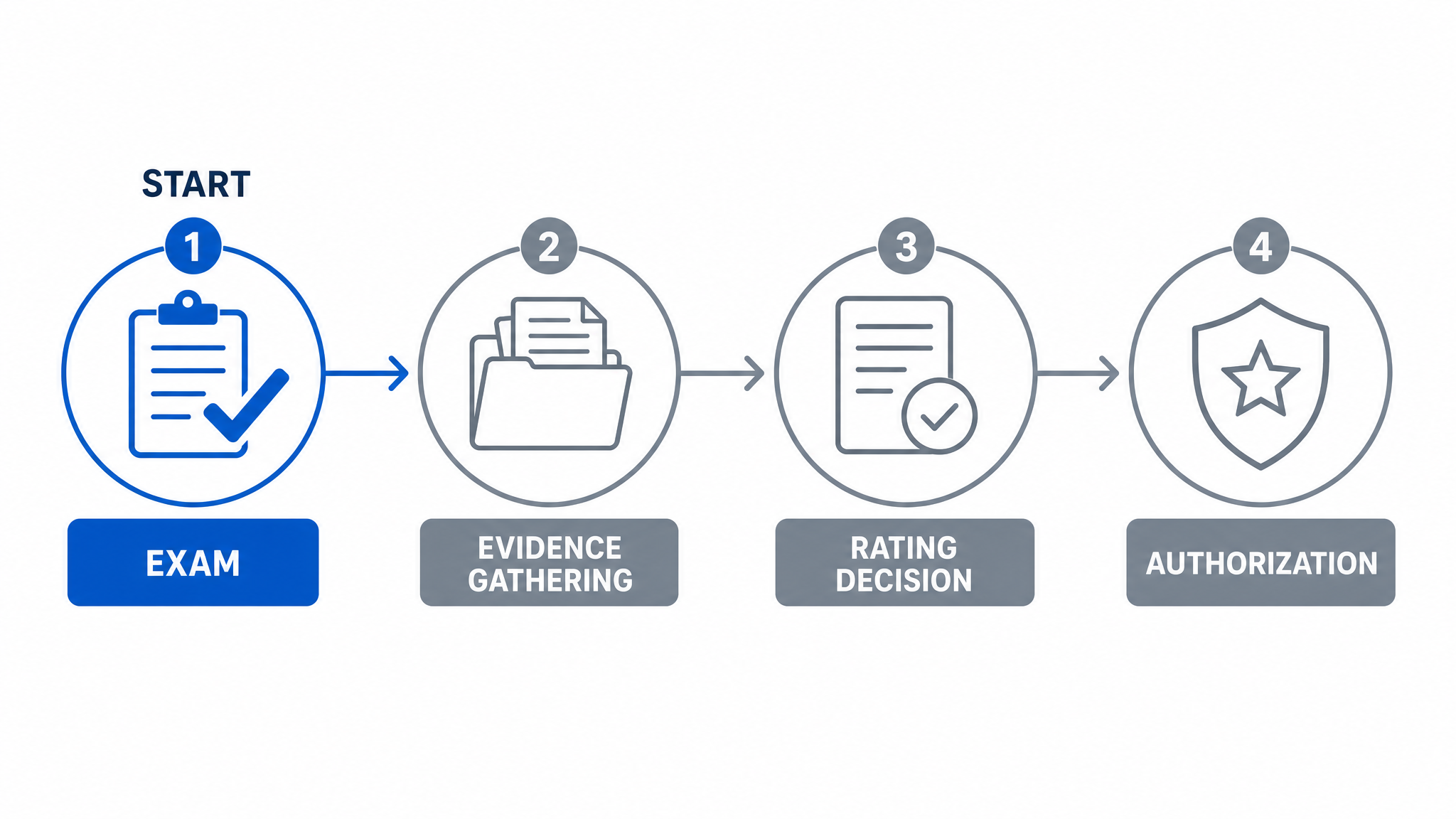
The exam is not the last step
Three stages still sit in front of you
The exam is not the last step. The clock does not start at the exam and it does not stop there either, the claim still has to clear evidence gathering, the rating decision and authorization.
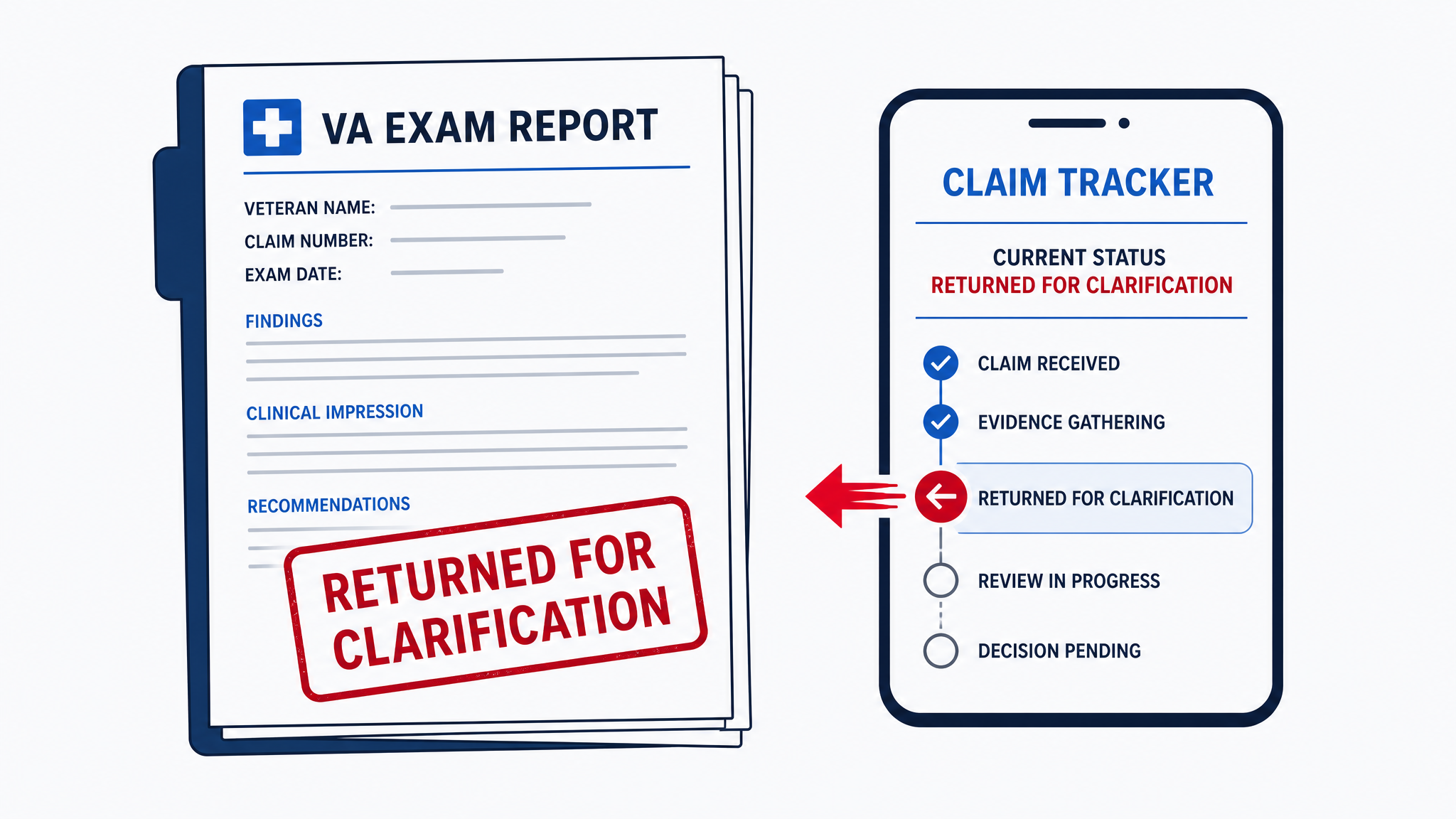
A returned exam is the invisible delay
The reason a tracker slides backward
A returned or clarified exam is the most common invisible delay, and it is why a tracker can slide backward. Expect some contact from the VA within 30 to 60 days of the exam. Past 60 days with nothing at all, call and ask specifically what the claim is waiting on.
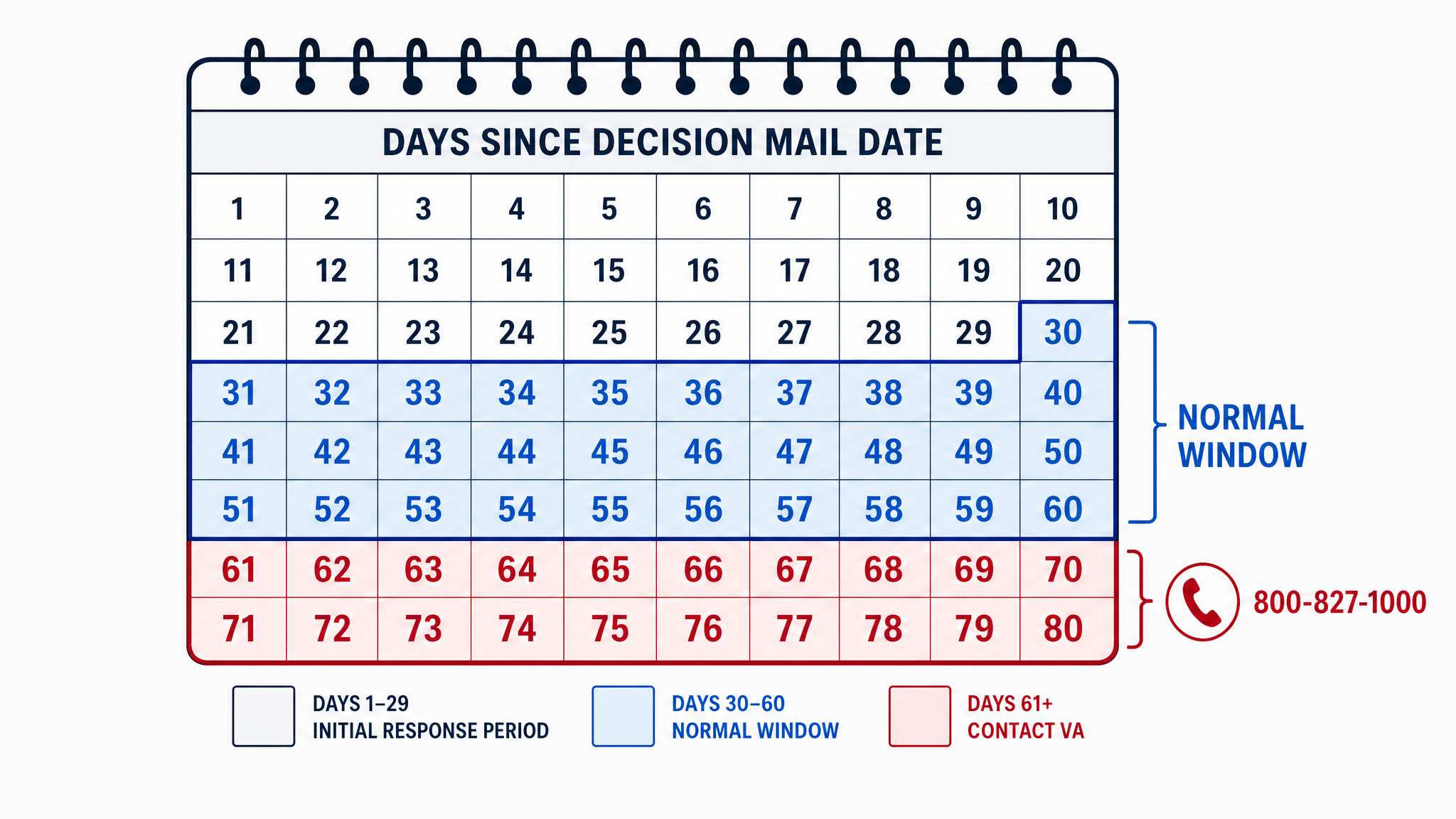
30 to 60 days is a guide, not a deadline
A complex case can take 90 days or more
Thirty to sixty days is a rough average for a simple, single-issue claim, not a hard rule and not a ceiling. A claim with several conditions, a presumptive or toxic-exposure question, a returned exam, or missing records can easily take 90 days or more, and that alone does not mean anything is wrong. Watch whether the claim is still moving, not the calendar. Only when it stalls well past what is normal for a case like yours, and no one can tell you what it is waiting on, should you stop waiting, call 800-827-1000 and ask what the claim is waiting on and who it is assigned to.

Watch your status yourself, in one of three places
Weekly, not daily
Check your own status in one of three places: your VA.gov claim status page, the VA Health and Benefits mobile app, or by calling 800-827-1000. Check it weekly, not daily. And understand exactly what a status check can tell you: if a decision is posted in your account, it is live; if it is not posted, it is not ready. That is the whole rule. This is not something your representative or your attorney can speed up, we see the same thing you see, at the same time, and calling us to ask does not move it. Calling the VA to ask for an update does not move it either. Watch it yourself, weekly, and the moment a decision posts, bring it to us.
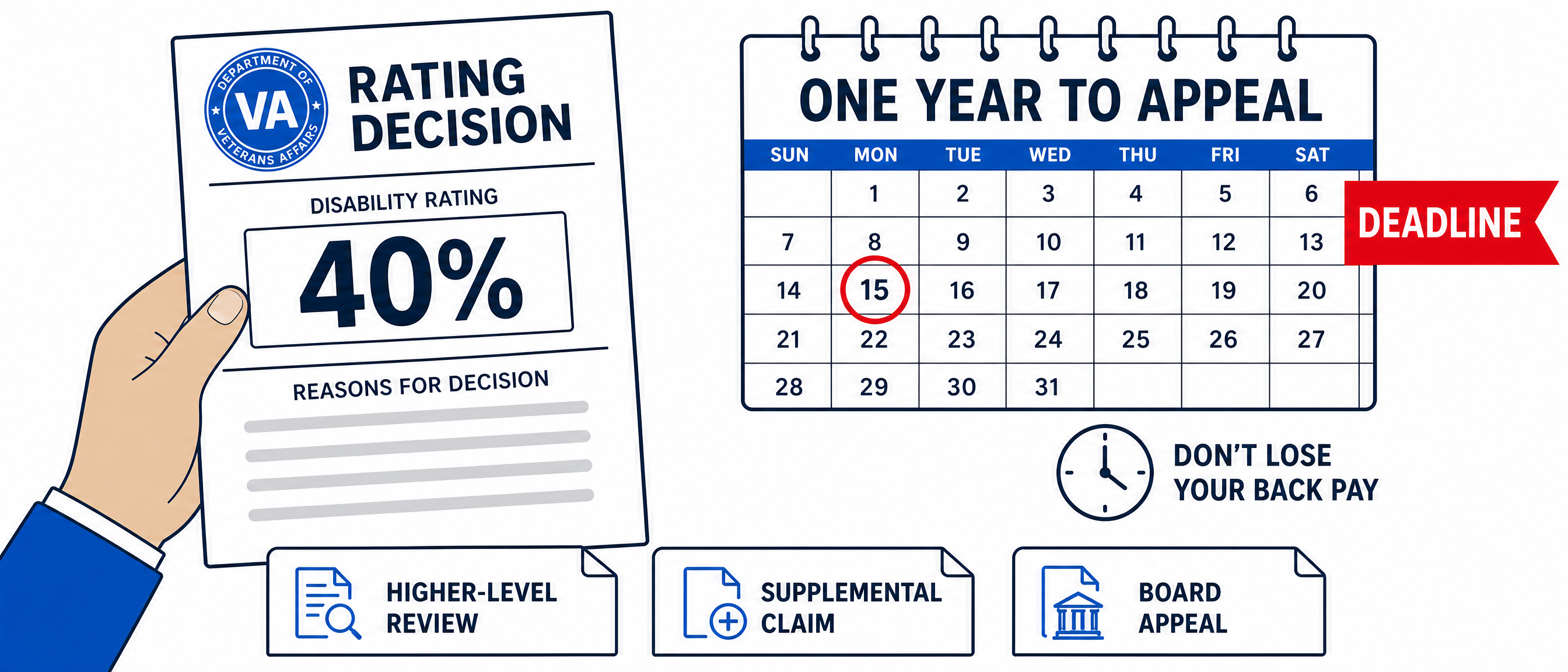
Your decision letter arrives, read it, then start the appeal clock
What to do the day it lands in your mailbox
The decision letter is the finish line of the claim and the starting line of the appeal, and the moment it arrives, a one-year clock starts running. Read it the same day. Find the combined rating, the percentage assigned to each condition, and the effective date, because the effective date controls how far back your back pay reaches. Then request a copy of your C&P exam report so you can see whether the rater used your real range-of-motion numbers or ignored the radiculopathy. If any part of the decision is wrong, a low rating, a denied condition, or a bad effective date, you have three appeal lanes, and you must choose one within one year of the date printed on the letter: a **Higher-Level Review (VA Form 20-0996)**, where a senior reviewer re-decides on the same evidence; a **Supplemental Claim (VA Form 20-0995)**, when you have new and relevant evidence such as a private DBQ or your own range-of-motion exam; or a **Board Appeal (VA Form 10182)** to a Veterans Law Judge. Miss that one-year deadline and the decision becomes final. You can still file again later, but you lose the original effective date, and that lost time is lost back pay you never get back. Bring the letter to this office before the year runs out and we will read it with you, line by line, at no cost.
07Remedy
How to report a bad exam
Where this exam goes wrong
The signature failure here is a report that documents a negative straight-leg raise, calls the picture **"mild sensory radiculopathy, left lower extremity"**, never measures a calf and never grades a reflex. That produces a single 10% where two legs and, very often, a second nerve were available. A report that omits the findings the rating criteria require is **inadequate for rating purposes** under **38 CFR §4.2** and the adjudicator is obligated to return it, but only if someone points at it and says so.

Write it down the moment you get to your car
Date, start time, end time, the examiner’s name and credentials, the vendor, every test that was performed, and every test that was not. A contemporaneous note written the same day is evidence. A memory reconstructed four months later is not.
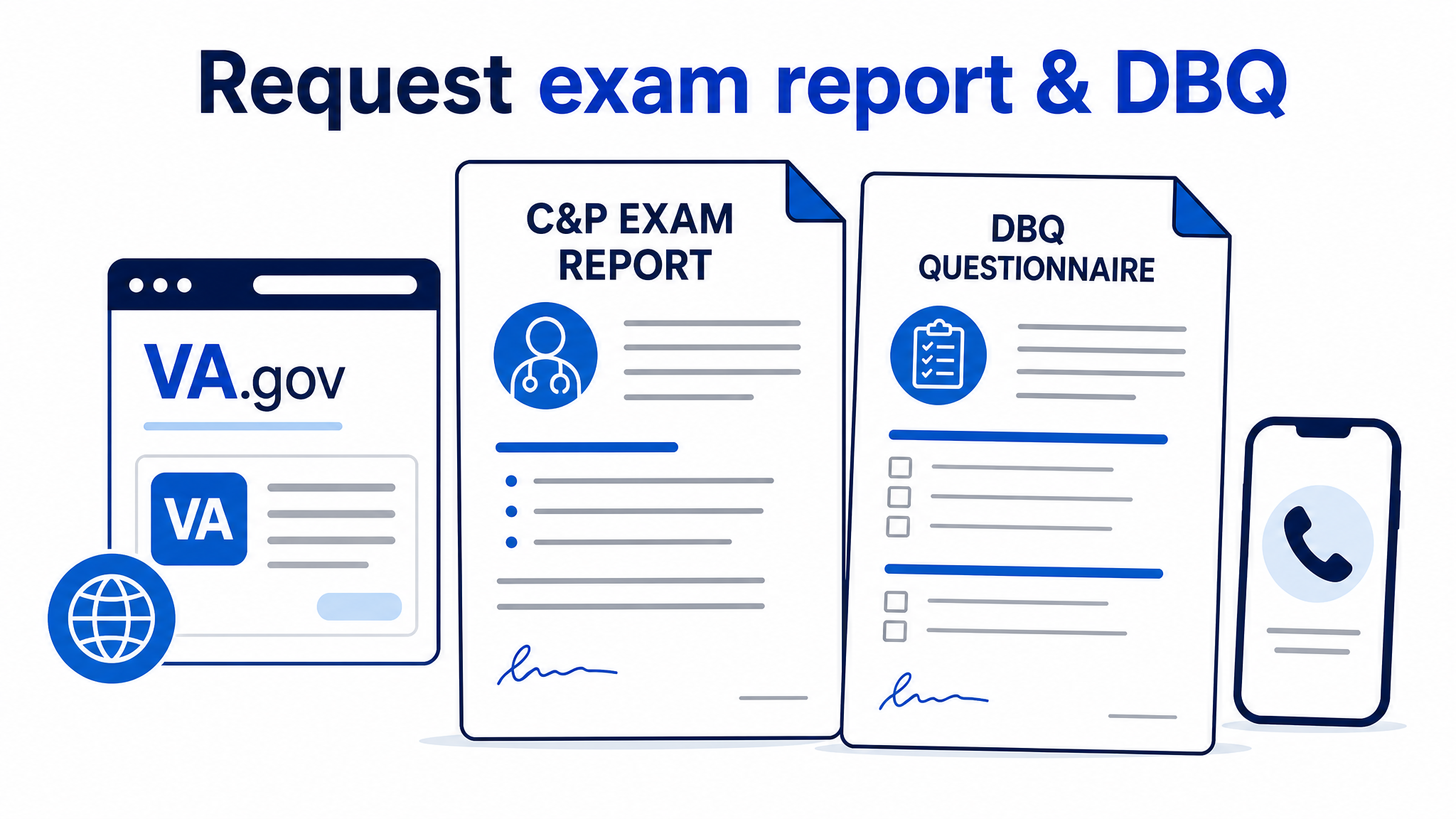
Get the exam report and the questionnaire
Request a copy through VA.gov, through a written request to the Regional Office, or by calling 800-827-1000. You cannot challenge what you have not read. Compare it line by line against what actually happened in the room.

Name the defect specifically, with the citation
Never write "the exam was unfair." Write "no goniometer was used, contrary to 38 CFR §4.46" or "flare-ups were reported and not addressed, contrary to Sharp v. Shulkin" or "repetitive use testing was not performed, contrary to 38 CFR §4.40 and DeLuca." A specific, citable defect is what forces action.
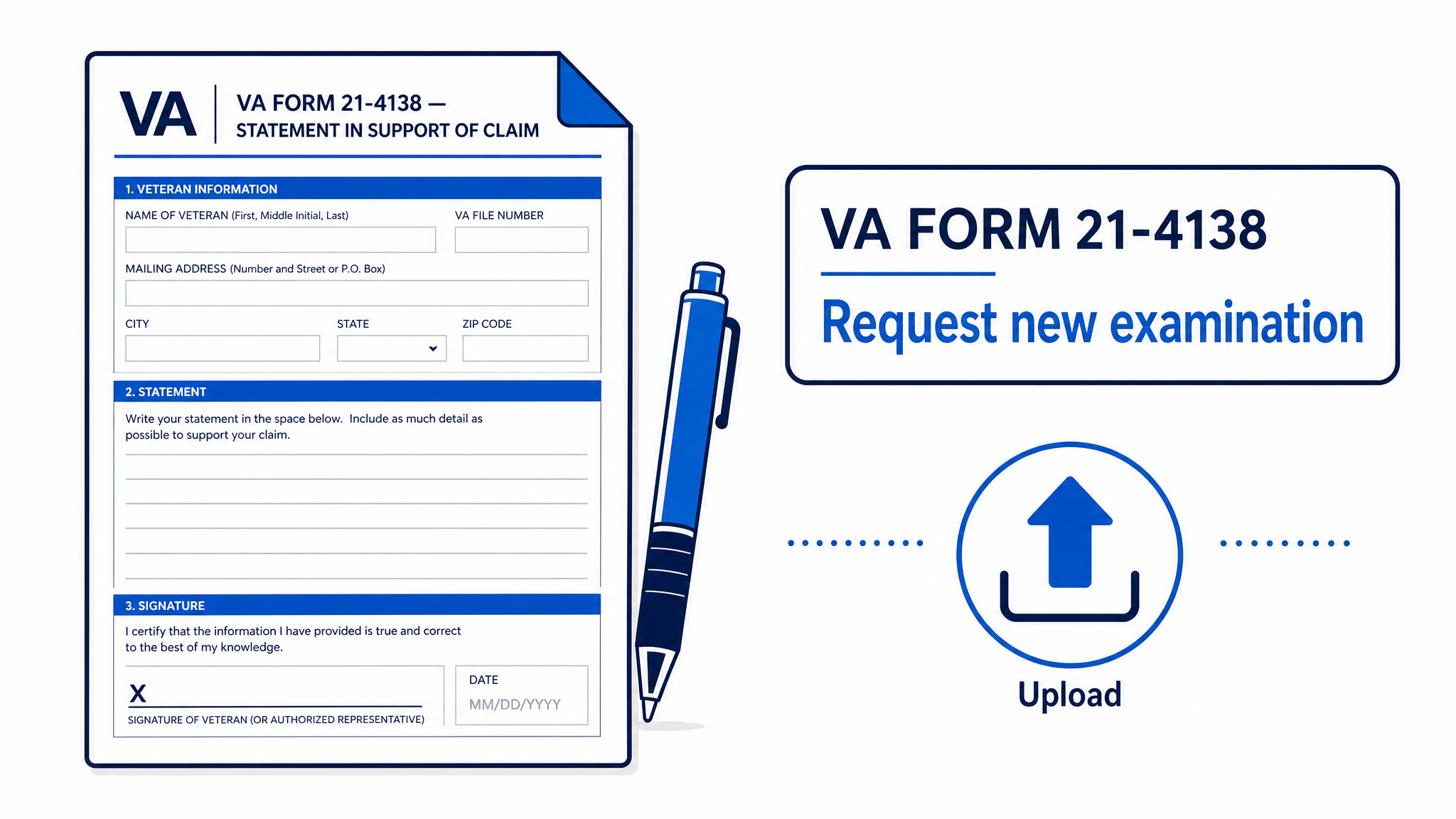
Submit a statement asking for a new examination
VA Form 21-4138, Statement in Support of Claim, filed through VA.gov or mailed to the Evidence Intake Center. State the defect, cite the authority, and request a new or supplemental examination. Do this BEFORE the decision if the claim is still open, it is far easier than undoing a decision afterward.
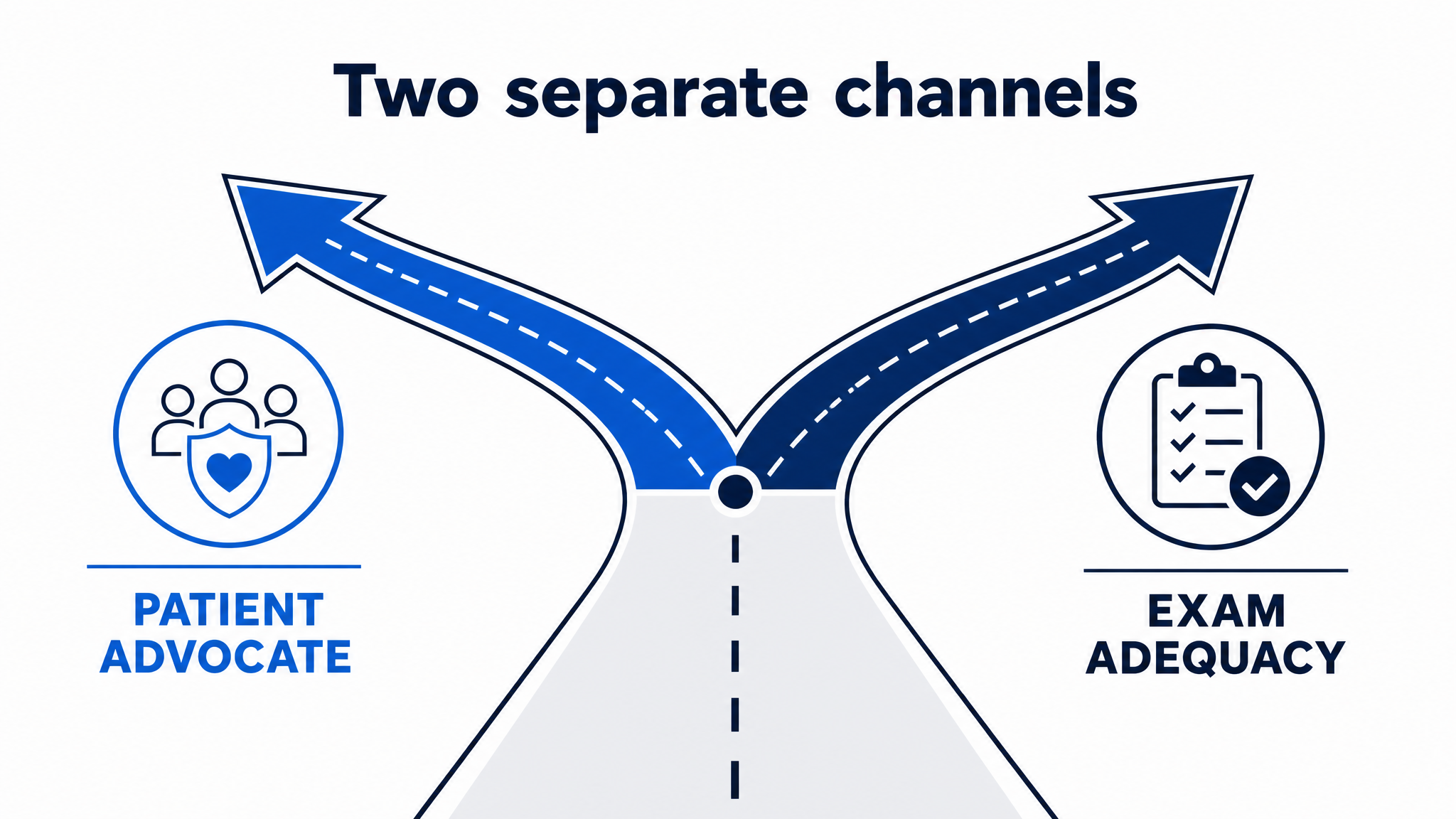
Report examiner conduct separately
If the problem is behavior rather than methodology, you were rushed out, dismissed, never touched, or treated with hostility, file a complaint with the VA facility’s Patient Advocate, or with the vendor directly for a contract exam, and copy the Regional Office. Conduct complaints and adequacy challenges are two different tracks and you can run both.

If a decision has already issued, pick the right lane
A Higher-Level Review (VA Form 20-0996) argues the VA erred on the evidence it had, the right vehicle when the exam was inadequate on its face. A Supplemental Claim (VA Form 20-0995) is the vehicle when you are adding new and relevant evidence, such as your own private range-of-motion examination or a completed DBQ from your treating provider.
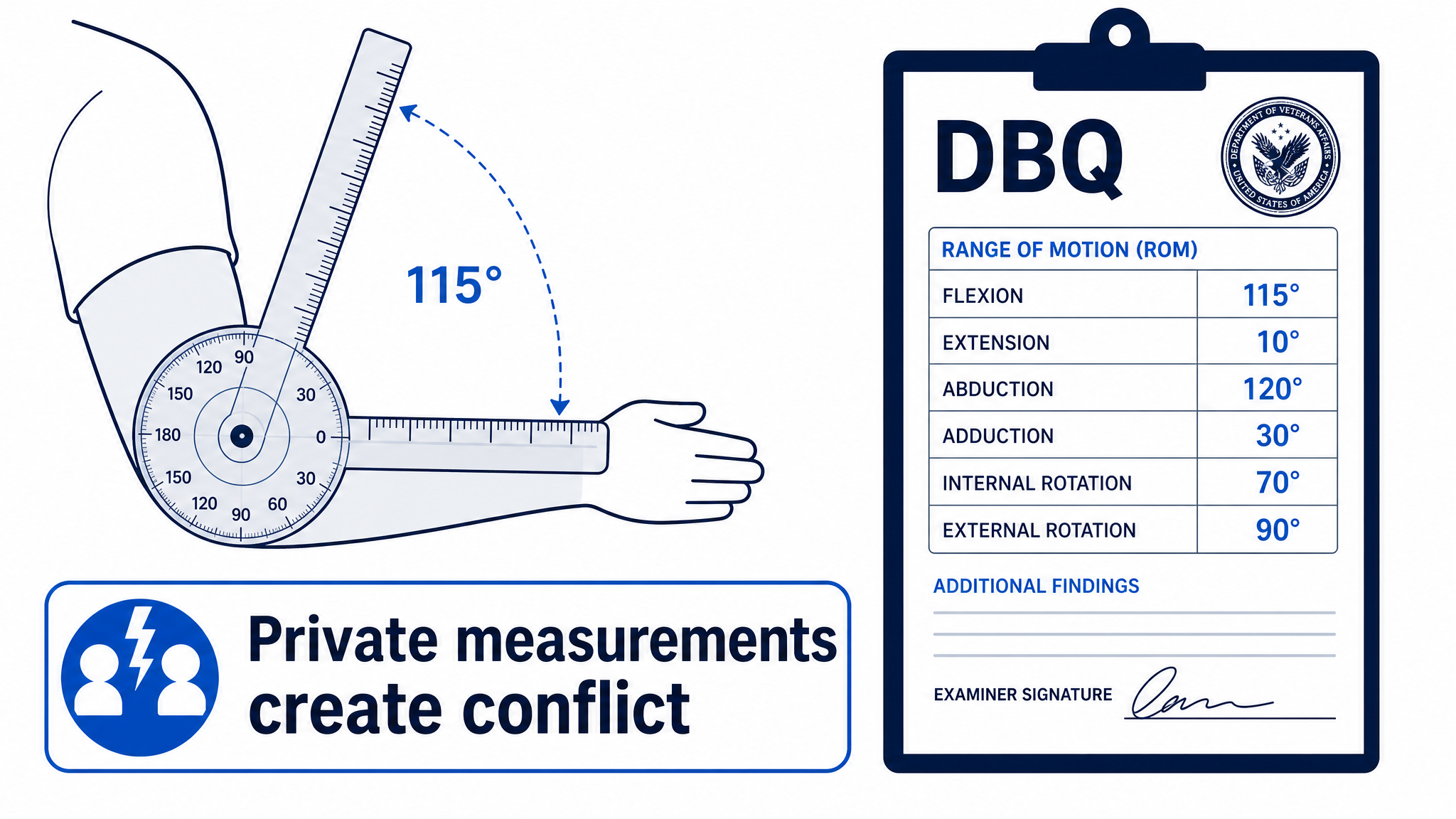
Put your own measurements on the table
A private examination with full goniometric measurements, or a DBQ completed by your own provider, creates a conflict in the evidence that the VA has to resolve, and under 38 CFR §3.102 reasonable doubt is resolved in your favor.
End of clinical section
Sciatica (Sciatic Nerve), DC 8520
See It Before You Sit In The Room
Lumbar Radiculopathy ("Sciatica") Explained
Spine Surgeon Speaks
Sciatica and Lumbar Disc Herniation, Causes and Treatment
Nabil Ebraheim, MD
The Questions Veterans Actually Ask
Sciatica (Sciatic Nerve) Claims, Frequently Asked Questions
Straight answers to the questions that decide sciatica (sciatic nerve) claims, the ratings, the separate evaluations, and the exam mistakes that cost veterans money. Read every answer with your own file open. If an answer depends on a record you do not have yet, that is the next thing to request, from your doctor, your unit or the VA itself.
Sciatica (Sciatic Nerve) is evaluated under DC 8520. The scale runs across 11 rating levels, and the highest is Note, which the VA assigns for: The wholly-sensory cap, §4.124a, preamble. "The term *incomplete paralysis* ... indicates a degree of lost or impaired function substantially less than the type picture for complete paralysis given with each nerve, whether due to varied level of the nerve lesion or to partial regeneration. When the involvement is wholly sensory, the rating should be for the mild, or at most, the moderate degree.". Where your evaluation actually lands depends on how your exam and records document those criteria, not on how bad the condition feels on an average day.