
You served. The VA owes you a debt it does not volunteer to pay. Everything here is free. When you need an accredited agent in your corner, we are right here.

Crisis Line: 988702-992-4883
The VA DisabilityADVOCATE

What The VA Won’t Put In Writing

Declassified

Description

We decode the evidence rules, exam traps, and rating tricks the VA won’t spell out, then fight to win what you earned.

Notes

Information here is free. Optional accredited representation, no fees unless you win.

VA-ACCREDITED CLAIMS AGENT #45147DENIALS REOPENEDLOW RATINGS CHALLENGEDC&P EXAMS AUDITEDEFFECTIVE-DATE & CUE HUNTSTDIU · SMC · PACT ACTNO WIN, NO FEE ON 20% OR 30% REPRESENTATION · $750 FLAT MISSION 5 BRIEFGOVERNED BY 38 CFR §14.636SECONDARY CONDITIONS LINKEDTERA & TOXIC-EXPOSURE CLAIMSBOARD & HIGHER-LEVEL APPEALSFREE CASE REVIEW, ASK A QUESTIONVA-ACCREDITED CLAIMS AGENT #45147DENIALS REOPENEDLOW RATINGS CHALLENGEDC&P EXAMS AUDITEDEFFECTIVE-DATE & CUE HUNTSTDIU · SMC · PACT ACTNO WIN, NO FEE ON 20% OR 30% REPRESENTATION · $750 FLAT MISSION 5 BRIEFGOVERNED BY 38 CFR §14.636SECONDARY CONDITIONS LINKEDTERA & TOXIC-EXPOSURE CLAIMSBOARD & HIGHER-LEVEL APPEALSFREE CASE REVIEW, ASK A QUESTION
VA Decision Letter
← All AI Tools
Upload or Paste Your Decision

AI Denial Decoder

Paste your VA denial letter or upload the PDF. The AI explains exactly why they denied you in plain English, identifies errors, picks the strongest appeal lane, and tells you what evidence you need to win.

Denial DecoderSupports PDF, image, or pasted text

Paste the text of your VA decision letter, or click the upload button to attach the PDF or a photo of the letter. The AI will decode it in plain English.

Read Between The Lines

Why The VA Really Denied You

A denial letter is written in bureaucratic code designed to sound final. It rarely is. Nearly every denial falls into one of these buckets, and almost all of them are fixable. The Decoder reads your letter and tells you which one you are looking at.

No Nexus Found

The most common denial. The VA agrees you have the condition and agrees you served, but says nothing in the record links the two. The fix is a nexus opinion, a doctor stating it is "at least as likely as not" connected, with a rationale.

Insufficient Evidence

The rater says the file does not show the condition is severe enough, or is missing records entirely. Often the evidence exists, it was never requested, or the C&P exam was inadequate.

Inadequate C&P Exam

The examiner rushed, ignored your flare-ups, or used the wrong diagnostic code. An inadequate exam is a legal error you can challenge, the VA has a duty to provide an adequate one.

Wrong Effective Date

They granted the claim but back-dated it incorrectly, costing you months or years of retroactive pay. This is appealable on its own without risking the grant itself.

Under-Rated (Low Percentage)

They service-connected you but assigned a percentage below what your symptoms support. The Decoder compares your evidence to the diagnostic code tiers and shows the gap.

Clear & Unmistakable Error

An old, final decision contains an undebatable legal or factual mistake. A CUE claim can reopen it and recover benefits back to the original date, the only way to beat a decision that is otherwise final.

The AMA Decision Review Options

The Three Appeal Lanes, And Which One Fits

Since the Appeals Modernization Act of 2019, you have three separate lanes to challenge a decision. Picking the wrong one wastes months. The Decoder recommends the lane that matches why you were denied. If the evidence was there and the rater misread it, that points one way. If something was missing, that points another. Your part is to file within one year of the decision date, or you can lose the effective date you already fought for.

Supplemental Claim

38 CFR 3.2501

File when you have new and relevant evidence, a nexus letter, new medical records, a buddy statement. A different reviewer looks at the whole file again with the new evidence. Best lane when the problem was a missing piece of proof.

Best for: missing evidence

Higher-Level Review

38 CFR 3.2601

File when the evidence was already there but the rater got it wrong. A senior reviewer re-decides with no new evidence, and you can request an informal phone conference to argue the error directly. Best when the exam or the law was misapplied.

Best for: rater error

Board Appeal

38 CFR 20.202

Goes to a Veterans Law Judge at the Board. Three dockets: Direct (no new evidence), Evidence (submit within 90 days), or Hearing (testify before the judge). The strongest lane for complex cases, but the longest.

Best for: complex cases

You generally have one year from the decision date to choose a lane and keep your effective date. Supplemental Claims and Higher-Level Reviews can also be re-filed, you are rarely out of options.

Know What You Are Reading

The Anatomy Of Your Decision Letter

Your decision packet has predictable parts. Knowing where to look tells you exactly what to challenge, and the Decoder walks you through your specific letter section by section. The reasons for decision and the evidence list are where most denials give themselves away. Your part is to read the whole packet, not just the first page, and to keep it somewhere safe. Every appeal deadline is counted from the date on that letter.

01

The Decision Summary

The front page lists each claimed condition and whether it was granted, denied, or continued, with the percentage assigned. This is where you confirm what they actually decided.

02

The Evidence List

Everything the VA says it reviewed. If a record you submitted is missing from this list, that alone can be grounds to appeal, they failed their duty to assist.

03

Reasons And Bases

The heart of the letter. This is where the rater explains their logic. Every denial has its weak point here, a misread exam, an ignored record, the wrong diagnostic code.

04

The Effective Date

The date your benefits (and back pay) start from. An error here can cost you thousands in retroactive compensation.

05

Your Appeal Rights

The final pages spell out your deadlines and lane options. This is the clock, and it is ticking from the date on the letter.


A woman veteran handing a folder of medical records to a receptionist
Your responsibility as a veteran

Your Part in This Is Not Optional

I will be straight with you. No advocate on earth can win a claim for a veteran who will not do his or her part. The VA decides on the record, and you are the only person who can build the medical side of that record. We do the legal and forensic work. You do yours. Here is what that means, every single time:

  • See a doctor and get every symptom written into your medical record. If it is not on paper, the VA treats it as if it never happened.
  • Keep a symptom journal. Dates, flare-ups, missed work, the nights you did not sleep. That is the evidence of how this condition actually runs your life.
  • Answer every VA letter and every request for evidence before the deadline. Silence gets claims denied.
  • Show up to your C&P exam and describe your worst days honestly. Do not tough it out in that room. Do not exaggerate either.

You do your job and we will do ours. That is how claims get won.

Choose Your Service

The Three Services

We offer three completely separate services, kept distinct on purpose so you know exactly what you are buying, what it costs, and how it is paid. These are not tiers of one agreement, you choose the single option that fits your situation.

Two are contingency representation with no cost up front; they differ by how hard the case is and how the fee gets paid. The third is a flat-fee forensic report for the veteran who wants to fight the claim himself.

An accredited claims agent and a veteran reviewing a clean, single-issue appeal together
Option 1

Standard Direct-Pay Representation

20% of back pay

No cost up front, nothing out of pocket. The VA withholds our fee and pays us directly under §14.636(h). Best for cleaner, more recent, single-issue denials, routine higher-level reviews, supplemental claims, and rating increases, carried all the way to the Board of Veterans’ Appeals.

See full details
An advocate reviewing a veteran's decade-deep claims file
Option 2

High-Complexity Representation

30% of back pay

For high-complexity cases, long claim histories, prior Board denials, CUE, complex effective-date and TDIU fights, multi-issue toxic exposure. Still no cost up front. Because the VA pays a rep only up to 20% directly, the VA sends your full retro to you and we invoice you directly for the 30%. Lawful, but never entered into lightly.

See full details
A forensic file audit in progress
Option 3

Mission 5 Intelligence Brief

$750 flat

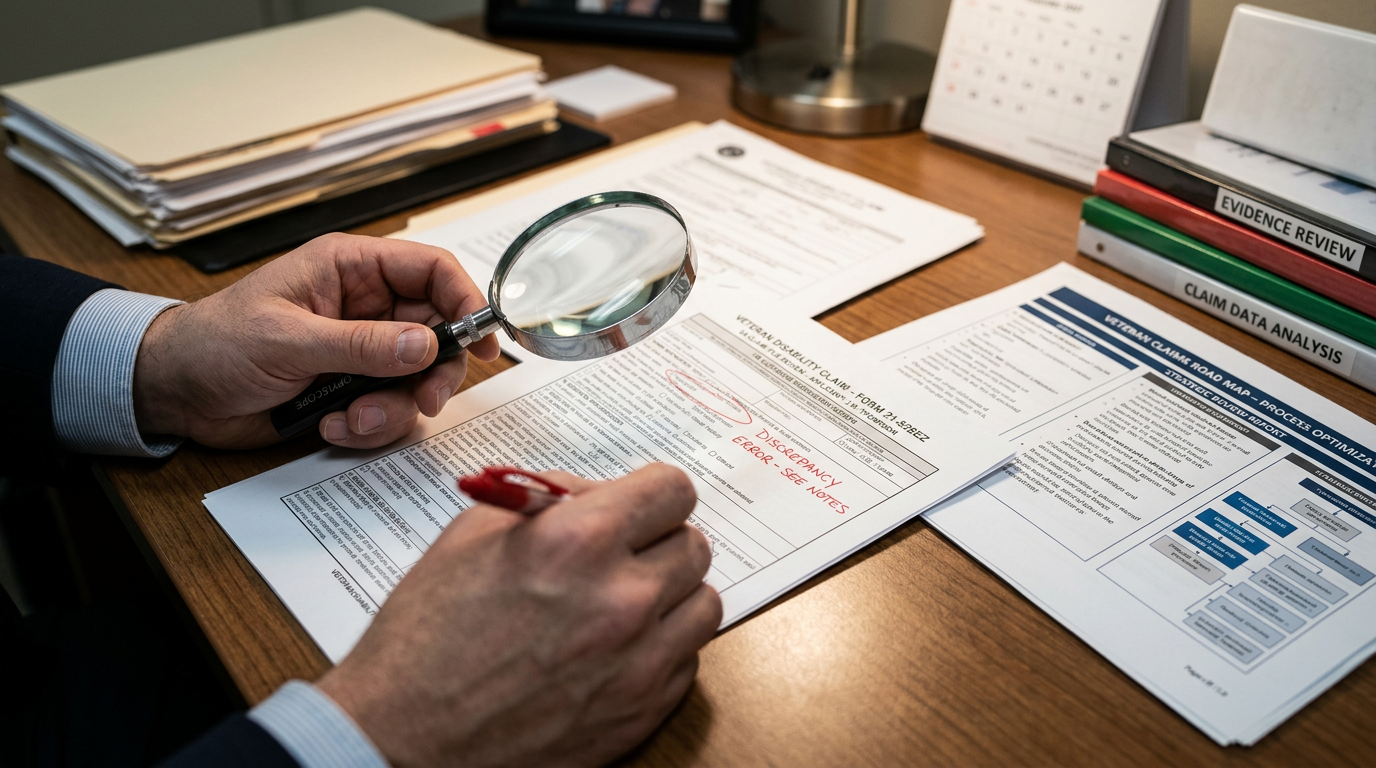
A standalone forensic file review and written road map, not representation. For the veteran with a tough, older case who wants to fight it himself and keep 100% of his back pay. We audit your file, show you every error, and hand you the plan. Available only to veterans who already have a VA decision.

See full details

The exact contingency percentage on your case is set in a written agreement by the complexity of the work, always within the maximum the law allows. Federal-court litigation, if it is ever needed, is a separate, pre-agreed arrangement.

A veteran shaking hands with his VA-accredited claims agent after reviewing his claim
Denied or under-rated?

Talk to a VA-accredited claims agent about your claim

Albert L. Thombs Jr. is a US Army veteran, VA-Accredited Claims Agent #45147, and 100% service-connected himself. He personally reviews every request. Fees are capped by 38 CFR §14.636, and there are no fees on representation unless you win.

702-992-4883

Mon–Fri, 11AM–6PM Pacific

Questions are always free. The Mission 5 Brief is $750 flat.