High-Complexity Representation
A 30% contingency for high-complexity cases, long histories, prior Board denials, CUE, complex effective-date and TDIU fights, and multi-issue toxic exposure. Still no cost up front. Lawful under 38 CFR §14.636, and never entered into lightly.
These are the files that take years, not months. Multiple appeals, prior Board denials, earlier effective date fights, and conditions spread across several body systems. I will review your history first and tell you honestly whether the case fits this tier, the standard tier, or neither. Your part is to bring every decision letter you have received, so nothing in the history gets missed.
 Option 1
Standard Direct-Pay
of back pay · VA pays us
Cleaner, more recent, single-issue denials.
View this option Option 2 You’re here
High-Complexity
of back pay · high-complexity cases
TDIU, stuck ratings, CUE, heavy multi-issue evidence.
Viewing this option Option 3
Mission 5 Brief
flat fee · forensic roadmap
A 7-section forensic report + strategy call before you commit.
View this optionAt a Glance
30%
Contingency Fee
of past-due benefits only
$0
Out of Pocket
no retainer, no hourly charge
You
Who Pays
VA sends 100% to you; you remit 30%
Heavy
Case Scope
multi-year, multi-issue, Board-level
It Starts With the Forensic Review Every Client Gets
Every one of our clients starts with the same forensic review. On a complex file that review goes deep, an exhaustive, multi-year audit of a C-file that can run hundreds or thousands of pages, tracing every prior denial, every missed effective date, and every error the VA has stacked up over the years. What makes this service different is not a better review; it is the scope of the fight that follows it.
How the Money Flows at 30%
We Win Your Claim
The VA issues a favorable decision with a retroactive award. On complex cases this can represent years of underpayment.
VA Sends 100% to You
Because the fee exceeds 20%, this is a non-direct-pay case. The VA deposits your entire retroactive award into your account.
You Remit 30% to Us
You pay our 30% fee under the written agreement, due within 10 business days of the later of our invoice or the retro cash. We bill you directly, the VA is not in the middle.
Monthly Pay Is 100% Yours
All future monthly compensation belongs entirely to you. The fee applies only to past-due benefits, no recurring charge.
Understand What 30% Means
At 30%, we are, frankly, hanging out in the wind, trusting you to pay us directly. The VA will only withhold and pay a representative up to 20% directly. The portion above that is paid to us directly by you. That is a different level of trust on both sides.
This is allowed under the law. As an accredited agent, the government allows fees up to the regulatory maximum under 38 CFR §14.636. A 30% agreement is lawful. But it should not be entered into lightly. A 20% direct-file case and a 30% complex case are not the same thing, and they should never be treated like they are.
When the Standard Fight Isn’t Enough
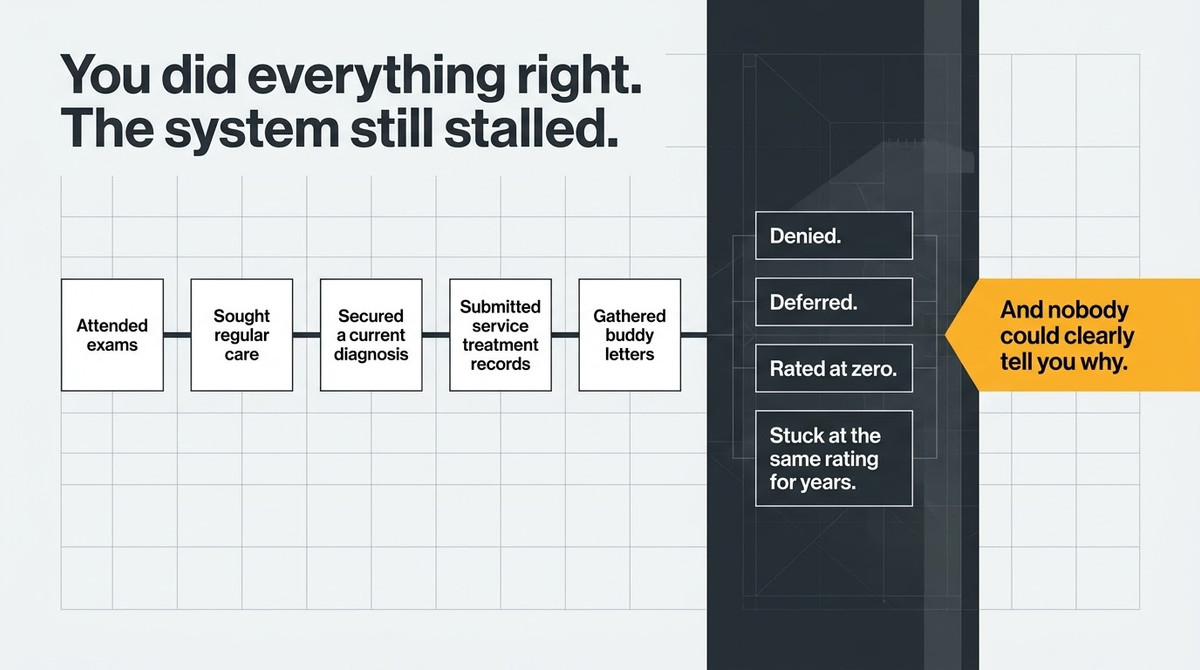
Some cases need far more than the standard fight. These are the files with 5-, 10-, even 20-year histories, hundreds or thousands of pages, prior Board denials, CUE actions, complex effective-date disputes, TDIU with real vocational complexity, and multi-issue toxic-exposure or TERA claims.

You’re out of time or out of tries on TDIU
You are filing for TDIU, you do not have the time to run it yourself, or you have tried multiple times already. You need us to be the last resort.

You’re stuck at 80% or 90% and can’t move
You have been sitting at 80% or 90% for too long. Getting over the line takes development the standard track was not built for.

A serious or chronic condition
A chronic issue, cancer, or toxic exposure that requires additional research, specialist recommendations, and a case built from the medicine up.
Your case needs evidence produced, not just filed
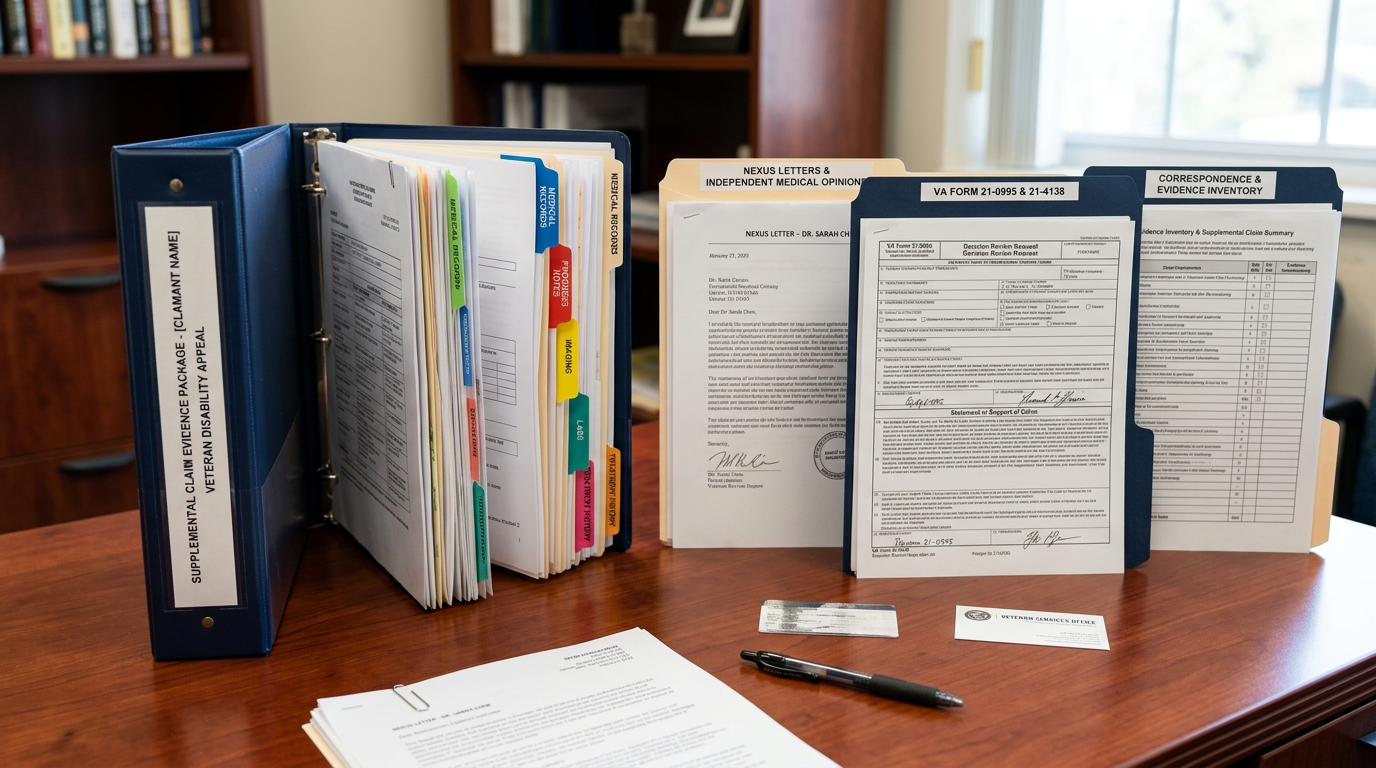
We are gathering evidence, producing reports, drafting notices, briefs, and motions. That is heavy lifting, original evidence production, not form-filling.
If your file is actually clean, recent, and single-issue, the forensic review will show it, and we will tell you honestly that the Standard 20% track is the right lane. We do not sign veterans into a 30% agreement they do not need.
What the Extra 10% Covers
The Regulatory Framework
38 CFR §14.636(e)-(f), a fee of 20% or less is presumed reasonable and a fee above 33⅓% is presumed unreasonable. At 30% our fee sits below that upper line but is not automatically presumed reasonable, so it remains reviewable for reasonableness.
38 CFR §14.636(h), direct payment is capped at 20%. The portion above 20% on a complex case is a non-direct-pay arrangement billed to the veteran after award.
Filed with VA OGC (022D), the written agreement is filed with the VA Office of General Counsel within 30 days and is reviewable for reasonableness under the regulation.
Per-recovery billing, each condition is its own case. Each favorable decision is its own recovery. A new appeal or claim always requires a new written agreement.
The Three Decision-Review Options
Complex cases usually require multiple rounds across these options. Choosing the wrong one wastes months and can kill your effective date. This is where experience matters. A Supplemental Claim is for new and relevant evidence. A Higher-Level Review is a fresh look at the same record by a senior reviewer, with no new evidence allowed. A Board appeal goes to a Veterans Law Judge. As long as you file within one year of each decision, you keep your original effective date alive while we move the case to the right lane.
The Three Decision-Review Options
A denial is not the end, it is a fork in the road. Choosing the WRONG option wastes months. Choosing right protects your back pay.
- Requires NEW & RELEVANT evidence
- File within 1 year to protect your effective date
- Reviewed by a claims adjudicator

- NO new evidence allowed
- An experienced adjudicator who did not decide your claim re-examines the same record
- Best when the evidence was there and the decision got it wrong

- Decided by a Veterans Law Judge
- Three dockets: Direct Review, Evidence Submission, or Hearing
- The most thorough review in the VA system

- A Clear and Unmistakable Error (CUE) motion is not one of the three decision-review options, it is a separate legal challenge to a FINAL decision.
- It alleges the earlier decision was undebatably wrong on the facts or the law as they existed at the time.
- When granted, it can reach back years for retroactive pay tied to the original effective date.
Protect your effective date: filing a Supplemental Claim within one year of the decision keeps your original filing date, which can mean thousands in retroactive back pay.
Understand How the VA Calculates Your Rating
Complex cases often involve multiple conditions stacking. This is the math the VA uses, and it is why getting stuck at 80% or 90% is so common. Under 38 CFR 4.25, each new rating applies only to the efficiency you have left, so every added condition moves the total less than the last one did. Getting from 90% to 100% usually takes a strong new rating or a TDIU argument, not one more small percentage. I map the full stack before deciding which condition to push first.
Why 50% + 30% Does NOT Equal 80%
The VA uses “whole-person” math, not simple addition. This is how ratings really stack.
The VA always begins from a whole, healthy person (100%).
50% of 100 is subtracted. You have 50% “efficiency” left.
30% is taken from the REMAINING 50 (0.30 × 50 = 15). 50 − 15 = 35 left.
100 − 35 = 65, then rounded to the nearest 10 → 70%.
Bottom line: 50% and 30% combine to 65% → rounded to 70%, not 80%. The same math turns two 50% ratings into 75% → rounded to 80%, not 100%. Every rating you add is worth less than the last. That is why which conditions you claim, and in what order, matters as much as how many.
High-Complexity Representation, Questions Veterans Ask
These are the questions veterans ask me about High-Complexity Representation. This service is built for long claim histories, prior Board denials, CUE, and fights where several issues tangle together. Your part is to gather every decision letter you have and tell me everything that has happened in your case so far, even the parts you think do not matter.
Why is the fee 30% instead of 20%?
How is 30% paid if the VA only withholds 20%?
Is 30% legal?
What if my case turns out to be simpler than expected?
What does “evidence we produce ourselves” mean?
What if we lose?
How long do complex cases take?
Can I cancel the agreement?
Not Sure If Your Case Is This Complex?
You do not decide that, the free forensic review does. Many veterans think their case is hopeless when it is actually a clean 20% file; others assume it is simple when it is buried a decade deep. Let us look before anyone talks numbers.
Could You Qualify for TDIU?
Many complex cases involve TDIU, Total Disability based on Individual Unemployability. If your service-connected conditions prevent you from working, answer a few questions to see if you may qualify under 38 CFR §4.16.
What is your highest single service-connected disability rating?
This is the rating for your single most severe condition, not the combined total.
Real Veterans. Real Claims. Real Outcomes.
Every case on this desk belongs to someone who served. These are the veterans this practice represents, across every era, branch, and condition: the Vietnam vet who was told it was too late, the Gulf War vet the system called a mystery, the young veteran who walked out of a five minute exam with a zero. Different stories, same fight. The record decides the claim, so we build the record.
 Veteran Representation
 Veteran Representation
 Veteran Representation
What a Judge Weighs, and Where Exams Go Wrong
Many Board appeals trace back to a defective C&P exam or a misapplied rating. A Veterans Law Judge decides your appeal on one of three dockets: direct review, evidence submission, or a hearing. These official VA videos show how the exam and the compensation math are supposed to work, so you can spot exactly where your exam fell short and show the judge why the VA should never have relied on it.
Your VA Claim Exam: What to Expect
Tips to Prepare for Your VA Claim Exam