
Our Services
Every pathway. Every angle. We fight denied and under-rated VA disability claims across all appeal lanes, supplemental claims, higher-level reviews, Board appeals, CUE motions, effective date disputes, and toxic exposure claims under the PACT Act. Each lane has its own rules, its own deadlines, and its own evidence standard, and the wrong choice can cost you months. We start with your file and pick the lane that fits it. Your part is to bring us your decision letters and tell us what the VA said.
Three Separate Services. One Standard of Honesty.
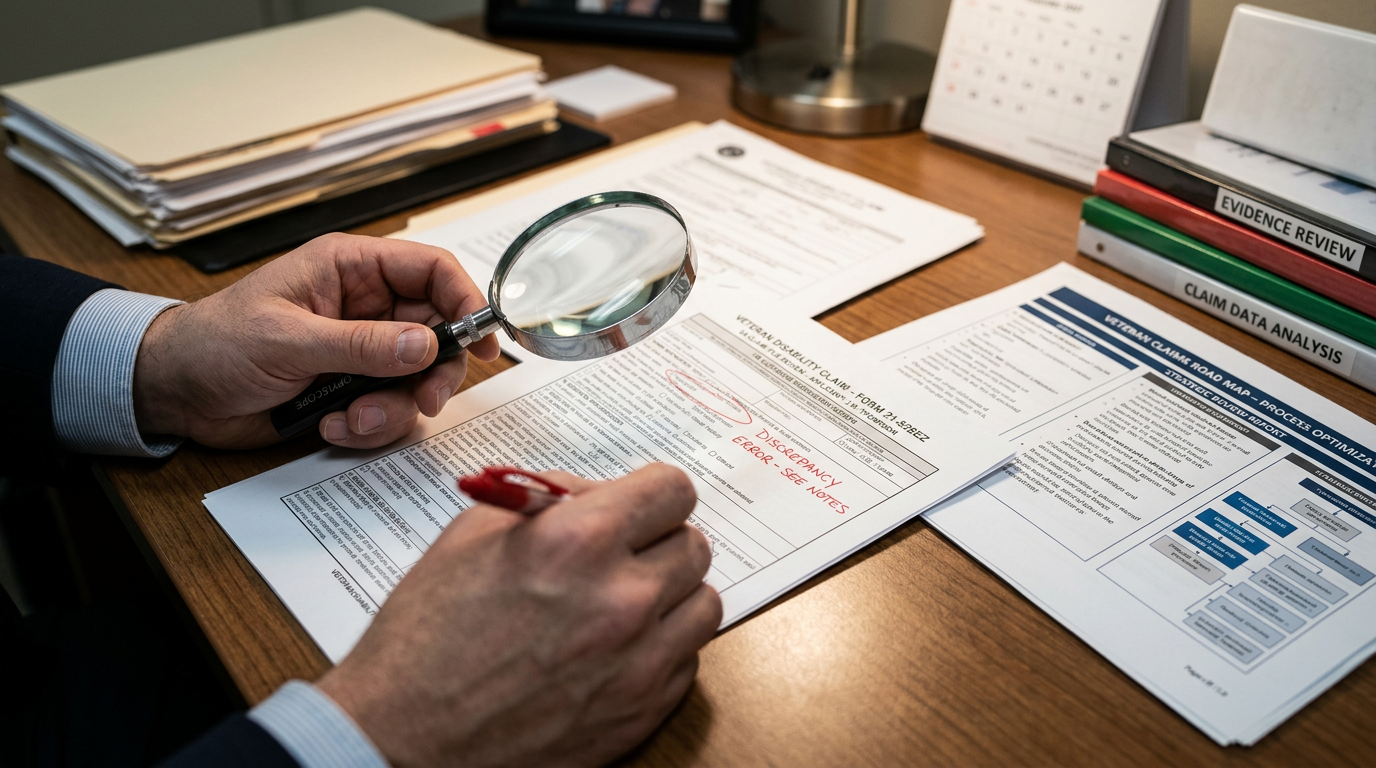
More than 20 years in VA claims work taught Albert L. Thombs Jr. that a rating decision cannot be accepted at face value. It must be examined as a series of factual, medical, mathematical, and legal choices. That experience led to Mission 5, a structured forensic process that maps the veteran’s conditions, evidence, examinations, rating history, effective dates, decision errors, evidence gaps, and available actions before a filing strategy is selected.
Veterans do not all need the same relationship with an advocate. Some want us to take responsibility for executing the claim. Some want to participate more closely at each major decision point. Others want a complete forensic analysis and the freedom to proceed independently. These are three separate engagements, not upgrades in how much we care and not different levels of truth.
Every service begins with the same disciplined review of the veteran’s record. What changes is who carries the claim forward, how much ongoing collaboration is included, what work falls within the engagement, and how the fee is paid. No service changes what we will tell you.
Option 1 · Standard Direct-Pay, 20%
$0 upfront. For cleaner, recent, single-issue cases, the VA withholds and pays us 20% of your back pay directly under 38 CFR §14.636. No win, no fee.

Option 2 · High-Complexity, 30%
$0 upfront. For long histories, prior Board denials, CUE, effective-date and complex TDIU fights. The VA pays a rep only up to 20% directly, so it sends your full retro to you and we invoice you for 30%. You pay this fee directly under the signed agreement, and every fee remains subject to the reasonableness requirements of §14.636.

Option 3 · Mission 5 Intelligence Brief
$750 flat, paid up front. A forensic file review + written road map + 45-min strategy call for the veteran who wants to file it themselves and keep 100% of the back pay. Not representation. Learn more
See the full breakdown of all three on our Representation & Fees page.
Not Everyone Who Charges You Is Allowed To
What Is a VA-Accredited Claims Agent, and Why It Matters
Before you let anyone touch your claim, know who is legally allowed to. VA accreditation is the line between a representative the law can hold responsible and a paid stranger operating in a gray market. Here is what accreditation is, and why it protects you.

No one may prepare, present, or prosecute your VA claim unless the Department of Veterans Affairs has accredited them. It is not a marketing word. It is a legal status governed by 38 U.S.C. §5901 and 38 CFR §14.629.

A claims agent earns accreditation by passing a written VA examination, clearing a character and background investigation, and completing ongoing continuing education. It is not a title anyone can give themselves.

VA recognizes exactly three: accredited attorneys, accredited claims agents, and representatives of VA-recognized Veterans Service Organizations. A “consultant” or “coach” is none of these.

And never for preparing your initial claim. A fee is permissible only after VA issues a decision and a review is initiated, and every fee is subject to reasonableness review under 38 CFR §14.636.

An accredited agent answers to VA’s Office of General Counsel and can be investigated, suspended, or stripped of accreditation for misconduct. You have somewhere to complain. An unaccredited coach answers to no one.

Companies that charge a percentage of your monthly benefits, or a flat fee just to “file,” are operating outside the law. They cannot represent you before VA, cannot sign into your file, and often disappear when the claim goes sideways.
Why This Matters for You
Albert L. Thombs Jr. is a VA-Accredited Claims Agent, accreditation #45147. That accreditation is what lets me stand between you and VA, access your claims file directly, sign filings as your representative, and be held accountable for how your claim is handled. When you choose an accredited agent, you are choosing someone the law can hold responsible, not someone who vanishes when the fight gets hard.
The Forensic Review Every Client Gets, and the Law Behind Each Step
Before we file a single form, every case starts with the same five-part forensic review of your actual file. It is identical for all three services, the fee changes the scope of the fight, not the depth of the review. Here is exactly what we examine, what it uncovers, and the federal authority that governs each step.

| The Forensic Work | What It Uncovers | Governing Authority |
|---|---|---|
| Historical C-File Audit | A page-by-page reconstruction of your entire claims file, every rating decision, every exam, and the buried evidence the VA already has but never applied. | 38 CFR §3.159, the VA’s Duty to Assist |
| C&P Exam Forensic Review | Whether each Compensation & Pension exam was legally adequate, and where an inadequate exam becomes your opening to challenge the rating. | Nieves-Rodriguez v. Peake (2008); 38 CFR §3.159(c)(4) |
| Secondary & Bilateral Opportunity Mapping | Service-connected conditions that cause or aggravate new ones, plus paired-limb disabilities most veterans never knew they could claim. | 38 CFR §3.310(a) (secondary); §4.26 (bilateral factor) |
| Combined-Math Optimization | We model your combined rating so you pursue the increases that actually move the needle, not the ones that net $0. | 38 CFR §4.25, the combined ratings table |
| Tactical Strategy Session | A 30–45 minute working call with Albert to walk your file, confirm the right lane, and set the battle plan. | Accredited Agent #45147; 38 CFR §14.629 |
The forensic review is the foundation of all three services. Want it as a standalone deliverable? See the Mission 5 Intelligence Brief.
Every Appeal Lane Covered
Each service page below contains the full legal framework, regulatory citations, case snapshots, and FAQs for that claim type. Click any card to go deep. Start with the card that matches the letter in your hand: a denial, a rating you think is too low, or an effective date that cost you back pay. If you are not sure which one fits, the decision letter tells us, and that is the first thing we read.
















Built for Women Who Served: Four Guides the VA Will Never Hand You
The VA claims system was built around the men who served, and the claims that belong to women alone get missed, lowballed, or never filed. These four guides cover the reproductive codes, the mental health claim, the care you are owed, and the claims women walk away from. Every one of them is a service I take on. Start with the one that sounds like your story.




Four Fights the VA Hopes You Never Pick
Some claims get buried because the veteran is older, because the exposure happened decades ago, because nobody ran the numbers, or because the family member doing the work never knew help existed. Each of these guides lives right here on this site, and every one of them is a service I take on.




The Tactical Triad
Three capabilities that define how we fight, regardless of which service you need. We read the whole file forensically, we hold the VA to its own regulations, and we build the evidence the decision said was missing. Every case gets all three, from a single-issue appeal to a decade-deep file.

Accredited File Access
As agents federally accredited by the Department of Veterans Affairs under accreditation #45147, we access your claims file directly, not through a VSO portal, not through a third-party service. We see what the VA sees, and we identify what they missed.

AI-Powered Analysis
Our proprietary AI advocacy tools, the Claim Strength Analyzer, Denial Decoder, and Symptom Translator, augment hard-won claims expertise with structured, data-driven analysis of your file.

Continuous Re-Analysis
After every VA decision, we re-analyze your file and adapt. If a C&P exam is inadequate, we challenge it. If a decision ignores evidence, we escalate. The VA does not get the last word.
This Is How Your Claim Is Actually Decided
Before you choose a service, understand the process every service runs through. VA decides your claim from the evidence in your record and the law that applies to it, nothing else. Here is the nine-step path we follow with you, from the first question to every decision after.

How VA Actually Reaches a Decision
A claim is not won because a condition is serious, because another veteran got rated for the same diagnosis, or because someone online called it “automatic.” VA decides from the evidence in your record and the law that applies to it.
- 1Step 1
The Claim Defines the Question
What benefit are you actually asking VA to grant? Service connection, a higher percentage, secondary service connection, TDIU, an earlier effective date, or Special Monthly Compensation? A different question requires different evidence. Before we file anything, we identify the exact question VA will have to decide.
- 2Step 2
The Record Has to Support the Claim
We separate what you believe from what the evidence proves. Your record may include service treatment records, military personnel records, deployment and occupational history, VA and private medical records, C&P examinations, DBQs, medical opinions, lay statements, prior rating decisions, and code sheets. The goal is not the thickest file. The goal is the clearest record.
- 3Step 3
VA Develops the Claim
Depending on the claim, VA may obtain federal records, request the private records you identify, order a medical examination or opinion, or decide on the evidence already there. A C&P examination is not treatment, it is evidence collection. The examiner does not award your claim, the examiner provides the findings and opinions VA uses to decide it.
- 4Step 4
VA Makes Findings
A rating decision should tell you what VA decided, what evidence it considered, which findings were favorable, and why it granted or denied. Read the favorable findings. Read the effective date. Read the diagnostic code. That is where the next decision begins.
- 5Step 5
We Audit the Decision
After VA decides, we ask five separate questions. Facts: did VA understand your history correctly? Medicine: does the evidence actually support the examiner’s conclusions? Law: did VA apply the correct regulation? Math: is the combined rating calculated correctly? Time: was the correct effective date assigned? A decision can be right in four of those areas and wrong in the fifth. That still matters.
- 6Step 6
We Identify the Type of Problem
There is a major difference between an evidence problem and a decision problem. If the necessary evidence never existed or was never submitted, the record needs development. If the evidence was already there but VA misread or misapplied it, the strategy is completely different. Do not choose an appeal form before you identify the problem.
- 7Step 7
We Choose the Review Path
The modern system gives three decision-review options: the Supplemental Claim, when new and relevant evidence is needed, Higher-Level Review, when the argument can be made from the existing record, and the Board Appeal, review by a Veterans Law Judge. Clear and Unmistakable Error is separate and applies only in specific circumstances. The form follows the strategy, not the other way around.
- 8Step 8
We Protect the Date
Deadlines matter because effective dates matter. For most VA decisions, requesting the appropriate review within one year can be critical to continuous pursuit and to preserving your effective-date rights. A Supplemental Claim can often be filed later, but filing outside the continuous-pursuit period can change the date your benefits begin. Never let frustration make the deadline decision for you.
- 9Step 9
We Do It Again After Every Decision
One VA decision does not always end the analysis. If VA grants service connection, we still examine the percentage, the effective date, whether TDIU is raised, whether SMC applies, and whether the rating is protected from reduction. Every decision is a new starting point, not a finish line.
This is education first, representation second. When you understand how VA reaches the decision, you know what is happening in your own claim instead of simply handing it over.
Whose Move Is It Right Now?
A claim moves in turns. At every stage, someone owes the next move. Knowing whose it is keeps your claim from stalling, and shows you exactly what representation adds. Sometimes the VA owes the move and is sitting on it. Sometimes you owe it and do not know it. Your part is to open every VA letter the day it arrives and answer any deadline in it.

Everyone Has a Job. Here Is Yours, and Here Is Mine.
Representation is not a promise to “fight.” It is a defined set of moves at every stage of your claim, so you always know whose move it is.
- Obtain identified federal records.
- Conduct required development.
- Order an examination when warranted.
- Issue a written decision.
- Attend your examinations.
- Keep your contact information current.
- Identify private records.
- Respond to VA requests.
- Continue appropriate medical care.
- Tell the truth.
- Meet your deadlines.
- Audit the record.
- Identify the legal issue.
- Find the evidence gaps.
- Review the examinations.
- Protect the deadlines.
- Choose the right procedural path.
- Prepare evidence and argument.
- Track the decision.
- Reassess after VA acts.
Which Appeal Lane Is Yours?
Every service we offer routes through one of these decision-review lanes under the Appeals Modernization Act. Explore how each lane works and which fits your denial. If you have new evidence the VA never saw, that points to a Supplemental Claim. If the evidence was already there and the VA got it wrong, that points to a Higher-Level Review. If you want a Veterans Law Judge to decide it, that is the Board. You generally have one year from the decision date to pick a lane and protect your effective date.
The Three Decision-Review Options
A denial is not the end, it is a fork in the road. Choosing the WRONG option wastes months. Choosing right protects your back pay.
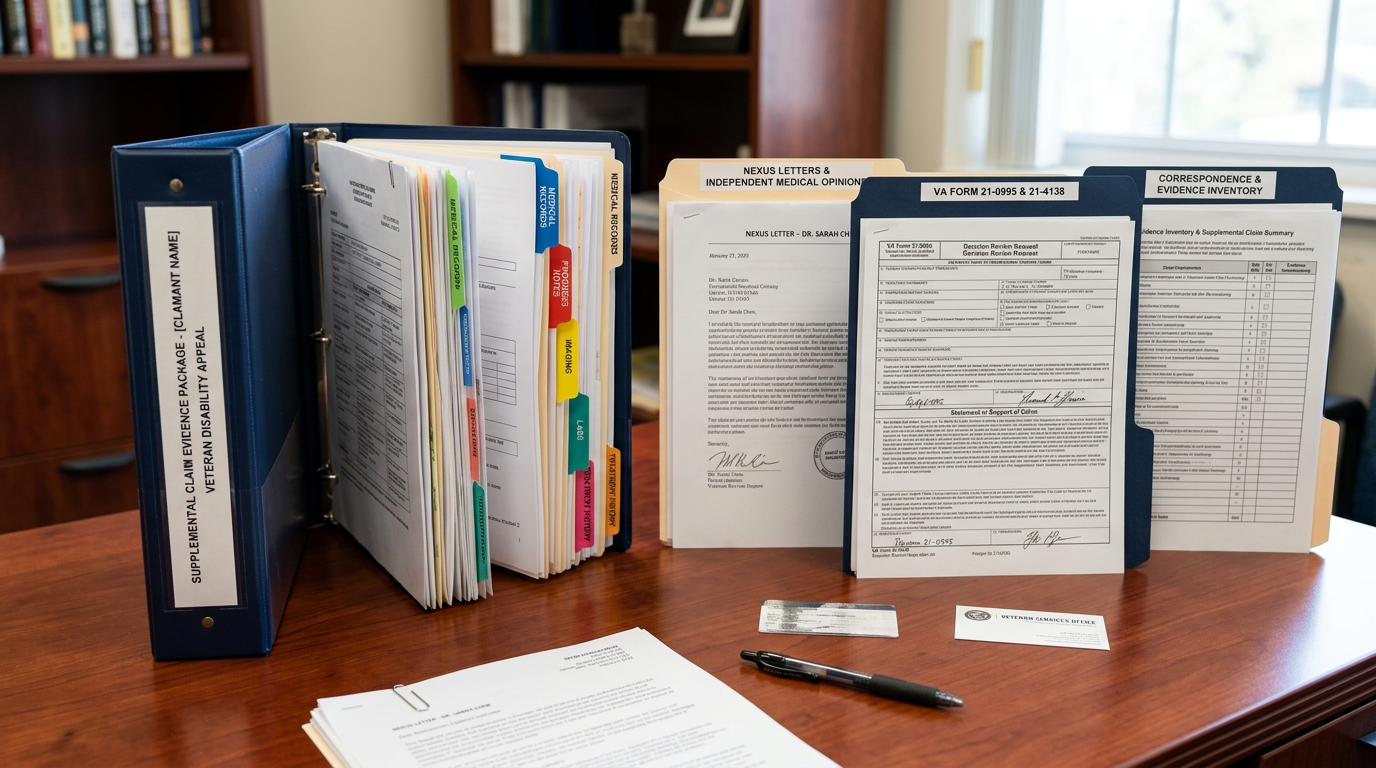
- Requires NEW & RELEVANT evidence
- File within 1 year to protect your effective date
- Reviewed by a claims adjudicator
- NO new evidence allowed
- An experienced adjudicator who did not decide your claim re-examines the same record
- Best when the evidence was there and the decision got it wrong

- Decided by a Veterans Law Judge
- Three dockets: Direct Review, Evidence Submission, or Hearing
- The most thorough review in the VA system

- A Clear and Unmistakable Error (CUE) motion is not one of the three decision-review options, it is a separate legal challenge to a FINAL decision.
- It alleges the earlier decision was undebatably wrong on the facts or the law as they existed at the time.
- When granted, it can reach back years for retroactive pay tied to the original effective date.
Protect your effective date: filing a Supplemental Claim within one year of the decision keeps your original filing date, which can mean thousands in retroactive back pay.
What to Expect at Your Claim Exam
Whichever service you need, the C&P exam is where your rating is decided. Watch the official VA overviews before you go. Show up on time, bring your notes, and describe your worst days, not your average ones. Under 38 CFR §3.655, missing the exam without good cause can get your claim decided on the record alone or denied. Your attendance is your job.
How Your Combined Rating Is Calculated
How VA Disability Compensation Works
Protecting the Benefits You Already Have
Many veterans hesitate to request a deserved increase, challenge an incorrect percentage, or correct an effective date because they fear that asking VA to review the claim will place existing benefits at risk. That fear is not irrational. Any claim on a rated condition lets the VA look at that condition again, and a careless filing can invite a new exam at the worst possible time.
We do not dismiss that concern, and we do not use it to frighten veterans into hiring us. We evaluate it.
Before recommending a filing, we review the record for the factors that determine whether a proposed action is safe, worthwhile, or premature:
Rating History
Every evaluation on the record and how it was reached.

Time in Effect
How long each evaluation has been continuously assigned.

Current Medical Evidence
What today’s records actually document about severity.

Prior Examinations
What earlier C&P exams found and whether they were adequate.

Stabilization & Protection Rules
Whether a rating is protected from reduction by law.

Exposure Risk
Whether the proposed action could open another issue to review.
The purpose is not to file everything. The purpose is to pursue what the evidence supports while protecting what the veteran has already earned.
If VA proposes a reduction, severance, or other adverse action, we examine whether VA met its procedural and evidentiary burden, identify the applicable response deadline, and determine the strongest lawful action. VA generally must explain a proposed reduction or severance and provide at least 60 days for evidence before final action under 38 CFR §3.105.
Services We Do Not Provide
We are a VA-accredited disability-claims representation practice. Our work is to analyze the record, identify errors and evidence gaps, develop the appropriate strategy, prepare authorized filings, and protect the veteran’s interests throughout the agreed representation. Knowing where that work starts and stops up front saves you time, keeps your expectations honest, and tells you exactly which parts of the claim stay in your hands.
We are not a medical provider, a routine claim-status service, or a business that promises every veteran a 100% rating. We do not manufacture evidence, script exaggerated symptoms, or file unsupported issues merely to see what happens.
We will tell you where your case is strong, where it is vulnerable, what VA may have gotten wrong, and what must happen next. That honesty applies equally to every service we provide. I am a VA-accredited claims agent, Agent #45147, and I am accountable for the accuracy and professional conduct of the representation I provide.

We Do Not Pull Claim Statuses
Our meetings are for strategy, not status checks. The VA gives you tools to track your claim in real time, VA.gov, the VA: Health and Benefits app, and My HealtheVet, showing exactly where it sits and whether an exam was ordered. We will not spend a strategy session reading you a screen you can pull up on your phone. Contact us when you have new medical evidence, a completed statement, or a case-development question, not for an update we cannot act on.

We Do Not Write Nexus Letters
We are not your doctors. A nexus letter has to come from a qualified medical provider who can speak to your diagnosis, your treatment history, and the link between your condition and your service. What we do is tell you exactly what that letter must say to carry legal weight under 38 C.F.R. Part 3, the standard, the language, and the evidence it has to line up with. A nexus opinion built on the wrong standard is worth nothing. We make sure yours is built to win.

We Do Not Recommend Doctors or Keep a List
We do not keep a “list of doctors” and we do not recommend specific providers. We have the law. Who treats you stays between you and your own providers, and anyone handing you a doctor and a nexus as a package deal should make you nervous. What we do is show you how to talk to your doctor, what to document, and what findings the rating schedule requires under 38 C.F.R. Part 4. The diagnosis has to be yours, we make it count.

We Do Not Coach You to Game an Exam
There are no magic words, no cheat sheet, no answers to memorize before a C&P examination. Every claim is different, so forget what your buddy told you, his 70% has nothing to do with your case, and following someone else’s playbook can sink a good claim. What we do is review your completed C&P exams, pinpoint what the examiner missed or got wrong, and challenge an inadequate exam under 38 C.F.R. §3.159 so nothing that matters gets left on the record.

We Do Not File Claims Without Evidence
We do not throw paperwork at the VA to see what sticks. Every claim we file is backed by a current diagnosis, a documented nexus, and a history of care showing functional impairment. Without those three, we cannot file, that is the law under 38 C.F.R. Part 3, not us being difficult. If you have not seen a doctor, you have no diagnosis, and there is nothing to file. That part is your responsibility: go get the condition documented, and we will tell you exactly what that record needs.

We Do Not Promise You 100%
Not every veteran is entitled to 100%. Every veteran is entitled to the maximum rating the evidence supports for each condition. If your case supports 70%, we get 70%; if it supports 100%, we get you there, but we will not tell you what you want to hear to sign you up. The combined ratings table under 38 C.F.R. § 4.25 is not additive; a new 30% on top of 90% does not add 30 points. We walk you through the real math in the Mission 5 forensic review.

We Do Not Entertain Medical Theories Without Medical Proof
We do not file claims built on theories, assumptions, or what a YouTube channel told you qualifies. If it is not documented by a licensed provider, it does not exist to the VA. None of it holds up under 38 C.F.R. Part 3, and filing it wastes your time, our time, and your appeal rights. What we do is review your actual record, diagnoses, treatment notes, clinical findings, and find which conditions have a legally and medically supportable pathway. Bring us records, not theories, and we will show you what the law can do.

We Do Not Pressure Veterans to Hire Us
We provide an honest assessment of whether the matter fits our practice. We do not promise a result, bid against another representative, or tell a veteran what we think they want to hear. When the evidence supports a path forward, we explain it. When it does not, we explain that too. If it is strong, we move; if it has holes, we tell you exactly how to fill them, because cycling through representatives looking for a yes is how veterans waste years.
Related Benefits We Help You Understand
A VA disability award may affect benefits involving dependents, health care, education, housing, taxes, and survivors. We help our disability-compensation clients understand the larger significance of their award, what records should be preserved, what family members should know, and when another benefit may require a separate application or specialist.
Matters Outside Our Current Representation Scope
We do not currently prepare or prosecute the following applications as part of our disability-compensation representation. When one of these matters is relevant, we explain the connection and direct the veteran or family toward the appropriate VA office, accredited representative, professional, or program.
- VA home-loan applications
- GI Bill and Chapter 35 applications
- CHAMPVA and TRICARE enrollment
- VR&E applications
- Standalone survivor or DIC representation
- Fiduciary and guardianship proceedings
- Discharge upgrades and military records correction
- CAVC or federal-court litigation
- Social Security claims
- Tax, estate, and financial planning
Outside your representation scope does not mean outside your concern.
Our standard: if your situation involves a VA disability compensation claim, whether it is a new filing, a denied claim, an appeal, or a rating increase, that is exactly what we do. Everything above is best handled by the specialists who focus on it.