Auditory
Tinnitus & Hearing Loss
The 10% ceiling on tinnitus and the §3.385 threshold for hearing loss
Tinnitus is capped at 10% but is a gateway condition. Hearing loss must meet the specific audiometric thresholds of §3.385 to be considered a disability for VA purposes.
Each Condition, Broken Out
Every Condition In This Category Has Its Own Page
These are separate diagnostic codes with separate criteria, separate exams and separate money. Each one below opens a full page: how it is rated, the schedule spelled out, the service-connection arguments, and exactly what happens at that specific C&P exam.
DC 6260
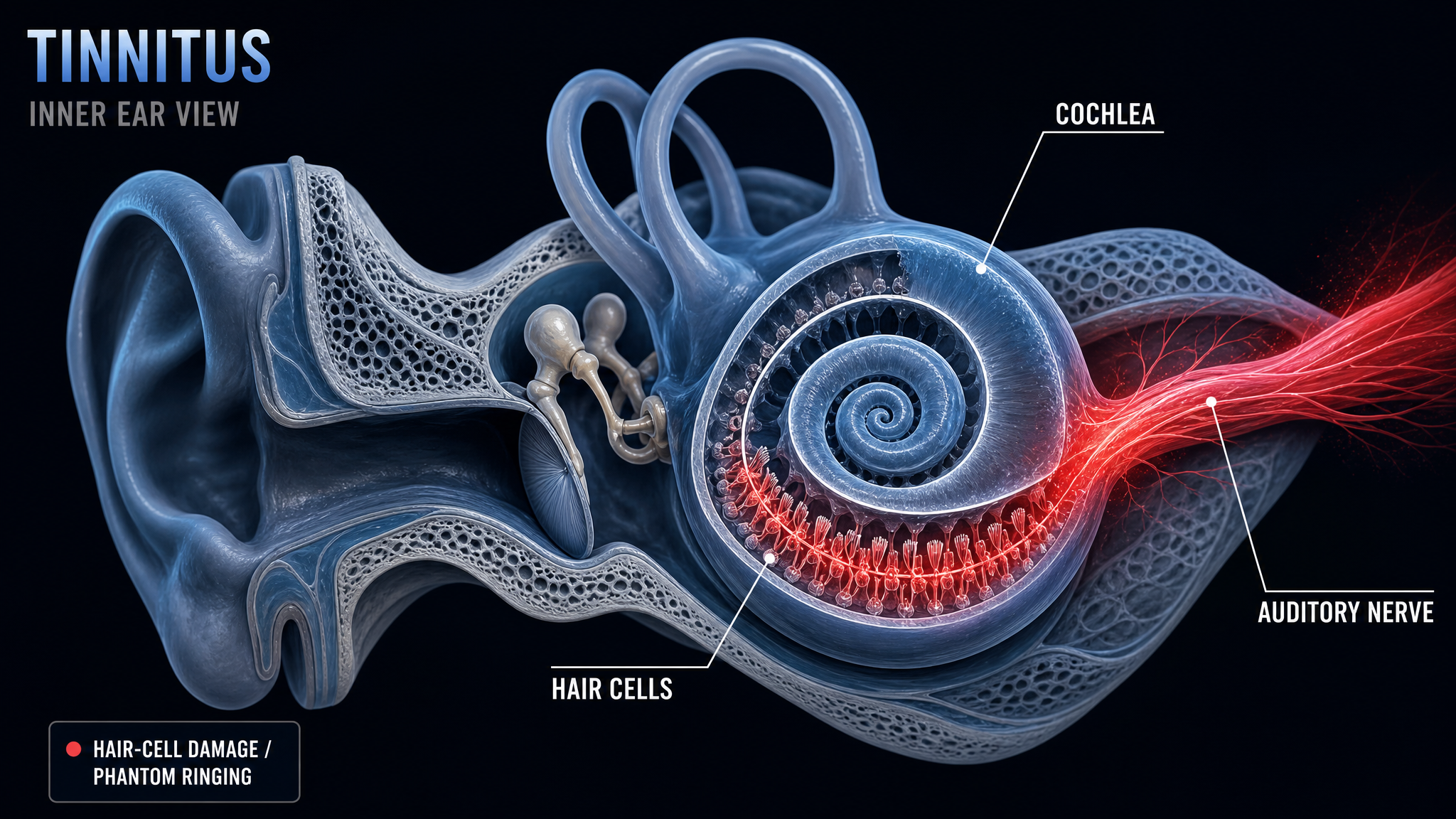
Tinnitus, Recurrent Ringing, Buzzing, or Hissing in the Ears
The ringing never stops. It is the sound of cochlear damage the military caused, and the VA rates it as a secondary condition linked to the hearing loss, the blast exposure, or the TBI that came first.
Read the full Tinnitus page
DC 6100
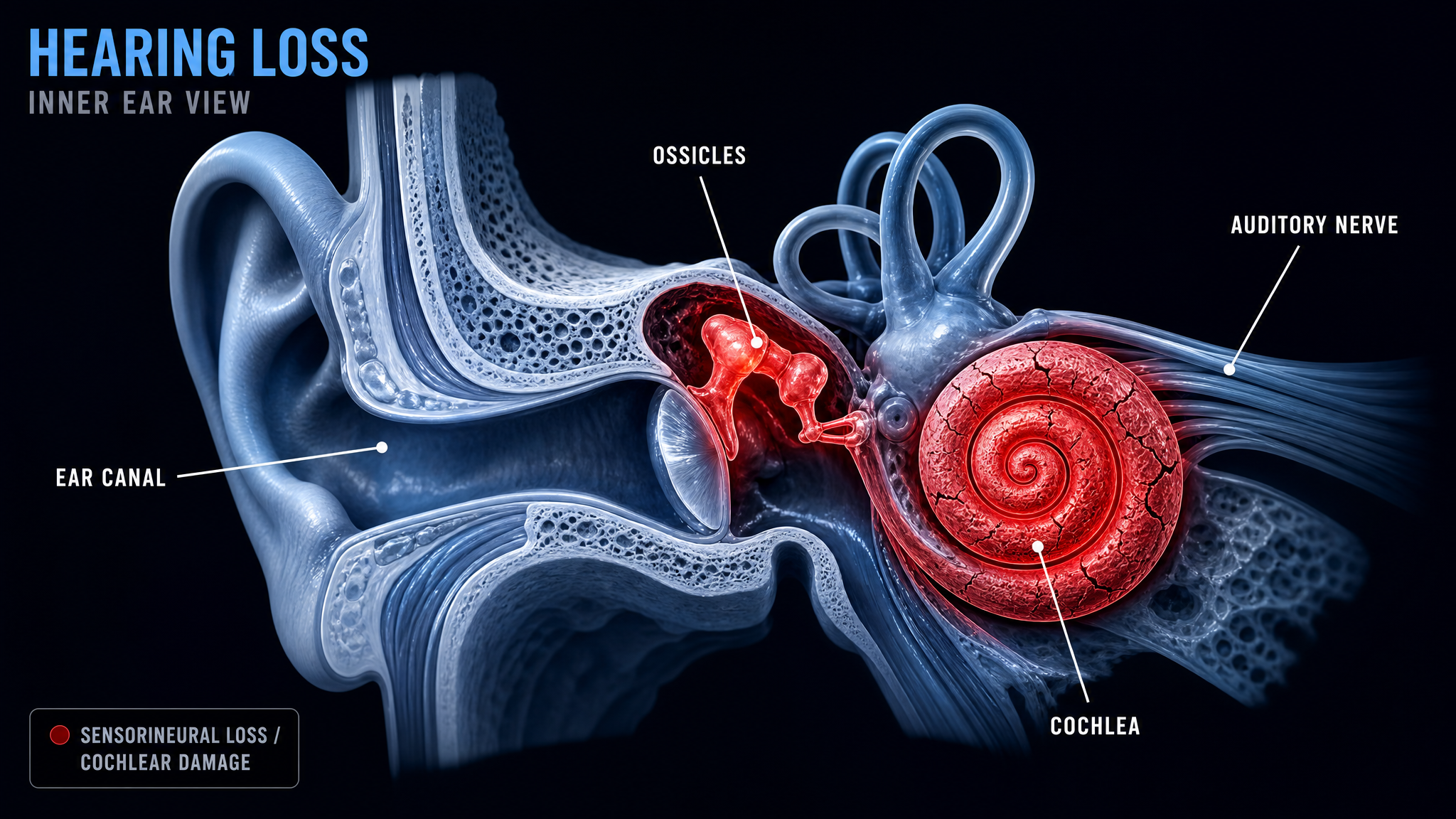
Sensorineural Hearing Loss, Bilateral and Unilateral
The damage is measured in decibels and word-recognition scores. The VA plugs those numbers into a table, and the table produces your rating, but only if the exam is done right.
Read the full Hearing Loss page
What Tinnitus & Hearing Loss Really Is
Tinnitus is ringing, hissing, or roaring generated inside your auditory system with no external source. Hearing loss is measured damage to how well you detect and discriminate sound.

What it actually means
Tinnitus is ringing, hissing, or roaring generated inside your auditory system with no external source. Hearing loss is measured damage to how well you detect and discriminate sound.
What the VA measures
Tinnitus is a single 10 percent rating under Diagnostic Code 6260 regardless of one ear or both. Hearing loss is a table calculation under 38 CFR §4.85 from puretone thresholds and Maryland CNC speech discrimination.

Why claims get missed
Veterans stop at the 10 percent for tinnitus and never claim what the tinnitus caused. Tinnitus is one of the most productive gateway conditions in the entire system for secondary claims.
What in Your Service Causes Tinnitus & Hearing Loss
Service connection is not a feeling, it is a chain of evidence. These are the pathways the VA already recognises. Find yours, then make sure your file says it out loud.
Weapons, artillery, and range fire
Small arms qualification, crew-served weapons, artillery, and demolition are the classic hazardous-noise exposures. Your MOS alone can establish exposure.
Aircraft, flight line, and engine rooms
Flight deck, flight line, motor pool, and engineering spaces produce sustained noise well beyond safe limits even with hearing protection.
Blast and concussive injury
IED and mortar blast damages the cochlea and produces immediate tinnitus, often alongside TBI residuals.
Ototoxic exposure
Jet fuel, solvents, and certain medications administered in service are documented contributors to auditory damage.
Tinnitus: Simple to Claim, Capped at 10%
Tinnitus is rated at a maximum of 10 percent under Code 6260, whether it is in one ear or both. It is one of the most commonly granted conditions because it is largely established through credible lay testimony, you can attest to the ringing in your ears. It is also a gateway: acknowledged noise exposure supports related hearing loss and secondary claims.

Hearing Loss and the §3.385 Threshold
Hearing loss is different. For VA purposes, it is only a disability if it meets §3.385, specific auditory thresholds or speech recognition scores. Many veterans have measurable hearing damage that does not yet meet the threshold. That does not mean the claim is worthless; it means the record must document noise exposure and preserve the connection for the future.

Documenting Noise Exposure
Tinnitus and hearing loss claims live or die on proving the noise happened in service. The VA keeps a duty-position noise exposure listing, but your MOS alone does not always carry the claim. Pull your personnel records and both audiograms, compare the entrance and separation numbers, and write down when the ringing started. If you do not put the noise on paper, nobody at the VA will do it for you.

MOS and duty assignments involving weapons, aircraft, or machinery

Absence of or inadequate hearing protection

Entrance and separation audiograms showing a shift

Lay statements about ringing beginning in service
Establishing Service Connection
To establish service connection for a hearing condition, veterans must meet three criteria. First, there must be a current diagnosis. Second, there must be evidence of in-service noise exposure or an event that could have caused or aggravated it, documented military occupational noise exposure is often central. Third, a nexus, a medical link, must connect the in-service event to the current condition.

Current diagnosis of hearing loss or tinnitus

In-service noise exposure or acoustic trauma

Medical nexus linking the condition to service ("at least as likely as not")
Audiometric results (puretone thresholds and speech discrimination)

Lay statements describing onset and continuity of symptoms
Why Work With an Accredited Advocate
Veterans should seek the assistance of an Accredited VA Disability Advocate because we guide you through the complex claims process and ensure all necessary evidence is gathered and presented effectively. Our advocates are trained to identify and link service-related conditions, increasing the likelihood of a successful claim. We also provide personalized representation, helping veterans navigate appeals and secure the benefits they deserve. As a VA-Accredited Claims Agent, our fees are regulated under 38 CFR §14.636, and there are no fees unless we win your appeal.

The Rating Schedule, Spelled Out
Tinnitus and hearing loss are rated under 38 CFR §4.87 and the audiometric tables in §4.85–§4.86. Tinnitus carries a single maximum evaluation; hearing loss is scored from a strict conversion of your audiogram, which is why the quality of the C&P audiology exam decides the number.
Recurrent tinnitus. A single 10% evaluation is assigned whether the sound is perceived in one ear, both ears, or in the head, this is the maximum schedular rating for tinnitus.
Evaluated under Tables VI, VIA and VII of §4.85. The puretone threshold average (1000, 2000, 3000 and 4000 Hz) and the Maryland CNC speech-discrimination score for each ear are converted to a Roman numeral (I–XI), then combined in Table VII to yield a percentage from 0% to 100%. §4.86 allows alternate Table VIA scoring for exceptional patterns (puretone thresholds of 55 dB or more at all four frequencies, or 30 dB or less at 1000 Hz with 70 dB or more at 2000 Hz).
Key Points to Remember
These are the rules the rating board applies to this condition, stripped down to what you can act on. Read each one and ask a single question: does my file prove it? If the answer is no, that is your homework, not the VA's. The VA has a duty to assist under 38 CFR 3.159, but it has no duty to build your argument for you.

Tinnitus is rated under Diagnostic Code 6260 at a single 10 percent maximum

Hearing loss is rated under 38 CFR §4.85 using puretone thresholds and Maryland CNC speech scores

Document in-service noise exposure, your MOS and duties often establish it

The audiogram is decisive; make sure the Maryland CNC test is actually performed
What to Expect at Your Audiology C&P Examination
Hearing claims are decided by an audiologist and by two tests, and the rating is produced mechanically from the results. Under 38 CFR §4.85 the examination must include a puretone audiometry test and the Maryland CNC controlled speech discrimination test. The puretone threshold average is taken at 1000, 2000, 3000 and 4000 Hertz, and those numbers are run through Table VI and Table VII to produce your percentage. Tinnitus, under Diagnostic Code 6260, has a single 10% level whether it is in one ear or both.

Puretone audiometry with thresholds recorded at 1000, 2000, 3000 and 4000 Hertz in each ear, and the four-frequency average calculated.
The Maryland CNC controlled speech discrimination test, no other word list satisfies §4.85, and a substitute is grounds to challenge the exam.

A determination of whether §4.86 exceptional patterns of hearing impairment apply, which sends the results through Table VIA instead and can raise the rating.

Confirmation that the examination was performed by a state-licensed audiologist, as the regulation requires.
For tinnitus, documentation that it is recurrent, and a statement of onset relative to the noise exposure in service.

Your military noise exposure history in detail: MOS, weapons systems, aircraft, engine rooms, and whether hearing protection was available and used.

A nexus opinion addressing delayed-onset hearing loss, since the absence of a threshold shift in your separation audiogram does not by itself defeat the claim.
What Happens Once the C&P Exam Is Complete
The examiner compiles a detailed report, your medical history, physical findings, and diagnostic results, and assesses the severity, symptoms, and impact of your condition. That report is sent to the VA Regional Office handling your claim and becomes part of your official file, reviewed alongside your other evidence.
The VA may send the report back for corrections, clarification, or a second opinion if it finds it incomplete or unclear. This can delay your claim, because the VA requires thorough and accurate information to decide. Your claim only moves to the decision phase once the VA is satisfied with the evidence, which is exactly why the quality of the file we build for you matters so much. Once decided, your effective date controls how far back your back pay reaches, and any denial can be challenged through a Supplemental Claim, Higher-Level Review, or Board appeal.

The Advocate’s Take
Tinnitus is small on its own but it opens the door. Establish the noise exposure once and it supports every auditory claim that follows.
Secondary Claims, Both Directions
Under 38 CFR §3.310, a condition caused or made worse by an already service-connected condition is itself service connected. That runs in both directions, and it is the single largest pool of unclaimed compensation in the system.
What can cause tinnitus & hearing loss
If one of these is already service connected, this condition can be claimed as secondary to it.
Traumatic brain injury
Blast-related TBI commonly produces tinnitus as a residual of the same event.
Meniere’s disease and vestibular conditions
Auditory and vestibular damage frequently occur together and are separately ratable.
What tinnitus & hearing loss can cause
If this condition is already service connected, each of these is a separate claim you may be owed.
Anxiety and depression
Constant, inescapable noise is a documented driver of anxiety, irritability, and mood disorder, and mental health ratings dwarf the 10 percent for tinnitus.
Insomnia and sleep disturbance
Tinnitus that prevents sleep onset supports a sleep-disturbance claim and interacts with apnea.
Headaches and migraines
Chronic auditory intrusion is an established migraine trigger.
A secondary claim still needs two things: a current diagnosis of the secondary condition, and a medical opinion saying it is at least as likely as not caused or aggravated by the service-connected condition. You do not have to prove it happened in service.
Building a Tinnitus & Hearing Loss Claim That Wins
Every claim stands on three legs. Knock one out and the claim falls over, no matter how bad your symptoms are. Before you file, look at your file and find all three.
 01
01A current diagnosis
A doctor has to say you have it, now, in writing. Not "reports symptoms of", a diagnosis. Without this leg, nothing else in the file matters.
 02
02A link to your service
An event, an injury, an exposure, or an already service-connected condition. Service records, unit records, buddy statements, and your own account all count as evidence.
 03
03A nexus that ties the two together
A medical opinion stating it is at least as likely as not that your service caused or aggravated the condition. That phrase is a legal standard: 50 percent or better. It is the leg most denials break.
Document the problem before you file
• Keep a dated symptom log for at least 30 days. Frequency, severity, and what it stopped you from doing.
• Get statements from people who see it, a spouse, a coworker, a battle buddy. Lay evidence is legal evidence.
• Pull your private treatment records. The VA only has to help; it does not have to go find everything.
• Write down what you have stopped doing. Lost work, lost sleep, lost activities. That is what impairment looks like on paper.
Your Rights in This Process
Most veterans walk into this system without knowing the rules the VA itself has to follow. That is how claims get denied for missing evidence the VA was supposed to help you find, and how exams get done by the wrong clinician. These six rights are written into federal regulation. Know them before you file, and make the VA honor every one of them when it decides your claim.

It costs nothing to file
Filing a VA claim is free. Accredited representatives may only charge for work on an appeal after an initial decision, and those fees are capped by 38 CFR §14.636.

The VA has a Duty to Assist you
Under 38 CFR §3.159 the VA must help you get the evidence it needs, and it must tell you what is missing before it denies you for missing it.

You can ask for a different examiner
You may request a trauma-informed clinician, or a clinician of a specific gender, for a C&P examination. Ask before the exam is scheduled.

You can claim every condition you have
There is no limit and no penalty. Primary conditions, secondary conditions, and conditions made worse by service all get filed.

You can appeal and be re-evaluated
A denial is not the end. You may submit new evidence, request a higher-level review, appeal to the Board, and ask for re-evaluation when your condition worsens.

You must be considered for TDIU
If your service-connected conditions keep you from holding substantially gainful employment, you may be paid at the 100 percent rate without a 100 percent rating.
Questions Veterans Ask About Tinnitus & Hearing Loss Claims
Why is tinnitus only 10 percent?
Diagnostic Code 6260 provides a single 10 percent evaluation for recurrent tinnitus, whether it affects one ear or both. There is no higher level. The value in a tinnitus claim is not the 10 percent, it is that it opens the door to the anxiety, depression, and sleep conditions the tinnitus causes.
My hearing test was "normal" but I cannot hear in a crowd. Why?
The VA rates from puretone thresholds at 1000, 2000, 3000, and 4000 Hz plus Maryland CNC speech discrimination. Real-world difficulty understanding speech in noise is not what the table measures, which is why many veterans with genuine functional loss are rated at 0 percent. The tinnitus claim and the secondary claims are usually the stronger path.
Do I need proof of noise exposure?
Your MOS is often enough. The VA maintains a duty-MOS noise exposure listing, and a rating specialist is expected to concede exposure for qualifying occupational specialties. Buddy statements and unit records fill any gap.
Can I be rated for tinnitus in both ears separately?
No. Diagnostic Code 6260 is one 10 percent rating regardless of whether it is unilateral or bilateral. That question has been litigated and settled.
When You Are Ready to File
Talk to an accredited representative before you file. It costs nothing to ask, and the order you file in changes what the VA is allowed to award you. Albert L. Thombs Jr. is VA-Accredited Claims Agent #45147.
The application itself
This is the form that opens a disability compensation claim. List every condition you are claiming, and name the secondary conditions explicitly.
Release for private records
Authorises the VA to request records from your private doctors. Without it, treatment outside the VA may never reach your file.
Lay or buddy statement
The official form for your own statement and for statements from people who witnessed the event or the change in you.
What This Rating Is Worth (2026)
| 10% | $180.42/mo |
| 20% | $356.66/mo |
| 30% | $552.47/mo |
| 40% | $795.84/mo |
| 50% | $1,132.90/mo |
| 60% | $1,435.02/mo |
| 70% | $1,808.45/mo |
| 80% | $2,102.15/mo |
| 90% | $2,362.30/mo |
| 100% | $3,938.58/mo |
Rates shown are the veteran-alone amounts effective December 1, 2025. A spouse, children, or dependent parents increase your payment at 30% and above. Every 10% you are under-rated can cost you thousands of dollars a year for the rest of your life.
Estimate Your Exact Pay Veteran Representation
Your VA Claim Exam: What to Expect
This official VBA video walks you through the entire C&P exam process. Understanding what happens in that room is the difference between a rating that reflects your true condition and one that undervalues you.
 Veteran Representation
What It Takes to Win These Benefits
Winning is not about how bad the condition is. It is about what your file proves. The rating board checks three things, and if one is missing the claim stalls no matter how much you hurt. Line up the evidence below before you file, not after the denial. The VA must help you gather records, but you are the one who knows where they are.
The Three-Part Test
Service connection under 38 CFR §3.303 requires all three:
- 1A current, diagnosed disability
- 2An in-service event, injury, or exposure
- 3A medical nexus linking the two
 Veteran Representation
The medical evidence the VA is actually looking for:
VA Claim Exams: Ophthalmological, Dental & Auditory
This exam is specific to your body system. The examiner uses a specialized DBQ for this category of conditions, and the tests they perform determine your exact rating level. Watch this before your appointment.
What to Expect at Your C&P Exam
Your Compensation & Pension (C&P) exam is not treatment. It is a rating tool. The examiner will not fix anything, they complete a Disability Benefits Questionnaire (DBQ) and check the boxes that decide your rating. What happens in that room can move your rating an entire level, so walk in prepared.
 Veteran Representation
The Forms You File, We Prepare Them For You
These are the forms that drive this claim. Start any of them on our site and an accredited agent prepares and files it for you, correctly, the first time.
Application for Disability Compensation
The core application that opens or reopens your claim.
Start this with usStatement in Support of Claim
Your own account and buddy/lay statements that fill the gaps in your record.
Start this with usAppoint Us as Your Representative
Authorizes our accredited agent to act on your behalf with the VA.
Start this with usUnemployability (TDIU) Application
Claims 100% pay when your conditions keep you from working, even below 100%.
Start this with usDisability Benefits Questionnaire
The exam form that captures the severity criteria for this specific condition.
Start this with usSMC & TDIU, When Your Rating Isn't the Whole Story
TDIU, Paid at 100% Without a 100% Rating
Total Disability based on Individual Unemployability (38 CFR §4.16) pays you at the 100% rate when your service-connected conditions prevent substantially gainful employment, even if your combined rating is lower. You may qualify if:
- One condition is rated 60% or higher, or
- Two+ conditions combine to 70% with at least one rated 40%, and
- Those conditions keep you from holding steady, gainful work.
- Cannot meet the numbers? Extraschedular TDIU under §4.16(b) may still apply.
Special Monthly Compensation (SMC)
SMC (38 CFR §3.350) pays above the normal schedule for especially serious losses, loss or loss of use of a body part, being housebound, or needing the aid and attendance of another person. Common levels:
- SMC-K, Loss / loss of use, Add-on for loss or loss of use of a specific body part (hand, foot, eye, reproductive organ, or certain other losses). Paid on top of your regular compensation. Can stack (up to the statutory cap).
- SMC-S, Housebound, Statutory housebound: a single 100% disability plus additional disabilities of 60%+, or substantially confined to your home. Veteran-alone rate shown.
- SMC-L, Aid & Attendance, You need the regular aid and attendance of another person, or have anatomical loss/loss of use of both feet, one hand and one foot, blindness, or are permanently bedridden. Veteran-alone rate shown.
- SMC-M, Higher Aid & Attendance, A higher level of aid and attendance (e.g., loss of use of both hands, or loss of use of both legs at a higher level). Veteran-alone rate shown.
These are the benefits veterans most often leave on the table because no one told them they qualified. If any of this sounds like your situation, call an accredited agent at 702-992-4883, we screen for SMC and TDIU on every case.