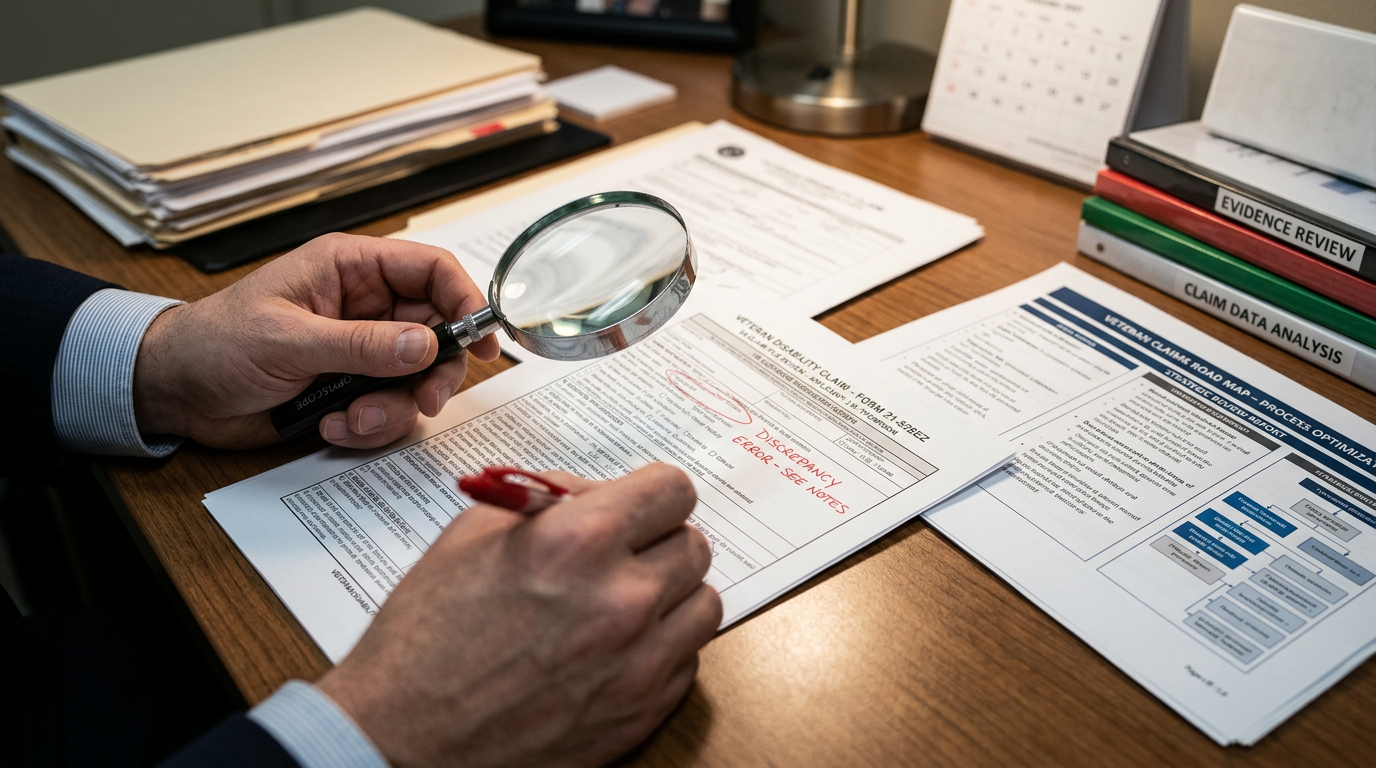

Sensorineural Hearing Loss, Bilateral and Unilateral
The damage is measured in decibels and word-recognition scores. The VA plugs those numbers into a table, and the table produces your rating, but only if the exam is done right.
Hearing loss is one of the most common service-connected disabilities, and one of the most mechanically rated. The VA does not decide your percentage by listening to your story. It takes two numbers from your audiology exam, your puretone threshold average and your Maryland CNC speech-discrimination score, and feeds them into Table VI of 38 CFR §4.85 to produce a Roman-numeral designation for each ear. Then it cross-references the two Roman numerals in Table VII to produce your percentage. The entire rating turns on those two numbers. If the exam is done wrong, the wrong word list, the wrong frequencies, an untreated ear infection distorting the results, the numbers are wrong and so is your rating. Understanding the mechanics is how you protect yourself.
The Diagnostic Codes
Conditions Rated In Tinnitus & Hearing Loss
These are the codes the VA will actually stamp on a decision in this group. The code you are granted under decides which formula is used, and that decides your percentage. Hearing Loss is highlighted below.
DC 6260
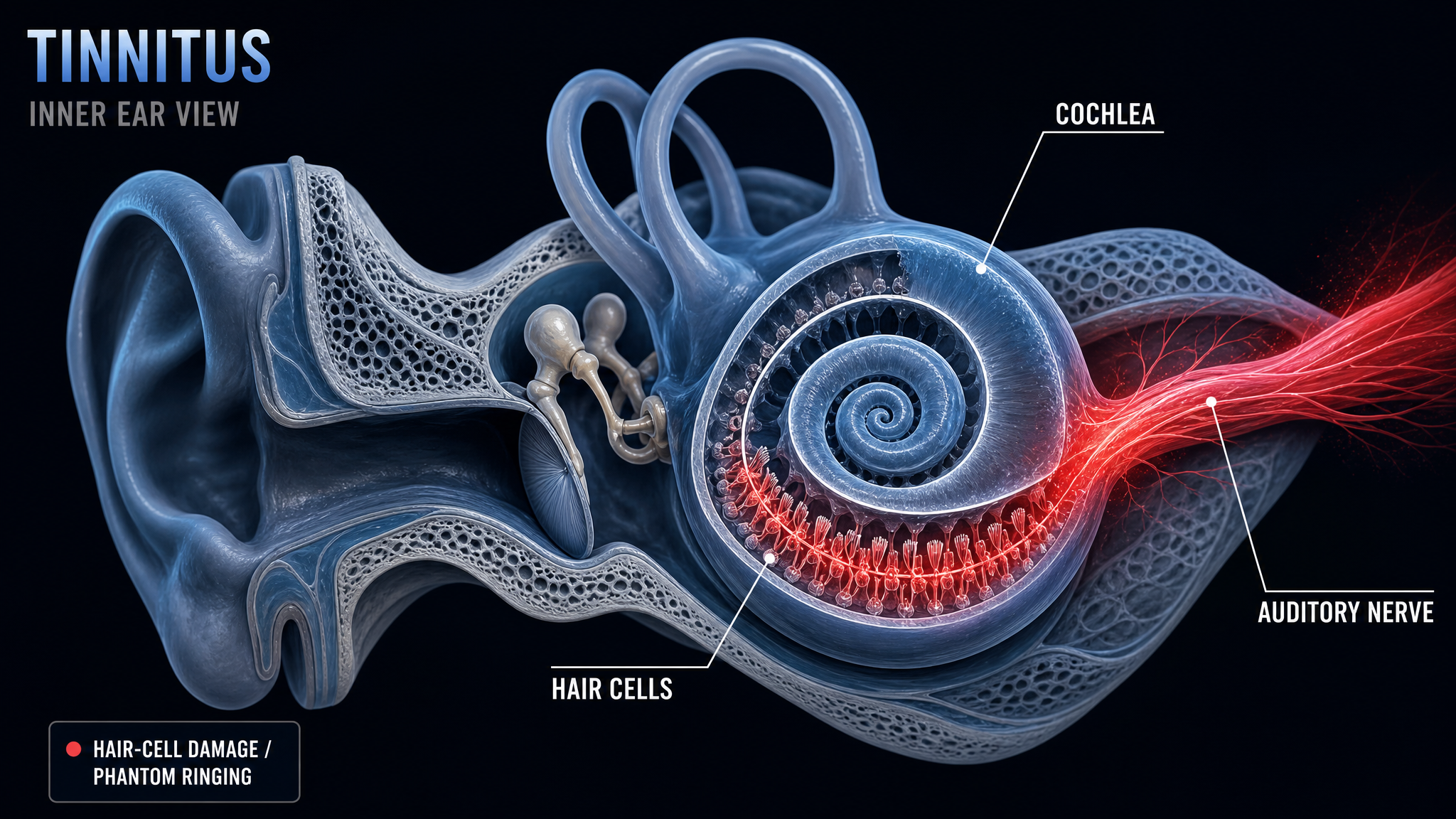
Tinnitus, Recurrent Ringing, Buzzing, or Hissing in the Ears
The ringing never stops. It is the sound of cochlear damage the military caused, and the VA rates it as a secondary condition linked to the hearing loss, the blast exposure, or the TBI that came first.
Read the full page
DC 6100
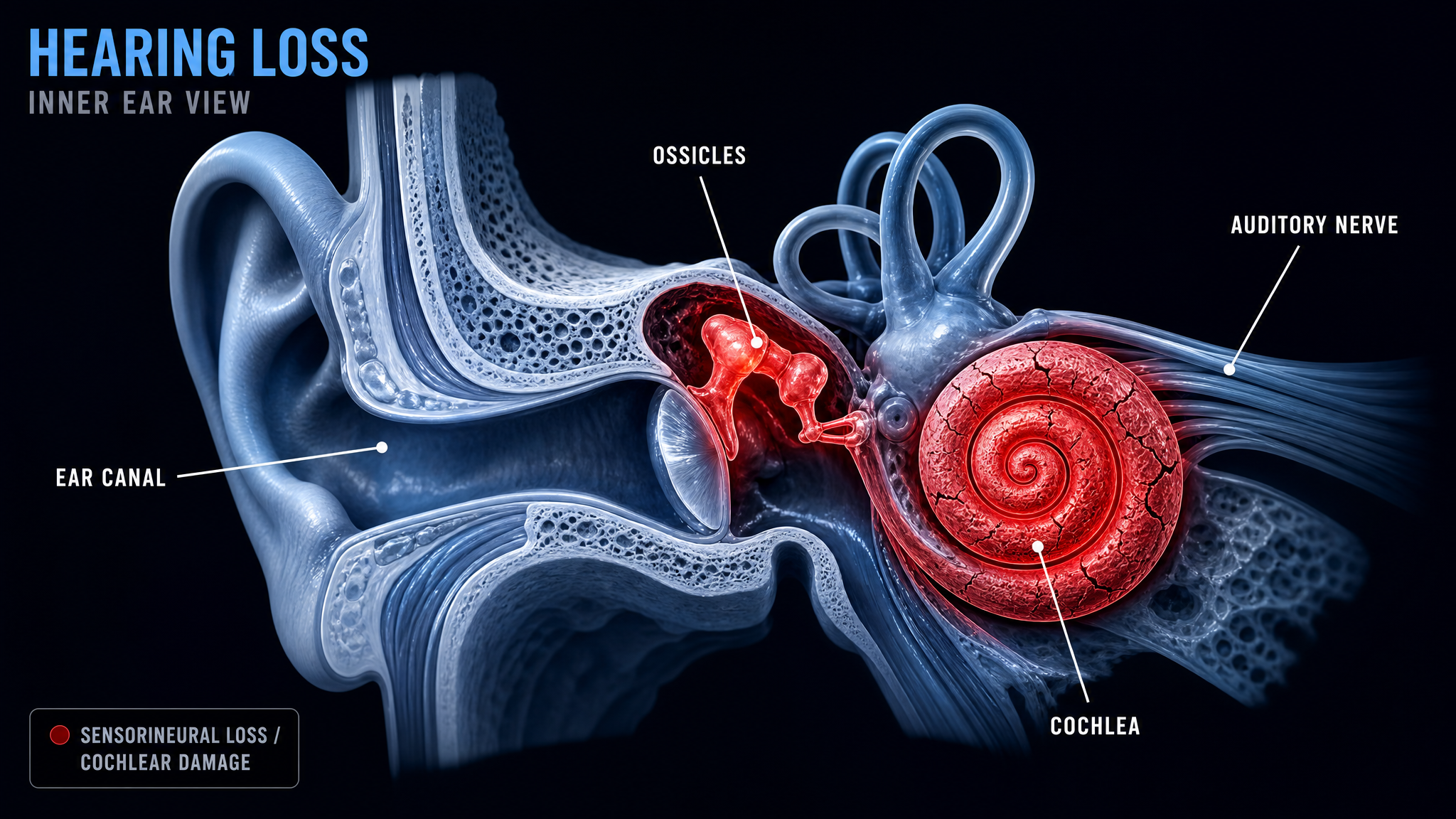
Sensorineural Hearing Loss, Bilateral and Unilateral
The damage is measured in decibels and word-recognition scores. The VA plugs those numbers into a table, and the table produces your rating, but only if the exam is done right.
You are reading this page
Before Anything Gets Rated
What The VA Is Actually Looking For, And What Service Connection Really Means
Before the VA ever opens the rating schedule, it asks one question: is this disability the government’s responsibility? That is what “service connection” means. It is not a diagnosis, it is not sympathy, and it is not a reward for having served. It is a legal finding that a current, diagnosed disability is linked to something that happened to you in uniform. Percentages come later. If service connection is not established, there is nothing to rate and the claim is denied, no matter how bad the hearing loss is.

For Hearing Loss Specifically
For hearing loss, the VA needs a formal audiological diagnosis of sensorineural hearing loss, not a primary care note saying you have trouble hearing, but an actual audiology report showing puretone threshold averages at 1000, 2000, 3000, and 4000 Hz and a Maryland CNC word-recognition score, both obtained during a VA compensation and pension (C&P) exam conducted by a licensed audiologist. Service connection is almost always won direct, you document noise exposure during service (weapons fire, aircraft, heavy equipment, shipboard machinery) and show that your current audiometric results meet the definition of hearing loss under 38 CFR §3.385, which requires that at least one frequency threshold reach 40 dB or that the speech-discrimination score fall below 94 percent. The rating under DC 6100 is entirely mechanical: Table VI of §4.85 converts each ear's puretone average and CNC score into a Roman numeral (I through XI), and Table VII cross-references both ears to produce the combined percentage, the rater has no discretion once the numbers are in. M21-1, Part III, Subpart iv, Chapter 4, Section N (Auditory and ENT Conditions) require that the C&P exam be conducted under controlled conditions using the standardized 50-word Maryland CNC list, and any deviation from that protocol is grounds to challenge the exam.
The three elements the VA must find. All three. Every time.
These come out of Caluza v. Brown and Shedden v. Principi, and they are the checklist a rating officer works through on your file. Miss one and the claim fails on that element alone.
A current, diagnosed disability
A doctor has to have written a diagnosis in a medical record, bilateral sensorineural hearing loss, unilateral sensorineural hearing loss right ear, noise-induced sensorineural hearing loss, or sensorineural hearing loss with speech discrimination deficit. Symptoms by themselves are not a disability the VA can rate. Saunders v. Wilkie held that pain causing functional impairment can be a disability, but you still need a clinician to document it as diagnosed and impairing. The diagnosis must exist now, during the claim period, not only years ago.
An in-service event, injury, illness or aggravation
Something in service had to have happened, an injury, an exposure, a documented sick call, or steady wear over a career. It does not have to be one dramatic moment and it does not have to be spelled out in your service treatment records: buddy statements, unit records, performance evaluations and your own competent lay testimony can establish it.
A medical nexus linking the two
A qualified medical opinion that says the current diagnosis is at least as likely as not related to the in-service event. That phrase matters: at least as likely as not means 50 percent or better. Under 38 C.F.R. §3.102, when the evidence is evenly balanced, the benefit of the doubt goes to you and the claim must be granted.
The five ways service connection is established
Most veterans only know the first one. The other routes are lower-effort paths to the same grant, and the secondary route is the one most often left on the table.
Direct, 38 C.F.R. §3.303(a)
The injury or disease began in service and never went away. The classic route: three elements, one nexus opinion.
Chronicity and continuity, §3.303(b)
A chronic condition shown in service, plus continuity of the same symptoms from separation to now, can establish the link without a formal nexus opinion. Your own testimony about symptoms you can observe is competent evidence.
Presumptive, §3.307 and §3.309
Certain chronic diseases are presumed service connected if they manifest to a compensable degree within a set window after separation. You do not have to prove causation at all.
Secondary, §3.310(a) and (b)
A disability proximately due to, or aggravated by, an already service-connected condition is itself service connected. This is how tinnitus caused by the same noise exposure, depression or anxiety secondary to hearing loss, and social isolation or relationship impairment documented as secondary to service-connected hearing loss get on the rating sheet get on the rating sheet.
Aggravation of a pre-service condition, §3.306
If you entered service with a condition and service made it permanently worse, the increase is compensable. The VA must rebut the presumption of soundness by clear and unmistakable evidence, a bar it frequently fails to meet.
VA medical care, 38 U.S.C. §1151
An additional disability caused by VA treatment, surgery, or a failure to diagnose is compensated as if it were service connected.
The bottom line, there is no way around this
No diagnosis, no rating. It has to be chronic. It has to cause impairment.
Without a diagnosis, the VA will not rate your claim.
The VA will not rate a claim for hearing loss unless an audiologist has produced a formal diagnosis supported by objective audiometric testing, a provider writing 'patient reports difficulty hearing' is not a ratable diagnosis. Without puretone threshold data and a CNC score in the record, the rater has no numbers to plug into Tables VI and VII, and the claim dies at the threshold. Veterans lose this element constantly by submitting primary care records instead of audiology records.
The condition must be chronic.
Hearing loss must be documented as a current, chronic condition, a single audiogram from years ago with no follow-up will not carry the claim if the VA questions whether the loss persists. A continuing history of audiological evaluations showing stable or progressive sensorineural loss is what locks in chronicity and defeats any argument that the condition resolved. The more recent the audiology record, the harder it is for the VA to claim the loss is not current.
It must cause actual impairment.
Under DC 6100, impairment is measured entirely by the audiometric numbers, not by how much you struggle in daily life, if your puretone average and CNC score produce a Roman numeral I in both ears, Table VII returns a zero-percent rating, meaning you are service-connected but receive no compensation. This zero-percent trap is common, and veterans who accept it without pushing for a higher-level review or a new C&P exam leave money on the table, especially if the original exam used the wrong word list or tested under substandard acoustic conditions.
What this means for you before you file: Before you file, get a private audiology evaluation that documents your puretone thresholds at the four compensable frequencies and your CNC word-recognition score, that gives you a baseline to compare against whatever the VA's examiner produces and a tool to challenge a bad C&P exam.
The Percentages
Rating Schedule, Hearing Loss, Diagnostic Code 6100
The percentage is not assigned by the examiner, it is produced mechanically by the two tables below. Your puretone average and speech-discrimination score enter Table VI (or Table VIa for exceptional patterns) to generate a Roman-numeral level for each ear. The two levels then cross in Table VII to produce the percentage. The examiner's subjective opinion of your hearing does not change these numbers.

0%
Table VII cross-reference of both ears' Roman-numeral designations produces Level I in both ears (e.g., puretone averages below roughly 42 dB with speech discrimination at 92% or higher in each ear).
10%
Table VII cross-reference produces a 10% evaluation, for example, Level II in the worse ear and Level II or III in the better ear, or Level III and Level IV.
20%
Table VII cross-reference produces a 20% evaluation, for example, Level IV in the worse ear and Level IV or V in the better ear.
30%
Table VII cross-reference produces a 30% evaluation, for example, Level VI in the worse ear and Level IV or V in the better ear.
40%
Table VII cross-reference produces a 40% evaluation, for example, Level VI in both ears, or Level VII in the worse ear and Level V or VI in the better ear.
50%–100%
Higher cross-references in Table VII, Level VIII through Level XI in one or both ears, produce ratings from 50% to 100%. Total deafness in both ears (Level XI bilaterally) is rated at 100%.
Note
An exceptional pattern of hearing impairment under §4.86 applies when (a) the puretone threshold at each of the four frequencies (1000, 2000, 3000, 4000 Hz) is 55 dB or more, or (b) the puretone threshold at 1000 Hz is 30 dB or less and at 2000 Hz is 70 dB or more. In either case the examiner determines the Roman-numeral designation from both Table VI and Table VIa, and the VA uses whichever produces the higher numeral.
Service Connection
Advice from the Advocate
This is where I stop explaining the rules and tell you how I would build your Hearing Loss claim if you were sitting across my desk. Read the causation notes below twice. The VA will not connect the dots for you, even though 38 CFR 3.159 says it has a duty to assist. Your job is to put the in-service event, the current diagnosis and the medical link on paper, then make the examiner deal with all three.

The advocate's notes on causation, Hearing Loss
The separate arguments that decide this code: where the VA will attack, the regulation that answers it, and the evidence that closes the gap.
1Direct service connection, noise exposure produced the damage, §3.303(a) and §3.303(d)
38 CFR §3.303(a) requires service connection for any disability resulting from injury incurred in the line of duty, and §3.303(d) expressly allows connection when the disease is first diagnosed after discharge. Sensorineural hearing loss from noise exposure is cumulative and progressive, it may not cross the §3.385 threshold until years after separation. An audiogram that was normal at discharge does not foreclose the claim; the damage was already underway, and the current loss is the same injury on a longer timeline.
2The §3.385 threshold is a rating gate, not a nexus gate, Hensley v. Brown
The VA sometimes denies the claim because the in-service audiogram did not meet the hearing-loss threshold at 38 CFR §3.385 (26 dB or greater at any of the relevant frequencies, or speech recognition below 94%). The Court of Veterans Appeals held in Hensley v. Brown, 5 Vet. App. 155 (1993) that §3.385 defines when hearing loss is severe enough to be rated, not whether the damage was incurred in service. A shift of 10 to 15 dB during service, even if still below the threshold, is evidence of noise injury that continued to progress.
3Combat and field conditions relax the proof standard, 38 U.S.C. §1154(b)
If the noise exposure occurred during combat service, 38 U.S.C. §1154(b) and 38 CFR §3.304(d) require the VA to accept lay evidence as sufficient proof of the injury if it is consistent with the circumstances of that service. Nobody filed an audiogram during a fire mission. The statute exists precisely for that, and the VA can only rebut it with clear and convincing evidence.
4MOS noise exposure corroborates the mechanism, the Duty MOS Noise Exposure Listing
The VA maintains a Duty MOS Noise Exposure Listing that rates each military specialty for its probability of hazardous noise. When the veteran's MOS carries a "Highly Probable" or "Probable" rating, it corroborates the causal chain. A nexus opinion that ignores the Listing is incomplete, raise it.
5Tinnitus is secondary to hearing loss, and rated on top of it, §3.310(a)
The same cochlear hair-cell damage that causes sensorineural hearing loss produces tinnitus. Under §3.310(a), tinnitus is proximately due to the hearing loss and is separately rated at 10% under DC 6260. That 10% stacks on top of the hearing-loss rating, and in VA combined-rating math every point moves the combined total. If the hearing loss is granted, the tinnitus claim should ride with it.
Exposure & Aggravation
How Hearing Loss Happens In Service, And How It Gets Worse

The VA wants an in-service event, and most veterans think that means one dramatic injury. It does not. Years of duty that wore the body down count too, and under 38 CFR 3.306 a condition service made worse can still be connected. Find yourself in the list below, then put that duty in writing with dates, units and names. The board only weighs what you put on paper.
How veterans pick this up in uniform, Hearing Loss
Hearing Loss rarely announces itself with one dramatic moment. It is built by what service asked of your body over months and years, and once it is service-connected, it is compensated for how it keeps getting worse, not for how it started. Below is how veterans pick this up in uniform, and who is most prone to it.
- Artillery, mortar, and heavy-weapons fire, the concussive blast at the gun position is well above the damage threshold
- Flight-line operations, jet engines, propeller wash, and auxiliary power units at sustained hazardous decibels
- Small-arms qualification ranges with inadequate or inconsistently issued hearing protection
- IED and rocket-attack blast exposure in theater, the overpressure wave damages the cochlea directly
- Tracked and wheeled vehicle crew compartments, tanks, APCs, MRAPs, and Bradleys at sustained noise levels
- Ship engine rooms, boiler spaces, and machinery areas in the Navy and Coast Guard
- Communications headsets at high volume over years of radio watch, tactical net monitoring, and flight operations
- Combat-engineer demolition, power-tool operation, and heavy-equipment use without consistent ear protection
Who is most prone to it
Artillery, infantry, armor, combat engineers, aircraft mechanics, flight crews, Navy machinist's mates and enginemen, military police, Special Operations, and any MOS whose duty description includes sustained exposure to hazardous noise levels as documented in the VA's Duty MOS Noise Exposure Listing.
The Symptoms
What Hearing Loss Actually Feels Like
Read this list the way the examiner will. Every symptom you live with but never report is a symptom the VA treats as if it does not exist. The rating schedule pays for how Hearing Loss affects your daily life and your work, so the details matter. Check off what matches your day, tell your doctor in those words, and make sure it lands in your treatment record before the exam.

- Asking people to repeat themselves, in person, on the phone, in meetings
- Turning the television or radio volume far higher than others in the room need
- Difficulty following conversation when there is background noise, restaurants, crowds, vehicles
- Misunderstanding words, especially consonant-heavy speech, and answering the wrong question
- Withdrawing from group conversations because you cannot keep up
- A spouse, child, or coworker who has told you that you are not hearing them
- Needing to see the speaker's face to understand what is being said
- Avoiding the telephone because you cannot hear the caller clearly
How this one is rated
Hearing loss is rated on two objective measurements: the puretone threshold average at 1000, 2000, 3000, and 4000 Hz, and the speech-discrimination score using the Maryland CNC word list. Those two numbers enter Table VI (38 CFR §4.85) to produce a Roman-numeral designation (I through XI) for each ear. The two designations then cross in Table VII to produce the percentage, 0% through 100% in 10-point increments. An exceptional pattern of hearing loss (§4.86) can elevate the Roman numeral through Table VIa when the puretone threshold is 55 dB or greater at each of the four frequencies, or when the threshold at 1000 Hz is 30 dB or less and at 2000 Hz is 70 dB or more.
What you are measured against
A controlled-environment puretone audiometric test at 1000, 2000, 3000, and 4000 Hz, plus the Maryland CNC speech-recognition test, both conducted by a state-licensed audiologist. The VA will not accept results from an unlicensed provider, a different word list, or a test run outside a sound-treated environment.
Each One On Its Own Page
Secondary Conditions, Aggravated or Caused by a Current Service-Connected Condition
Under 38 CFR §3.310(a), a disability that is proximately due to a service-connected condition is service-connected in its own right, and under §3.310(b), so is any additional disability caused when a service-connected condition aggravates a problem you already had. Each condition below is a separate evaluation with its own diagnostic code and its own percentage. They do not fold into the hearing loss rating, they stack on top of it. A veteran who claims only the primary condition leaves these ratings on the table.

Tinnitus, the same damage, a separate rating
Sensorineural hearing loss and tinnitus share the same mechanism: noise-induced cochlear hair-cell destruction. Under §3.310(a), tinnitus is proximately due to the hearing loss and is rated separately at 10% under DC 6260. That 10% stacks on top of the hearing-loss percentage, they are not pyramiding because they compensate different functional losses (measured thresholds versus subjective phantom sound). If the hearing loss is granted, the tinnitus should be filed secondary to it.
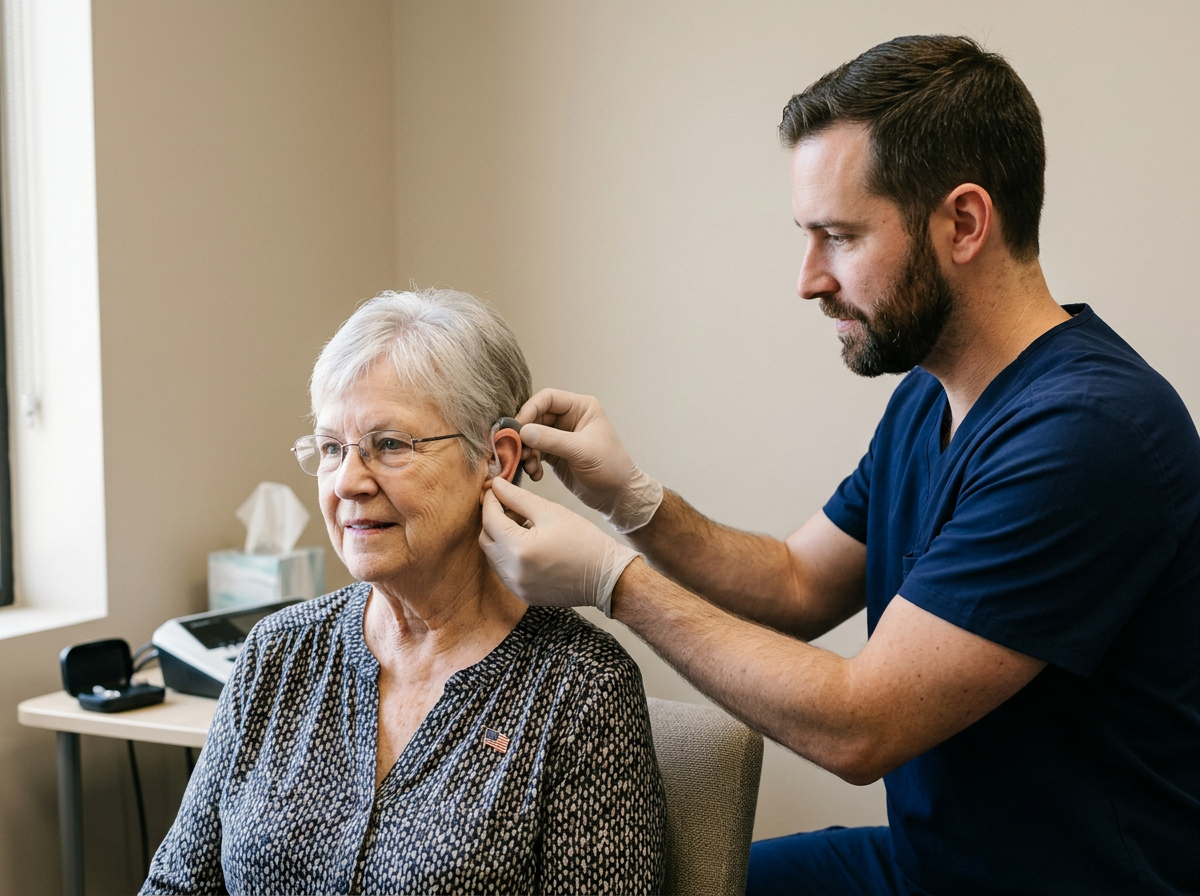
Mental-health impact, social isolation, depression, and anxiety
Hearing loss isolates people. The inability to follow conversations drives withdrawal, frustration, embarrassment, and eventually depression. Under §3.310(a), a mental-health condition caused by the hearing loss is secondary and separately ratable. Under §3.310(b), a pre-existing mental-health condition aggravated by the hearing loss is also compensable. Document the emotional toll, the avoidance, the frustration, the withdrawal from social life.

Occupational impairment and the TDIU path
A veteran who cannot hear safety warnings, cannot follow instructions in noise, cannot use a telephone reliably, and cannot participate in meetings has a straight line to TDIU under §4.16, the total disability based on individual unemployability. When hearing loss is combined with tinnitus, mental-health effects, and any other service-connected conditions, the combined total often reaches the TDIU threshold. Document every work task the hearing loss has taken away.
Accredited Claims Agent #45147
Ready To Get This Rated Correctly?
You have read how the VA rates Hearing Loss. Now the question is whether your file proves it. We represent veterans on a No Win, No Fee basis: 20% Direct-Pay paid by the VA from back pay, or 30% High-Complexity, and you owe nothing for representation if your rating does not increase. If you only need the roadmap, the Mission 5 Brief is a separate $750 flat fee. You bring the records, we build the argument.
Tinnitus & Hearing Loss, In Detail
Tinnitus & Hearing Loss, Service Connection In Depth
Here is each claimable condition in this group on its own terms, what it is, what service did to it, and what the VA requires before it will connect it.

Tinnitus, Recurrent Ringing, Buzzing, or Hissing in the Ears
Tinnitus is the single most-claimed VA disability, and yet most veterans file it wrong. They claim it as a standalone primary condition and get denied or undervalued. The stronger path is to claim tinnitus secondary to an already service-connected condition, sensorineural hearing loss, traumatic brain injury, PTSD, or another condition whose nexus is already established. Under 38 CFR §3.310(a), a disability that is proximately due to or the result of a service-connected disease or injury is itself service-connected. When the hearing loss is already rated, the tinnitus rides with it, because the same cochlear damage that destroyed the hair cells is what produces the ringing. That is not a theory; it is the mechanism every audiologist in the country will confirm.
Read the full Tinnitus page
Sensorineural Hearing Loss, Bilateral and Unilateral
Hearing loss is one of the most common service-connected disabilities, and one of the most mechanically rated. The VA does not decide your percentage by listening to your story. It takes two numbers from your audiology exam, your puretone threshold average and your Maryland CNC speech-discrimination score, and feeds them into Table VI of 38 CFR §4.85 to produce a Roman-numeral designation for each ear. Then it cross-references the two Roman numerals in Table VII to produce your percentage. The entire rating turns on those two numbers. If the exam is done wrong, the wrong word list, the wrong frequencies, an untreated ear infection distorting the results, the numbers are wrong and so is your rating. Understanding the mechanics is how you protect yourself.
You are reading this page now
The C&P Exam
What To Expect At The Hearing Loss Exam
This is the encounter your rating is built on. The examiner has a checklist and a limited window, what follows is exactly what happens in that room, so none of it surprises you.
Clinical Section, What To Expect at the Exam
What to Expect at Your Hearing Loss C&P Examination
Diagnostic Code 6100, this exam is about two numbers that produce your percentage
The hearing-loss C&P exam is one of the most mechanical in the VA system. Two numbers, your **puretone threshold average** and your **Maryland CNC speech-discrimination score**, enter a table and produce your rating. The examiner's subjective impression of your hearing does not change the outcome. What matters is that the test is administered correctly: in a sound-treated booth, by a licensed audiologist, using the Maryland CNC word list (not another list), at the required frequencies. An exam that deviates from these standards is inadequate under **38 CFR §4.85** and can be challenged.
Condition
Hearing Loss, DC 6100
Governing questionnaire
VA Form 21-0960N-1, Hearing Loss and Tinnitus Disability Benefits Questionnaire
Click the form number to open the official questionnaire on VA.gov.
01In The Room
What happens during the exam
The tests and maneuvers for this condition
- Puretone air-conduction audiometry at 1000, 2000, 3000, and 4000 Hz bilaterally
- Puretone bone-conduction audiometry bilaterally
- Maryland CNC speech-recognition testing bilaterally
- Otoscopic examination of both ears
- Tympanometry (if middle-ear pathology is suspected)
- Review of in-service audiograms and hearing-conservation records
- Review of post-service audiograms documenting progression
- Nexus opinion on the relationship between current hearing loss and military noise exposure
What gets measured, and to what number
Puretone thresholds at four frequencies
Air-conduction thresholds at 1000, 2000, 3000, and 4000 Hz for each ear, measured in a sound-treated booth. The average of these four thresholds is the puretone threshold average.
Speech-discrimination score
Percentage of words correctly identified from the Maryland CNC word list, tested at a comfortable listening level for each ear.
Bone-conduction thresholds
Thresholds measured through a bone-conduction oscillator placed on the mastoid bone. The air-bone gap separates sensorineural loss (inner ear) from conductive loss (middle ear).
Otoscopic examination
Visual inspection of the ear canal and tympanic membrane to identify cerumen impaction, perforation, or other structural abnormalities.
Exceptional-pattern check
Whether the thresholds at all four frequencies are 55 dB or greater, or the threshold at 1000 Hz is 30 dB or less with 2000 Hz at 70 dB or more, triggering the Table VIa elevation under §4.86.
02Orientation
What to expect during this exam
What makes this exam different from every other C&P exam
1Your rating is table-driven, two numbers produce it
The puretone average and the speech-discrimination score enter Table VI to produce a Roman-numeral designation for each ear. The two designations cross in Table VII to produce the percentage. There is no examiner discretion in this step. If you know your numbers, you can look up your own rating before the decision letter arrives.
2The Maryland CNC is the only accepted word list
The VA requires the Maryland CNC word list for speech-discrimination testing. If the examiner uses a different list, the NU-6, the W-22, or a clinic's own set, the exam is inadequate under §4.85 and the results cannot be used for rating purposes. Ask which list is being used.
3An exceptional pattern can elevate your rating through Table VIa
If your puretone threshold is 55 dB or greater at each of the four frequencies (1000–4000 Hz), or if it is 30 dB or less at 1000 Hz and 70 dB or more at 2000 Hz, the VA must also apply Table VIa under §4.86 and use whichever table produces the higher Roman numeral. Many veterans with severe high-frequency loss qualify for this, and many are never told.
See it before you sit in the room
03Preparation
Know your symptoms and secondary factors
What the report must actually say about hearing loss, dc 6100
- "I was exposed to ____", name the specific noise sources: the weapon system, the engine, the blast, the flight line.
- "I was never issued hearing protection" or "the protection was inadequate", if true, say it. Foam plugs in an artillery battery are inadequate.
- "I cannot follow conversations in noise", this is the functional impact the rater needs documented.
- "My hearing has gotten progressively worse since service", progression supports the nexus even if the discharge audiogram was normal.
- "I need to see people's faces to understand them", this documents a compensating behavior that proves severity.
- "Please use the Maryland CNC word list", if you are unsure which list the examiner is using, ask.
Pain level, frequency, lost work and functional loss, how to say them

Name the noise exposure, weapon, engine, blast
The examiner needs the causal link between your military noise environment and the current loss. Do not speak in generalities. Name the weapon system, the aircraft, the engine room, the IED. "I was a 13B cannon crewmember and we fired thousands of rounds without double hearing protection" is a nexus sentence. "It was loud" is not.
Reference your MOS and the VA's Duty MOS Noise Exposure Listing if your specialty carries a "Highly Probable" or "Probable" noise rating.
"I was an aircraft mechanic on the flight line at Miramar for four years. We stood next to running F/A-18 engines every day. Foam plugs were all we were issued."

Describe what you cannot hear anymore
The examiner documents functional impact, and functional impact supports a TDIU claim down the line. Do not say "my hearing is fine except for some trouble." Describe exactly what you miss: the doorbell, the turn signal, the grandchild's voice, the phone ringing from the next room. Every specific example is evidence.
Mention compensating behaviors: reading lips, asking people to repeat, sitting in specific positions so your better ear faces the speaker.
"I cannot hear my wife from the next room. I miss the doorbell and the phone. I have to watch people's faces to follow what they are saying."

Report the progression since service
Sensorineural hearing loss from noise exposure is cumulative and progressive. The discharge audiogram may have been normal, but if the loss has worsened steadily since, that progression is evidence of the in-service damage continuing its course. Under Hensley v. Brown, a normal audiogram at separation does not foreclose the claim. Say when you first noticed the loss getting worse and what you could hear then that you cannot hear now.
If you have audiograms from different years showing the decline, mention them, they are the strongest proof of progression.
"When I got out in 2004 I could still follow conversations. By 2010 my wife was repeating everything. By 2015 I needed hearing aids. It has gotten steadily worse."

Ask the examiner to confirm the Maryland CNC word list
Under §4.85, only the Maryland CNC word list is acceptable for VA rating purposes. If the examiner uses a different list, the NU-6, the W-22, or the clinic's own, the speech-discrimination score cannot be used and the exam is inadequate. You have the right to ask which list is being administered. If the report later shows a different list, that is grounds to challenge the exam.
This is not confrontational, it is self-advocacy. A polite "which word list are you using?" protects you.
"Can you confirm you are using the Maryland CNC word list? I want to make sure the results will be accepted for rating purposes."
Secondary conditions to raise in the same appointment
Every secondary condition laid out in the Secondary Conditions section above belongs in this same appointment. Name each one out loud, tell the examiner how the primary condition caused it or made it worse, and ask that it be noted in the report. Under 38 CFR 3.310, a secondary condition the examiner never hears about is a secondary condition the VA never rates. Bring your list on paper so nothing gets left in the parking lot.
What to expect at this specific exam
- Bring every audiogram you have, in-service, VA, and private, arranged chronologically to show progression.
- Bring hearing-conservation records from your military service if you have them.
- Do not use hearing aids during the test unless the examiner specifically instructs you to.
- Do not clean your ears aggressively before the exam, cerumen impaction that is normally present is part of your baseline.
- Arrive at the exam rested, fatigue can temporarily improve auditory attention and mask the true loss.
- Bring a buddy statement from someone who has observed the hearing difficulty, a spouse, a coworker, a friend.
04The Protocol
What procedures are required during the exam
These are not courtesies. Each comes out of the regulation or out of binding case law. Take this list in with you and tick them off as they happen.

01Puretone audiometry, the threshold average that enters Table VI
38 C.F.R. §4.85
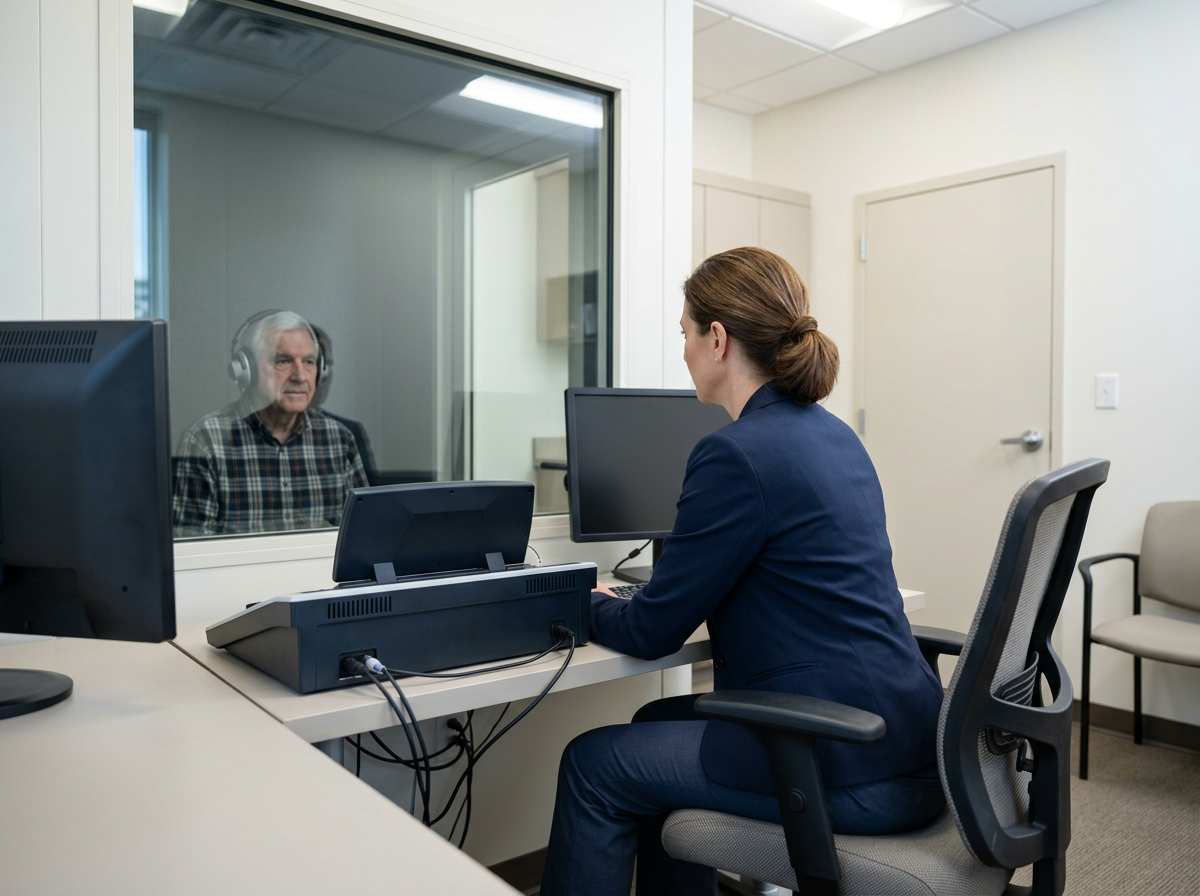
The audiologist places you in a sound-treated booth and delivers tones through headphones at 1000, 2000, 3000, and 4000 Hz. You press a button or raise your hand each time you hear a tone. The softest level you can detect at each frequency is recorded, and the average of the four thresholds becomes your puretone threshold average, the first of the two numbers that produce your rating.
This is half of the mechanical rating formula. An error in the threshold measurement, testing at the wrong frequencies, testing in a noisy room, testing with malfunctioning equipment, produces a wrong number and a wrong rating.
02Maryland CNC speech-recognition testing, the discrimination score
38 C.F.R. §4.85
The audiologist reads a standardized list of 50 single-syllable words (the Maryland CNC list) through a speaker or headphones, and you repeat each word. Your percentage correct is the speech-discrimination score, the second number that enters Table VI. A low score pushes your Roman-numeral designation higher than the puretone average alone would produce, potentially raising the final rating.
The Maryland CNC is the only word list the VA accepts. If the examiner uses a different list (NU-6, W-22, or a clinic proprietary set), the results are inadmissible for rating and the exam is inadequate under §4.85.

03Otoscopic examination, ruling out conductive causes
38 C.F.R. §4.85
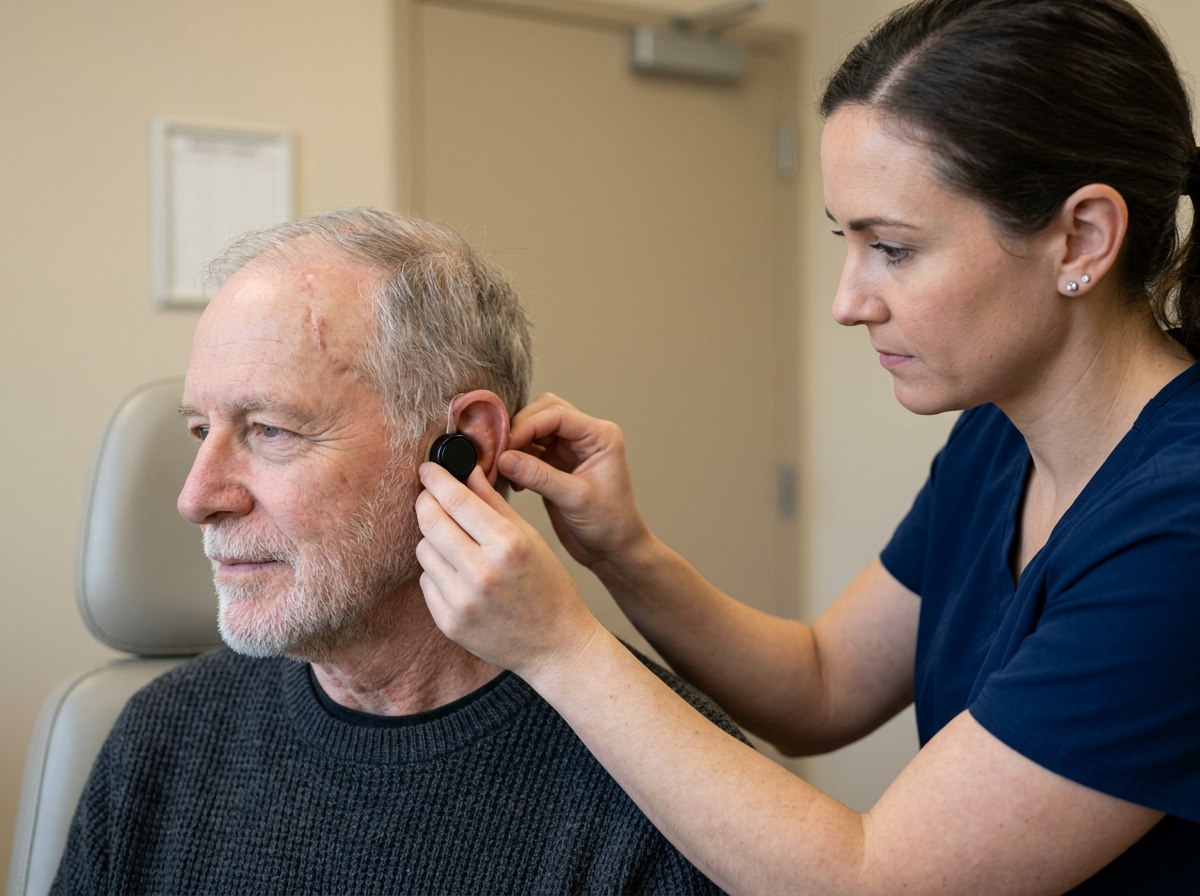
The examiner looks into each ear canal with an otoscope to check for cerumen impaction, tympanic-membrane perforation, or middle-ear pathology. A perforated eardrum from a blast is a separately ratable condition under DC 6211. Cerumen impaction that distorts the audiogram should be treated before testing, or noted as a confounding factor.
The otoscopic exam documents the physical state of the ear. Untreated pathology can artificially worsen or improve results, and a blast-related perforation is additional evidence of in-service injury.
04Bone-conduction testing, separating sensorineural from conductive loss
38 C.F.R. §4.85
A small vibrating device (the bone-conduction oscillator) is placed on the mastoid bone behind each ear. It delivers tones directly to the inner ear, bypassing the ear canal and middle ear. Comparing bone-conduction thresholds to air-conduction thresholds reveals the air-bone gap, the difference between inner-ear function and the total hearing pathway. A gap means part of the loss is conductive (middle ear), not sensorineural (cochlea).
The distinction matters because noise-induced damage is sensorineural. If a conductive component is inflating the loss, it should be treated or noted, and if the conductive component is itself service-connected (e.g., blast perforation), it is a separate claim.

05Nexus opinion, linking the loss to military noise exposure
38 C.F.R. §4.85
The examiner issues an opinion on whether the current hearing loss is at least as likely as not related to military noise exposure. This is the sentence the rater reads. A negative opinion that relies solely on a normal discharge audiogram is insufficient under Hensley v. Brown, the threshold shift during service, the MOS noise-exposure rating, and the progression since separation must all be addressed. If they are not, the opinion is inadequate.
The nexus opinion is the gate between a granted and a denied claim. An inadequate opinion, one that ignores threshold shifts, ignores the Duty MOS Noise Exposure Listing, or applies the wrong legal standard, can be challenged under §4.2.
05The Standard
What makes an exam adequate
Read your exam report against these. An exam that fails the standard is legally inadequate, and an inadequate exam is something you challenge rather than accept.
The range of motion has to be MEASURED, not estimated
38 CFR §4.46 states that the use of a goniometer in the measurement of limitation of motion is indispensable in examinations conducted within the Department of Veterans Affairs. An examiner who eyeballs your bend and writes a number has not complied with the regulation. This is the most common defect in a spine exam and it is the easiest one to spot from the chair.
Joints must be tested in every required condition
Under Correia v. McDonald, a joint examination for pain must, wherever possible, record active motion, passive motion, motion in weight-bearing and motion in non-weight-bearing, and where relevant, the range of the opposite undamaged joint. An exam that records one set of numbers and stops is incomplete on its face, and that incompleteness is grounds to challenge it.
Flare-ups have to be addressed, not dodged
Under Sharp v. Shulkin, when a veteran describes flare-ups, the examiner is obligated to estimate the additional loss of motion during a flare based on all the available evidence, including your own account of it. "I cannot opine without resorting to mere speculation" is not automatically acceptable; the examiner has to have actually sought the information first and explained why an estimate is impossible.
Repetitive use and functional loss must be factored in
Sections 4.40 and 4.45, and the DeLuca line of cases, require that pain, weakness, fatigability, incoordination and lack of endurance after repeated use be considered, and expressed in additional degrees of lost motion where that is feasible. Your rating is supposed to reflect what you can do on the fifth repetition and on a bad day, not just the first careful bend of the morning.
Neurological findings must be separately documented
Note (1) to the General Rating Formula requires that any associated objective neurologic abnormality be evaluated separately under an appropriate diagnostic code. If your leg symptoms were mentioned in the narrative but never tested and never assigned, the exam did not do what the schedule requires of it.
The examiner must review the record when the question requires it
Where a medical opinion on cause, aggravation or a secondary relationship was requested, the examiner is expected to review the relevant evidence and give a reasoned explanation. A bare conclusion, "less likely than not related to service" with no reasoning attached, carries little weight, and an opinion with no rationale is challengeable.
The examiner has to be qualified for the body system
The VA may use its own clinicians or a contract vendor. Either way, the examiner is expected to have the competence to evaluate the system being examined. If a spinal exam with a neurological component was performed by someone who never tested a reflex, that is a problem worth raising.
The exam has to be CURRENT
A rating is supposed to reflect your condition now. An exam performed before a documented worsening, or years before the decision, may not support the current evaluation, and you can request a new one on that basis.
06Afterward
What happens after your exam is complete
The examiner writes the report and submits it, it is reviewed for completeness, and only then does the claim move toward a rating decision. Here is what actually controls the clock.
The examiner writes and submits the report
Days 1–5 after the exam
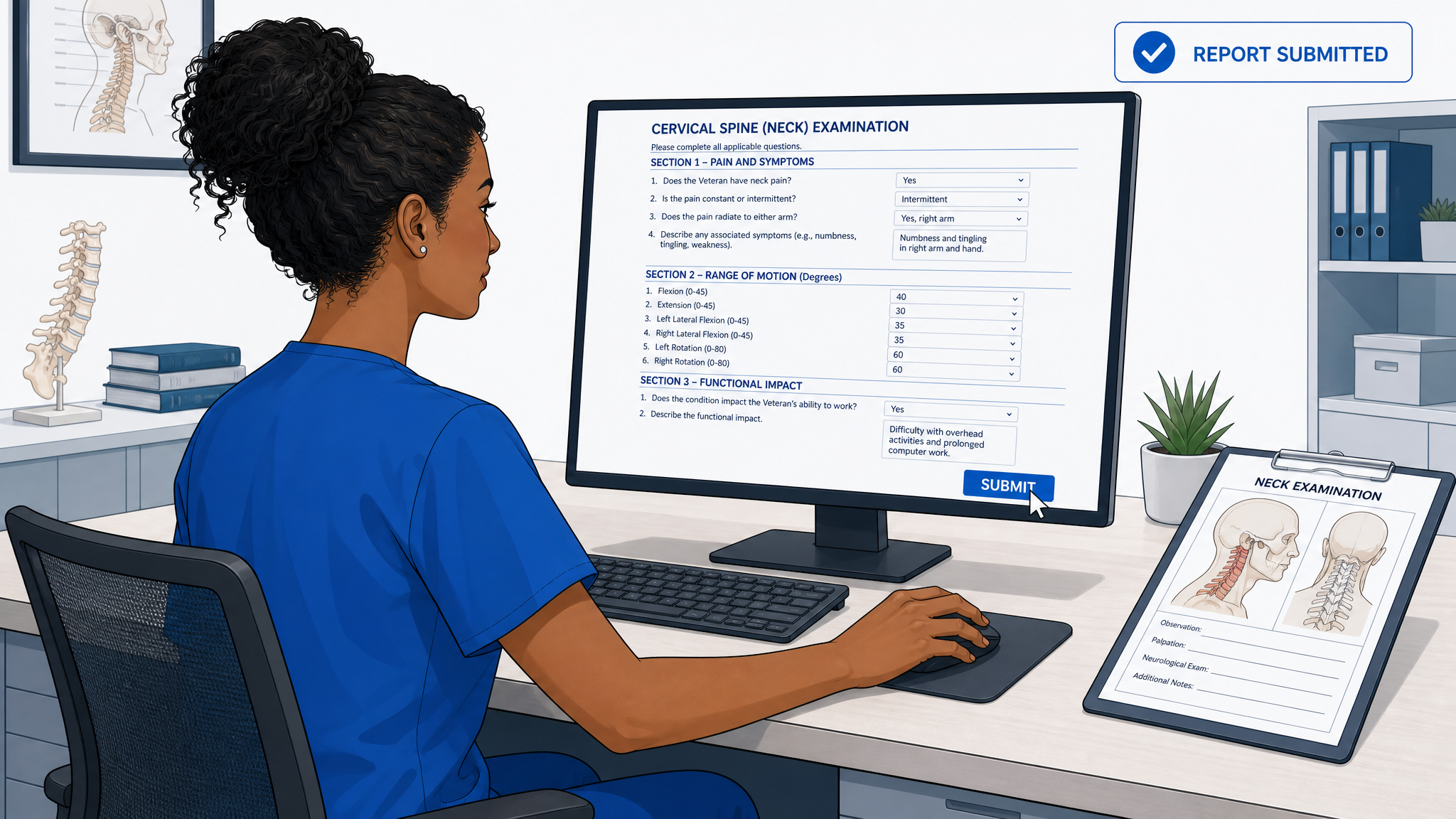
The examiner compiles the history, the physical findings, the measurements and any testing into the questionnaire, adds any requested medical opinion, and submits it. Contract vendors typically have a turnaround requirement measured in days, not weeks.
Nothing about your claim moves while this is happening, and nothing you do speeds it up. What matters is that the report is written from notes taken in the room, which is exactly why what you said, and how the examiner recorded it, is already locked in by the time you get to your car. Request your copy now rather than later.
Quality review, and the request for clarification
Days 3–30
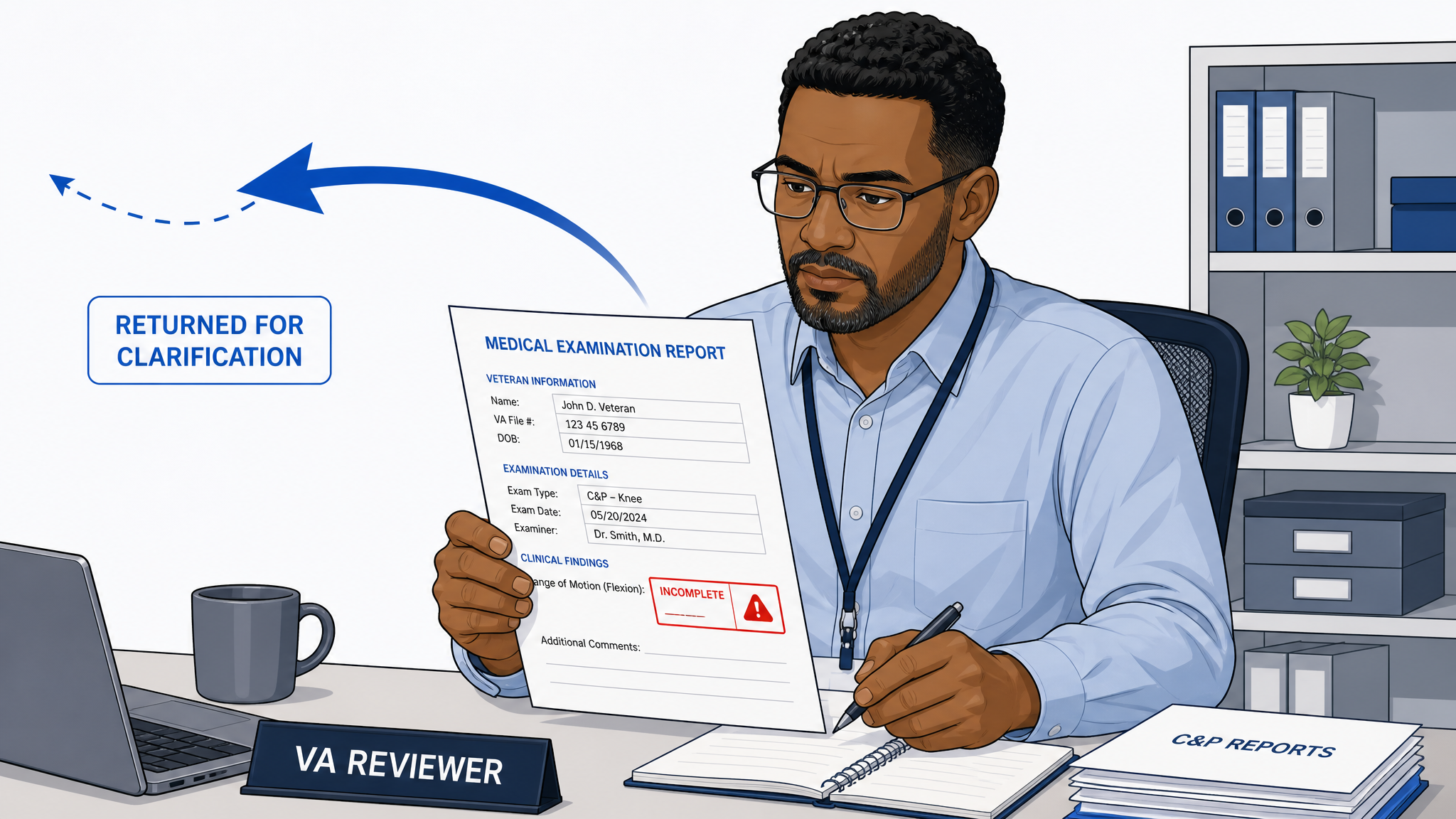
The report is reviewed for completeness. If it is internally inconsistent, missing a required field or missing the opinion the VA asked for, it goes back for correction or a second opinion. This is the single most common cause of a claim appearing to stall after the exam.
Understand what a finished exam actually means: it means the appointment happened, not that your claim is ready for a decision. If the reviewer finds a blank range-of-motion field, an opinion that does not answer the question that was asked, or findings that contradict each other, the file goes back out for more information. That is a normal quality control step, not a rejection of your claim, and it is not a sign that you did something wrong, but it does add weeks, and it is the reason so much of what you read online sounds like the system is broken.
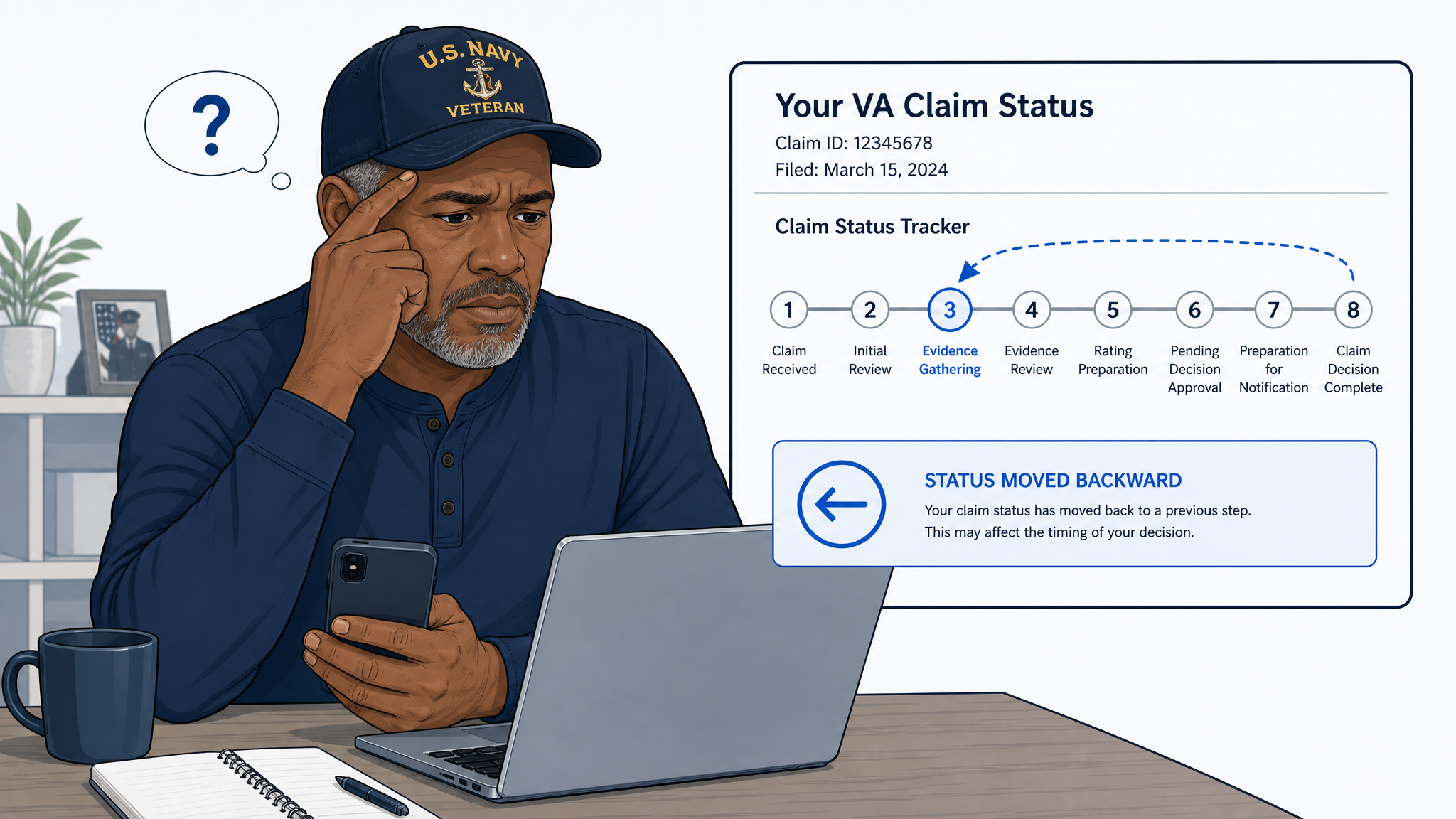
Your status tracker moves backward, and it is usually not bad news
Any time after the exam
The online tracker shows eight steps. Veterans watch it reach step 7 or 8, then find it back at step 3 or 4 a week later. That regression almost always means one thing: the file went back for additional information, most often a returned or clarified exam.
This is the number one thing veterans panic about, and it is misread constantly. The tracker is not a countdown, it is a location marker. When the VA decides it needs one more piece of evidence, a corrected exam, a clarifying medical opinion or an outstanding record, the claim is routed back to the evidence gathering step and the bar redraws itself where the file physically is. It does not mean a denial. It does not mean your case was thrown out or restarted. It does not erase anything already in the file, and it does not change your effective date. What it does mean is that something in the record was not good enough to decide on yet, which is worth knowing, because if the weak link is the exam, this is the window where a corrective statement or a private opinion from your own doctor does the most good.

Evidence gathering closes
Varies
Before anyone rates your claim, the file has to be built. This is the stretch where the Regional Office pulls together everything the decision will rest on: your service treatment records, your VA medical records, any federal records, the C&P exam report, and any private records it has requested on your behalf. The claim sits here until the VA is satisfied the record is complete enough to decide, which is exactly why a status tracker can appear to stall or slide backward at this step. You are not powerless while it sits here. Anything you put into the file yourself lands the day you send it, and every relevant record you add now is one less thing the rater can later say was missing.
A VA request to a private provider is a letter that may or may not be answered, and the VA will wait on it for weeks before moving on, sometimes without ever getting a response. A record you walk in yourself, or upload through your claim, is in the file the day you send it. So do not sit and wait to be asked. If you know a treatment record, an imaging report, a surgical note or a buddy statement exists and it matters, send it now, with a VA Form 21-4138 statement that explains in plain words what the document is and what it shows. This is also the window where a corrective statement or a private medical opinion from your own doctor does the most good, before the rater has locked in a decision, not after. Once the evidence gathering step closes, the file goes to a rating specialist, and your chance to shape the record cheaply and quickly closes with it.

Rating decision and promulgation
Typically several weeks after the last piece of evidence lands
This is the stage where your evidence finally becomes a number. A rating specialist, not the examiner, and not a doctor, takes everything in the file and applies the rating schedule to it: the exam findings, your range-of-motion measurements, your lay statements, your private records and any medical opinions. They assign a diagnostic code to each condition, pull a percentage from the schedule, set your effective date, and either grant, deny or defer each issue. The decision is then reviewed and authorized, promulgation is simply the VA’s word for making it official, and the decision letter and code sheet are generated and mailed. Where an award is made, payment follows the effective date rules, and back pay is calculated to that date.
Read the code sheet, not just the percentage. It names the diagnostic code used, the exact measurements relied on and the effective date assigned, and that is where most mistakes live. This is a human being reading a file under a production quota, and the two things that go wrong most often are a rater using the pre-repetition range-of-motion numbers instead of the worst-case figures §4.59 and §4.40 require, and a claimed condition being decided on a thin record or quietly left out. Check whether painful motion was accounted for, whether your radiculopathy was rated separately under Note (1) or folded into the spine rating, and whether every condition you claimed was actually addressed. A decision you do not read is a decision you cannot challenge, and the deadline to challenge it starts the day the letter is dated, not the day you understand it.
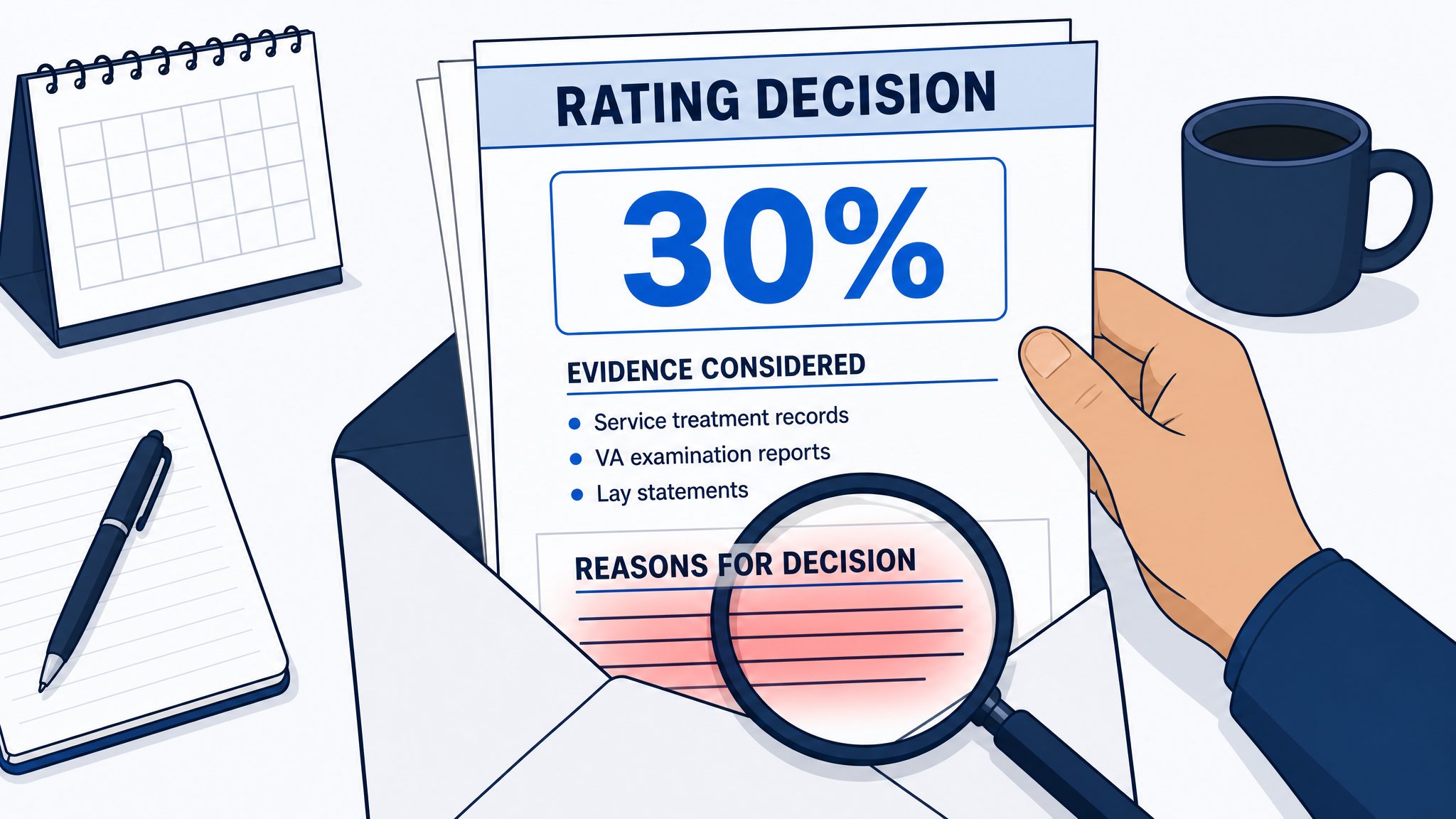
C&P examination is the decision letter
The day it lands in your mailbox
The envelope holds two different documents: the narrative decision letter, and the code sheet. Together they are the single most important piece of paper in your claim, because every deadline, every appeal option and every dollar of back pay is set by what is printed on them, not by what you were told at the exam.
Most veterans read one thing on that letter: the percentage. Then they either celebrate it or get angry at it, and file it in a drawer. That is the mistake. The percentage is the conclusion; the reasons section is the reasoning, and the reasoning is what you attack. It tells you which diagnostic code the rater used, which range-of-motion figures they relied on and which they ignored, whether painful motion under §4.59 was accounted for, whether your neurological findings were rated separately under Note (1) or folded into the spine rating, which conditions were decided, which were deferred, and which were never addressed at all. It also assigns your effective date, which controls back pay. A rating that looks low is very often not a disagreement about how bad your neck is, it is a rater who used the pre-repetition numbers, or missed the radiculopathy, or rated one side and not both. You cannot see any of that from the percentage. Do not go by the percentage alone, and do not decode it by yourself if you are not sure what you are looking at, have someone who reads these for a living read it with you before the clock runs out. You have one year from the date on that letter to file a Higher-Level Review (VA Form 20-0996), a Supplemental Claim (VA Form 20-0995) or a Board appeal, and the deadline runs from the date printed on the letter, not the date you opened it. Bring it to this office and we will go through it line by line, at no cost, and tell you plainly whether it is right.
What normal looks like: 30 to 60 days for a simple claim, longer for a complex one
After your exam you should expect some kind of notification from the VA, a decision, a request for more information, or a notice that another exam has been scheduled. For a straightforward, single-issue claim that often lands within 30 to 60 days. But 30 to 60 days is a rough guide, not a rule, and it is not a ceiling. A claim with several conditions, a toxic-exposure or presumptive question, a returned exam, or missing records routinely takes 90 days or more, and that alone does not mean anything is wrong, the more moving parts your case has, the longer the VA takes to work it. Inside the window that is normal for a case like yours, silence is expected and there is nothing to fix, and a tracker that jumps backward is normal too.
What matters is not a fixed number of days, it is whether the claim is still moving and whether you can get a straight answer about where it is. Once you are well past what is normal for a case like yours and the VA either goes silent or cannot tell you what the claim is waiting on, stop waiting. That is usually where the real trouble hides, an exam that came back twice, a records request that was never answered, a claimed condition that got dropped, or a file sitting in the wrong queue. Call the VA at 800-827-1000, ask specifically what the claim is waiting on and who it is assigned to, and write down the answer. If you cannot get a straight answer, or the answer tells you the exam is the problem, that is the moment to bring it to this office rather than sitting on it for another three months. Problems raised early get fixed inside the claim. Problems discovered in a denial letter get fixed on appeal, and that costs you a year.
Other things that control the clock
Six things decide how long you wait, and none of them are visible from the tracker alone.
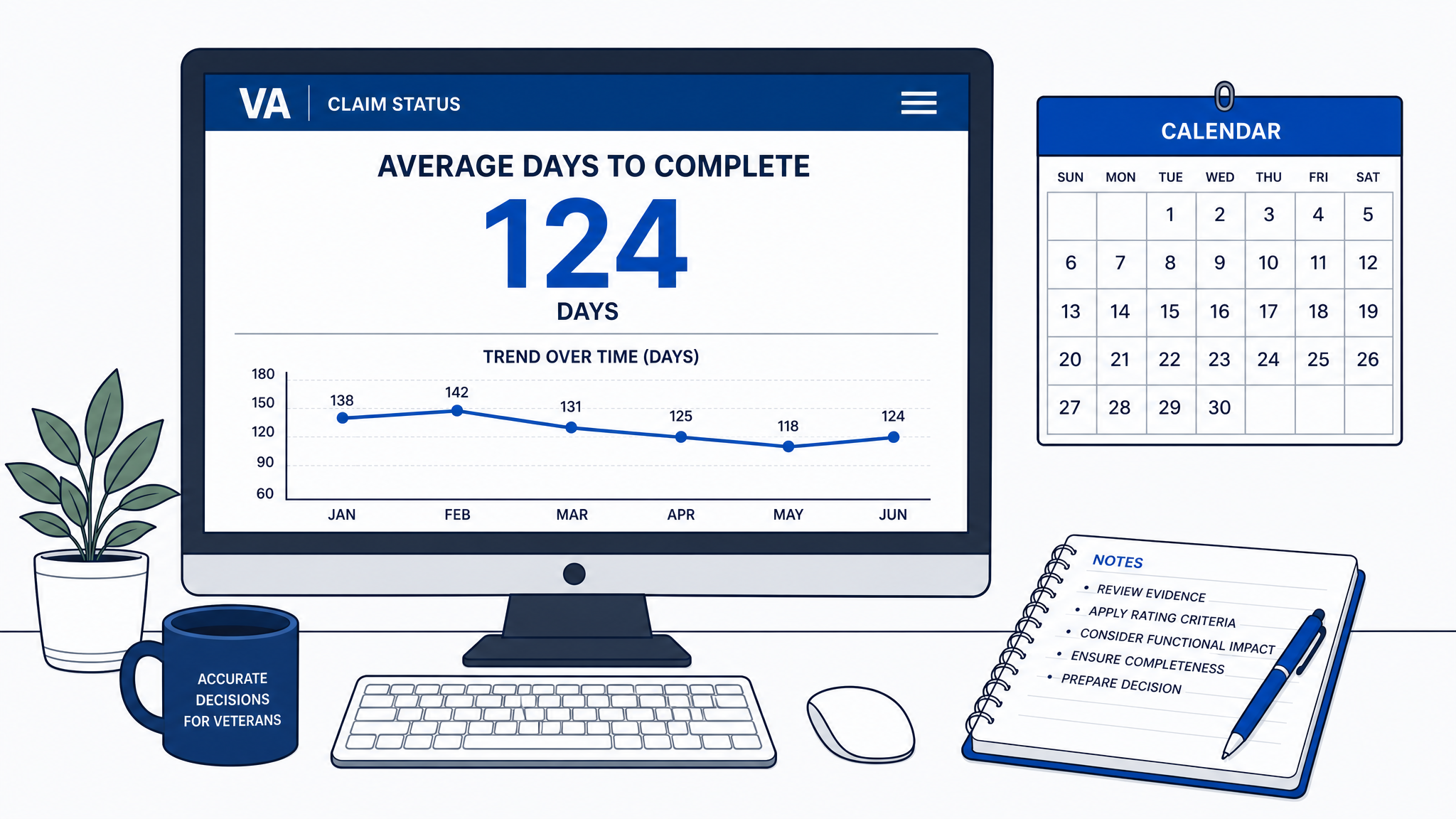
The average is a moving number
Check it at the source, not second-hand
The VA publishes an average days-to-complete figure for disability claims that moves month to month; check the current number on the VA’s own claim status page rather than relying on any second-hand figure. In practice, most veterans see a decision somewhere between roughly three and eight months from the date the claim was filed, with the exam usually falling in the middle of that window.
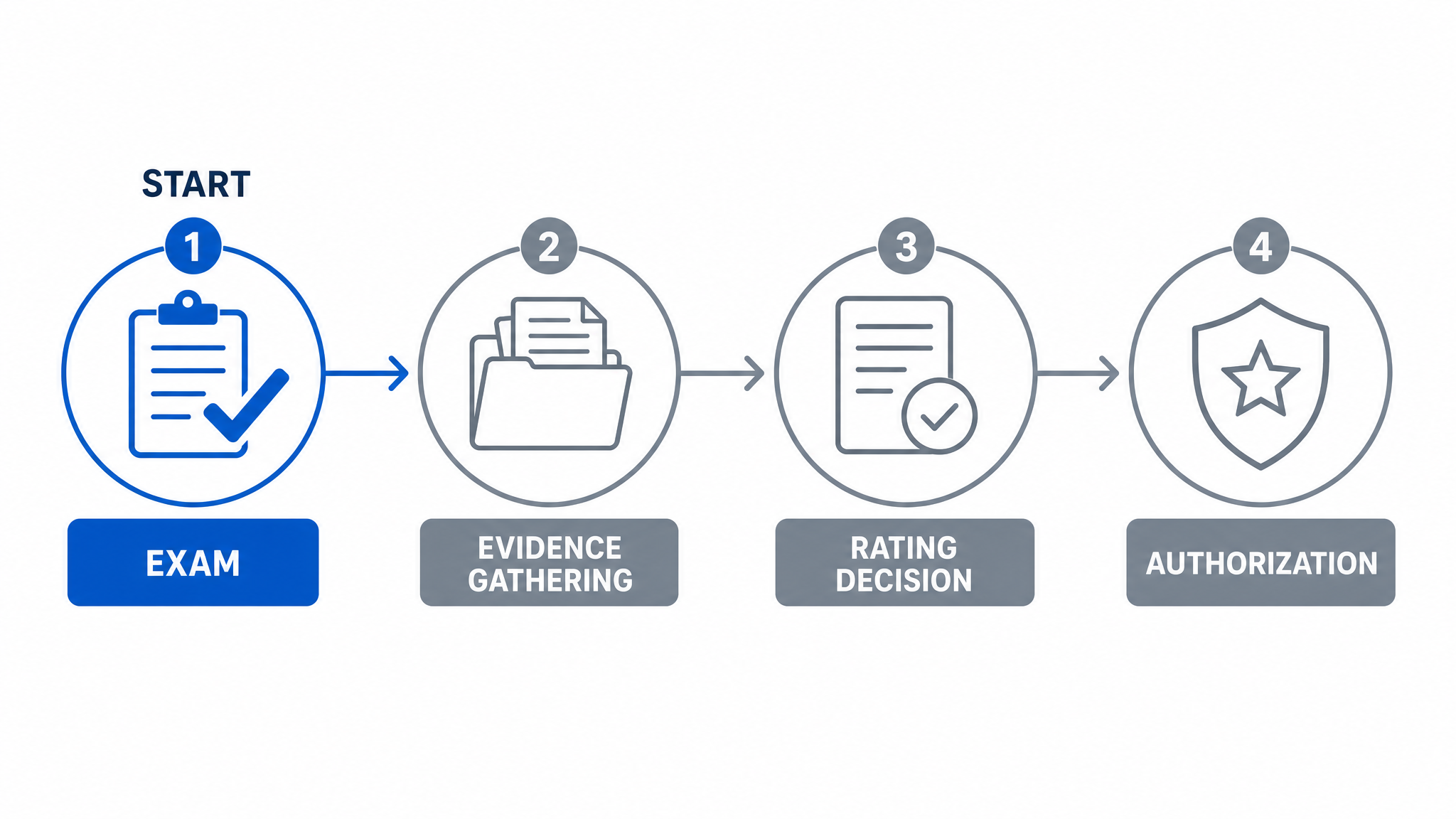
The exam is not the last step
Three stages still sit in front of you
The exam is not the last step. The clock does not start at the exam and it does not stop there either, the claim still has to clear evidence gathering, the rating decision and authorization.
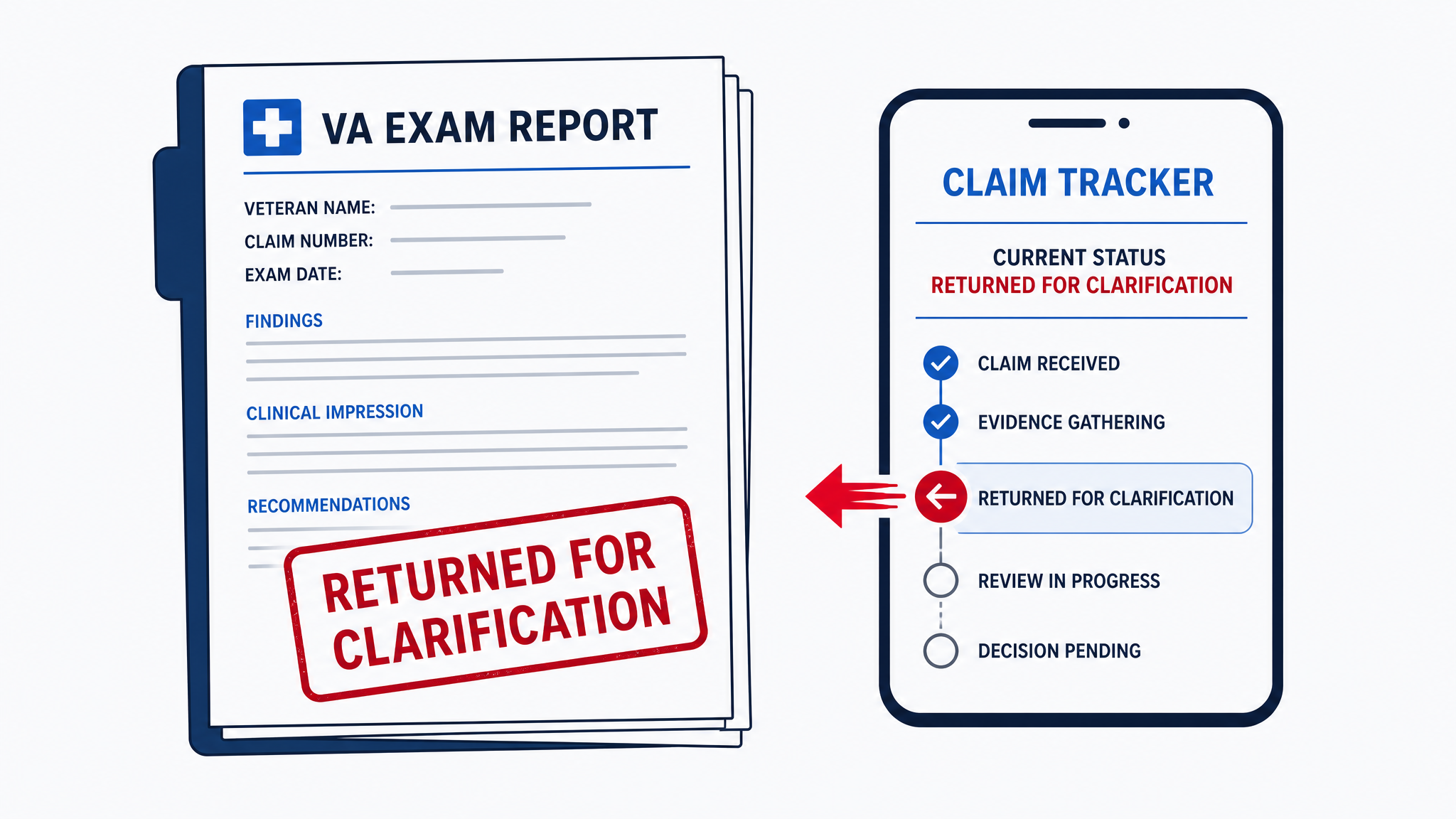
A returned exam is the invisible delay
The reason a tracker slides backward
A returned or clarified exam is the most common invisible delay, and it is why a tracker can slide backward. Expect some contact from the VA within 30 to 60 days of the exam. Past 60 days with nothing at all, call and ask specifically what the claim is waiting on.
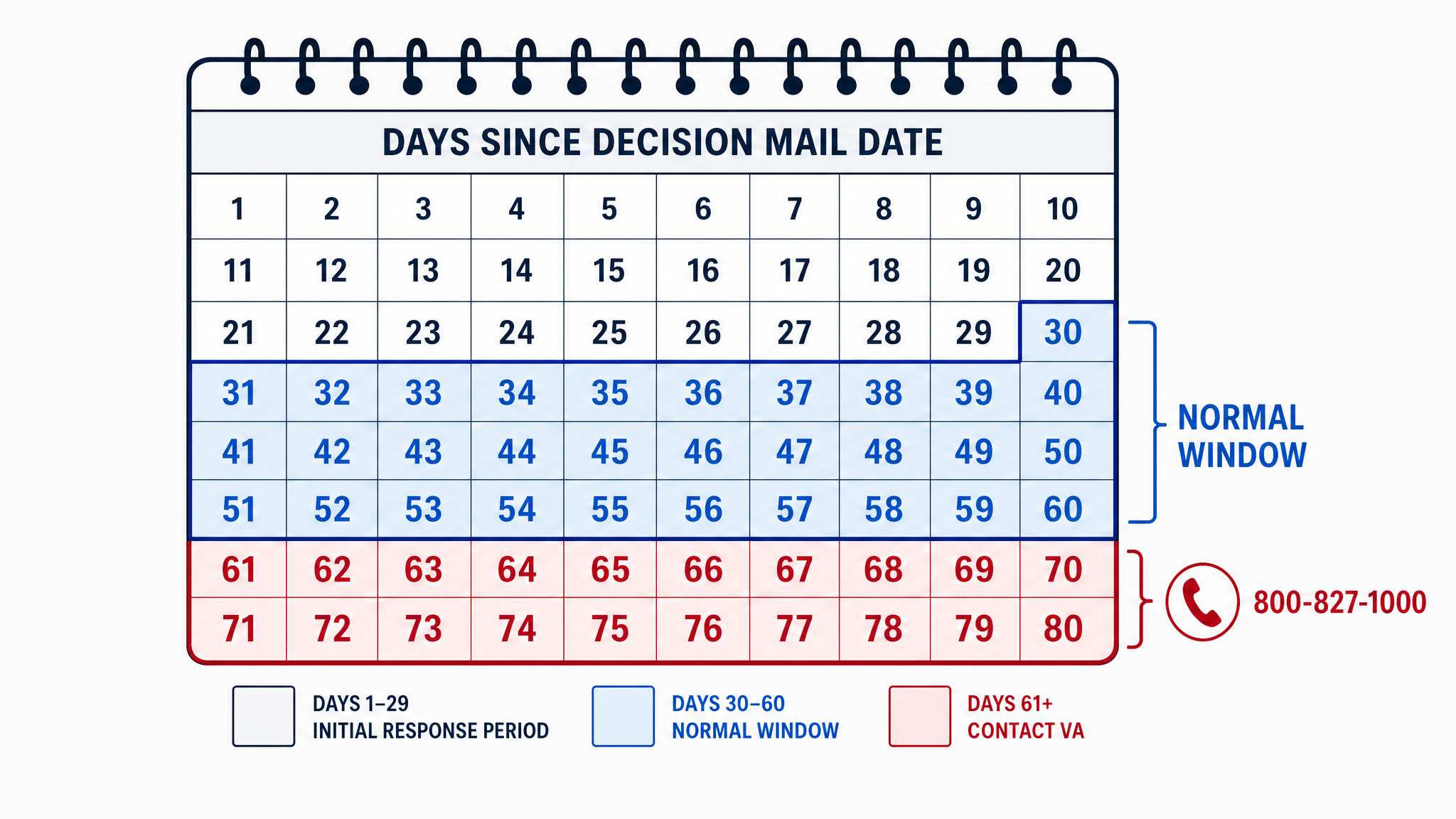
30 to 60 days is a guide, not a deadline
A complex case can take 90 days or more
Thirty to sixty days is a rough average for a simple, single-issue claim, not a hard rule and not a ceiling. A claim with several conditions, a presumptive or toxic-exposure question, a returned exam, or missing records can easily take 90 days or more, and that alone does not mean anything is wrong. Watch whether the claim is still moving, not the calendar. Only when it stalls well past what is normal for a case like yours, and no one can tell you what it is waiting on, should you stop waiting, call 800-827-1000 and ask what the claim is waiting on and who it is assigned to.
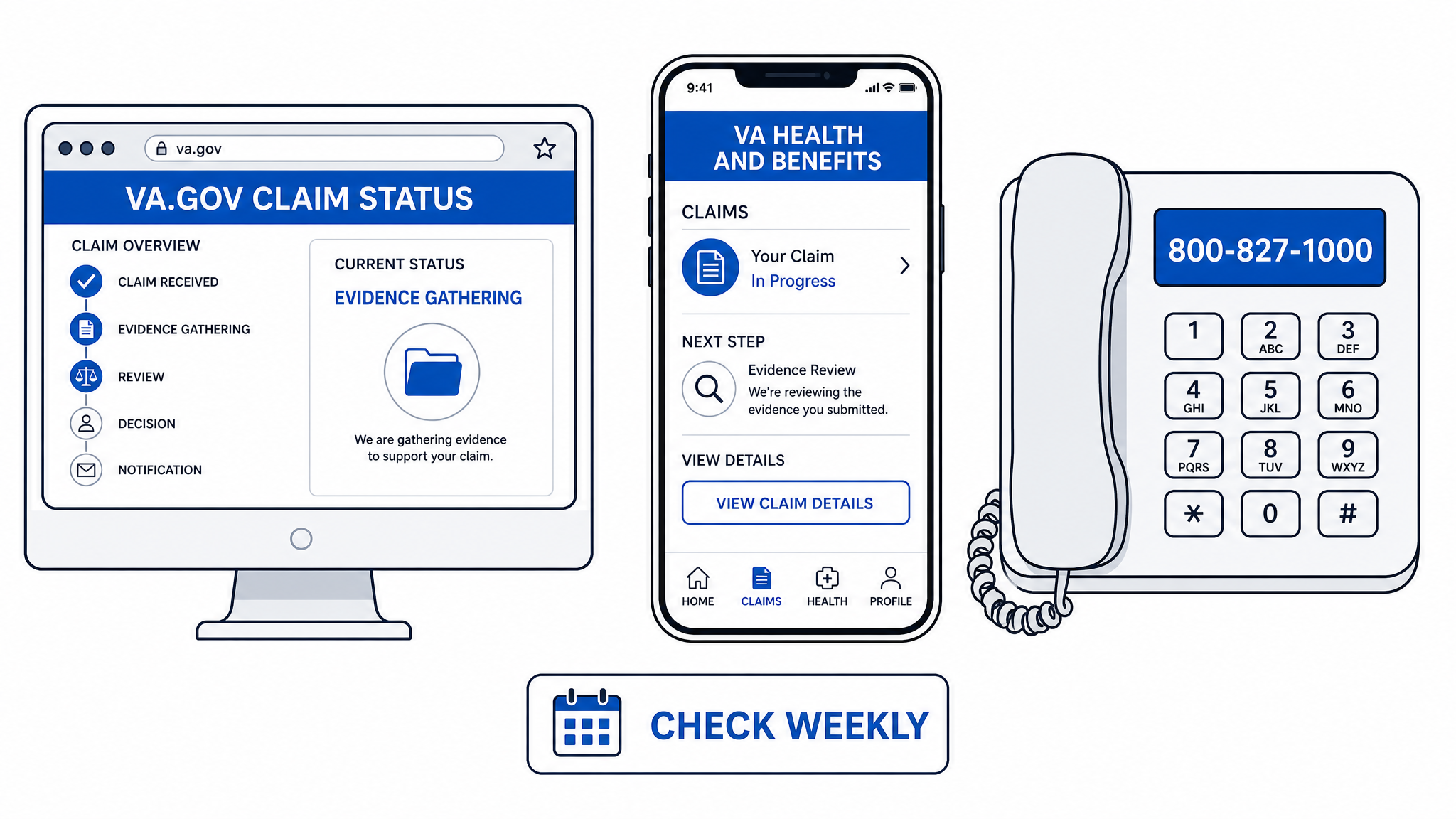
Watch your status yourself, in one of three places
Weekly, not daily
Check your own status in one of three places: your VA.gov claim status page, the VA Health and Benefits mobile app, or by calling 800-827-1000. Check it weekly, not daily. And understand exactly what a status check can tell you: if a decision is posted in your account, it is live; if it is not posted, it is not ready. That is the whole rule. This is not something your representative or your attorney can speed up, we see the same thing you see, at the same time, and calling us to ask does not move it. Calling the VA to ask for an update does not move it either. Watch it yourself, weekly, and the moment a decision posts, bring it to us.
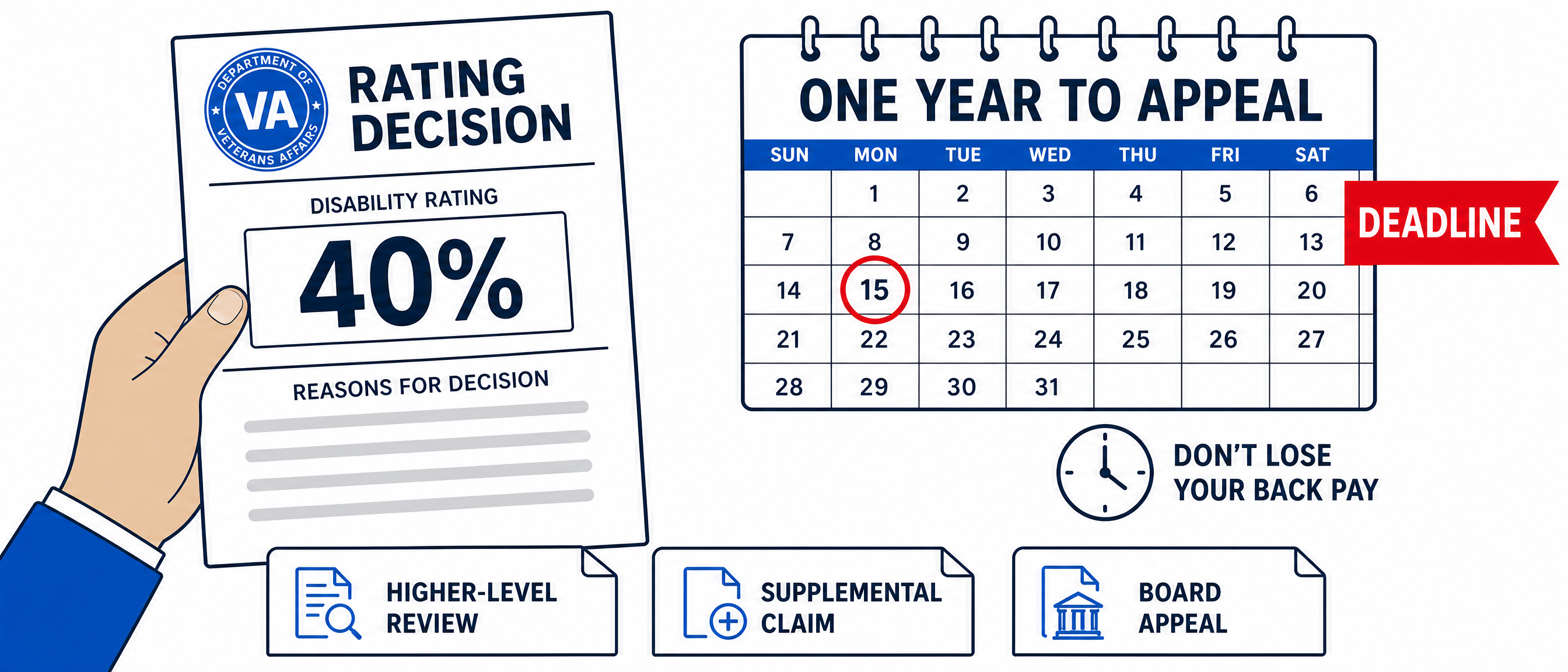
Your decision letter arrives, read it, then start the appeal clock
What to do the day it lands in your mailbox
The decision letter is the finish line of the claim and the starting line of the appeal, and the moment it arrives, a one-year clock starts running. Read it the same day. Find the combined rating, the percentage assigned to each condition, and the effective date, because the effective date controls how far back your back pay reaches. Then request a copy of your C&P exam report so you can see whether the rater used your real range-of-motion numbers or ignored the radiculopathy. If any part of the decision is wrong, a low rating, a denied condition, or a bad effective date, you have three appeal lanes, and you must choose one within one year of the date printed on the letter: a **Higher-Level Review (VA Form 20-0996)**, where a senior reviewer re-decides on the same evidence; a **Supplemental Claim (VA Form 20-0995)**, when you have new and relevant evidence such as a private DBQ or your own range-of-motion exam; or a **Board Appeal (VA Form 10182)** to a Veterans Law Judge. Miss that one-year deadline and the decision becomes final. You can still file again later, but you lose the original effective date, and that lost time is lost back pay you never get back. Bring the letter to this office before the year runs out and we will read it with you, line by line, at no cost.
07Remedy
How to report a bad exam
Where this exam goes wrong
The most common failure is an examiner who uses a **word list other than the Maryland CNC**, or who tests speech discrimination at a presentation level that is too loud, artificially inflating the score. Under §4.85, only the Maryland CNC results are acceptable for rating purposes. If the exam report does not identify the word list used, or identifies a different one, the exam is inadequate and the results should not be used. Check the report.

Write it down the moment you get to your car
Date, start time, end time, the examiner’s name and credentials, the vendor, every test that was performed, and every test that was not. A contemporaneous note written the same day is evidence. A memory reconstructed four months later is not.
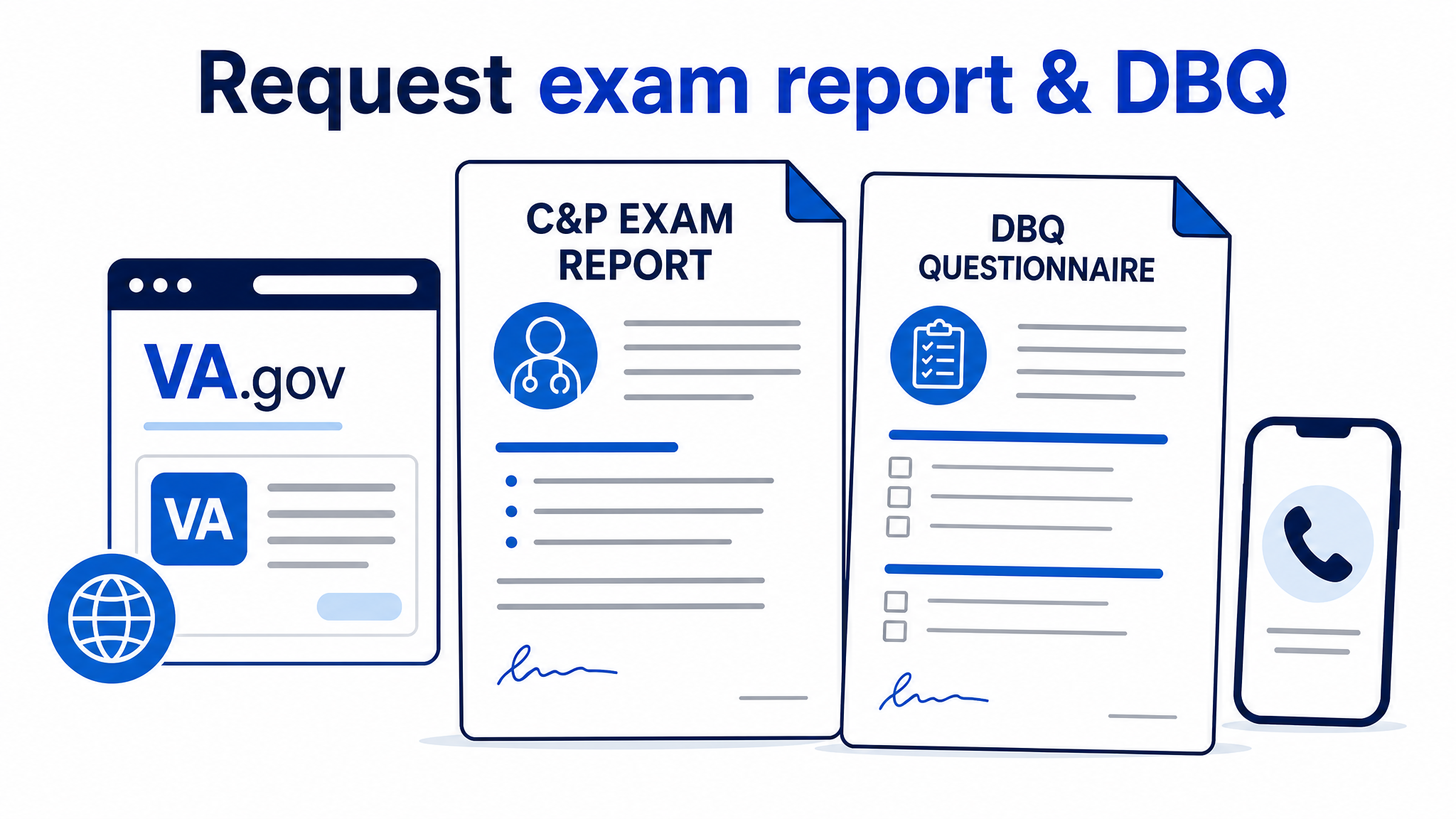
Get the exam report and the questionnaire
Request a copy through VA.gov, through a written request to the Regional Office, or by calling 800-827-1000. You cannot challenge what you have not read. Compare it line by line against what actually happened in the room.

Name the defect specifically, with the citation
Never write "the exam was unfair." Write "no goniometer was used, contrary to 38 CFR §4.46" or "flare-ups were reported and not addressed, contrary to Sharp v. Shulkin" or "repetitive use testing was not performed, contrary to 38 CFR §4.40 and DeLuca." A specific, citable defect is what forces action.
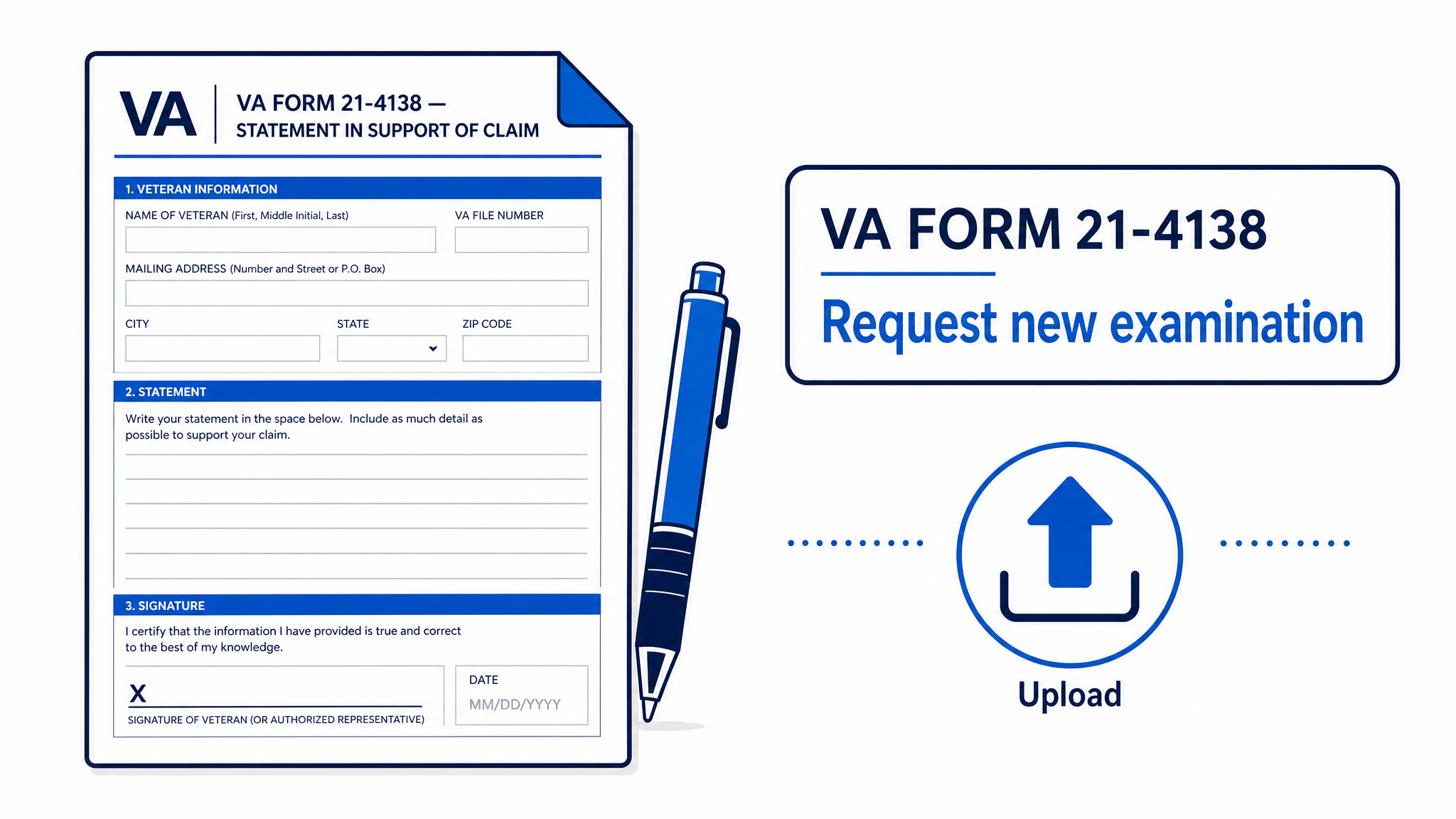
Submit a statement asking for a new examination
VA Form 21-4138, Statement in Support of Claim, filed through VA.gov or mailed to the Evidence Intake Center. State the defect, cite the authority, and request a new or supplemental examination. Do this BEFORE the decision if the claim is still open, it is far easier than undoing a decision afterward.
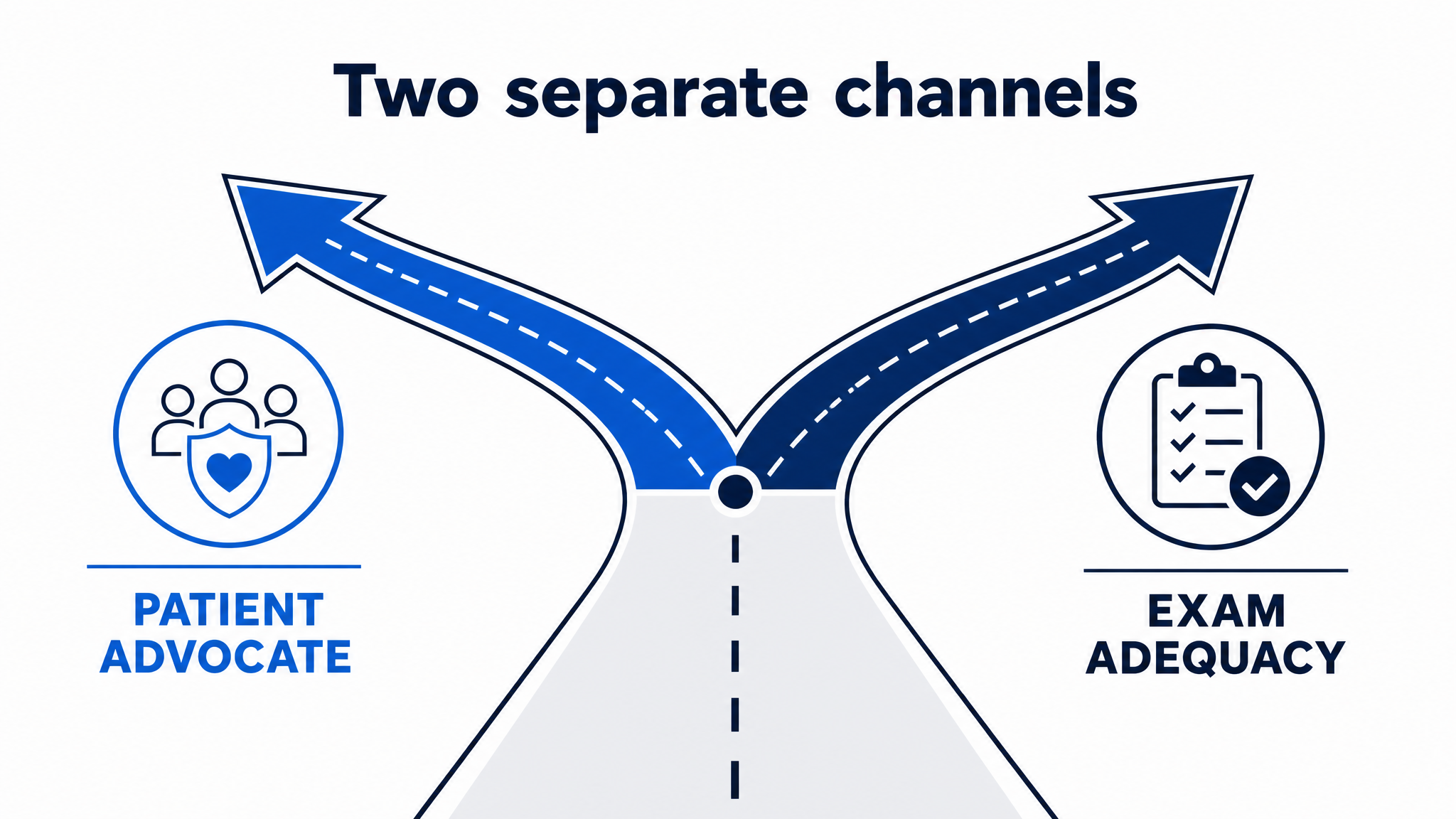
Report examiner conduct separately
If the problem is behavior rather than methodology, you were rushed out, dismissed, never touched, or treated with hostility, file a complaint with the VA facility’s Patient Advocate, or with the vendor directly for a contract exam, and copy the Regional Office. Conduct complaints and adequacy challenges are two different tracks and you can run both.

If a decision has already issued, pick the right lane
A Higher-Level Review (VA Form 20-0996) argues the VA erred on the evidence it had, the right vehicle when the exam was inadequate on its face. A Supplemental Claim (VA Form 20-0995) is the vehicle when you are adding new and relevant evidence, such as your own private range-of-motion examination or a completed DBQ from your treating provider.
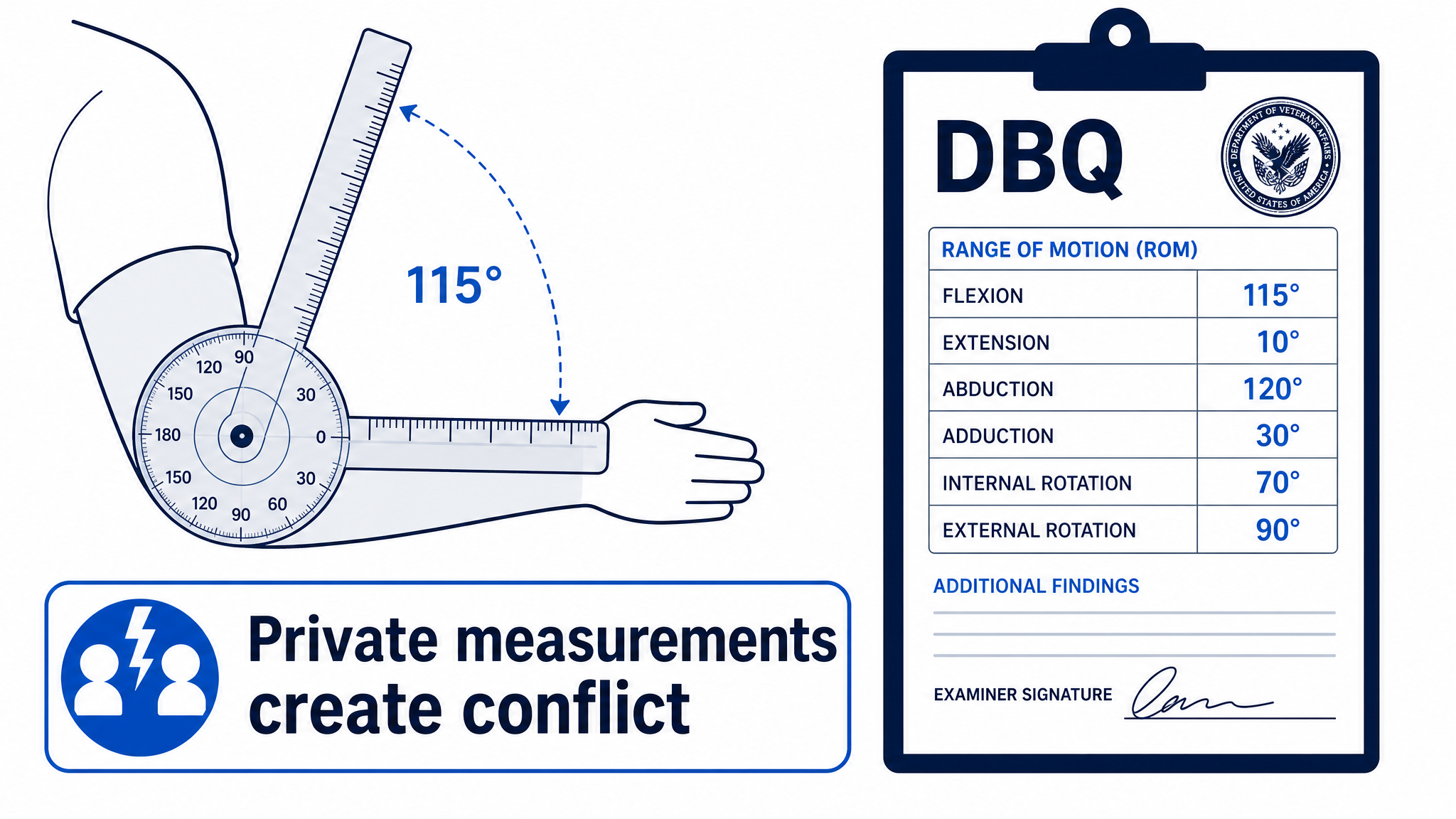
Put your own measurements on the table
A private examination with full goniometric measurements, or a DBQ completed by your own provider, creates a conflict in the evidence that the VA has to resolve, and under 38 CFR §3.102 reasonable doubt is resolved in your favor.
End of clinical section
Hearing Loss, DC 6100
See It Before You Sit In The Room
VA Hearing Loss Rating Explained, How Tables VI and VII Work
Combat Craig
How Hearing Works, 3D Animation of the Ear
MED-EL
The Questions Veterans Actually Ask
Hearing Loss Claims, Frequently Asked Questions
Straight answers to the questions that decide hearing loss claims, the ratings, the separate evaluations, and the exam mistakes that cost veterans money. Read every answer with your own file open. If an answer depends on a record you do not have yet, that is the next thing to request, from your doctor, your unit or the VA itself.
Hearing Loss is evaluated under DC 6100. The scale runs across 7 rating levels, and the highest is 0%, which the VA assigns for: table VII cross-reference of both ears' Roman-numeral designations produces Level I in both ears (e.g., puretone averages below roughly 42 dB with speech discrimination at 92% or higher in each ear). Where your evaluation actually lands depends on how your exam and records document those criteria, not on how bad the condition feels on an average day.
Every condition in Tinnitus & Hearing Loss