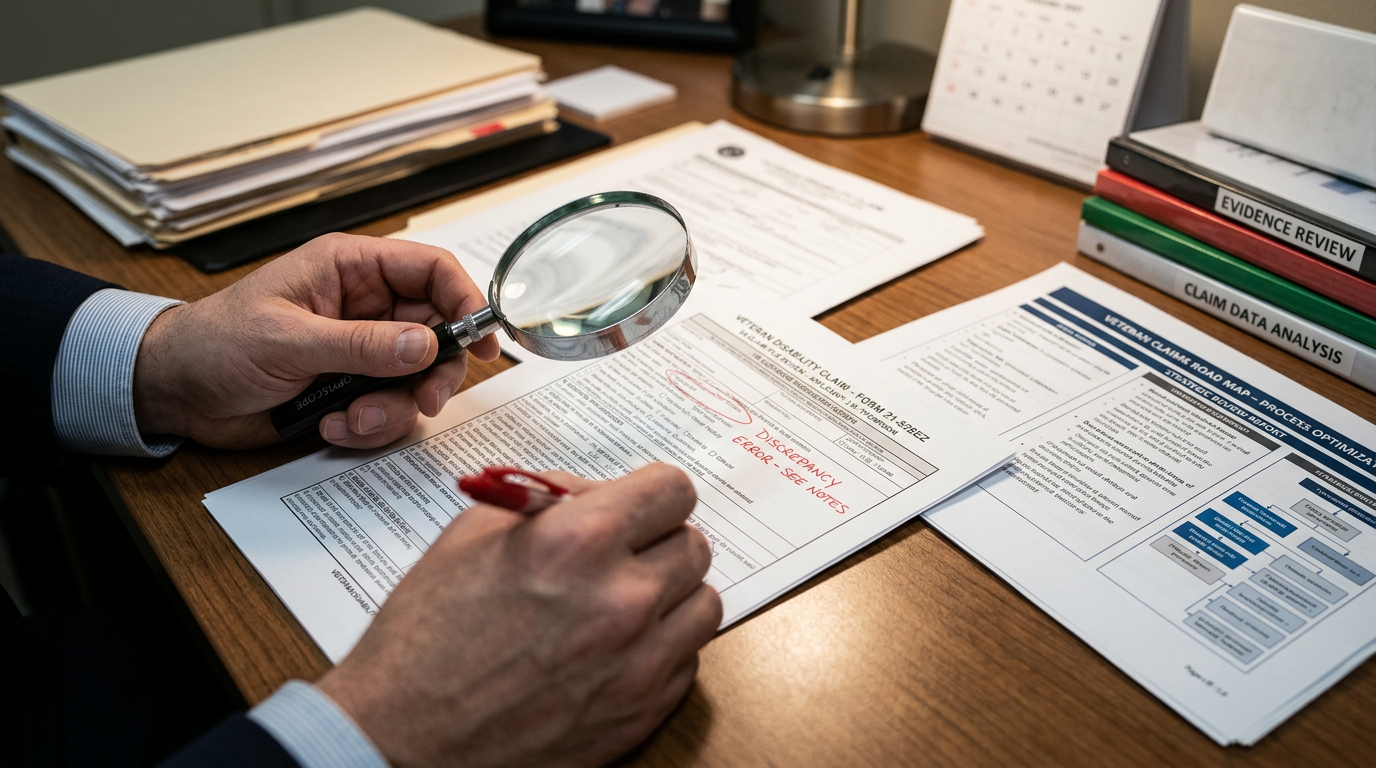

Evidence & Records
Gathering the Right Evidence
The three-legged stool: current diagnosis, in-service event, and medical nexus
Evidence is not about volume, it is about hitting the three elements the VA must find. A thousand pages that miss the nexus lose to three pages that nail it.
The Three Elements, Miss One and You Lose
Every direct service-connection claim needs three things: (1) a current, diagnosed disability, (2) evidence of an in-service event, injury, or exposure, and (3) a medical nexus opinion linking the two. These are not guidelines, they are legal requirements. Miss any one and the claim fails, no matter how sympathetic the story or how obvious the connection seems.
Secondary claims replace the in-service event with an already service-connected condition, and the nexus must link the new condition to the primary. Presumptive claims replace the nexus with a statutory presumption. But the structure is always: condition + link + trigger.

Types of Evidence and What They Prove
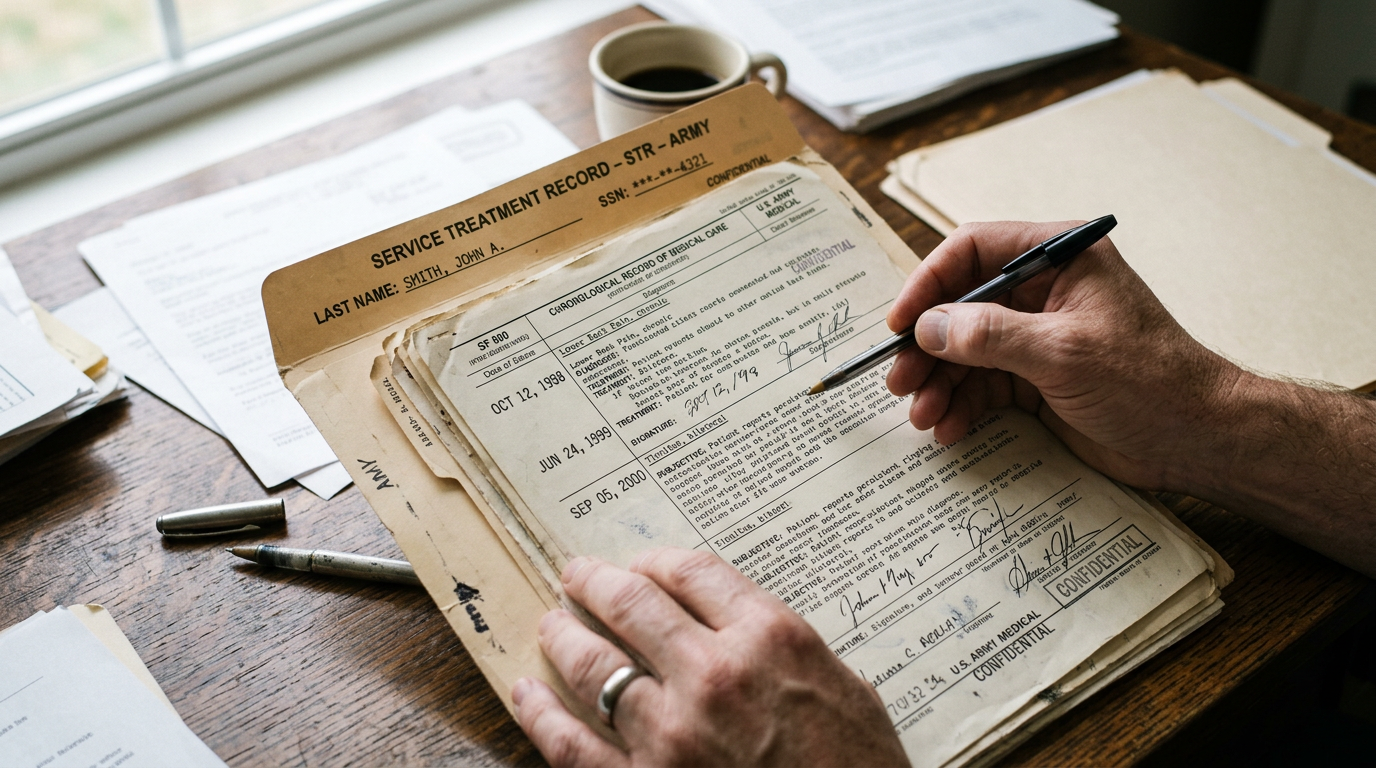
Service Treatment Records (STRs)
Your in-service medical records documenting injuries, treatments, complaints, and diagnoses during active duty. These are the strongest evidence of an in-service event. If they are missing, the VA has a heightened duty to assist under O'Hare v. Derwinski.

Service Personnel Records
Your 201 file, deployment orders, MOS assignment, duty stations, awards, and disciplinary records. Used to corroborate locations, dates, and duties relevant to the claimed exposure or event.

VA and Private Medical Records
Current treatment records that establish a diagnosed disability and document ongoing severity. The VA is required to obtain VA records and, with your authorization, identified private records under §3.159(c).

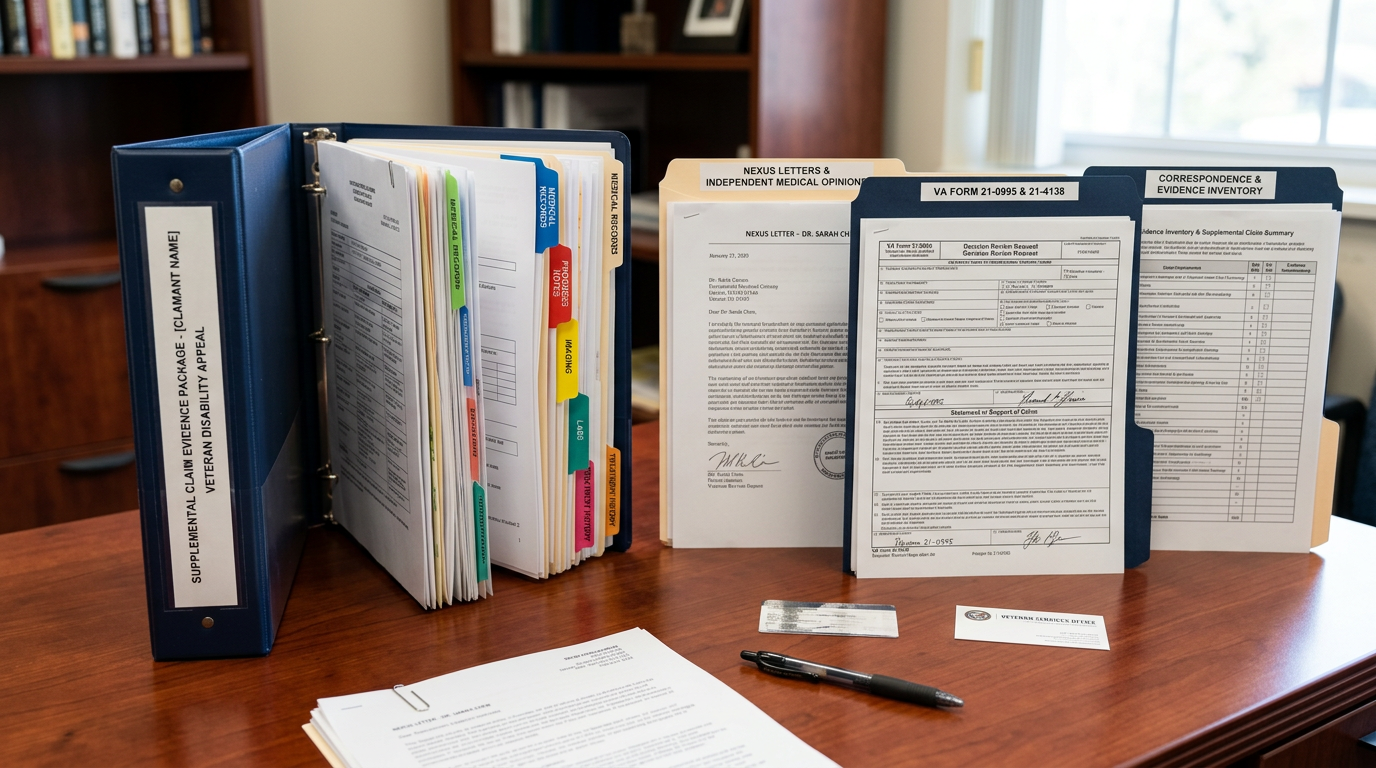
Nexus Letter
A written medical opinion from a qualified provider stating that your condition is "at least as likely as not" related to service (or to a service-connected condition). The "at least as likely as not" standard maps directly to the VA's benefit-of-the-doubt rule (§3.102). A strong nexus letter explains the reasoning, cites the medical literature, and addresses contrary evidence.
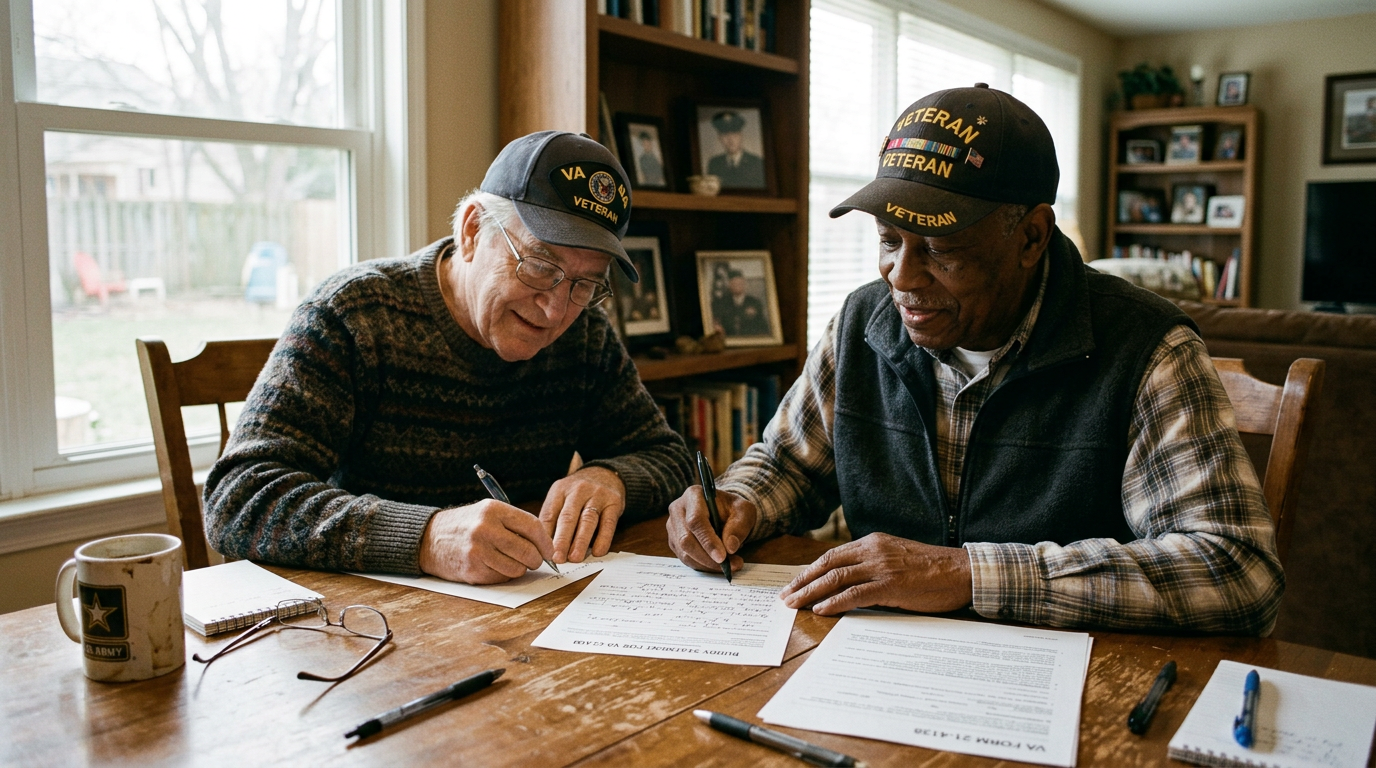
Lay Statements
Under §3.159(a)(2), you are competent to describe what you experienced and observed: pain, limitation, onset of symptoms, and functional impact. Buddy statements from fellow service members and family are equally valid lay evidence.

Diagnostic and Clinical Evidence
Lab results, imaging studies (MRI, X-ray, CT), psychological testing (PCL-5 scores), and pulmonary function tests. Objective clinical evidence is often the hardest for the VA to discount.
Quality Over Quantity
The VA is not persuaded by the size of a file. It is persuaded by evidence that satisfies each legal element. A 2,000-page records dump that does not contain a nexus opinion loses to a 10-page submission with a current diagnosis, a clear in-service event, and a well-reasoned nexus letter.
Our forensic review identifies which element your claim is missing and gets the specific evidence that fills the gap, nothing more, nothing less.

The Duty to Assist, And Its Limits
Under §3.159(c), the VA has a legal obligation to help you gather evidence: obtaining service records, VA treatment records, and scheduling exams. But this duty has limits. The VA will not search for records you have not identified. It will not write your personal statement. And if you fail to cooperate, the duty can be suspended entirely.
Think of the duty to assist as a matching obligation: you identify and authorize, the VA obtains. The more precise your identification, the more the VA is required to do.

The Evidence Clock: Thirty Days Encouraged, One Year Allowed
When you file, the VA sends a notice telling you what evidence it still needs. The VA asks you to send what you have within about 30 days, and I agree with that, because the sooner the file is complete the sooner a rater can act on it. But 30 days is a request, not the deadline. Under 38 U.S.C. §5103(b), you have one year from that notice to get the information and evidence in.
Use that year like it matters. Ask for your private records the week you file. Get your statement and buddy statements written while the details are fresh. If you are waiting on a doctor’s opinion, tell your representative so the file does not go to a rater looking half built.
Be careful how you release records. When you sign VA Form 21-4142 and 21-4142a, you are authorizing a provider to send records straight to the VA, and those records go in the file whether they help you or not. A chart full of “denies pain” notes, an old note blaming a different cause, or a history you forgot about will all land in front of the rater. Talk to your representative before you sign any release, so we know what is coming and can get ahead of it.
Here is the trap: veterans hear “one year” and relax. Then a decision arrives in month four, the evidence they meant to send is still sitting in a drawer, and they have a denial to fight instead of a claim to win. If a decision does come before your evidence is in, do not panic and do not start over. A Supplemental Claim filed within one year of the decision keeps your original effective date alive under 38 CFR §3.2500(h). Starting a brand new claim can throw away months or years of back pay.
Your part: write the date of your VA notice on your calendar, set a 30-day goal and a hard one-year deadline, and do not sign a single release until you have talked it over with us.

When Records Are Missing, the Claim Is Not Over
I hear it constantly: “My records are gone, so there’s no point filing.” That is wrong, and it costs veterans benefits they earned. Missing records change how a claim is proven. They do not end it. The regulation spells out exactly how hard the VA has to look, and what it owes you when it comes up empty.
The best known example is the fire at the National Personnel Records Center in St. Louis on July 12, 1973. It destroyed roughly 80 percent of the Army records for soldiers discharged from November 1912 through January 1960, and about 75 percent of the Air Force records for airmen discharged from September 1947 through January 1964, for names from Hubbard through the end of the alphabet. Thousands of veterans have won claims anyway. When records are lost while the government had them, the Court of Appeals for Veterans Claims held in O’Hare v. Derwinski that the VA has a heightened duty to explain its findings and to consider the benefit of the doubt carefully.
Here is the trap: the VA’s “unable to obtain” letter often reads like a final answer, and many veterans take it as one. It is not. It is a notice that the VA is about to decide your claim on what it has, and it is your cue to fill the hole with other evidence before that happens.
Your part: if the VA tells you a record cannot be found, send us that letter right away, and start gathering the substitute evidence described in the cards below.

Federal Records: The VA Keeps Looking Until It Is Futile
For records held by a federal agency, like your service treatment records, VA treatment records, or Social Security records, 38 CFR §3.159(c)(2) requires the VA to keep trying until it is reasonably certain the records do not exist or further efforts would be futile. One unanswered request is not enough. If the file shows a single attempt and then a denial, that is a duty to assist error worth raising.

Private Records: One Request and at Least One Follow Up
For private doctors, hospitals, and employers, 38 CFR §3.159(c)(1) requires an initial request and at least one follow up if the records do not arrive. You have to give the VA enough to find them: the provider, the dates, and the condition treated, plus a signed release. Honestly, the faster route is often to request your own records and submit them yourself, so you see them before the VA does.

The Notice the VA Owes You When It Fails
When the VA cannot get a record, 38 CFR §3.159(e) requires it to tell you which records it could not get, what it did to try, what it plans to do next, and that you are ultimately responsible for providing the evidence. Read that letter closely. If the VA never sent it, or the efforts it describes are thin, that goes in your appeal.

Substitute Evidence That Fills the Hole
When the official record is gone, build around it. Buddy statements from people who served with you, letters you sent home, photographs, unit histories and morning reports, pay records, award citations, and early post-service medical records all help. Your own detailed statement counts too, because you are competent to describe what happened to you and what you have felt since.
The Advocate's Take
Do not bury the rater. Give them the three things they are required to find, and make each one impossible to ignore. Volume impresses no one, precision wins claims.
Building a Gathering the Right Evidence Claim That Wins
Every claim stands on three legs. Knock one out and the claim falls over, no matter how bad your symptoms are. Before you file, look at your file and find all three. If one is missing, that is the piece to build first. The VA will not build it for you, and filing without it usually just buys you a denial letter and lost time.
 01
01A current diagnosis
A doctor has to say you have it, now, in writing. Not "reports symptoms of", a diagnosis. Without this leg, nothing else in the file matters.
 02
02A link to your service
An event, an injury, an exposure, or an already service-connected condition. Service records, unit records, buddy statements, and your own account all count as evidence.
 03
03A nexus that ties the two together
A medical opinion stating it is at least as likely as not that your service caused or aggravated the condition. That phrase is a legal standard: 50 percent or better. It is the leg most denials break.
Document the problem before you file
• Keep a dated symptom log for at least 30 days. Frequency, severity, and what it stopped you from doing.
• Get statements from people who see it, a spouse, a coworker, a battle buddy. Lay evidence is legal evidence.
• Pull your private treatment records. The VA only has to help; it does not have to go find everything.
• Write down what you have stopped doing. Lost work, lost sleep, lost activities. That is what impairment looks like on paper.
Your Rights in This Process
Most veterans walk into this system without knowing the rules the VA itself has to follow. That is how claims get denied for missing evidence the VA was supposed to help you find, and how exams get done by the wrong clinician. These six rights are written into federal regulation. Know them before you file, and make the VA honor every one of them when it decides your claim.

It costs nothing to file
Filing a VA claim is free. Accredited representatives may only charge for work on an appeal after an initial decision, and those fees are capped by 38 CFR §14.636.

The VA has a Duty to Assist you
Under 38 CFR §3.159 the VA must help you get the evidence it needs, and it must tell you what is missing before it denies you for missing it.

You can ask for a different examiner
You may request a trauma-informed clinician, or a clinician of a specific gender, for a C&P examination. Ask before the exam is scheduled.

You can claim every condition you have
There is no limit and no penalty. Primary conditions, secondary conditions, and conditions made worse by service all get filed.

You can appeal and be re-evaluated
A denial is not the end. You may submit new evidence, request a higher-level review, appeal to the Board, and ask for re-evaluation when your condition worsens.

You must be considered for TDIU
If your service-connected conditions keep you from holding substantially gainful employment, you may be paid at the 100 percent rate without a 100 percent rating.
When You Are Ready to File
Talk to an accredited representative before you file. It costs nothing to ask, and the order you file in changes what the VA is allowed to award you. Albert L. Thombs Jr. is VA-Accredited Claims Agent #45147. A short conversation now can save you a year spent waiting in the wrong review lane.
Your part starts at the kitchen table. Pull your DD-214, your rating decision if you have one, and the names of every doctor who treats you today. Under 38 CFR 3.159 the VA has to help you gather records, but it can only chase the records you tell it about. Leave a doctor off the 21-4142 and that treatment may never reach your file.

The application itself
This is the form that opens a disability compensation claim. List every condition you are claiming, and name the secondary conditions explicitly.
Release for private records
Authorises the VA to request records from your private doctors. Without it, treatment outside the VA may never reach your file.
Lay or buddy statement
The official form for your own statement and for statements from people who witnessed the event or the change in you.
Keep Reading
One page never tells the whole story of a claim. The VA rates every condition on its own evidence, its own exam and its own diagnostic code, and the pieces connect in ways most veterans never see until a decision letter lands. These are the pages that pick up where this one stops. Read them before you file, not after a denial, because the cheapest fix in this process is the mistake you never make.

How to Write a Compelling Statement
A well-structured lay statement gives the VA a vivid, personal account of how your service-connected condition affects your life. It is the part of the claim you have the most power over, and the part most veterans waste.
Read more
Nexus Letter vs. Lay Statement
A nexus letter supplies the medical opinion linking your condition to service. A lay statement supplies facts you witnessed. Confusing the two costs claims.
Read more
How to Talk to Your Doctor
Your medical records become VA evidence. How you describe your symptoms, and whether your provider documents them, directly shapes your rating.
Read more