

Coronary Artery Disease, Ischemic Heart Disease
Narrowed heart arteries that choke off blood flow, bringing chest pain, breathlessness and fatigue on exertion.
Coronary artery disease is one of the most consequential, and most valuable, conditions in the VA system. Under 38 CFR §4.104, Diagnostic Code 7005, the VA rates ischemic heart disease using a workload-based formula measured in METs (metabolic equivalents), combined with left ventricular ejection fraction and the presence of congestive heart failure. The ratings jump in large increments, 10%, 30%, 60%, 100%, making even one step the difference between a few hundred dollars a month and full disability compensation. The first thing every veteran with CAD needs to understand is this: ischemic heart disease is on the Agent Orange presumptive list under §3.309(e). If you served in Vietnam, Thailand, the Korean DMZ, or any qualifying location during the herbicide-exposure era, and you have a diagnosis of ischemic heart disease, your service connection is established by law, no nexus letter, no independent medical opinion, no argument. Diagnosis plus exposure equals connection. Beyond the presumptive path, CAD is commonly rated as a secondary condition to service-connected hypertension, diabetes, PTSD, and sleep apnea, each of which has a well-established medical pathway to cardiovascular damage. The C&P examination for DC 7005 centers on an exercise stress test that measures your METs capacity, the energy cost of the activity level at which your cardiac symptoms appear. That number drives your rating.
The Diagnostic Codes
Conditions Rated In Cardiovascular Conditions
These are the codes the VA will actually stamp on a decision in this group. The code you are granted under decides which formula is used, and that decides your percentage. CAD / Ischemic Heart Disease (DC 7005) is highlighted below.

Before Anything Gets Rated
What The VA Is Actually Looking For, And What Service Connection Really Means
Before the VA ever opens the rating schedule, it asks one question: is this disability the government’s responsibility? That is what “service connection” means. It is not a diagnosis, it is not sympathy, and it is not a reward for having served. It is a legal finding that a current, diagnosed disability is linked to something that happened to you in uniform. Percentages come later. If service connection is not established, there is nothing to rate and the claim is denied, no matter how bad the cad / ischemic heart disease (dc 7005) is.

For CAD / Ischemic Heart Disease (DC 7005) Specifically
Heart claims turn on objective cardiac testing: the VA wants your METs level from a stress test (or an estimate when testing is unsafe), your ejection fraction from an echocardiogram, and any documented congestive heart failure, then it must award the highest rating any one of those three supports under DC 7005. The costliest mistake is a rating built on an old or missing METs figure. If ischemic heart disease is tied to Agent Orange exposure, it is presumptive under §3.309(e), diagnosis plus qualifying service equals connection.
The three elements the VA must find. All three. Every time.
These come out of Caluza v. Brown and Shedden v. Principi, and they are the checklist a rating officer works through on your file. Miss one and the claim fails on that element alone.
A current, diagnosed disability
A doctor has to have written a diagnosis in a medical record, coronary artery disease, ischemic heart disease, atherosclerotic coronary artery disease, or status post myocardial infarction with documented coronary artery disease. Symptoms by themselves are not a disability the VA can rate. Saunders v. Wilkie held that pain causing functional impairment can be a disability, but you still need a clinician to document it as diagnosed and impairing. The diagnosis must exist now, during the claim period, not only years ago.
An in-service event, injury, illness or aggravation
Something in service had to have happened, an injury, an exposure, a documented sick call, or steady wear over a career. It does not have to be one dramatic moment and it does not have to be spelled out in your service treatment records: buddy statements, unit records, performance evaluations and your own competent lay testimony can establish it.
A medical nexus linking the two
A qualified medical opinion that says the current diagnosis is at least as likely as not related to the in-service event. That phrase matters: at least as likely as not means 50 percent or better. Under 38 C.F.R. §3.102, when the evidence is evenly balanced, the benefit of the doubt goes to you and the claim must be granted.
The five ways service connection is established
Most veterans only know the first one. The other routes are lower-effort paths to the same grant, and the secondary route is the one most often left on the table.
Direct, 38 C.F.R. §3.303(a)
The injury or disease began in service and never went away. The classic route: three elements, one nexus opinion.
Chronicity and continuity, §3.303(b)
A chronic condition shown in service, plus continuity of the same symptoms from separation to now, can establish the link without a formal nexus opinion. Your own testimony about symptoms you can observe is competent evidence.
Presumptive, §3.307 and §3.309
Certain chronic diseases are presumed service connected if they manifest to a compensable degree within a set window after separation. You do not have to prove causation at all.
Secondary, §3.310(a) and (b)
A disability proximately due to, or aggravated by, an already service-connected condition is itself service connected. This is how hypertension causing CAD, diabetes mellitus type II causing CAD, PTSD causing CAD, and obstructive sleep apnea causing CAD get on the rating sheet as the upstream conditions, while CAD itself can drive downstream ratings for arrhythmias, congestive heart failure, and stroke get on the rating sheet.
Aggravation of a pre-service condition, §3.306
If you entered service with a condition and service made it permanently worse, the increase is compensable. The VA must rebut the presumption of soundness by clear and unmistakable evidence, a bar it frequently fails to meet.
VA medical care, 38 U.S.C. §1151
An additional disability caused by VA treatment, surgery, or a failure to diagnose is compensated as if it were service connected.
The bottom line, there is no way around this
No diagnosis, no rating. It has to be chronic. It has to cause impairment.
Without a diagnosis, the VA will not rate your claim.
The VA will not rate chest pain, exertional fatigue, or shortness of breath under DC 7005 unless a physician has documented a confirmed diagnosis of ischemic heart disease or coronary artery disease, a risk factor list, a family history note, or an inconclusive stress test does not qualify. Veterans lose this element when their records show only cardiac symptoms managed with medication but no treating physician ever wrote the actual diagnosis in the chart. Get the diagnosis in writing before you file, a cardiology note, a catheterization report, or a hospital discharge summary that names the condition explicitly.
The condition must be chronic.
CAD is by nature a chronic, progressive condition, but the VA still needs a documented treatment history showing the disease has persisted, ongoing cardiology follow-ups, medication refills, repeat imaging, or documented anginal episodes over time. A veteran who had a cardiac event in service but has no post-service medical records showing continued treatment is going to face a rater who argues the condition resolved or was never formally diagnosed as chronic. Continuous treatment records are your chronicity proof, gaps in care become gaps in your rating.
It must cause actual impairment.
Under DC 7005, impairment is measured in METs, the workload level at which your cardiac symptoms appear on exercise stress testing, combined with your ejection fraction and the presence or absence of congestive heart failure. A veteran with confirmed CAD who exercises regularly, tests above 5 METs, has a normal ejection fraction, and has no CHF can be rated at 10% or even 0% despite a real diagnosis and real disease burden. The zero-percent trap hits veterans who are medically managed and functionally compensated, the VA rates your current functional capacity, not the severity of your underlying arterial disease.
What this means for you before you file: Before you file, get a current cardiology evaluation that includes exercise stress testing with METs documentation and an echocardiogram reporting your ejection fraction, those two data points are what DC 7005 is built on, and without them the C&P examiner will fill in the blanks against you. Under Gilbert v. Derwinski, when the evidence for and against service connection is in approximate balance, the VA must resolve doubt in your favor, the benefit-of-the-doubt standard at §3.102 is mandatory, not discretionary.
The Percentages
Rating Schedule, Coronary Artery Disease (Ischemic Heart Disease), DC 7005
DC 7005 uses the General Rating Formula for Diseases of the Heart, shared across many cardiac codes including DC 7000 (valvular), DC 7006 (MI), DC 7007 (hypertensive heart), DC 7017 (bypass), and DC 7020 (cardiomyopathy). A temporary 100% rating applies for three months following a myocardial infarction or coronary bypass, with reevaluation under this formula. Veterans with implantable cardiac defibrillators receive 100% for the duration the device is in place. Note 2: one MET equals the energy cost of standing quietly at rest; 1–3 METs approximates eating, dressing, or walking slowly. If stress testing is contraindicated, the examiner must estimate METs based on these benchmarks. The DBQ form is VA Form 21-0960A-1 (Heart Conditions).

100%
Chronic congestive heart failure; or a workload of 3 METs or less results in dyspnea, fatigue, angina, dizziness, or syncope; or left ventricular dysfunction with an ejection fraction of less than 30 percent.
60%
More than one episode of acute congestive heart failure in the past year; or a workload of greater than 3 METs but not greater than 5 METs results in dyspnea, fatigue, angina, dizziness, or syncope; or left ventricular dysfunction with an ejection fraction of 30 to 50 percent.
30%
A workload of greater than 5 METs but not greater than 7 METs results in dyspnea, fatigue, angina, dizziness, or syncope; or evidence of cardiac hypertrophy or dilatation on electrocardiogram, echocardiogram, or X-ray.
10%
A workload of greater than 7 METs but not greater than 10 METs results in dyspnea, fatigue, angina, dizziness, or syncope; or continuous medication is required.
Service Connection
Advice from the Advocate
This is where I stop explaining the rules and tell you how I would build your CAD / Ischemic Heart Disease (DC 7005) claim if you were sitting across my desk. Read the causation notes below twice. The VA will not connect the dots for you, even though 38 CFR 3.159 says it has a duty to assist. Your job is to put the in-service event, the current diagnosis and the medical link on paper, then make the examiner deal with all three.

The advocate's notes on causation, CAD / Ischemic Heart Disease (DC 7005)
The separate arguments that decide this code: where the VA will attack, the regulation that answers it, and the evidence that closes the gap.
1Presumptive, Agent Orange / herbicide exposure, §3.309(e)
Ischemic heart disease is on the Agent Orange presumptive list. If you served in a qualifying location during the specified period, Vietnam, Korean DMZ, Thailand air bases, or other designated areas, and you have a diagnosis of IHD, the VA presumes service connection. No nexus letter. No independent medical opinion. Qualifying service plus diagnosis equals connection. This is the most powerful and straightforward path to service connection for heart disease.
2Direct service connection, §3.303(a)
Heart disease diagnosed during service or manifesting to a compensable degree within the one-year presumptive period after separation under §3.307/§3.309(a) as a chronic cardiovascular disease. In-service ECG abnormalities, documented chest pain, or elevated cardiac risk markers during active duty support a direct connection.
3Secondary to hypertension, §3.310(a)
This is one of the strongest and most common secondary pathways. Chronic hypertension subjects the coronary arteries to sustained elevated pressure, accelerating plaque formation and atherosclerosis. If you are already service-connected for hypertension and develop coronary artery disease, the medical link is direct, well-established, and supported by extensive cardiovascular literature. A nexus letter should explain the hemodynamic mechanism: elevated arterial pressure damages the endothelial lining, promotes lipid infiltration, and accelerates stenosis.
4Secondary to diabetes mellitus, §3.310(a)
Diabetes mellitus is a recognized risk factor and causal pathway for coronary artery disease. Chronic hyperglycemia damages the vascular endothelium, promotes inflammation, and accelerates atherosclerotic plaque development. If you are service-connected for diabetes and develop heart disease, the secondary claim is medically straightforward under §3.310.
5Secondary to PTSD or sleep apnea, §3.310(a)
Both PTSD and obstructive sleep apnea have well-documented cardiovascular consequences. PTSD drives chronic sympathetic activation, elevated cortisol, systemic inflammation, and endothelial dysfunction, all of which accelerate coronary artery disease. Sleep apnea subjects the heart to repeated cycles of oxygen deprivation and reoxygenation, promoting oxidative stress and plaque instability. Either condition, when service-connected, supports a secondary claim for CAD.
Exposure & Aggravation
How CAD / Ischemic Heart Disease (DC 7005) Happens In Service, And How It Gets Worse

The VA wants an in-service event, and most veterans think that means one dramatic injury. It does not. Years of duty that wore the body down count too, and under 38 CFR 3.306 a condition service made worse can still be connected. Find yourself in the list below, then put that duty in writing with dates, units and names. The board only weighs what you put on paper.
How veterans pick this up in uniform, CAD / Ischemic Heart Disease (DC 7005)
CAD / Ischemic Heart Disease (DC 7005) rarely announces itself with one dramatic moment. It is built by what service asked of your body over months and years, and once it is service-connected, it is compensated for how it keeps getting worse, not for how it started. Below is how veterans pick this up in uniform, and who is most prone to it.
- Agent Orange and herbicide exposure, ischemic heart disease is a presumptive condition under §3.309(e) for veterans who served in Vietnam, the Korean DMZ, Thailand air bases, and other qualifying locations during specified periods, no nexus letter required
- Burn-pit and airborne-hazard exposure, toxic exposure during Gulf War, Iraq, and Afghanistan deployments that damages the cardiovascular system, covered under PACT Act presumptions
- Service-connected hypertension, chronic elevated arterial pressure accelerates atherosclerotic plaque formation in the coronary arteries, one of the strongest secondary pathways to IHD
- Service-connected diabetes mellitus, hyperglycemia damages the endothelial lining of blood vessels and accelerates atherosclerosis, creating a direct pathway to coronary artery disease
- Service-connected PTSD and chronic stress, sustained cortisol elevation, sympathetic nervous system hyperactivation, systemic inflammation, and endothelial dysfunction accelerating atherosclerosis
- Service-connected sleep apnea, repeated nighttime oxygen desaturation (intermittent hypoxia) placing chronic stress on the cardiovascular system and promoting plaque instability
- High-stress military operational environment, combat stress, disrupted sleep, field rations, and sustained physical and psychological demand that compound cardiovascular risk over years of service
- Steroid and medication exposure, long-term corticosteroid or other medication use for service-connected conditions contributing to weight gain, metabolic syndrome, and cardiovascular strain
Who is most prone to it
Vietnam-era veterans and anyone with qualifying herbicide exposure (presumptive under §3.309(e)); Gulf War, Iraq, and Afghanistan veterans with burn-pit exposure (PACT Act); veterans service-connected for hypertension (the most direct secondary pathway to CAD); veterans with service-connected diabetes mellitus (endothelial damage and accelerated atherosclerosis); veterans with service-connected PTSD, anxiety, or depression (cortisol-driven inflammation and cardiovascular strain); veterans with service-connected sleep apnea (intermittent hypoxia); and veterans with a family history of heart disease compounded by the cardiovascular strain of military service.
The Symptoms
What CAD / Ischemic Heart Disease (DC 7005) Actually Feels Like
Read this list the way the examiner will. Every symptom you live with but never report is a symptom the VA treats as if it does not exist. The rating schedule pays for how CAD / Ischemic Heart Disease (DC 7005) affects your daily life and your work, so the details matter. Check off what matches your day, tell your doctor in those words, and make sure it lands in your treatment record before the exam.

- Chest pain or pressure, angina, during physical exertion, emotional stress, or sometimes at rest, caused by reduced blood flow through narrowed coronary arteries
- Shortness of breath with activities that used to be routine, climbing stairs, walking across a parking lot, carrying groceries, a sign the heart cannot meet the body's oxygen demand
- Fatigue and exhaustion disproportionate to the effort, feeling wiped out after light activity because the heart struggles to pump adequate blood
- Dizziness, lightheadedness, or near-syncope when exerting yourself or standing up, caused by reduced cardiac output
- Heart palpitations or arrhythmias, the sensation of a racing, skipping, or irregular heartbeat as the damaged heart struggles to maintain rhythm
- Swelling in the ankles, feet, or legs, peripheral edema from fluid retention when the heart cannot pump efficiently
- Waking at night short of breath or needing to sleep propped up on pillows, fluid backing up into the lungs
- The need for daily cardiac medications, beta blockers, statins, blood thinners, ACE inhibitors, to manage the disease
How this one is rated
CAD is rated under 38 CFR §4.104, DC 7005 using the General Rating Formula for Diseases of the Heart. The VA assigns the highest rating for which any single criterion is met. The tiers are: 100% for chronic congestive heart failure, OR a workload of 3 METs or less resulting in cardiac symptoms, OR left ventricular dysfunction with an ejection fraction of less than 30%; 60% for more than one episode of acute congestive heart failure in the past year, OR a workload of greater than 3 but not greater than 5 METs resulting in symptoms, OR an ejection fraction of 30 to 50%; 30% for a workload of greater than 5 but not greater than 7 METs resulting in symptoms, OR evidence of cardiac hypertrophy or dilatation on electrocardiogram, echocardiogram, or X-ray; and 10% for a workload of greater than 7 but not greater than 10 METs resulting in symptoms, OR a requirement for continuous medication to control the condition.
What you are measured against
The METs workload is measured by an exercise stress test, typically a treadmill test with continuous ECG monitoring. If a test is medically contraindicated, the examiner may estimate METs based on the veteran's described functional limitations, but must document why testing was not performed. An estimated value without adequate justification is challengeable. The left ventricular ejection fraction is measured by echocardiogram, cardiac MRI, or nuclear imaging. Because LVEF and METs are independent criteria, a veteran with normal METs but an LVEF below 30% qualifies for 100% on ejection fraction alone. Congestive heart failure is documented by clinical history, hospitalizations, emergency visits, imaging, and treatment records.
Each One On Its Own Page
Secondary Conditions, Aggravated or Caused by a Current Service-Connected Condition
Under 38 CFR §3.310(a), a disability that is proximately due to a service-connected condition is service-connected in its own right, and under §3.310(b), so is any additional disability caused when a service-connected condition aggravates a problem you already had. Each condition below is a separate evaluation with its own diagnostic code and its own percentage. They do not fold into the cad / ischemic heart disease (dc 7005) rating, they stack on top of it. A veteran who claims only the primary condition leaves these ratings on the table.

Occupational impact and unemployability
Heart disease directly limits the types and intensity of work a veteran can perform. If you cannot sustain physical labor, tolerate workplace stress, or maintain a full workday without cardiac symptoms, document the occupational loss specifically. Veterans rated 60% or higher for CAD who cannot maintain substantially gainful employment should pursue TDIU, total disability based on individual unemployability, which compensates at the 100% rate.

PTSD and chronic stress as cardiovascular accelerators
The link between PTSD and cardiovascular disease is one of the strongest secondary connections in the VA system. Chronic PTSD drives sustained cortisol elevation, sympathetic nervous system hyperactivation, systemic inflammation, and endothelial dysfunction, all of which accelerate atherosclerosis and increase the risk of acute coronary events. If you are already service-connected for PTSD and develop CAD, a secondary claim under §3.310 is medically well-supported. The nexus letter should explain the cortisol-inflammation-endothelial pathway specifically.

Cardiology specialist documentation and nexus strength
A treating cardiologist's records carry significantly more weight than a general-practice C&P examiner's brief evaluation. If you see a cardiologist regularly, ensure your records include current echocardiogram results with LVEF, stress test results with METs values and symptom onset, medication lists with dosages, and the cardiologist's assessment of your functional limitations. A strong nexus letter from a treating cardiologist, one who knows your cardiac history over years, is the most powerful piece of secondary or aggravation evidence you can submit.
Accredited Claims Agent #45147
Ready To Get This Rated Correctly?
You have read how the VA rates CAD / Ischemic Heart Disease (DC 7005). Now the question is whether your file proves it. We represent veterans on a No Win, No Fee basis: 20% Direct-Pay paid by the VA from back pay, or 30% High-Complexity, and you owe nothing for representation if your rating does not increase. If you only need the roadmap, the Mission 5 Brief is a separate $750 flat fee. You bring the records, we build the argument.
Cardiovascular Conditions, In Detail
Cardiovascular Conditions, Service Connection In Depth
Here is each claimable condition in this group on its own terms, what it is, what service did to it, and what the VA requires before it will connect it.

Coronary Artery Disease, Ischemic Heart Disease
Coronary artery disease is one of the most consequential, and most valuable, conditions in the VA system. Under 38 CFR §4.104, Diagnostic Code 7005, the VA rates ischemic heart disease using a workload-based formula measured in METs (metabolic equivalents), combined with left ventricular ejection fraction and the presence of congestive heart failure. The ratings jump in large increments, 10%, 30%, 60%, 100%, making even one step the difference between a few hundred dollars a month and full disability compensation. The first thing every veteran with CAD needs to understand is this: ischemic heart disease is on the Agent Orange presumptive list under §3.309(e). If you served in Vietnam, Thailand, the Korean DMZ, or any qualifying location during the herbicide-exposure era, and you have a diagnosis of ischemic heart disease, your service connection is established by law, no nexus letter, no independent medical opinion, no argument. Diagnosis plus exposure equals connection. Beyond the presumptive path, CAD is commonly rated as a secondary condition to service-connected hypertension, diabetes, PTSD, and sleep apnea, each of which has a well-established medical pathway to cardiovascular damage. The C&P examination for DC 7005 centers on an exercise stress test that measures your METs capacity, the energy cost of the activity level at which your cardiac symptoms appear. That number drives your rating.
You are reading this page now
The C&P Exam
What To Expect At The CAD / Ischemic Heart Disease (DC 7005) Exam
This is the encounter your rating is built on. The examiner has a checklist and a limited window, what follows is exactly what happens in that room, so none of it surprises you.
Clinical Section, What To Expect at the Exam
What to Expect at Your Coronary Artery Disease C&P Examination
Diagnostic Code 7005, METs workload capacity, ejection fraction, and congestive heart failure history decide everything
The VA cardiac examination uses **VA Form 21-0960A-1** and is built around three independent measurements: your **METs workload** (the energy cost of the activity level at which cardiac symptoms appear), your **left ventricular ejection fraction (LVEF)** measured by echocardiogram, and your **history of congestive heart failure**. The VA must award the highest rating for which any single one of these criteria is met, you do not have to fail all three. The centerpiece of the exam is the **exercise stress test**, a treadmill test with continuous ECG monitoring that measures the METs level at which you develop dyspnea, fatigue, angina, dizziness, or syncope. If the examiner cannot perform a stress test because it is medically contraindicated, they must estimate your METs based on your described daily activity limitations, but they must document why testing was not performed. An estimated METs value without adequate clinical justification is grounds to challenge the exam as inadequate. Walk into this exam knowing your numbers: your most recent LVEF, your exercise tolerance in concrete terms, and your history of cardiac events and procedures.
Condition
CAD / Ischemic Heart Disease (DC 7005), DC 7005
Governing questionnaire
VA Form 21-0960A-1, Heart Conditions Disability Benefits Questionnaire, METs testing, LVEF, CHF history, medication, procedures, and functional impact
Click the form number to open the official questionnaire on VA.gov.
01In The Room
What happens during the exam
The tests and maneuvers for this condition
- Exercise stress test (treadmill or bicycle) with continuous ECG monitoring, measuring the METs level at which cardiac symptoms appear
- Echocardiogram, ultrasound of the heart measuring left ventricular ejection fraction, wall motion, and chamber size
- Electrocardiogram (12-lead ECG), recording electrical activity to detect hypertrophy, dilatation, ischemic changes, prior infarction, and arrhythmias
- Cardiac biomarker blood panel, troponin levels (heart muscle damage), BNP/NT-proBNP (heart failure markers), lipid panel, and inflammatory markers
- Review of cardiac procedure history, stents, bypass, valve repair, pacemaker or defibrillator, with dates and outcomes
- Chest X-ray or cardiac imaging, checking for cardiomegaly (enlarged heart) and pulmonary congestion
- Documentation of medication regimen, beta blockers, statins, blood thinners, ACE inhibitors, nitrates, and all cardiac medications with doses
- Assessment of congestive heart failure history, number and dates of CHF episodes, hospitalizations, and emergency visits in the past year
What gets measured, and to what number
METs workload (metabolic equivalents)
The METs level at which cardiac symptoms appear during an exercise stress test, or, if testing is contraindicated, an interview-based estimate with documented clinical justification. This is the primary rating driver: ≤3 METs = 100%, >3–5 = 60%, >5–7 = 30%, >7–10 = 10%.
Left ventricular ejection fraction (LVEF)
The percentage of blood the left ventricle ejects with each beat, measured by echocardiogram, cardiac MRI, or nuclear imaging. Normal is 55–70%. An LVEF <30% supports 100%; 30–50% supports 60%. This is independent of METs, a low LVEF alone sets your rating.
Congestive heart failure history
Chronic CHF supports 100%. More than one episode of acute CHF in the past year supports 60%. The examiner documents hospitalizations, emergency visits, imaging, and treatment records that establish the CHF diagnosis and frequency.
Cardiac hypertrophy or dilatation
Evidence of enlarged or thickened heart chambers on ECG, echocardiogram, or chest X-ray supports a minimum 30% rating under the general formula, even without a low METs value.
Procedure and intervention history
Stents, coronary bypass, valve repair or replacement, pacemaker or defibrillator implantation, each carries its own minimum evaluation and convalescent rating. Bypass surgery and MI both trigger a temporary 100% for three months. An ICD warrants 100% for the duration it is in place.
02Orientation
What to expect during this exam
What makes this exam different from every other C&P exam
1METs and LVEF are independent criteria, you only need one
The single most important thing to understand about the cardiac rating formula is that METs workload, ejection fraction, and congestive heart failure are independent criteria. A veteran with a normal stress test but an LVEF of 28% qualifies for 100% on ejection fraction alone. A veteran with a decent ejection fraction but who develops angina at 4 METs qualifies for 60%. You do not need to fail multiple criteria, one alone at the right level sets your rating.
2If the stress test was estimated, not performed, challenge the adequacy
The regulation allows METs estimation only when a laboratory exercise test is medically contraindicated, meaning there must be a documented medical reason testing was not performed. If the examiner simply estimated your METs based on a brief interview without explaining why a treadmill test was not done, the examination may be inadequate. Request a new exam or file a Higher-Level Review pointing out the missing clinical justification.
3Agent Orange makes this a presumptive condition, no nexus needed
Ischemic heart disease is on the Agent Orange presumptive list under §3.309(e). If you have qualifying herbicide exposure and a diagnosis of IHD, your service connection is established by law. If you were previously denied for CAD before this provision was in effect, file a supplemental claim immediately.
See it before you sit in the room
03Preparation
Know your symptoms and secondary factors
What the report must actually say about cad / ischemic heart disease (dc 7005), dc 7005
- "I develop chest pressure and shortness of breath when I try to [specific activity], I have to stop after [specific distance/duration]", establish the precise activity level at which symptoms appear, because the examiner translates this into a METs estimate.
- "My most recent echocardiogram showed an ejection fraction of [number]%, here is the report", ensure your LVEF is in the record, because it is an independent criterion that can set your rating regardless of METs.
- "I have been hospitalized [number] times in the past year for congestive heart failure / acute cardiac events, here are the admission records", establish the CHF frequency that drives the 60% and 100% tiers.
- "I had a myocardial infarction / coronary bypass surgery / stent placement / ICD implantation on [date], I want the temporary 100% convalescent rating documented", trigger the procedure-specific minimum evaluations.
- "I take [list every cardiac medication with dose and frequency] every day to manage this condition", continuous medication alone supports 10%, and the full medication list documents disease severity.
- "My heart condition prevents me from working, I cannot sustain physical exertion, I cannot handle workplace stress, and I have missed [number] days due to cardiac symptoms", establish the occupational impact for potential TDIU.
Pain level, frequency, lost work and functional loss, how to say them

Describe angina by the activity that triggers it, not just "chest pain"
The rating schedule is built on METs, the energy cost of the activity level at which symptoms appear. Saying "I have chest pain" gives the examiner nothing to work with. Describing the specific activity and the point at which you must stop gives the examiner a METs estimate that translates directly into a rating level.
Keep a daily symptom log: what you were doing, when the pain started, how long you had to rest, and whether it resolved on its own or required medication (nitroglycerin).
"I get a squeezing pressure in the center of my chest every time I try to walk more than about 50 yards at a normal pace. I have to stop and rest for several minutes before it subsides. I cannot carry groceries from the car to the house without stopping twice."

Quantify shortness of breath by stairs, distance, and duration
Dyspnea is one of the five cardinal symptoms at every rating level. The examiner needs concrete benchmarks: how many stairs before you stop, how far you can walk, how long before you recover. These benchmarks map directly to METs tiers.
Compare your current capacity to what you could do before, if you used to run three miles and now cannot walk to the mailbox, that trajectory is medical evidence.
"I cannot climb a single flight of stairs without stopping halfway to catch my breath. By the time I reach the top I am gasping and have to sit down for five minutes. I used to run three miles, now I cannot walk one block without stopping."

Describe cardiac fatigue as inability to perform routine tasks
Fatigue in the rating formula is not ordinary tiredness, it is the body running out of oxygenated blood during routine demands. Describing it in functional terms, what household tasks you can and cannot complete, gives the examiner the daily-activity benchmarks that translate to a METs estimate.
Describe your worst days, not your best. The rating should reflect the full range of your functional impairment.
"After doing light housework for 20 minutes, dishes, folding laundry, I have to lie down for an hour because I feel completely drained. I cannot mow the lawn, vacuum the house, or carry a basket of laundry up the stairs anymore. My wife does everything that requires sustained effort."

Report every episode of dizziness and syncope with dates and circumstances
Dizziness and syncope are listed alongside dyspnea, fatigue, and angina as qualifying symptoms at every rating level. Every documented episode strengthens the evidence. If you have lost consciousness, the VA must consider that in the rating.
Get witness statements from family members who have seen you during episodes, a spouse or child who found you confused or on the floor provides powerful corroborating evidence.
"I blacked out in the kitchen last month while standing at the stove. My wife found me on the floor. This has happened three times this year. I also get lightheaded every time I stand up from a chair or bend over to pick something up."
Secondary conditions to raise in the same appointment
Every secondary condition laid out in the Secondary Conditions section above belongs in this same appointment. Name each one out loud, tell the examiner how the primary condition caused it or made it worse, and ask that it be noted in the report. Under 38 CFR 3.310, a secondary condition the examiner never hears about is a secondary condition the VA never rates. Bring your list on paper so nothing gets left in the parking lot.
What to expect at this specific exam
- Get a current echocardiogram BEFORE the exam, the LVEF is an independent rating criterion and must be recent. If your last echo was more than a year ago, request a new one from your cardiologist.
- Bring your complete cardiac procedure history with dates: stents, bypass, valve repair, pacemaker or ICD implantation. Each procedure carries its own minimum evaluation.
- Bring your current medication list with doses and frequencies, every cardiac drug documents the severity and management requirements of your disease.
- Keep a symptom log for the weeks before the exam: every episode of chest pain, shortness of breath, dizziness, fatigue, or palpitations, what you were doing, how long it lasted, what you had to stop doing.
- If you have been hospitalized for cardiac events or CHF in the past year, bring all admission records, discharge summaries, and ER records with exact dates.
- If claiming secondary to hypertension, diabetes, PTSD, or sleep apnea, bring your service-connection documentation and a nexus letter from your cardiologist explaining the physiological mechanism.
- Know your daily activity limits in specific terms: how far you can walk, how many stairs you can climb, what household tasks you can and cannot do. The examiner needs this to estimate METs if a stress test is contraindicated.
04The Protocol
What procedures are required during the exam
These are not courtesies. Each comes out of the regulation or out of binding case law. Take this list in with you and tick them off as they happen.
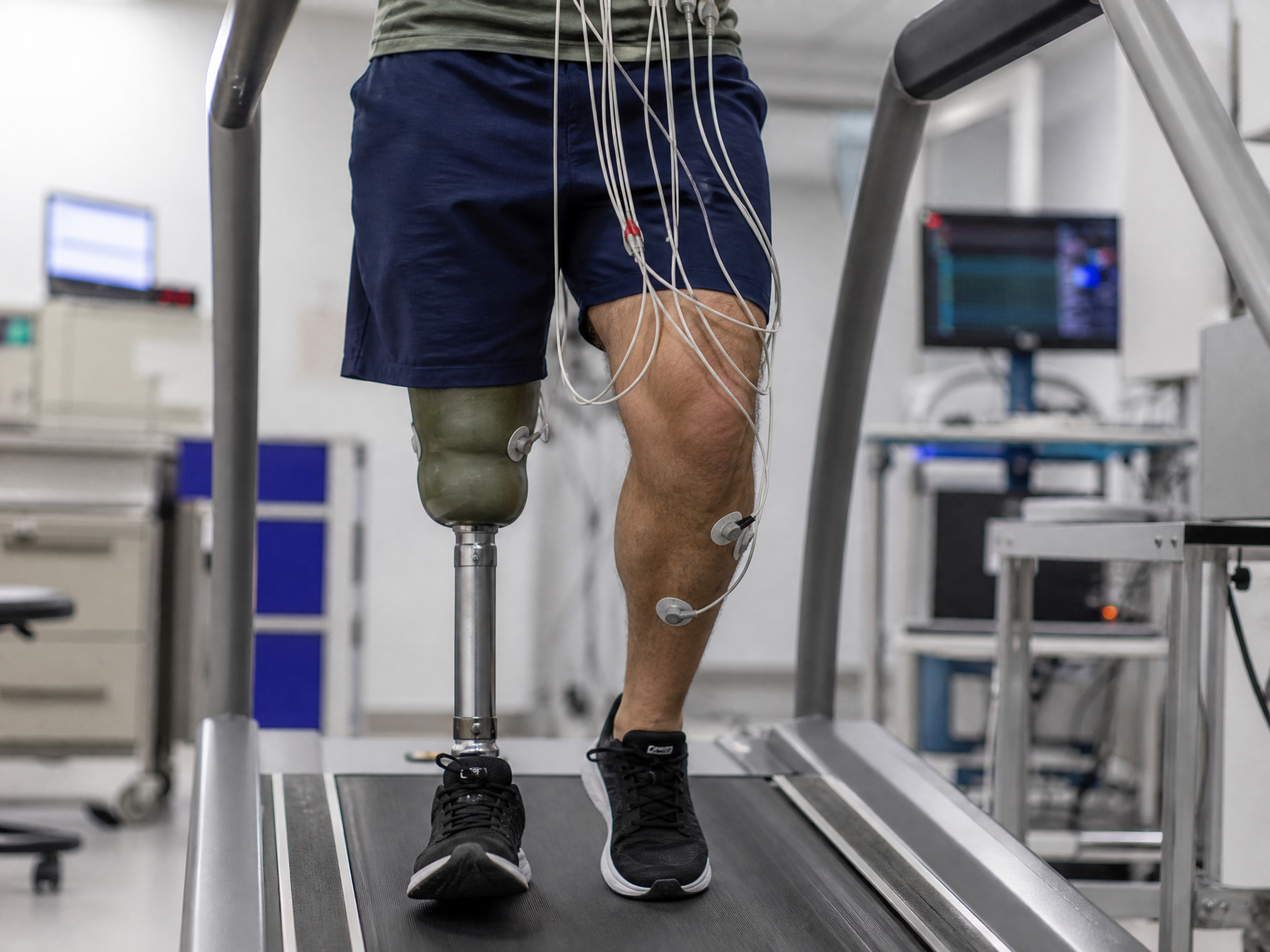
01Exercise stress test, the METs measurement that drives the rating
38 C.F.R. §4.104, General Rating Formula for Diseases of the Heart, Note 2
The treadmill or bicycle exercise stress test is the primary measurement that drives the CAD rating. You exercise on the treadmill with ECG leads attached while the intensity gradually increases until cardiac symptoms appear. The workload level at which symptoms begin, measured in METs, is the number the rater uses. If you cannot complete the test due to cardiac symptoms at a low workload, that low METs number supports a higher rating. If the test is medically contraindicated, the examiner must estimate METs based on your described activities and document the reason testing was not performed.
The METs number is the single most important data point in a cardiac claim. Without it, or with an improperly estimated value, the rater cannot accurately assign a rating. The stress test produces objective, measurable evidence.

02Echocardiogram, the ejection fraction that can set your rating alone
38 C.F.R. §4.104, DC 7005
The echocardiogram is an ultrasound of the heart that measures how efficiently the left ventricle pumps blood, the left ventricular ejection fraction (LVEF). A normal LVEF is 55–70%. An LVEF of 30–50% supports a 60% rating; below 30% supports 100%. Because LVEF is an independent criterion, it can establish your rating even if your stress test shows moderate METs. Make sure you have a current echocardiogram, a study from years ago may not reflect your present cardiac function.
Ejection fraction is the criterion most veterans overlook. You can have a seemingly normal exercise tolerance but a dangerously low LVEF, and that low number alone can get you to 60% or 100%. An outdated echo means an outdated LVEF in the record.

03Electrocardiogram (ECG/EKG), detecting hypertrophy and electrical changes
38 C.F.R. §4.104, General Rating Formula for Diseases of the Heart
The 12-lead ECG records the electrical activity of the heart and can reveal evidence of cardiac hypertrophy, dilatation, ischemic changes, prior infarction, or arrhythmias. Evidence of cardiac hypertrophy or dilatation on ECG supports a minimum 30% rating under the general formula even without a low METs value. The ECG is a standard part of the cardiac C&P examination and provides objective evidence of structural cardiac damage.
Cardiac hypertrophy or dilatation on ECG establishes a floor of 30%, even if your stress test and ejection fraction are moderate. Many veterans miss this criterion because they do not understand that structural changes on an ECG alone can drive a rating.
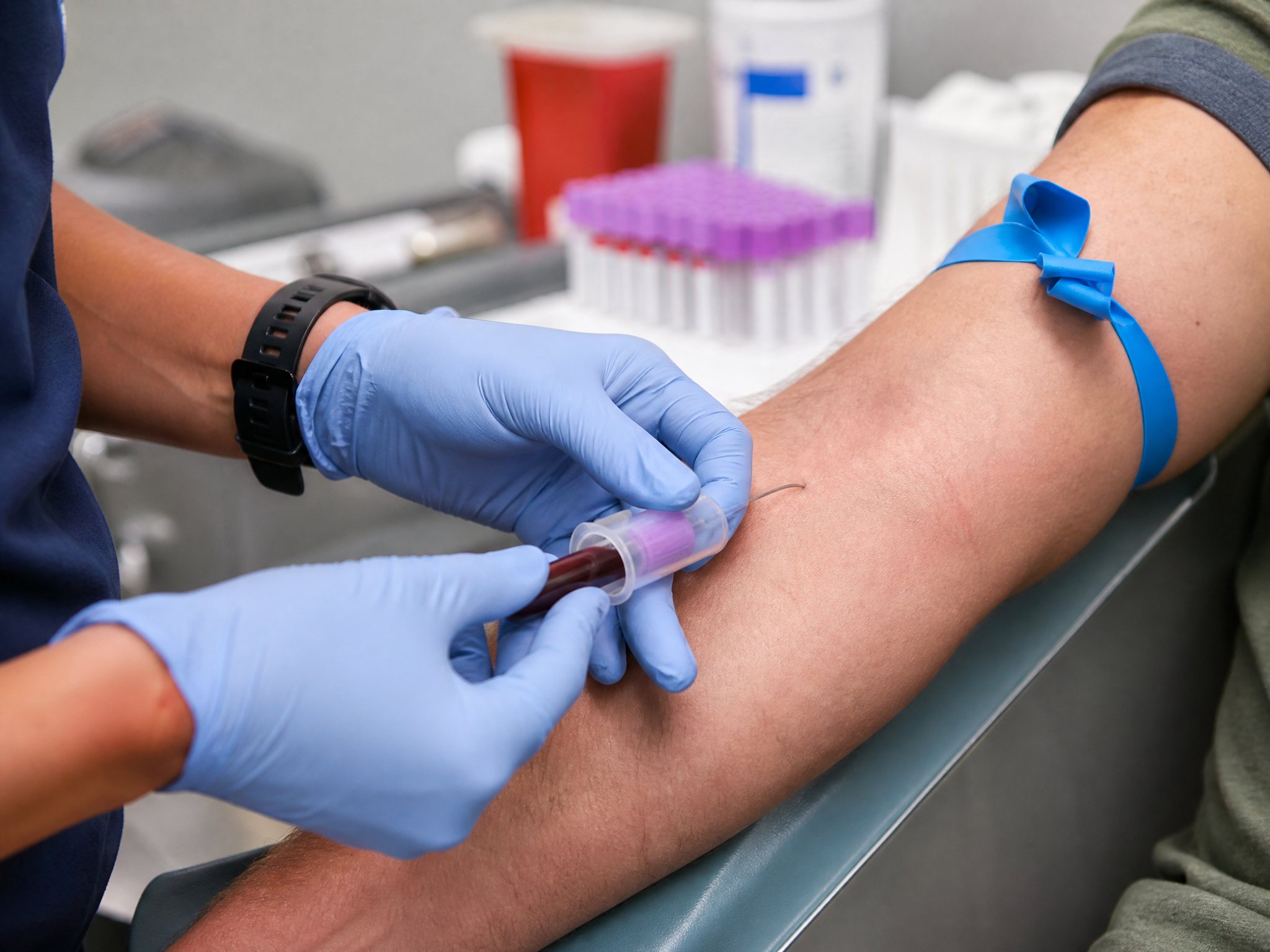
04Cardiac biomarker blood panel, objective markers of heart damage
38 C.F.R. §4.104, DC 7005
Blood work for cardiac evaluation includes troponin levels (indicating heart muscle damage), BNP or NT-proBNP (markers of heart failure and ventricular strain), lipid panels (cholesterol and triglycerides driving atherosclerosis), and inflammatory markers like C-reactive protein. Elevated troponin or BNP levels provide objective evidence of ongoing cardiac damage or heart failure that supports higher ratings and documents disease progression.
Biomarkers provide objective laboratory evidence that complements the stress test and echo. Elevated BNP in particular is strong evidence of heart failure, which is one of the three independent criteria for 100%.

05Functional capacity and occupational impact assessment
38 C.F.R. §§4.1, 4.10, 4.104; §4.16 (TDIU)
Beyond the objective cardiac measurements, the C&P examiner documents how your heart disease affects your ability to function in daily life and work. This includes your ability to perform activities of daily living, maintain employment, engage in recreation, and handle physical and emotional stress. Be prepared to describe your worst days, not your best, the rating should reflect the full range of your functional impairment. If you have been hospitalized for cardiac events, bring dates and records. If you have had stents, bypass, or other interventions, those procedures carry their own minimum evaluations and convalescent ratings.
Functional impact documentation is essential for TDIU claims and for painting the full picture of how this disease has changed your life. An objective number on a stress test does not capture the jobs you can no longer do or the daily activities you have lost.
05The Standard
What makes an exam adequate
Read your exam report against these. An exam that fails the standard is legally inadequate, and an inadequate exam is something you challenge rather than accept.
The range of motion has to be MEASURED, not estimated
38 CFR §4.46 states that the use of a goniometer in the measurement of limitation of motion is indispensable in examinations conducted within the Department of Veterans Affairs. An examiner who eyeballs your bend and writes a number has not complied with the regulation. This is the most common defect in a spine exam and it is the easiest one to spot from the chair.
Joints must be tested in every required condition
Under Correia v. McDonald, a joint examination for pain must, wherever possible, record active motion, passive motion, motion in weight-bearing and motion in non-weight-bearing, and where relevant, the range of the opposite undamaged joint. An exam that records one set of numbers and stops is incomplete on its face, and that incompleteness is grounds to challenge it.
Flare-ups have to be addressed, not dodged
Under Sharp v. Shulkin, when a veteran describes flare-ups, the examiner is obligated to estimate the additional loss of motion during a flare based on all the available evidence, including your own account of it. "I cannot opine without resorting to mere speculation" is not automatically acceptable; the examiner has to have actually sought the information first and explained why an estimate is impossible.
Repetitive use and functional loss must be factored in
Sections 4.40 and 4.45, and the DeLuca line of cases, require that pain, weakness, fatigability, incoordination and lack of endurance after repeated use be considered, and expressed in additional degrees of lost motion where that is feasible. Your rating is supposed to reflect what you can do on the fifth repetition and on a bad day, not just the first careful bend of the morning.
Neurological findings must be separately documented
Note (1) to the General Rating Formula requires that any associated objective neurologic abnormality be evaluated separately under an appropriate diagnostic code. If your leg symptoms were mentioned in the narrative but never tested and never assigned, the exam did not do what the schedule requires of it.
The examiner must review the record when the question requires it
Where a medical opinion on cause, aggravation or a secondary relationship was requested, the examiner is expected to review the relevant evidence and give a reasoned explanation. A bare conclusion, "less likely than not related to service" with no reasoning attached, carries little weight, and an opinion with no rationale is challengeable.
The examiner has to be qualified for the body system
The VA may use its own clinicians or a contract vendor. Either way, the examiner is expected to have the competence to evaluate the system being examined. If a spinal exam with a neurological component was performed by someone who never tested a reflex, that is a problem worth raising.
The exam has to be CURRENT
A rating is supposed to reflect your condition now. An exam performed before a documented worsening, or years before the decision, may not support the current evaluation, and you can request a new one on that basis.
06Afterward
What happens after your exam is complete
The examiner writes the report and submits it, it is reviewed for completeness, and only then does the claim move toward a rating decision. Here is what actually controls the clock.
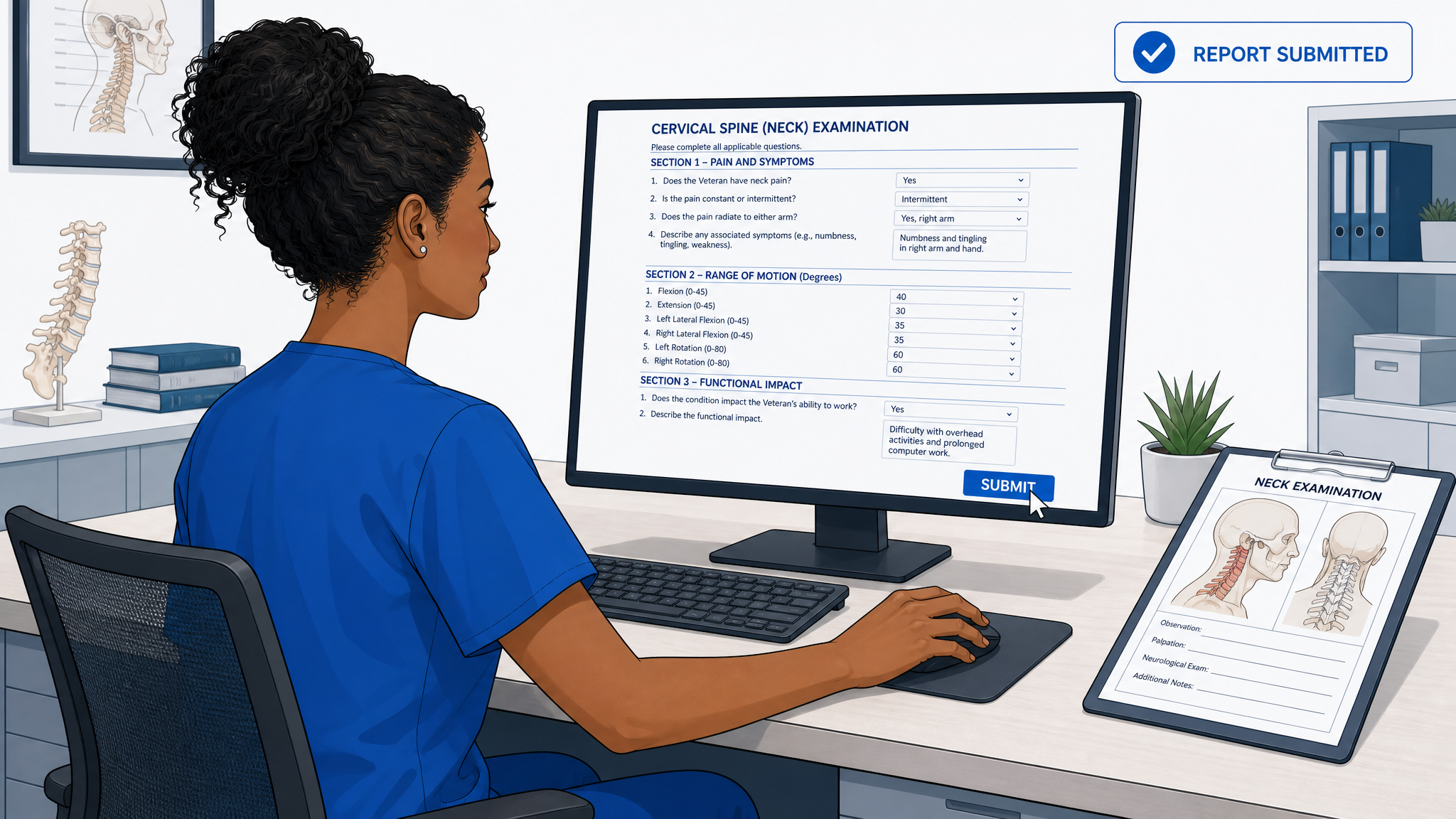
The examiner writes and submits the report
Days 1–5 after the exam
The examiner compiles the history, the physical findings, the measurements and any testing into the questionnaire, adds any requested medical opinion, and submits it. Contract vendors typically have a turnaround requirement measured in days, not weeks.
Nothing about your claim moves while this is happening, and nothing you do speeds it up. What matters is that the report is written from notes taken in the room, which is exactly why what you said, and how the examiner recorded it, is already locked in by the time you get to your car. Request your copy now rather than later.

Quality review, and the request for clarification
Days 3–30
The report is reviewed for completeness. If it is internally inconsistent, missing a required field or missing the opinion the VA asked for, it goes back for correction or a second opinion. This is the single most common cause of a claim appearing to stall after the exam.
Understand what a finished exam actually means: it means the appointment happened, not that your claim is ready for a decision. If the reviewer finds a blank range-of-motion field, an opinion that does not answer the question that was asked, or findings that contradict each other, the file goes back out for more information. That is a normal quality control step, not a rejection of your claim, and it is not a sign that you did something wrong, but it does add weeks, and it is the reason so much of what you read online sounds like the system is broken.

Your status tracker moves backward, and it is usually not bad news
Any time after the exam
The online tracker shows eight steps. Veterans watch it reach step 7 or 8, then find it back at step 3 or 4 a week later. That regression almost always means one thing: the file went back for additional information, most often a returned or clarified exam.
This is the number one thing veterans panic about, and it is misread constantly. The tracker is not a countdown, it is a location marker. When the VA decides it needs one more piece of evidence, a corrected exam, a clarifying medical opinion or an outstanding record, the claim is routed back to the evidence gathering step and the bar redraws itself where the file physically is. It does not mean a denial. It does not mean your case was thrown out or restarted. It does not erase anything already in the file, and it does not change your effective date. What it does mean is that something in the record was not good enough to decide on yet, which is worth knowing, because if the weak link is the exam, this is the window where a corrective statement or a private opinion from your own doctor does the most good.

Evidence gathering closes
Varies
Before anyone rates your claim, the file has to be built. This is the stretch where the Regional Office pulls together everything the decision will rest on: your service treatment records, your VA medical records, any federal records, the C&P exam report, and any private records it has requested on your behalf. The claim sits here until the VA is satisfied the record is complete enough to decide, which is exactly why a status tracker can appear to stall or slide backward at this step. You are not powerless while it sits here. Anything you put into the file yourself lands the day you send it, and every relevant record you add now is one less thing the rater can later say was missing.
A VA request to a private provider is a letter that may or may not be answered, and the VA will wait on it for weeks before moving on, sometimes without ever getting a response. A record you walk in yourself, or upload through your claim, is in the file the day you send it. So do not sit and wait to be asked. If you know a treatment record, an imaging report, a surgical note or a buddy statement exists and it matters, send it now, with a VA Form 21-4138 statement that explains in plain words what the document is and what it shows. This is also the window where a corrective statement or a private medical opinion from your own doctor does the most good, before the rater has locked in a decision, not after. Once the evidence gathering step closes, the file goes to a rating specialist, and your chance to shape the record cheaply and quickly closes with it.

Rating decision and promulgation
Typically several weeks after the last piece of evidence lands
This is the stage where your evidence finally becomes a number. A rating specialist, not the examiner, and not a doctor, takes everything in the file and applies the rating schedule to it: the exam findings, your range-of-motion measurements, your lay statements, your private records and any medical opinions. They assign a diagnostic code to each condition, pull a percentage from the schedule, set your effective date, and either grant, deny or defer each issue. The decision is then reviewed and authorized, promulgation is simply the VA’s word for making it official, and the decision letter and code sheet are generated and mailed. Where an award is made, payment follows the effective date rules, and back pay is calculated to that date.
Read the code sheet, not just the percentage. It names the diagnostic code used, the exact measurements relied on and the effective date assigned, and that is where most mistakes live. This is a human being reading a file under a production quota, and the two things that go wrong most often are a rater using the pre-repetition range-of-motion numbers instead of the worst-case figures §4.59 and §4.40 require, and a claimed condition being decided on a thin record or quietly left out. Check whether painful motion was accounted for, whether your radiculopathy was rated separately under Note (1) or folded into the spine rating, and whether every condition you claimed was actually addressed. A decision you do not read is a decision you cannot challenge, and the deadline to challenge it starts the day the letter is dated, not the day you understand it.
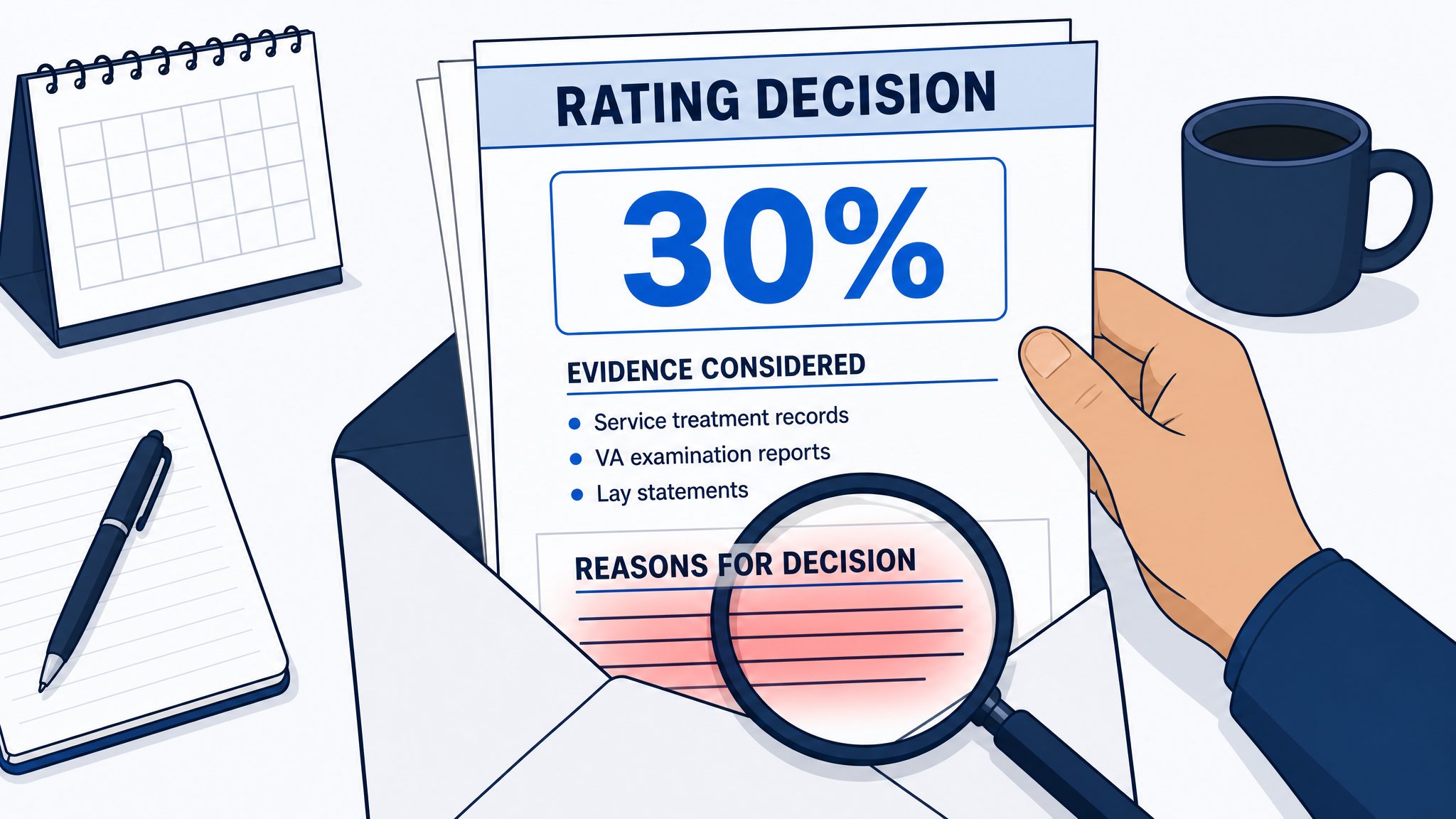
C&P examination is the decision letter
The day it lands in your mailbox
The envelope holds two different documents: the narrative decision letter, and the code sheet. Together they are the single most important piece of paper in your claim, because every deadline, every appeal option and every dollar of back pay is set by what is printed on them, not by what you were told at the exam.
Most veterans read one thing on that letter: the percentage. Then they either celebrate it or get angry at it, and file it in a drawer. That is the mistake. The percentage is the conclusion; the reasons section is the reasoning, and the reasoning is what you attack. It tells you which diagnostic code the rater used, which range-of-motion figures they relied on and which they ignored, whether painful motion under §4.59 was accounted for, whether your neurological findings were rated separately under Note (1) or folded into the spine rating, which conditions were decided, which were deferred, and which were never addressed at all. It also assigns your effective date, which controls back pay. A rating that looks low is very often not a disagreement about how bad your neck is, it is a rater who used the pre-repetition numbers, or missed the radiculopathy, or rated one side and not both. You cannot see any of that from the percentage. Do not go by the percentage alone, and do not decode it by yourself if you are not sure what you are looking at, have someone who reads these for a living read it with you before the clock runs out. You have one year from the date on that letter to file a Higher-Level Review (VA Form 20-0996), a Supplemental Claim (VA Form 20-0995) or a Board appeal, and the deadline runs from the date printed on the letter, not the date you opened it. Bring it to this office and we will go through it line by line, at no cost, and tell you plainly whether it is right.
What normal looks like: 30 to 60 days for a simple claim, longer for a complex one
After your exam you should expect some kind of notification from the VA, a decision, a request for more information, or a notice that another exam has been scheduled. For a straightforward, single-issue claim that often lands within 30 to 60 days. But 30 to 60 days is a rough guide, not a rule, and it is not a ceiling. A claim with several conditions, a toxic-exposure or presumptive question, a returned exam, or missing records routinely takes 90 days or more, and that alone does not mean anything is wrong, the more moving parts your case has, the longer the VA takes to work it. Inside the window that is normal for a case like yours, silence is expected and there is nothing to fix, and a tracker that jumps backward is normal too.
What matters is not a fixed number of days, it is whether the claim is still moving and whether you can get a straight answer about where it is. Once you are well past what is normal for a case like yours and the VA either goes silent or cannot tell you what the claim is waiting on, stop waiting. That is usually where the real trouble hides, an exam that came back twice, a records request that was never answered, a claimed condition that got dropped, or a file sitting in the wrong queue. Call the VA at 800-827-1000, ask specifically what the claim is waiting on and who it is assigned to, and write down the answer. If you cannot get a straight answer, or the answer tells you the exam is the problem, that is the moment to bring it to this office rather than sitting on it for another three months. Problems raised early get fixed inside the claim. Problems discovered in a denial letter get fixed on appeal, and that costs you a year.
Other things that control the clock
Six things decide how long you wait, and none of them are visible from the tracker alone.

The average is a moving number
Check it at the source, not second-hand
The VA publishes an average days-to-complete figure for disability claims that moves month to month; check the current number on the VA’s own claim status page rather than relying on any second-hand figure. In practice, most veterans see a decision somewhere between roughly three and eight months from the date the claim was filed, with the exam usually falling in the middle of that window.
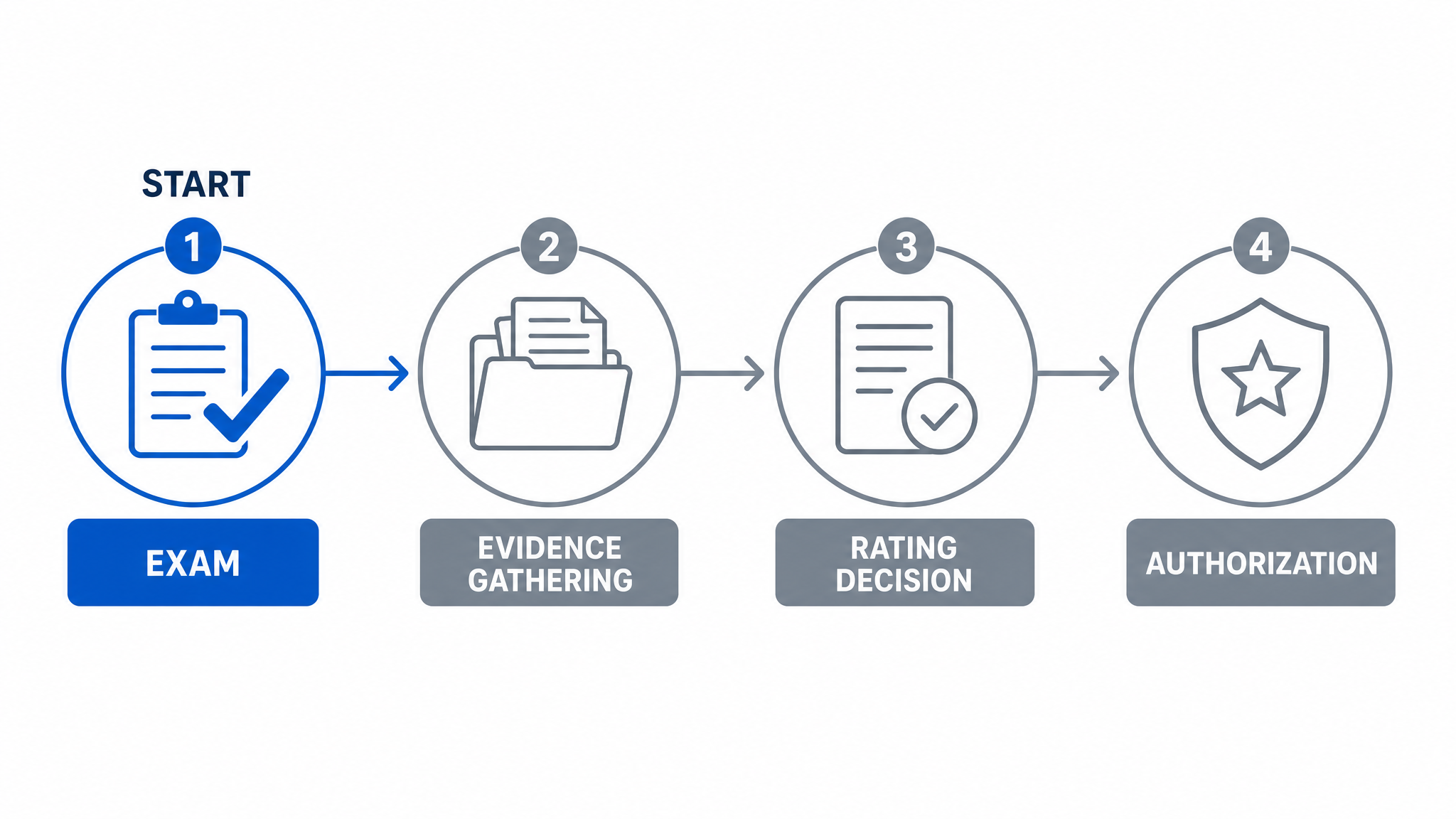
The exam is not the last step
Three stages still sit in front of you
The exam is not the last step. The clock does not start at the exam and it does not stop there either, the claim still has to clear evidence gathering, the rating decision and authorization.
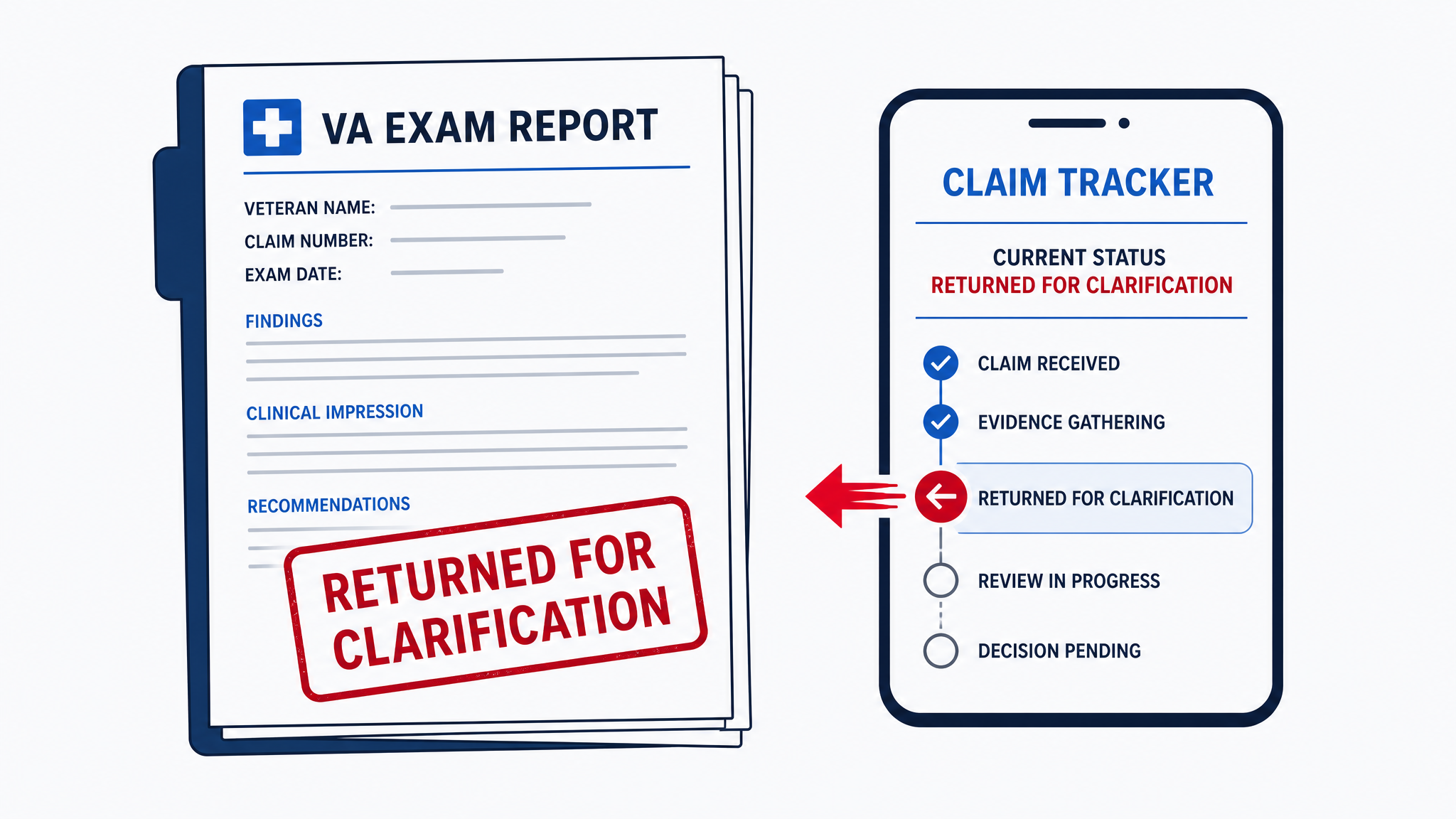
A returned exam is the invisible delay
The reason a tracker slides backward
A returned or clarified exam is the most common invisible delay, and it is why a tracker can slide backward. Expect some contact from the VA within 30 to 60 days of the exam. Past 60 days with nothing at all, call and ask specifically what the claim is waiting on.
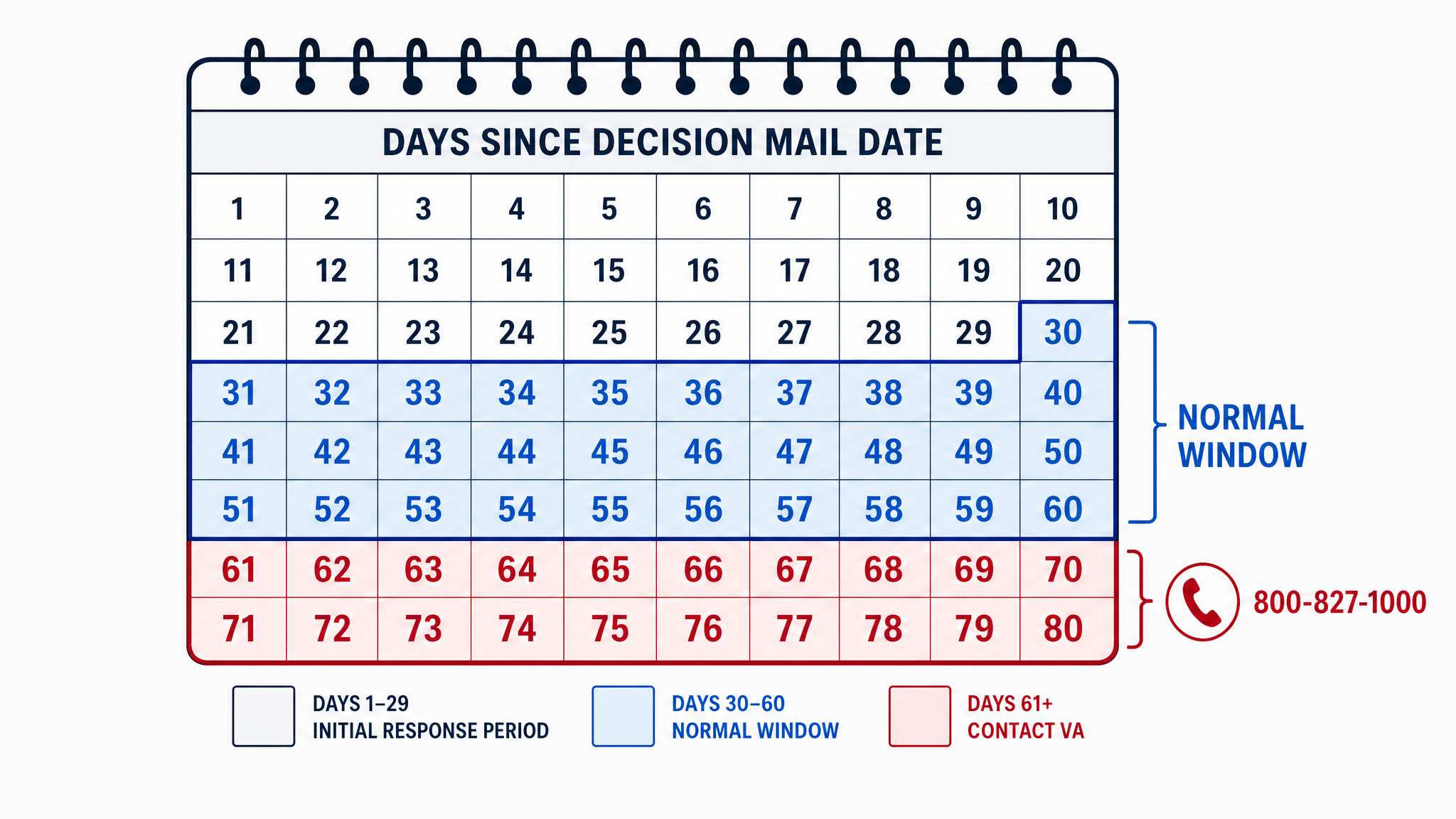
30 to 60 days is a guide, not a deadline
A complex case can take 90 days or more
Thirty to sixty days is a rough average for a simple, single-issue claim, not a hard rule and not a ceiling. A claim with several conditions, a presumptive or toxic-exposure question, a returned exam, or missing records can easily take 90 days or more, and that alone does not mean anything is wrong. Watch whether the claim is still moving, not the calendar. Only when it stalls well past what is normal for a case like yours, and no one can tell you what it is waiting on, should you stop waiting, call 800-827-1000 and ask what the claim is waiting on and who it is assigned to.
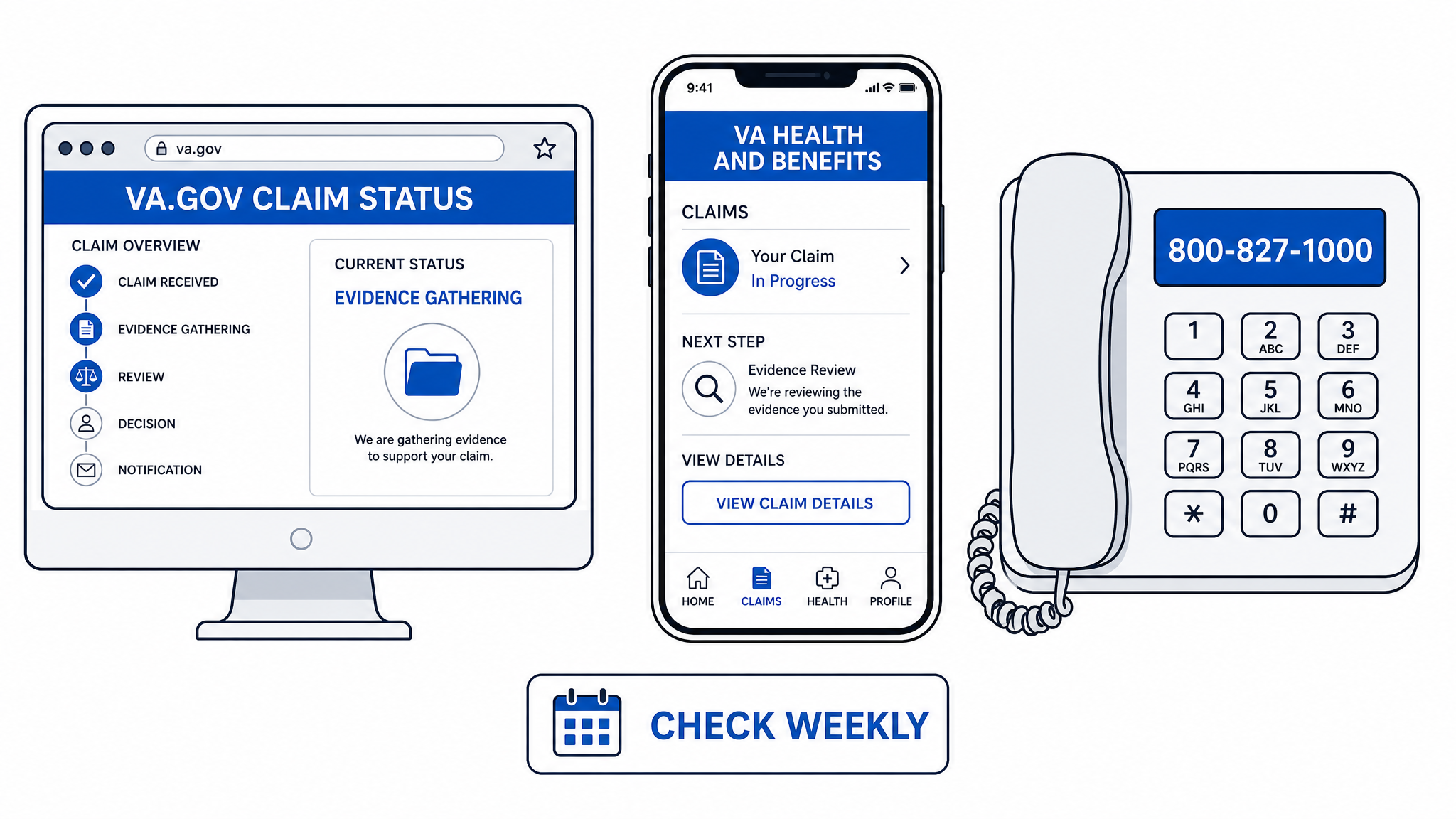
Watch your status yourself, in one of three places
Weekly, not daily
Check your own status in one of three places: your VA.gov claim status page, the VA Health and Benefits mobile app, or by calling 800-827-1000. Check it weekly, not daily. And understand exactly what a status check can tell you: if a decision is posted in your account, it is live; if it is not posted, it is not ready. That is the whole rule. This is not something your representative or your attorney can speed up, we see the same thing you see, at the same time, and calling us to ask does not move it. Calling the VA to ask for an update does not move it either. Watch it yourself, weekly, and the moment a decision posts, bring it to us.
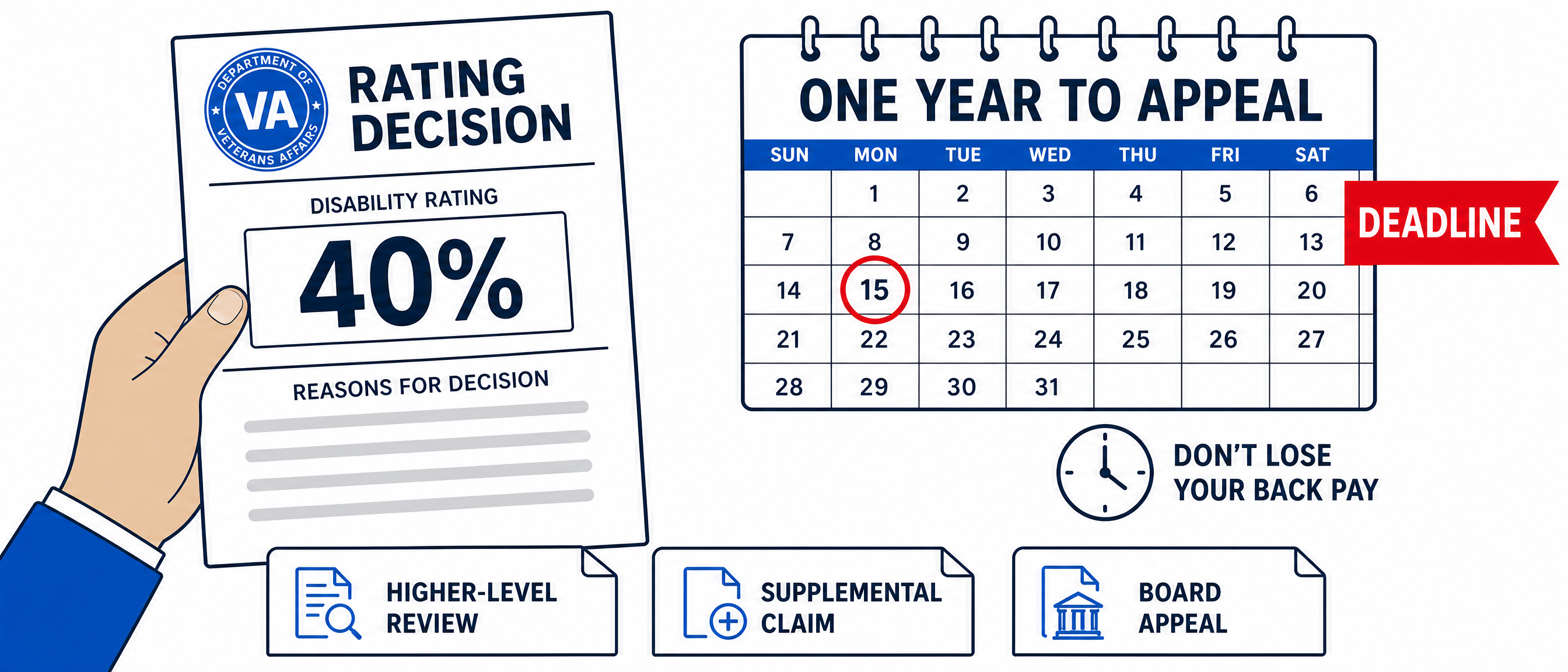
Your decision letter arrives, read it, then start the appeal clock
What to do the day it lands in your mailbox
The decision letter is the finish line of the claim and the starting line of the appeal, and the moment it arrives, a one-year clock starts running. Read it the same day. Find the combined rating, the percentage assigned to each condition, and the effective date, because the effective date controls how far back your back pay reaches. Then request a copy of your C&P exam report so you can see whether the rater used your real range-of-motion numbers or ignored the radiculopathy. If any part of the decision is wrong, a low rating, a denied condition, or a bad effective date, you have three appeal lanes, and you must choose one within one year of the date printed on the letter: a **Higher-Level Review (VA Form 20-0996)**, where a senior reviewer re-decides on the same evidence; a **Supplemental Claim (VA Form 20-0995)**, when you have new and relevant evidence such as a private DBQ or your own range-of-motion exam; or a **Board Appeal (VA Form 10182)** to a Veterans Law Judge. Miss that one-year deadline and the decision becomes final. You can still file again later, but you lose the original effective date, and that lost time is lost back pay you never get back. Bring the letter to this office before the year runs out and we will read it with you, line by line, at no cost.
07Remedy
How to report a bad exam
Where this exam goes wrong
The biggest trap in a cardiac claim is the **estimated METs without a stress test**. If the examiner skips the treadmill test and estimates your METs based on a brief interview, without documenting a specific medical reason why testing was contraindicated, the resulting number may be higher than your actual functional capacity, and the exam may be inadequate. The second trap is **not having a current echocardiogram**: your ejection fraction is an independent criterion that can set your rating at 60% or 100% regardless of your METs, but if the most recent echo in the record is from years ago, the examiner uses the old number. The third trap is **underreporting symptoms**: saying "I get tired sometimes" does not translate into a specific METs estimate. You must describe the exact activity that triggers symptoms and the exact point at which you must stop. The fourth trap is **missing the presumptive path**: if you have qualifying herbicide exposure and IHD, the service connection is automatic, no nexus letter needed. Veterans who do not know about §3.309(e) waste years fighting for direct or secondary connection when the presumptive would have been immediate.

Write it down the moment you get to your car
Date, start time, end time, the examiner’s name and credentials, the vendor, every test that was performed, and every test that was not. A contemporaneous note written the same day is evidence. A memory reconstructed four months later is not.
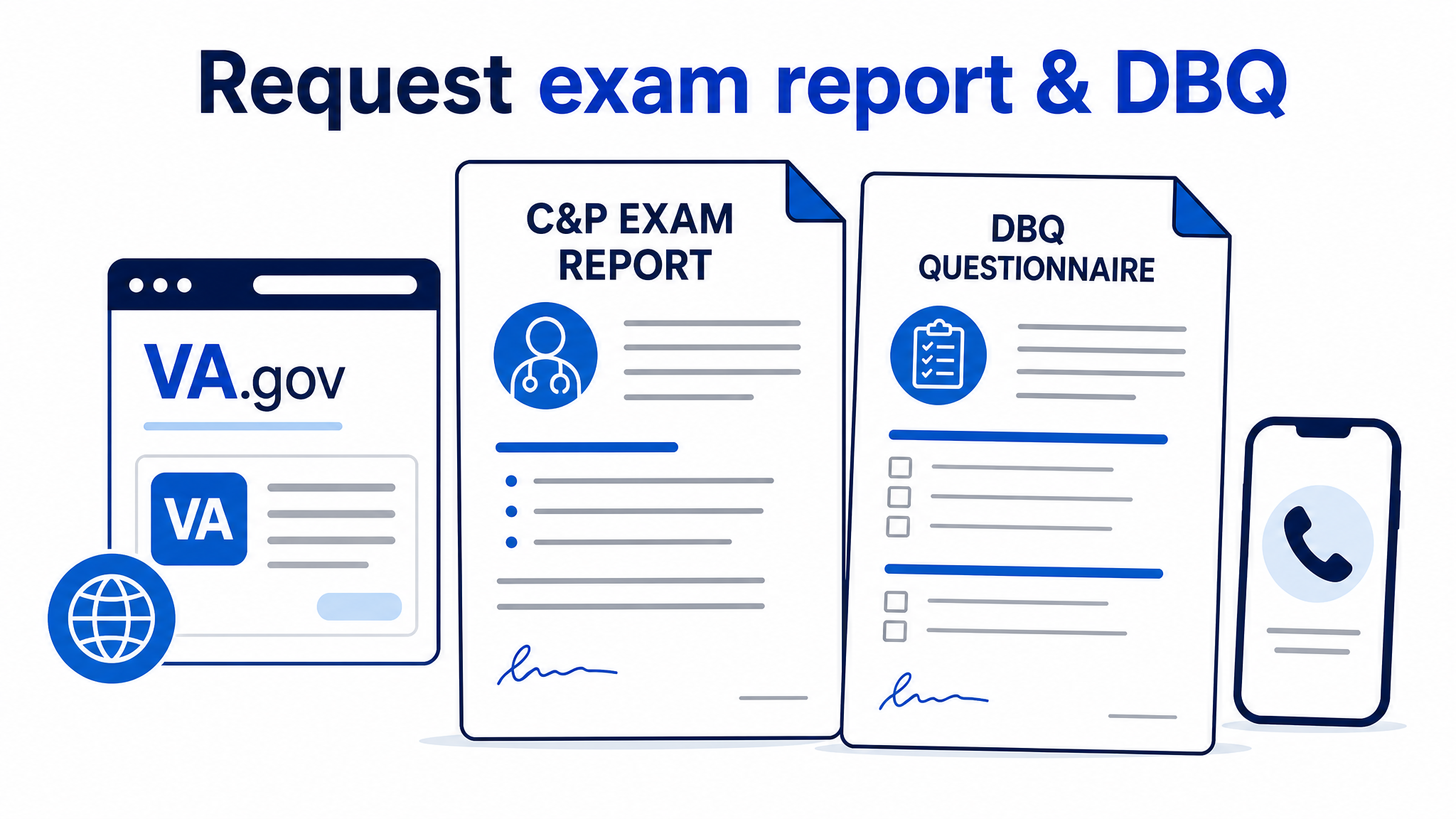
Get the exam report and the questionnaire
Request a copy through VA.gov, through a written request to the Regional Office, or by calling 800-827-1000. You cannot challenge what you have not read. Compare it line by line against what actually happened in the room.

Name the defect specifically, with the citation
Never write "the exam was unfair." Write "no goniometer was used, contrary to 38 CFR §4.46" or "flare-ups were reported and not addressed, contrary to Sharp v. Shulkin" or "repetitive use testing was not performed, contrary to 38 CFR §4.40 and DeLuca." A specific, citable defect is what forces action.
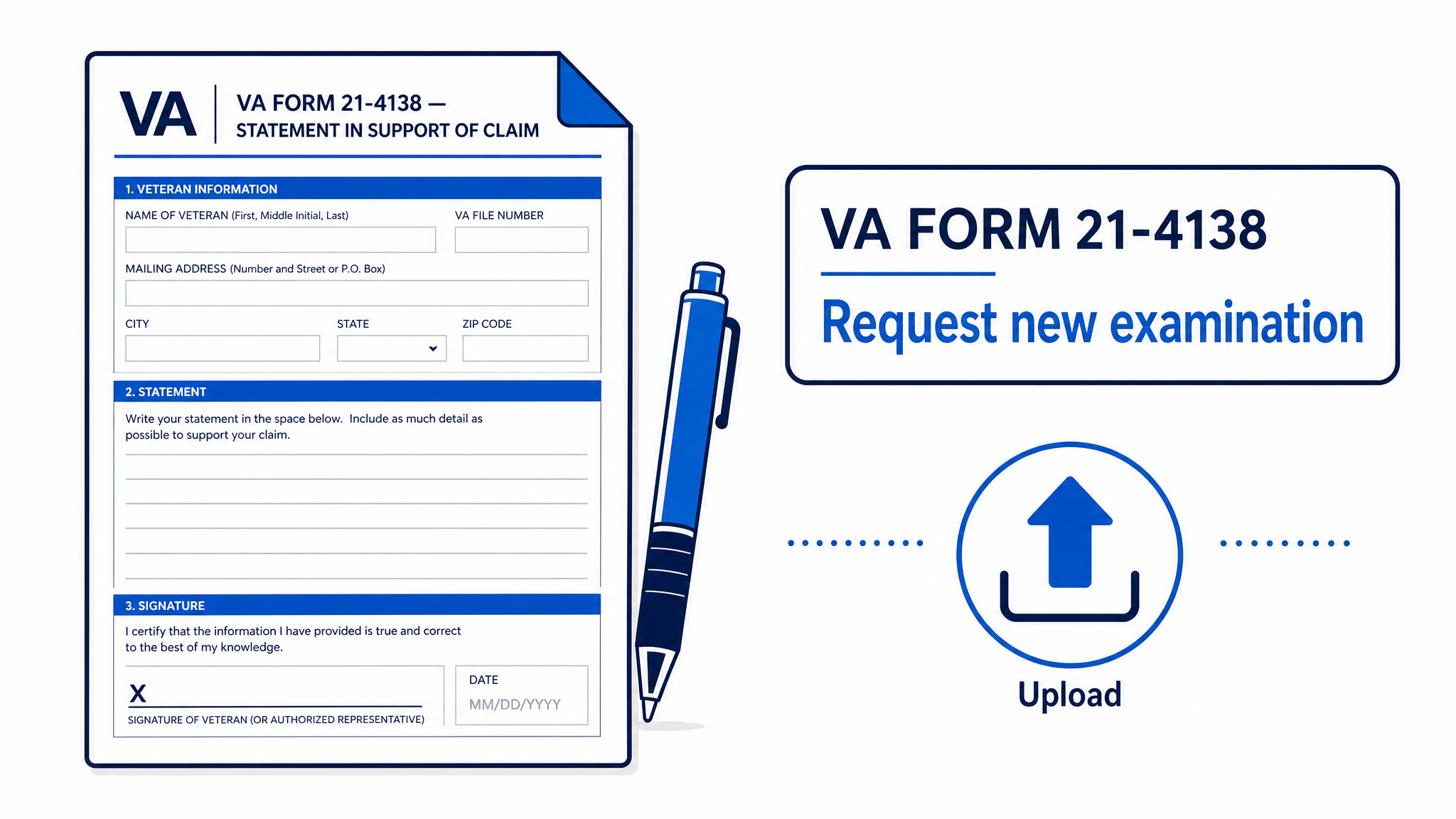
Submit a statement asking for a new examination
VA Form 21-4138, Statement in Support of Claim, filed through VA.gov or mailed to the Evidence Intake Center. State the defect, cite the authority, and request a new or supplemental examination. Do this BEFORE the decision if the claim is still open, it is far easier than undoing a decision afterward.
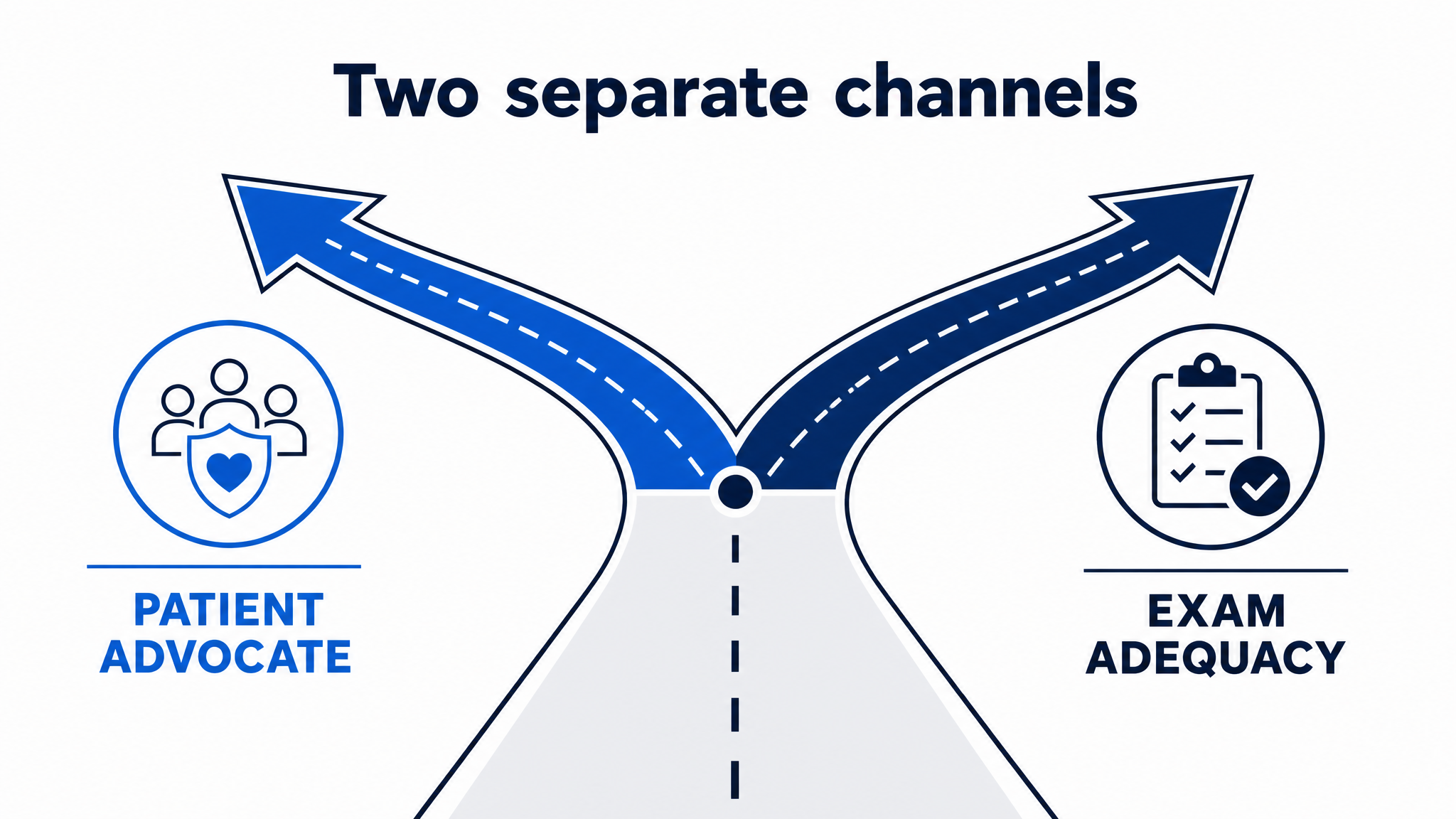
Report examiner conduct separately
If the problem is behavior rather than methodology, you were rushed out, dismissed, never touched, or treated with hostility, file a complaint with the VA facility’s Patient Advocate, or with the vendor directly for a contract exam, and copy the Regional Office. Conduct complaints and adequacy challenges are two different tracks and you can run both.

If a decision has already issued, pick the right lane
A Higher-Level Review (VA Form 20-0996) argues the VA erred on the evidence it had, the right vehicle when the exam was inadequate on its face. A Supplemental Claim (VA Form 20-0995) is the vehicle when you are adding new and relevant evidence, such as your own private range-of-motion examination or a completed DBQ from your treating provider.
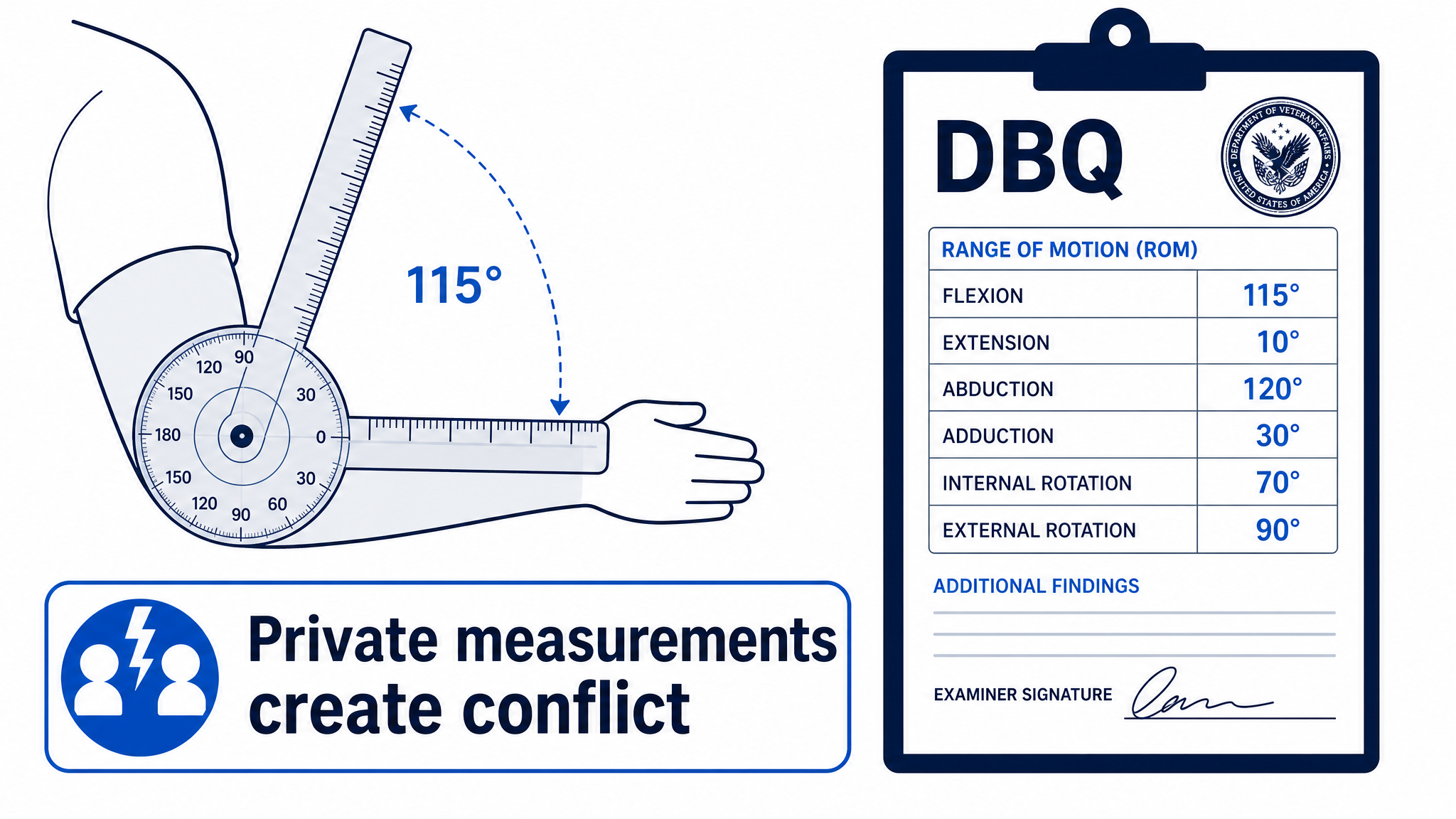
Put your own measurements on the table
A private examination with full goniometric measurements, or a DBQ completed by your own provider, creates a conflict in the evidence that the VA has to resolve, and under 38 CFR §3.102 reasonable doubt is resolved in your favor.
End of clinical section
CAD / Ischemic Heart Disease (DC 7005), DC 7005
See It Before You Sit In The Room
VA Disability Ratings for Heart Disease, What You Need to Know
Hill & Ponton
Coronary Artery Disease VA Rating Explained, METs, Ejection Fraction & Tips
Veteran HQ
The Questions Veterans Actually Ask
CAD / Ischemic Heart Disease (DC 7005) Claims, Frequently Asked Questions
Straight answers to the questions that decide cad / ischemic heart disease (dc 7005) claims, the ratings, the separate evaluations, and the exam mistakes that cost veterans money. Read every answer with your own file open. If an answer depends on a record you do not have yet, that is the next thing to request, from your doctor, your unit or the VA itself.
CAD / Ischemic Heart Disease (DC 7005) is evaluated under DC 7005. The scale runs across 4 rating levels, and the highest is 100%, which the VA assigns for: chronic congestive heart failure; or a workload of 3 METs or less results in dyspnea, fatigue, angina, dizziness, or syncope; or left ventricular dysfunction with an ejection fraction of less than 30 percent. Where your evaluation actually lands depends on how your exam and records document those criteria, not on how bad the condition feels on an average day.
Every condition in Cardiovascular Conditions