
Kidney & Renal Conditions
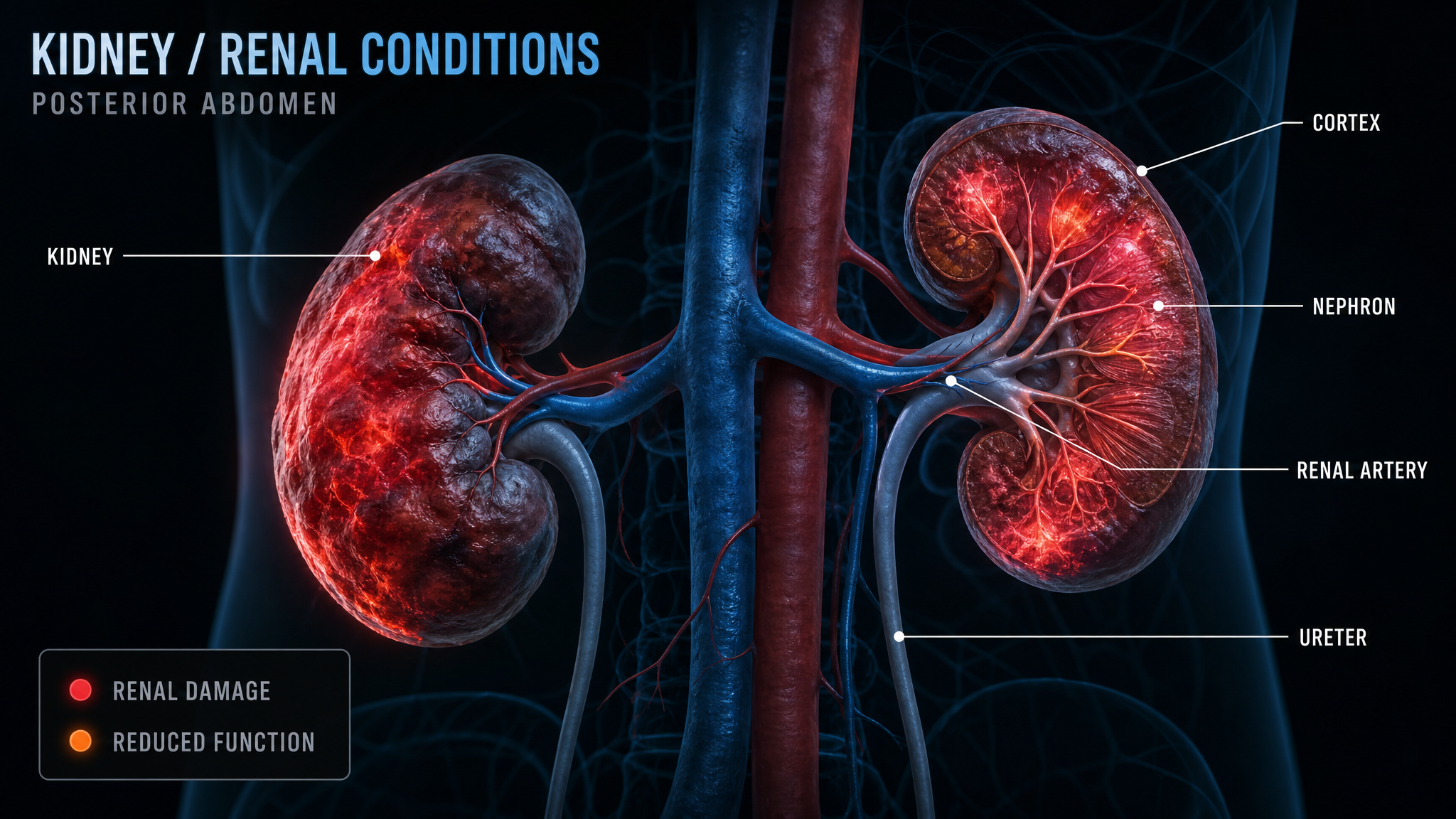
Kidneys that can no longer filter the blood properly, driving up blood pressure, swelling and fatigue.
Kidney disease is one of the few conditions in the rating schedule that is scored on lab values, not symptoms. Creatinine, BUN, eGFR, proteinuria, and blood pressure drive the entire evaluation under §4.115a, which means a claim with current bloodwork and urinalysis in the file is far stronger than one built on how you feel. It is also rarely a standalone claim: chronic kidney disease usually flows from service-connected diabetes or hypertension, and under §3.310 that makes it service-connected too. At the dialysis stage, it is a 100 percent rating.
The Diagnostic Codes
Conditions Rated In Kidney & Renal Conditions
These are the codes the VA will actually stamp on a decision in this group. The code you are granted under decides which formula is used, and that decides your percentage. Chronic kidney disease is rated on renal dysfunction under §4.115a, driven by lab values like creatinine, BUN, and eGFR. It is very commonly secondary to service-connected diabetes or hypertension, and dialysis warrants 100 percent. is highlighted below.
Before Anything Gets Rated
What The VA Is Actually Looking For, And What Service Connection Really Means
Before the VA ever opens the rating schedule, it asks one question: is this disability the government’s responsibility? That is what “service connection” means. It is not a diagnosis, it is not sympathy, and it is not a reward for having served. It is a legal finding that a current, diagnosed disability is linked to something that happened to you in uniform. Percentages come later. If service connection is not established, there is nothing to rate and the claim is denied, no matter how bad the chronic kidney disease is rated on renal dysfunction under §4.115a, driven by lab values like creatinine, bun, and egfr. it is very commonly secondary to service-connected diabetes or hypertension, and dialysis warrants 100 percent. is.

For Chronic kidney disease is rated on renal dysfunction under §4.115a, driven by lab values like creatinine, BUN, and eGFR. It is very commonly secondary to service-connected diabetes or hypertension, and dialysis warrants 100 percent. Specifically
The VA rates chronic kidney disease under §4.115a using objective lab values, specifically creatinine, BUN, eGFR, and proteinuria, not how sick you feel. The rater needs a formal CKD diagnosis with a stage (CKD Stage 1–5) written by a physician, tied either to an in-service event (nephrotoxic exposure, combat injury, acute kidney injury during service) or, far more commonly, secondary to already service-connected diabetes mellitus or hypertension under §3.310. M21-1, Part III, Subpart iv, Chapter 4, Section I (Genitourinary Disabilities) requires the rater to pull current lab work and blood pressure readings to assign the correct rating under DC 7530–7541, without those numbers in the file, the rater has nothing to anchor a rating to. If you are on dialysis, the rating is automatically 100 percent under DC 7541, full stop.
The three elements the VA must find. All three. Every time.
These come out of Caluza v. Brown and Shedden v. Principi, and they are the checklist a rating officer works through on your file. Miss one and the claim fails on that element alone.
A current, diagnosed disability
A doctor has to have written a diagnosis in a medical record, chronic kidney disease stage 3 secondary to diabetic nephropathy, hypertensive nephrosclerosis with reduced eGFR, or end-stage renal disease requiring hemodialysis. Symptoms by themselves are not a disability the VA can rate. Saunders v. Wilkie held that pain causing functional impairment can be a disability, but you still need a clinician to document it as diagnosed and impairing. The diagnosis must exist now, during the claim period, not only years ago.
An in-service event, injury, illness or aggravation
Something in service had to have happened, an injury, an exposure, a documented sick call, or steady wear over a career. It does not have to be one dramatic moment and it does not have to be spelled out in your service treatment records: buddy statements, unit records, performance evaluations and your own competent lay testimony can establish it.
A medical nexus linking the two
A qualified medical opinion that says the current diagnosis is at least as likely as not related to the in-service event. That phrase matters: at least as likely as not means 50 percent or better. Under 38 C.F.R. §3.102, when the evidence is evenly balanced, the benefit of the doubt goes to you and the claim must be granted.
The five ways service connection is established
Most veterans only know the first one. The other routes are lower-effort paths to the same grant, and the secondary route is the one most often left on the table.
Direct, 38 C.F.R. §3.303(a)
The injury or disease began in service and never went away. The classic route: three elements, one nexus opinion.
Chronicity and continuity, §3.303(b)
A chronic condition shown in service, plus continuity of the same symptoms from separation to now, can establish the link without a formal nexus opinion. Your own testimony about symptoms you can observe is competent evidence.
Presumptive, §3.307 and §3.309
Certain chronic diseases are presumed service connected if they manifest to a compensable degree within a set window after separation. You do not have to prove causation at all.
Secondary, §3.310(a) and (b)
A disability proximately due to, or aggravated by, an already service-connected condition is itself service connected. This is how service-connected diabetes mellitus type II or service-connected hypertension causing CKD, and CKD itself then driving secondary anemia (DC 7700 under §4.117), secondary hypertension that is now harder to control, and peripheral neuropathy from uremic buildup, get on the rating sheet get on the rating sheet.
Aggravation of a pre-service condition, §3.306
If you entered service with a condition and service made it permanently worse, the increase is compensable. The VA must rebut the presumption of soundness by clear and unmistakable evidence, a bar it frequently fails to meet.
VA medical care, 38 U.S.C. §1151
An additional disability caused by VA treatment, surgery, or a failure to diagnose is compensated as if it were service connected.
The bottom line, there is no way around this
No diagnosis, no rating. It has to be chronic. It has to cause impairment.
Without a diagnosis, the VA will not rate your claim.
The VA cannot rate 'kidney problems' or 'poor kidney function', the file must contain a physician-documented diagnosis of chronic kidney disease with a CKD stage or specific diagnostic code condition (nephritis, nephrosis, nephrosclerosis, etc.) matching DC 7530–7541. Veterans lose this element when their records show abnormal labs but no treating physician ever wrote the formal diagnosis. An abnormal creatinine alone is not a ratable disability, the diagnosis has to be in the record.
The condition must be chronic.
CKD is by definition a chronic condition, kidney damage persisting for three months or more with structural or functional abnormalities, but the VA still needs a documented treatment history showing the condition has continued since the nexus event or since the primary service-connected condition (diabetes, hypertension) was established. Veterans who were diagnosed once and then lost to follow-up create gaps that raters use to question continuity. Serial lab results and ongoing nephrology or primary care notes are what lock in chronicity.
It must cause actual impairment.
Impairment under §4.115a is measured entirely by lab thresholds and dialysis status, not by fatigue or swelling, a veteran with significant symptoms but lab values that fall below a rating threshold gets rated at the lower level or zero percent regardless of how debilitating the condition feels. The zero-percent trap hits veterans with early-stage CKD (Stage 1–2) whose creatinine and eGFR have not yet crossed the rating schedule's cutoffs; they are service-connected but receive no compensation until the numbers deteriorate. Under §4.1 and §4.10, the rating must reflect actual functional impairment, but for renal disease the schedule ties that impairment directly to the lab values.
What this means for you before you file: Before you file, get current bloodwork, eGFR, creatinine, BUN, urinalysis with protein, and a formal CKD stage documented by your treating physician. If your kidney disease flows from service-connected diabetes or hypertension, line up a nexus opinion that explicitly invokes §3.310 secondary service connection. Under Sharp v. Shulkin, the examiner cannot dismiss flare-up impact without a reasoned explanation. Esteban v. Brown confirms separate ratings for instability (DC 5257), limitation of flexion (DC 5260), and limitation of extension (DC 5261), do not accept a single rating when the regulation mandates separate evaluations.
The Percentages
The Rating Schedule, Spelled Out
Kidney conditions are rated under 38 CFR §4.115a (renal dysfunction) and the specific genitourinary codes in §4.115b (7530–7541). The predominant problem, renal dysfunction or voiding dysfunction, controls the rating. The renal dysfunction formula below carries the highest evaluations, including the 100 percent level for regular dialysis.

100%
Requires regular dialysis; or precludes more than sedentary activity from persistent edema and albuminuria; or BUN more than 80 mg%; or creatinine more than 8 mg%; or markedly decreased function of the kidney or other organ systems. This is the dialysis-stage rating and the clearest path to a total evaluation.
80%
Persistent edema and albuminuria with BUN 40 to 80 mg%, or creatinine 4 to 8 mg%; or generalized poor health characterized by lethargy, weakness, anorexia, weight loss, or limitation of exertion.
60%
Constant albuminuria with some edema; or definite decrease in kidney function; or hypertension that is at least 40 percent disabling under Diagnostic Code 7101.
30%
Albumin constant or recurring with hyaline and granular casts or red blood cells; or transient or slight edema; or hypertension that is at least 10 percent disabling under Diagnostic Code 7101.
0%
Albumin and casts with a history of acute nephritis; or hypertension that is noncompensable under Diagnostic Code 7101. A noncompensable rating still establishes service connection and preserves the path to a higher evaluation as kidney function declines.
Service Connection
Advice from the Advocate
This is where I stop explaining the rules and tell you how I would build your Chronic kidney disease is rated on renal dysfunction under §4.115a, driven by lab values like creatinine, BUN, and eGFR. It is very commonly secondary to service-connected diabetes or hypertension, and dialysis warrants 100 percent. claim if you were sitting across my desk. Read the causation notes below twice. The VA will not connect the dots for you, even though 38 CFR 3.159 says it has a duty to assist. Your job is to put the in-service event, the current diagnosis and the medical link on paper, then make the examiner deal with all three.
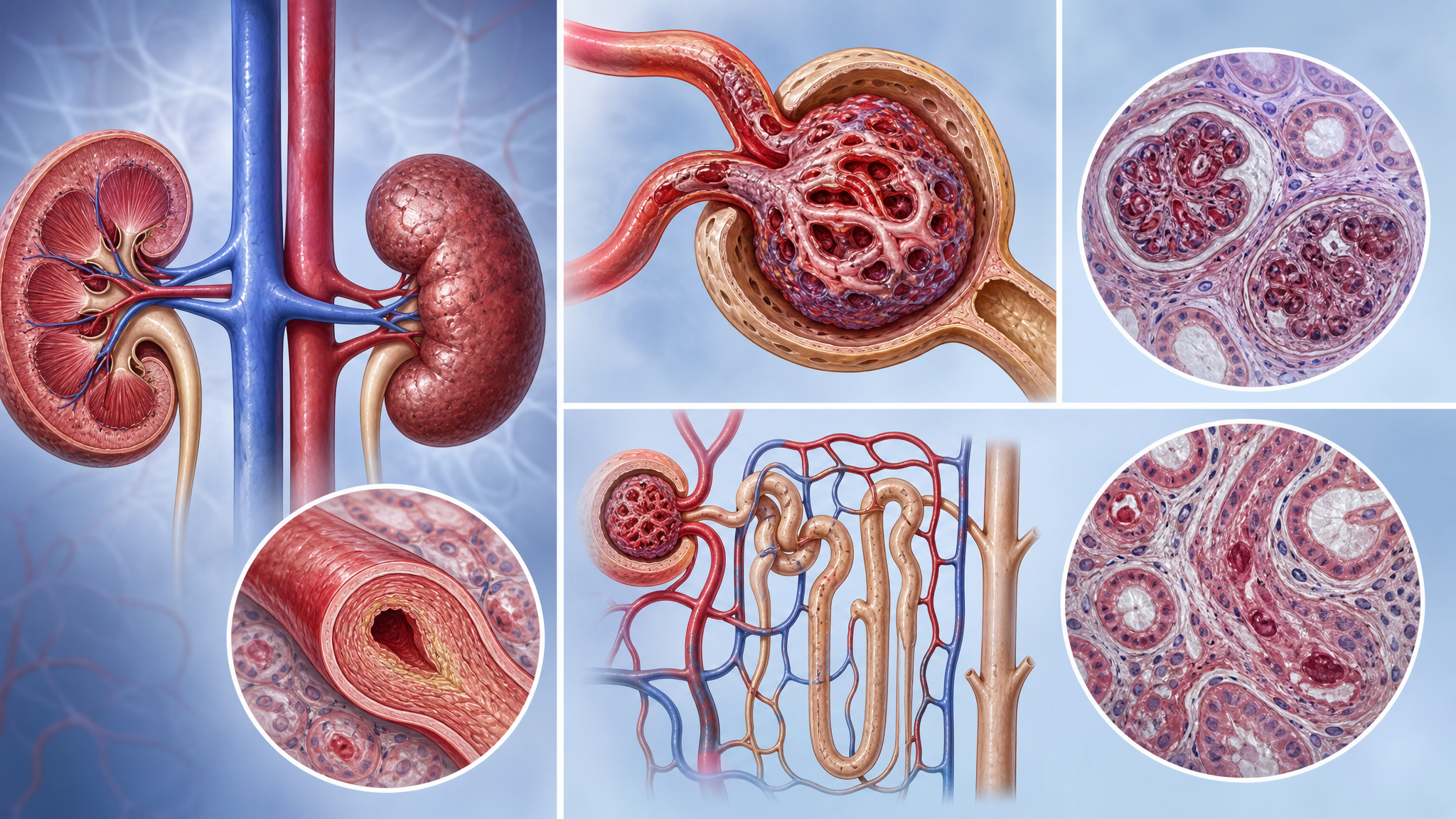
The advocate's notes on causation, Chronic kidney disease is rated on renal dysfunction under §4.115a, driven by lab values like creatinine, BUN, and eGFR. It is very commonly secondary to service-connected diabetes or hypertension, and dialysis warrants 100 percent.
The separate arguments that decide this code: where the VA will attack, the regulation that answers it, and the evidence that closes the gap.
1Secondary to Diabetes (§3.310)
The most common pathway. Diabetes damages the glomeruli and small blood vessels of the kidney, producing diabetic nephropathy, the leading cause of end-stage renal disease. The nexus opinion should document the duration and severity of the diabetes, the presence of proteinuria and declining eGFR, and state that the kidney disease is at least as likely as not caused or aggravated by the service-connected diabetes mellitus.
2Secondary to Hypertension (§3.310)
Long-standing high blood pressure damages the renal arteries and accelerates loss of kidney function (hypertensive nephrosclerosis). The nexus should tie the veteran's service-connected hypertension to the decline in renal function shown in the labs, and address whether the kidney disease has in turn worsened the blood pressure, a two-way relationship the rater must understand.
3Toxic Exposure, Camp Lejeune and Others
Contaminated water at Camp Lejeune, solvents, and heavy-metal exposures have recognized links to renal disease. Where the veteran served in a qualifying location and period, the nexus should connect the documented exposure to the current kidney diagnosis under the direct service-connection framework.
4Hypertension Arising From the Kidney Condition
Kidney disease itself frequently causes or worsens hypertension. Where the renal condition is service-connected, the resulting hypertension is separately claimable under §3.310, and the interplay between the two raises the overall evaluation. The nexus should document that the blood pressure elevation followed and flows from the renal dysfunction.
5Aggravation Theory (§3.310(b))
Even if a kidney condition pre-existed service connection of the primary disability, aggravation beyond its natural baseline by a service-connected condition is compensable. The opinion must establish the baseline severity of the renal function before aggravation and the current, worsened severity attributable to the service-connected diabetes or hypertension.
Exposure & Aggravation
Secondary Service Connection, The Diabetes and Hypertension Pathway

The VA wants an in-service event, and most veterans think that means one dramatic injury. It does not. Years of duty that wore the body down count too, and under 38 CFR 3.306 a condition service made worse can still be connected. Find yourself in the list below, then put that duty in writing with dates, units and names. The board only weighs what you put on paper.
How veterans pick this up in uniform, Chronic kidney disease is rated on renal dysfunction under §4.115a, driven by lab values like creatinine, BUN, and eGFR. It is very commonly secondary to service-connected diabetes or hypertension, and dialysis warrants 100 percent.
Chronic kidney disease is overwhelmingly a secondary condition. The two most common drivers are diabetes and hypertension, both frequently service-connected, diabetes often as an Agent Orange presumptive. Under 38 CFR §3.310, a kidney condition caused or aggravated by a service-connected disability is itself service-connected. Diabetes damages the small blood vessels and filtering units (glomeruli) of the kidney, producing diabetic nephropathy; hypertension damages the renal arteries and accelerates the loss of function. Veterans already rated for diabetes or high blood pressure routinely have unclaimed renal ratings, because the kidney decline shows up in lab values the veteran never sees and the VA will not raise the secondary claim for them. Toxic exposures, including Camp Lejeune contaminated water, provide a direct service-connection pathway in appropriate cases.
- Diabetes mellitus (the leading cause of chronic kidney disease; frequently service-connected as an Agent Orange presumptive or direct condition)
- Hypertension (the second leading cause of kidney disease; a very common service-connected condition that damages renal blood vessels over time)
- Toxic water and chemical exposure, Camp Lejeune contaminated water, solvents, and heavy metals linked to renal disease
- Burn pit and airborne hazard exposure associated with kidney and other organ-system damage
- Recurrent kidney infections or stones with origins during service
- Medications taken long-term for service-connected conditions that stress kidney function (certain NSAIDs and others)
- Cardiovascular disease that reduces blood flow to the kidneys
Who is most prone to it
Veterans with service-connected diabetes mellitus or hypertension are at the highest risk for chronic kidney disease, these are the two leading causes of renal failure, and both are frequently service-connected. Diabetes is often established as an Agent Orange presumptive, and hypertension is one of the most common service-connected conditions. Toxic exposures during service, contaminated water, solvents, heavy metals, and burn pit smoke, have also been linked to kidney disease. Because renal decline is gradual and driven by lab values the veteran may never see, kidney involvement often goes unclaimed for years while the underlying diabetes or hypertension is already rated.
The Symptoms
What Chronic kidney disease is rated on renal dysfunction under §4.115a, driven by lab values like creatinine, BUN, and eGFR. It is very commonly secondary to service-connected diabetes or hypertension, and dialysis warrants 100 percent. Actually Feels Like
Read this list the way the examiner will. Every symptom you live with but never report is a symptom the VA treats as if it does not exist. The rating schedule pays for how Chronic kidney disease is rated on renal dysfunction under §4.115a, driven by lab values like creatinine, BUN, and eGFR. It is very commonly secondary to service-connected diabetes or hypertension, and dialysis warrants 100 percent. affects your daily life and your work, so the details matter. Check off what matches your day, tell your doctor in those words, and make sure it lands in your treatment record before the exam.

- Persistent fatigue and low energy as waste products build up in the blood
- Swelling (edema) in the legs, ankles, and feet from fluid retention
- Increased or decreased urination, especially frequent nighttime urination
- Nausea, loss of appetite, and unintended weight loss in advancing disease
- Muscle weakness, cramps, and generalized poor health
- Shortness of breath from fluid overload
- Difficulty concentrating and sleep disturbance as kidney function declines
- High blood pressure that is difficult to control
How this one is rated
Renal dysfunction under 38 CFR §4.115a, an objective, laboratory-driven formula. The evaluation is built on serum creatinine, BUN, eGFR, proteinuria (albumin and casts), the presence and degree of edema, blood pressure control, generalized health decline, and whether the veteran requires regular dialysis. Specific kidney diseases carry their own diagnostic codes (7530–7541), but when renal dysfunction is the predominant problem the condition is rated on that formula.
What you are measured against
The examiner and the rater compare the veteran's current lab work against the renal dysfunction thresholds: creatinine of 4 to 8 mg% and BUN of 40 to 80 mg% define the 80 percent level, while creatinine above 8 mg% or BUN above 80 mg%, or the need for regular dialysis, define 100 percent. Persistent edema and albuminuria, definite decrease in kidney function, and hypertension rated under Code 7101 fill in the lower and middle levels. Because the criteria are numbers, current and complete bloodwork and urinalysis in the file are decisive.
Each One On Its Own Page
Secondary Conditions, Aggravated or Caused by a Current Service-Connected Condition
Under 38 CFR §3.310(a), a disability that is proximately due to a service-connected condition is service-connected in its own right, and under §3.310(b), so is any additional disability caused when a service-connected condition aggravates a problem you already had. Each condition below is a separate evaluation with its own diagnostic code and its own percentage. They do not fold into the chronic kidney disease is rated on renal dysfunction under §4.115a, driven by lab values like creatinine, bun, and egfr. it is very commonly secondary to service-connected diabetes or hypertension, and dialysis warrants 100 percent. rating, they stack on top of it. A veteran who claims only the primary condition leaves these ratings on the table.

Depression Secondary to Chronic Illness (§3.310)
Chronic kidney disease, particularly at the dialysis stage, frequently causes or worsens depression and anxiety as the veteran confronts a life-altering, progressive illness and the demands of treatment. These mental health conditions are separately claimable as secondary to the service-connected renal disease under §3.310. The veteran should document the emotional impact, any mental health treatment sought because of the kidney disease, and any worsening of existing depression attributable to the diagnosis and its treatment burden.

Diabetes Mellitus as the Primary Driver (§3.310)
Diabetes is the single most common cause of chronic kidney disease, damaging the glomeruli and small blood vessels that filter the blood (diabetic nephropathy). Veterans with service-connected diabetes, including Agent Orange presumptives, who develop declining kidney function have a clear secondary pathway. The nexus requires documenting the duration and severity of the diabetes, the presence of proteinuria and falling eGFR, and the temporal relationship between diabetes progression and renal decline.

Hypertension, Both Cause and Consequence (§3.310)
High blood pressure and kidney disease drive each other. Long-standing service-connected hypertension damages the renal arteries and accelerates loss of function; failing kidneys in turn raise blood pressure. Either direction supports a secondary claim under §3.310, and the interplay raises the overall evaluation. The veteran should document blood pressure control over time and any statement from a nephrologist connecting the hypertension and the renal decline.
Accredited Claims Agent #45147
Ready To Get This Rated Correctly?
You have read how the VA rates Chronic kidney disease is rated on renal dysfunction under §4.115a, driven by lab values like creatinine, BUN, and eGFR. It is very commonly secondary to service-connected diabetes or hypertension, and dialysis warrants 100 percent.. Now the question is whether your file proves it. We represent veterans on a No Win, No Fee basis: 20% Direct-Pay paid by the VA from back pay, or 30% High-Complexity, and you owe nothing for representation if your rating does not increase. If you only need the roadmap, the Mission 5 Brief is a separate $750 flat fee. You bring the records, we build the argument.
Kidney & Renal Conditions, In Detail
Kidney & Renal Conditions, Service Connection In Depth
Here is each claimable condition in this group on its own terms, what it is, what service did to it, and what the VA requires before it will connect it.

Kidney & Renal Conditions
Kidney disease is one of the few conditions in the rating schedule that is scored on lab values, not symptoms. Creatinine, BUN, eGFR, proteinuria, and blood pressure drive the entire evaluation under §4.115a, which means a claim with current bloodwork and urinalysis in the file is far stronger than one built on how you feel. It is also rarely a standalone claim: chronic kidney disease usually flows from service-connected diabetes or hypertension, and under §3.310 that makes it service-connected too. At the dialysis stage, it is a 100 percent rating.
You are reading this page now
The C&P Exam
What To Expect At The Chronic kidney disease is rated on renal dysfunction under §4.115a, driven by lab values like creatinine, BUN, and eGFR. It is very commonly secondary to service-connected diabetes or hypertension, and dialysis warrants 100 percent. Exam
This is the encounter your rating is built on. The examiner has a checklist and a limited window, what follows is exactly what happens in that room, so none of it surprises you.
Clinical Section, What To Expect at the Exam
The Kidney & Renal C&P Examination
A veteran's guide to the renal exam, an exam without current labs in the file is an exam that cannot produce a rating
Renal claims are rated under 38 CFR §4.115a on renal dysfunction, and unlike most of the schedule the criteria are laboratory values and blood pressure readings rather than symptoms. Creatinine, BUN, eGFR, proteinuria, and diastolic pressure are the evidence. A renal exam without current labs in the file is an exam that cannot produce a rating. The exam must accomplish two things: document the current level of renal dysfunction against the §4.115a thresholds, and, where the kidney disease flows from diabetes or hypertension, establish the secondary nexus under §3.310.
Condition
Chronic kidney disease is rated on renal dysfunction under §4.115a, driven by lab values like creatinine, BUN, and eGFR. It is very commonly secondary to service-connected diabetes or hypertension, and dialysis warrants 100 percent., §4.115a, DC 7530–7541
Governing questionnaire
Kidney Conditions (Nephrology) DBQ
Click the form number to open the official questionnaire on VA.gov.
01In The Room
What happens during the exam
The tests and maneuvers for this condition
- Serum creatinine and blood urea nitrogen (BUN)
- Estimated glomerular filtration rate (eGFR)
- Urinalysis with quantified proteinuria and microscopic examination for casts
- Multiple blood pressure measurements
- Renal ultrasound or other imaging to identify the underlying disease
- Fasting glucose and HbA1c where diabetes is the claimed primary condition
What gets measured, and to what number
Serum creatinine
The headline renal value, 4 to 8 mg% defines the 80 percent level and above 8 mg% defines 100 percent
Blood urea nitrogen (BUN)
40 to 80 mg% at the 80 percent level and above 80 mg% at 100 percent
Estimated glomerular filtration rate (eGFR)
The standard measure of overall kidney function and disease stage
Urinalysis, albumin and casts
Proteinuria (constant or recurring albuminuria), hyaline and granular casts, and red blood cells
Blood pressure readings
Multiple readings, because persistent hypertension is written into the renal dysfunction levels
Edema assessment
Presence, degree, and persistence, transient or slight versus persistent edema
02Orientation
What to expect during this exam
What makes this exam different from every other C&P exam
1The rating lives in the lab work
This is not an exam where symptoms drive the outcome. The creatinine, BUN, eGFR, and urinalysis values decide the rating. If current labs are not in the file, the examiner cannot place the veteran on the renal dysfunction scale.
2Dialysis is the 100 percent trigger
The single clearest finding is whether the veteran requires regular dialysis, that alone warrants 100 percent. The exam should document the dialysis schedule precisely.
3Edema must be graded, not just noted
The criteria distinguish transient or slight edema from persistent edema. The examiner should document the degree and persistence of any swelling, because it moves the rating between levels.
4The secondary nexus must be stated
Where the kidney disease is claimed secondary to diabetes or hypertension, the causal pathway must be written out, not assumed. The examiner should name the primary condition and state the connection.
5Blood pressure is part of the renal picture
Multiple blood pressure readings matter, because hypertension is written into the renal dysfunction levels and because kidney disease and hypertension drive each other.
See it before you sit in the room
03Preparation
Know your symptoms and secondary factors
What the report must actually say about chronic kidney disease is rated on renal dysfunction under §4.115a, driven by lab values like creatinine, bun, and egfr. it is very commonly secondary to service-connected diabetes or hypertension, and dialysis warrants 100 percent., §4.115a, dc 7530–7541
- "I am on dialysis three times a week, here is my treatment schedule."
- "My diabetes has been service-connected for years, and my kidney numbers have been getting worse ever since the neuropathy started."
- "My ankles and legs stay swollen, it does not go away, and I get short of breath from the fluid."
- "My blood pressure has been service-connected, and my nephrologist told me the high pressure is what damaged my kidneys."
Pain level, frequency, lost work and functional loss, how to say them

Persistent Fatigue and Generalized Poor Health
The 80 percent level is written around “generalized poor health characterized by lethargy, weakness, anorexia, weight loss, or limitation of exertion.” Documenting profound fatigue in the veteran's own words supports that level alongside the lab values.
Describe how the fatigue limits what you can do in a day, not in general terms. Can you finish tasks you used to complete easily? Do you need to rest after minimal exertion? Concrete limitation is stronger evidence than “I feel tired.”
"I am exhausted all the time, I have to rest after the smallest tasks and I have lost my appetite and dropped weight."

Swelling and Fluid Retention (Edema)
The renal dysfunction criteria distinguish transient or slight edema from persistent edema, the difference moves the rating between levels. The veteran's account of constant, non-resolving swelling supports the higher finding.
Note whether the swelling goes away with rest and elevation or stays constant, which limbs are affected, and whether it comes with shortness of breath from fluid overload. Persistence is the key detail the examiner must capture.
"My ankles and legs stay swollen all the time, pressing on them leaves a dent, and it does not go down even when I keep them up."

Changes in Urination
Frequent nighttime urination and changes in urine output are early markers of declining kidney function and support the overall clinical picture the examiner documents alongside the urinalysis findings.
Describe the pattern, how many times you wake at night, whether output has increased or decreased, and any foaming (a sign of proteinuria). These details connect the symptom account to the lab findings of albumin in the urine.
"I am up four or five times a night to urinate, and my doctor says there is protein in my urine."

Nausea, Loss of Appetite, and Weight Loss
These are the constitutional findings the 80 percent level lists as “generalized poor health.” As waste products build up, appetite falls and weight drops, documenting this supports the higher renal dysfunction evaluation.
Note how much weight you have lost and over what period, whether food makes you nauseous, and whether you have had to change your diet. Unintended weight loss is a specific criterion the examiner should record.
"Food makes me nauseous and I have lost weight without trying, I just do not have an appetite anymore."

Weakness and Limitation of Exertion
“Limitation of exertion” is written directly into the 80 percent renal dysfunction level. The veteran's account of muscle weakness and inability to exert supports that finding and connects the fatigue to functional loss.
Describe specific activities you can no longer sustain, stairs, walking a distance, carrying groceries, and whether shortness of breath from fluid overload limits you further. Tie the weakness to concrete limits.
"I get weak and short of breath doing things I used to do easily, I cannot exert myself the way I could before my kidneys started failing."
Secondary conditions to raise in the same appointment
Every secondary condition laid out in the Secondary Conditions section above belongs in this same appointment. Name each one out loud, tell the examiner how the primary condition caused it or made it worse, and ask that it be noted in the report. Under 38 CFR 3.310, a secondary condition the examiner never hears about is a secondary condition the VA never rates. Bring your list on paper so nothing gets left in the parking lot.
What to expect at this specific exam
- Make sure recent bloodwork, creatinine, BUN, and eGFR, and a urinalysis are in the file; the rating is built on these numbers, not on symptoms
- Bring your dialysis schedule if you are on dialysis, since regular dialysis supports the 100 percent level
- Have documentation of any fluid or diet restriction and required rest, which push the evaluation higher
- If you are diabetic or hypertensive, make sure the exam links the kidney disease to that service-connected condition (§3.310)
- Bring records of edema, weight loss, lethargy, weakness, or loss of appetite, the generalized poor-health findings written into the 80 percent level
- Bring copies of any renal imaging, biopsy results, or history of stones, infections, or surgery
04The Protocol
What procedures are required during the exam
These are not courtesies. Each comes out of the regulation or out of binding case law. Take this list in with you and tick them off as they happen.

01Blood Work, Creatinine, BUN, and eGFR
38 CFR §4.115a, renal dysfunction rated on creatinine, BUN, and kidney function
The single most important part of the renal claim. Serum creatinine and BUN, together with the calculated eGFR, place the veteran on the renal dysfunction scale. Creatinine of 4 to 8 mg% and BUN of 40 to 80 mg% define the 80 percent level; values above those thresholds define 100 percent. These labs must be current and in the file, without them the rating cannot be assigned.
The entire renal dysfunction formula is built on these numbers. An exam without current creatinine, BUN, and eGFR cannot produce a rating no matter how severe the disease.

02Urinalysis, Albumin, Casts, and Proteinuria
38 CFR §4.115a, albuminuria and casts define the lower and middle renal dysfunction levels
A urinalysis quantifies proteinuria (albumin) and identifies hyaline and granular casts and red blood cells, findings written directly into the 0, 30, and 60 percent renal dysfunction levels. Constant or recurring albuminuria with casts supports the 30 percent level; constant albuminuria with some edema supports 60 percent. The specimen and its microscopic examination document the filtering damage the kidneys have sustained.
Proteinuria and casts are explicit criteria in the rating formula. The urinalysis is the second half of the objective evidence, alongside the blood work, that the rater needs.

03Blood Pressure Measurement
38 CFR §4.115a and DC 7101, hypertension incorporated into the renal dysfunction levels
Multiple blood pressure readings are taken because hypertension is written into the renal dysfunction levels, the 30, 60, and 0 percent tiers reference the degree to which blood pressure is disabling under Diagnostic Code 7101. Blood pressure also documents the two-way relationship between kidney disease and hypertension that raises the overall evaluation.
Blood pressure is both a rating criterion within the renal formula and evidence of the hypertension-kidney interplay. A single reading is not enough, the criteria contemplate persistent elevation.

04Dialysis Documentation
38 CFR §4.115a, requires regular dialysis warrants a 100 percent evaluation
Where the veteran requires regular dialysis, the exam must document the treatment schedule precisely, how many sessions per week and for how long. Regular dialysis warrants a 100 percent rating on its own under the renal dysfunction formula, making this the single clearest path to a total evaluation. The dialysis records should be in the file, not merely mentioned.
Regular dialysis is an explicit 100 percent criterion. Documenting the schedule removes any ambiguity about entitlement to the total rating.

05Renal Imaging
38 CFR §3.310, imaging supports the secondary nexus to diabetes or hypertension
Renal ultrasound or other imaging identifies the underlying kidney disease, documents structural changes and kidney size, and captures any history of stones, infections, or prior surgery. Imaging supports the diagnosis behind the renal dysfunction and, where the claim is secondary, helps connect the pattern of damage to diabetes, hypertension, or toxic exposure.
Imaging establishes the underlying disease and the structural basis for the functional decline, strengthening both the diagnosis and the nexus opinion for a secondary claim.
05The Standard
What makes an exam adequate
Read your exam report against these. An exam that fails the standard is legally inadequate, and an inadequate exam is something you challenge rather than accept.
The range of motion has to be MEASURED, not estimated
38 CFR §4.46 states that the use of a goniometer in the measurement of limitation of motion is indispensable in examinations conducted within the Department of Veterans Affairs. An examiner who eyeballs your bend and writes a number has not complied with the regulation. This is the most common defect in a spine exam and it is the easiest one to spot from the chair.
Joints must be tested in every required condition
Under Correia v. McDonald, a joint examination for pain must, wherever possible, record active motion, passive motion, motion in weight-bearing and motion in non-weight-bearing, and where relevant, the range of the opposite undamaged joint. An exam that records one set of numbers and stops is incomplete on its face, and that incompleteness is grounds to challenge it.
Flare-ups have to be addressed, not dodged
Under Sharp v. Shulkin, when a veteran describes flare-ups, the examiner is obligated to estimate the additional loss of motion during a flare based on all the available evidence, including your own account of it. "I cannot opine without resorting to mere speculation" is not automatically acceptable; the examiner has to have actually sought the information first and explained why an estimate is impossible.
Repetitive use and functional loss must be factored in
Sections 4.40 and 4.45, and the DeLuca line of cases, require that pain, weakness, fatigability, incoordination and lack of endurance after repeated use be considered, and expressed in additional degrees of lost motion where that is feasible. Your rating is supposed to reflect what you can do on the fifth repetition and on a bad day, not just the first careful bend of the morning.
Neurological findings must be separately documented
Note (1) to the General Rating Formula requires that any associated objective neurologic abnormality be evaluated separately under an appropriate diagnostic code. If your leg symptoms were mentioned in the narrative but never tested and never assigned, the exam did not do what the schedule requires of it.
The examiner must review the record when the question requires it
Where a medical opinion on cause, aggravation or a secondary relationship was requested, the examiner is expected to review the relevant evidence and give a reasoned explanation. A bare conclusion, "less likely than not related to service" with no reasoning attached, carries little weight, and an opinion with no rationale is challengeable.
The examiner has to be qualified for the body system
The VA may use its own clinicians or a contract vendor. Either way, the examiner is expected to have the competence to evaluate the system being examined. If a spinal exam with a neurological component was performed by someone who never tested a reflex, that is a problem worth raising.
The exam has to be CURRENT
A rating is supposed to reflect your condition now. An exam performed before a documented worsening, or years before the decision, may not support the current evaluation, and you can request a new one on that basis.
06Afterward
What happens after your exam is complete
The examiner writes the report and submits it, it is reviewed for completeness, and only then does the claim move toward a rating decision. Here is what actually controls the clock.

The examiner writes and submits the report
Days 1–5 after the exam
The examiner compiles the history, the physical findings, the measurements and any testing into the questionnaire, adds any requested medical opinion, and submits it. Contract vendors typically have a turnaround requirement measured in days, not weeks.
Nothing about your claim moves while this is happening, and nothing you do speeds it up. What matters is that the report is written from notes taken in the room, which is exactly why what you said, and how the examiner recorded it, is already locked in by the time you get to your car. Request your copy now rather than later.

Quality review, and the request for clarification
Days 3–30
The report is reviewed for completeness. If it is internally inconsistent, missing a required field or missing the opinion the VA asked for, it goes back for correction or a second opinion. This is the single most common cause of a claim appearing to stall after the exam.
Understand what a finished exam actually means: it means the appointment happened, not that your claim is ready for a decision. If the reviewer finds a blank range-of-motion field, an opinion that does not answer the question that was asked, or findings that contradict each other, the file goes back out for more information. That is a normal quality control step, not a rejection of your claim, and it is not a sign that you did something wrong, but it does add weeks, and it is the reason so much of what you read online sounds like the system is broken.

Your status tracker moves backward, and it is usually not bad news
Any time after the exam
The online tracker shows eight steps. Veterans watch it reach step 7 or 8, then find it back at step 3 or 4 a week later. That regression almost always means one thing: the file went back for additional information, most often a returned or clarified exam.
This is the number one thing veterans panic about, and it is misread constantly. The tracker is not a countdown, it is a location marker. When the VA decides it needs one more piece of evidence, a corrected exam, a clarifying medical opinion or an outstanding record, the claim is routed back to the evidence gathering step and the bar redraws itself where the file physically is. It does not mean a denial. It does not mean your case was thrown out or restarted. It does not erase anything already in the file, and it does not change your effective date. What it does mean is that something in the record was not good enough to decide on yet, which is worth knowing, because if the weak link is the exam, this is the window where a corrective statement or a private opinion from your own doctor does the most good.

Evidence gathering closes
Varies
Before anyone rates your claim, the file has to be built. This is the stretch where the Regional Office pulls together everything the decision will rest on: your service treatment records, your VA medical records, any federal records, the C&P exam report, and any private records it has requested on your behalf. The claim sits here until the VA is satisfied the record is complete enough to decide, which is exactly why a status tracker can appear to stall or slide backward at this step. You are not powerless while it sits here. Anything you put into the file yourself lands the day you send it, and every relevant record you add now is one less thing the rater can later say was missing.
A VA request to a private provider is a letter that may or may not be answered, and the VA will wait on it for weeks before moving on, sometimes without ever getting a response. A record you walk in yourself, or upload through your claim, is in the file the day you send it. So do not sit and wait to be asked. If you know a treatment record, an imaging report, a surgical note or a buddy statement exists and it matters, send it now, with a VA Form 21-4138 statement that explains in plain words what the document is and what it shows. This is also the window where a corrective statement or a private medical opinion from your own doctor does the most good, before the rater has locked in a decision, not after. Once the evidence gathering step closes, the file goes to a rating specialist, and your chance to shape the record cheaply and quickly closes with it.

Rating decision and promulgation
Typically several weeks after the last piece of evidence lands
This is the stage where your evidence finally becomes a number. A rating specialist, not the examiner, and not a doctor, takes everything in the file and applies the rating schedule to it: the exam findings, your range-of-motion measurements, your lay statements, your private records and any medical opinions. They assign a diagnostic code to each condition, pull a percentage from the schedule, set your effective date, and either grant, deny or defer each issue. The decision is then reviewed and authorized, promulgation is simply the VA’s word for making it official, and the decision letter and code sheet are generated and mailed. Where an award is made, payment follows the effective date rules, and back pay is calculated to that date.
Read the code sheet, not just the percentage. It names the diagnostic code used, the exact measurements relied on and the effective date assigned, and that is where most mistakes live. This is a human being reading a file under a production quota, and the two things that go wrong most often are a rater using the pre-repetition range-of-motion numbers instead of the worst-case figures §4.59 and §4.40 require, and a claimed condition being decided on a thin record or quietly left out. Check whether painful motion was accounted for, whether your radiculopathy was rated separately under Note (1) or folded into the spine rating, and whether every condition you claimed was actually addressed. A decision you do not read is a decision you cannot challenge, and the deadline to challenge it starts the day the letter is dated, not the day you understand it.
C&P examination is the decision letter
The day it lands in your mailbox
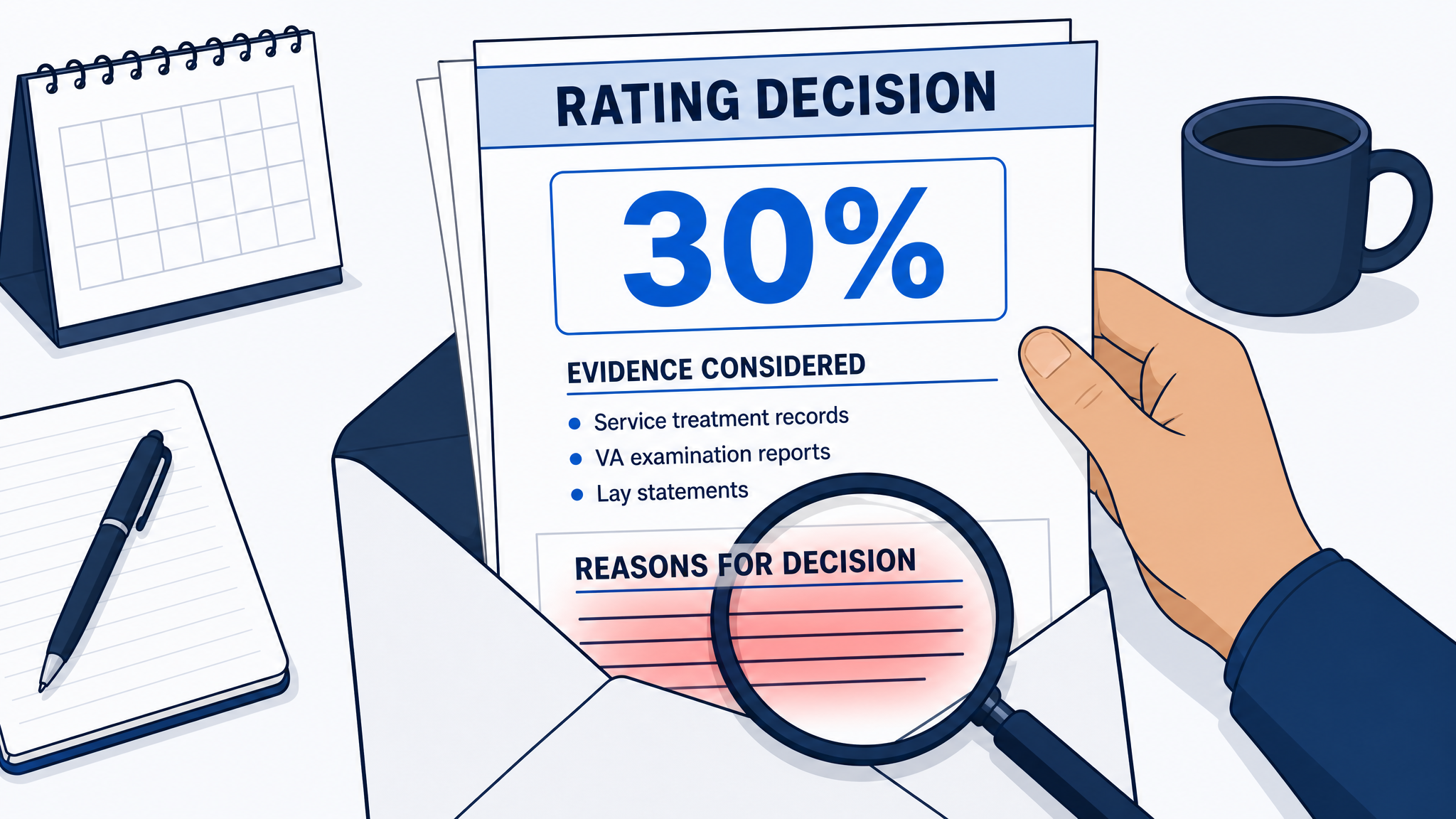
The envelope holds two different documents: the narrative decision letter, and the code sheet. Together they are the single most important piece of paper in your claim, because every deadline, every appeal option and every dollar of back pay is set by what is printed on them, not by what you were told at the exam.
Most veterans read one thing on that letter: the percentage. Then they either celebrate it or get angry at it, and file it in a drawer. That is the mistake. The percentage is the conclusion; the reasons section is the reasoning, and the reasoning is what you attack. It tells you which diagnostic code the rater used, which range-of-motion figures they relied on and which they ignored, whether painful motion under §4.59 was accounted for, whether your neurological findings were rated separately under Note (1) or folded into the spine rating, which conditions were decided, which were deferred, and which were never addressed at all. It also assigns your effective date, which controls back pay. A rating that looks low is very often not a disagreement about how bad your neck is, it is a rater who used the pre-repetition numbers, or missed the radiculopathy, or rated one side and not both. You cannot see any of that from the percentage. Do not go by the percentage alone, and do not decode it by yourself if you are not sure what you are looking at, have someone who reads these for a living read it with you before the clock runs out. You have one year from the date on that letter to file a Higher-Level Review (VA Form 20-0996), a Supplemental Claim (VA Form 20-0995) or a Board appeal, and the deadline runs from the date printed on the letter, not the date you opened it. Bring it to this office and we will go through it line by line, at no cost, and tell you plainly whether it is right.
What normal looks like: 30 to 60 days for a simple claim, longer for a complex one
After your exam you should expect some kind of notification from the VA, a decision, a request for more information, or a notice that another exam has been scheduled. For a straightforward, single-issue claim that often lands within 30 to 60 days. But 30 to 60 days is a rough guide, not a rule, and it is not a ceiling. A claim with several conditions, a toxic-exposure or presumptive question, a returned exam, or missing records routinely takes 90 days or more, and that alone does not mean anything is wrong, the more moving parts your case has, the longer the VA takes to work it. Inside the window that is normal for a case like yours, silence is expected and there is nothing to fix, and a tracker that jumps backward is normal too.
What matters is not a fixed number of days, it is whether the claim is still moving and whether you can get a straight answer about where it is. Once you are well past what is normal for a case like yours and the VA either goes silent or cannot tell you what the claim is waiting on, stop waiting. That is usually where the real trouble hides, an exam that came back twice, a records request that was never answered, a claimed condition that got dropped, or a file sitting in the wrong queue. Call the VA at 800-827-1000, ask specifically what the claim is waiting on and who it is assigned to, and write down the answer. If you cannot get a straight answer, or the answer tells you the exam is the problem, that is the moment to bring it to this office rather than sitting on it for another three months. Problems raised early get fixed inside the claim. Problems discovered in a denial letter get fixed on appeal, and that costs you a year.
Other things that control the clock
Six things decide how long you wait, and none of them are visible from the tracker alone.

The average is a moving number
Check it at the source, not second-hand
The VA publishes an average days-to-complete figure for disability claims that moves month to month; check the current number on the VA’s own claim status page rather than relying on any second-hand figure. In practice, most veterans see a decision somewhere between roughly three and eight months from the date the claim was filed, with the exam usually falling in the middle of that window.
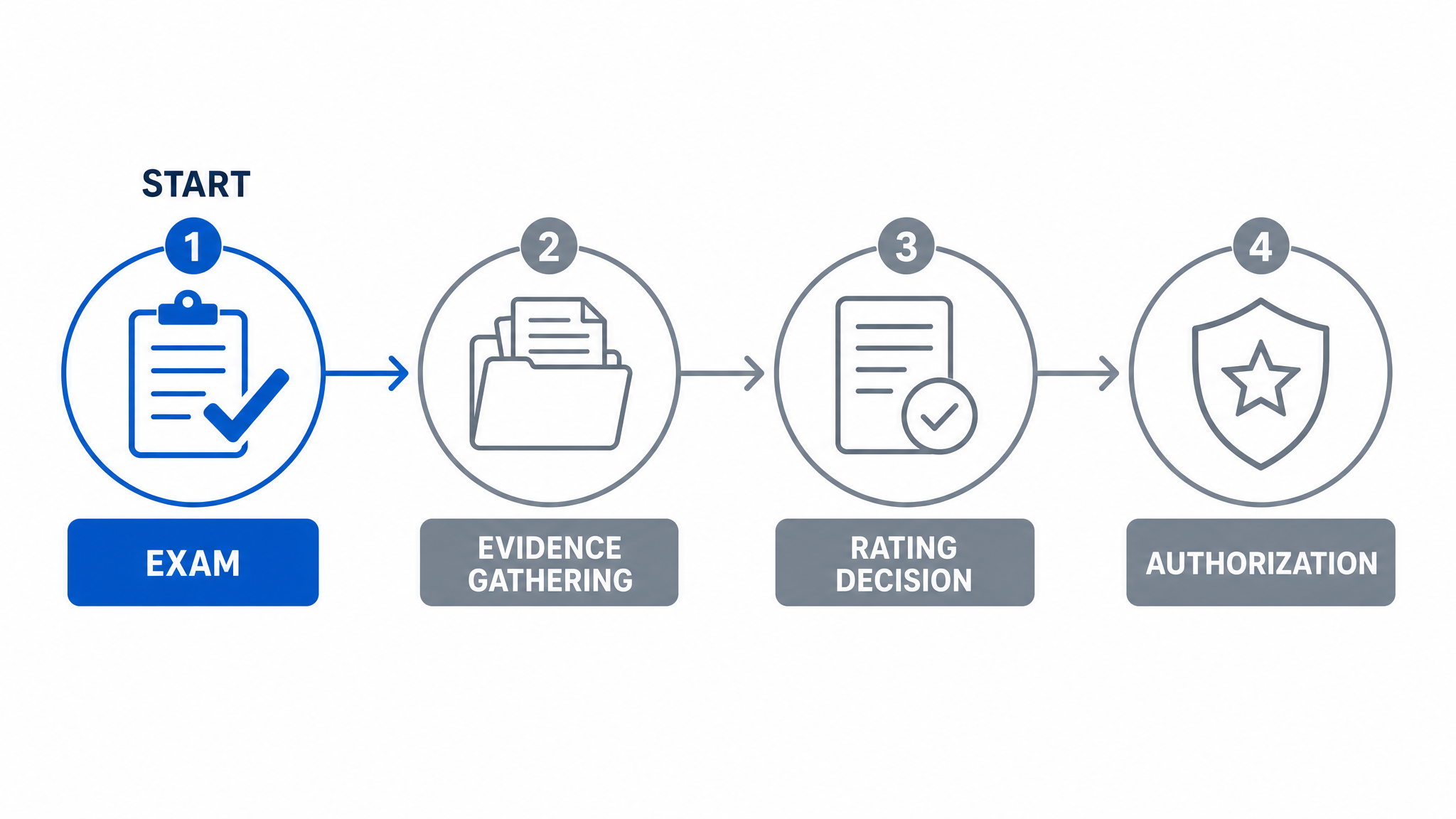
The exam is not the last step
Three stages still sit in front of you
The exam is not the last step. The clock does not start at the exam and it does not stop there either, the claim still has to clear evidence gathering, the rating decision and authorization.
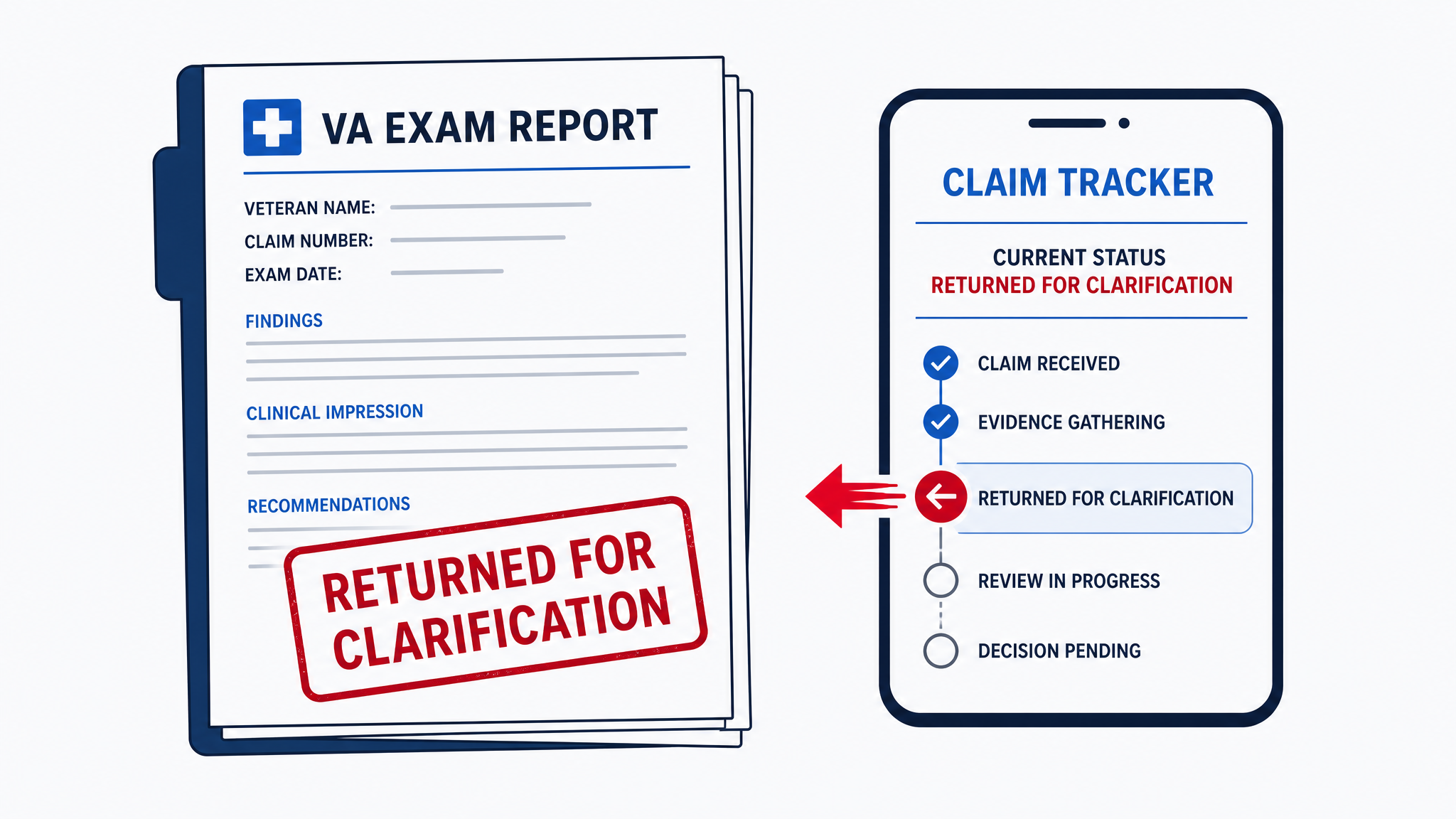
A returned exam is the invisible delay
The reason a tracker slides backward
A returned or clarified exam is the most common invisible delay, and it is why a tracker can slide backward. Expect some contact from the VA within 30 to 60 days of the exam. Past 60 days with nothing at all, call and ask specifically what the claim is waiting on.
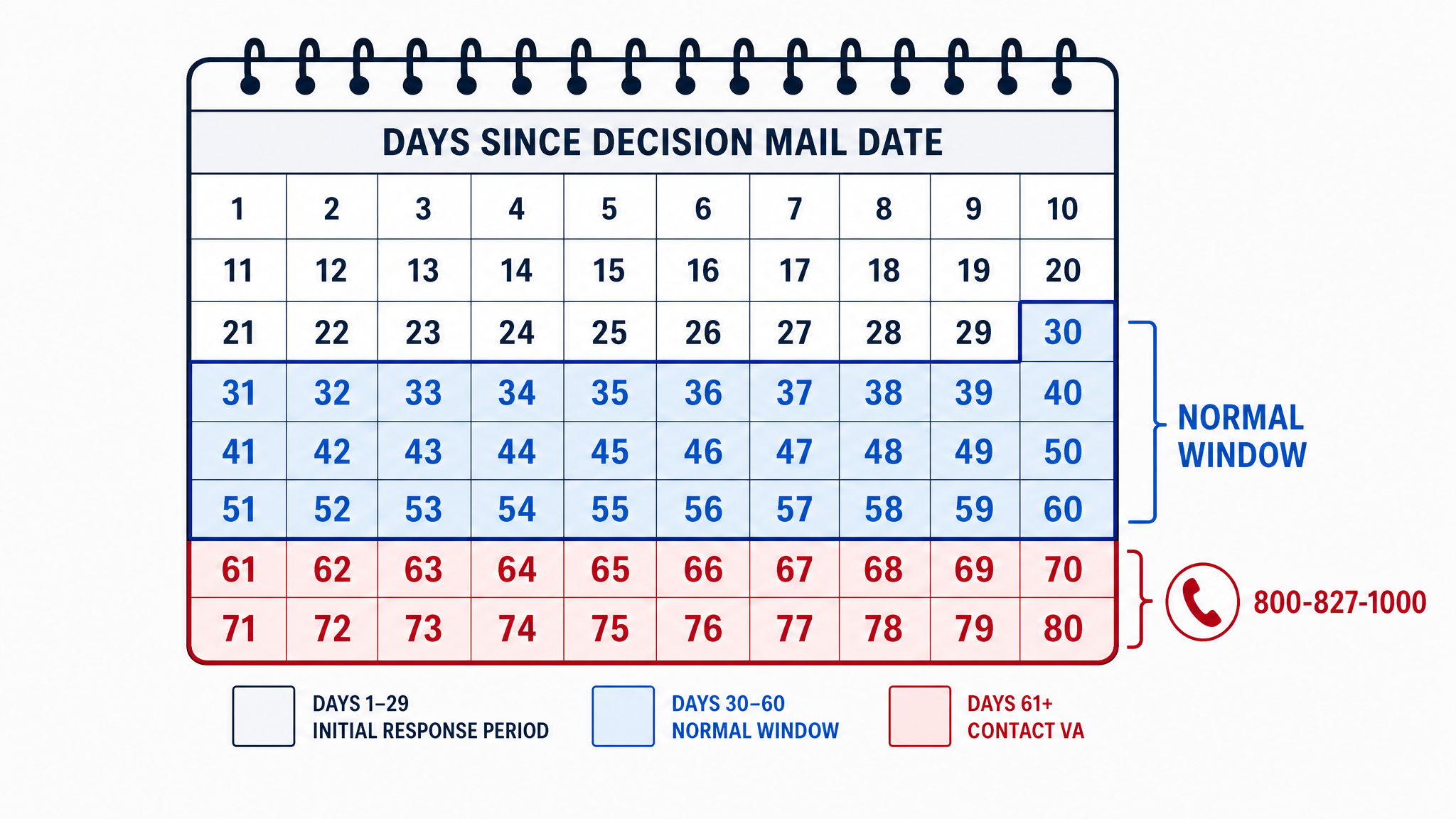
30 to 60 days is a guide, not a deadline
A complex case can take 90 days or more
Thirty to sixty days is a rough average for a simple, single-issue claim, not a hard rule and not a ceiling. A claim with several conditions, a presumptive or toxic-exposure question, a returned exam, or missing records can easily take 90 days or more, and that alone does not mean anything is wrong. Watch whether the claim is still moving, not the calendar. Only when it stalls well past what is normal for a case like yours, and no one can tell you what it is waiting on, should you stop waiting, call 800-827-1000 and ask what the claim is waiting on and who it is assigned to.

Watch your status yourself, in one of three places
Weekly, not daily
Check your own status in one of three places: your VA.gov claim status page, the VA Health and Benefits mobile app, or by calling 800-827-1000. Check it weekly, not daily. And understand exactly what a status check can tell you: if a decision is posted in your account, it is live; if it is not posted, it is not ready. That is the whole rule. This is not something your representative or your attorney can speed up, we see the same thing you see, at the same time, and calling us to ask does not move it. Calling the VA to ask for an update does not move it either. Watch it yourself, weekly, and the moment a decision posts, bring it to us.
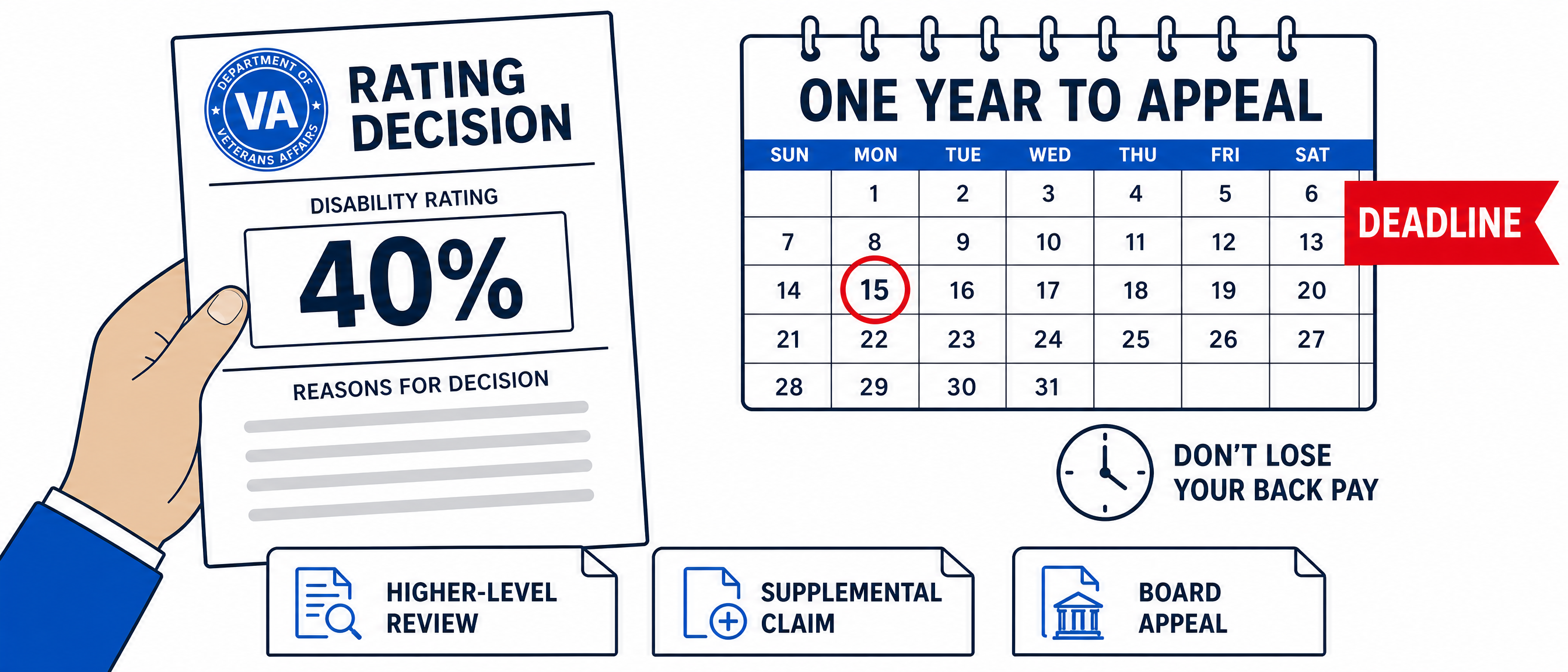
Your decision letter arrives, read it, then start the appeal clock
What to do the day it lands in your mailbox
The decision letter is the finish line of the claim and the starting line of the appeal, and the moment it arrives, a one-year clock starts running. Read it the same day. Find the combined rating, the percentage assigned to each condition, and the effective date, because the effective date controls how far back your back pay reaches. Then request a copy of your C&P exam report so you can see whether the rater used your real range-of-motion numbers or ignored the radiculopathy. If any part of the decision is wrong, a low rating, a denied condition, or a bad effective date, you have three appeal lanes, and you must choose one within one year of the date printed on the letter: a **Higher-Level Review (VA Form 20-0996)**, where a senior reviewer re-decides on the same evidence; a **Supplemental Claim (VA Form 20-0995)**, when you have new and relevant evidence such as a private DBQ or your own range-of-motion exam; or a **Board Appeal (VA Form 10182)** to a Veterans Law Judge. Miss that one-year deadline and the decision becomes final. You can still file again later, but you lose the original effective date, and that lost time is lost back pay you never get back. Bring the letter to this office before the year runs out and we will read it with you, line by line, at no cost.
07Remedy
How to report a bad exam
Where this exam goes wrong
The most common failure in renal exams is an exam performed without current labs in the file, creatinine, BUN, eGFR, and a urinalysis. Without those numbers the examiner cannot place the veteran on the renal dysfunction scale, and the rating defaults low regardless of how sick the veteran is. A second common failure is the omitted secondary nexus: the examiner documents the kidney disease but never links it to the service-connected diabetes or hypertension, leaving the claim without the medical connection required under §3.310. If your exam report does not contain current lab values, or does not name the service-connected condition driving the kidney disease, the exam is inadequate.

Write it down the moment you get to your car
Date, start time, end time, the examiner’s name and credentials, the vendor, every test that was performed, and every test that was not. A contemporaneous note written the same day is evidence. A memory reconstructed four months later is not.

Get the exam report and the questionnaire
Request a copy through VA.gov, through a written request to the Regional Office, or by calling 800-827-1000. You cannot challenge what you have not read. Compare it line by line against what actually happened in the room.

Name the defect specifically, with the citation
Never write "the exam was unfair." Write "no goniometer was used, contrary to 38 CFR §4.46" or "flare-ups were reported and not addressed, contrary to Sharp v. Shulkin" or "repetitive use testing was not performed, contrary to 38 CFR §4.40 and DeLuca." A specific, citable defect is what forces action.
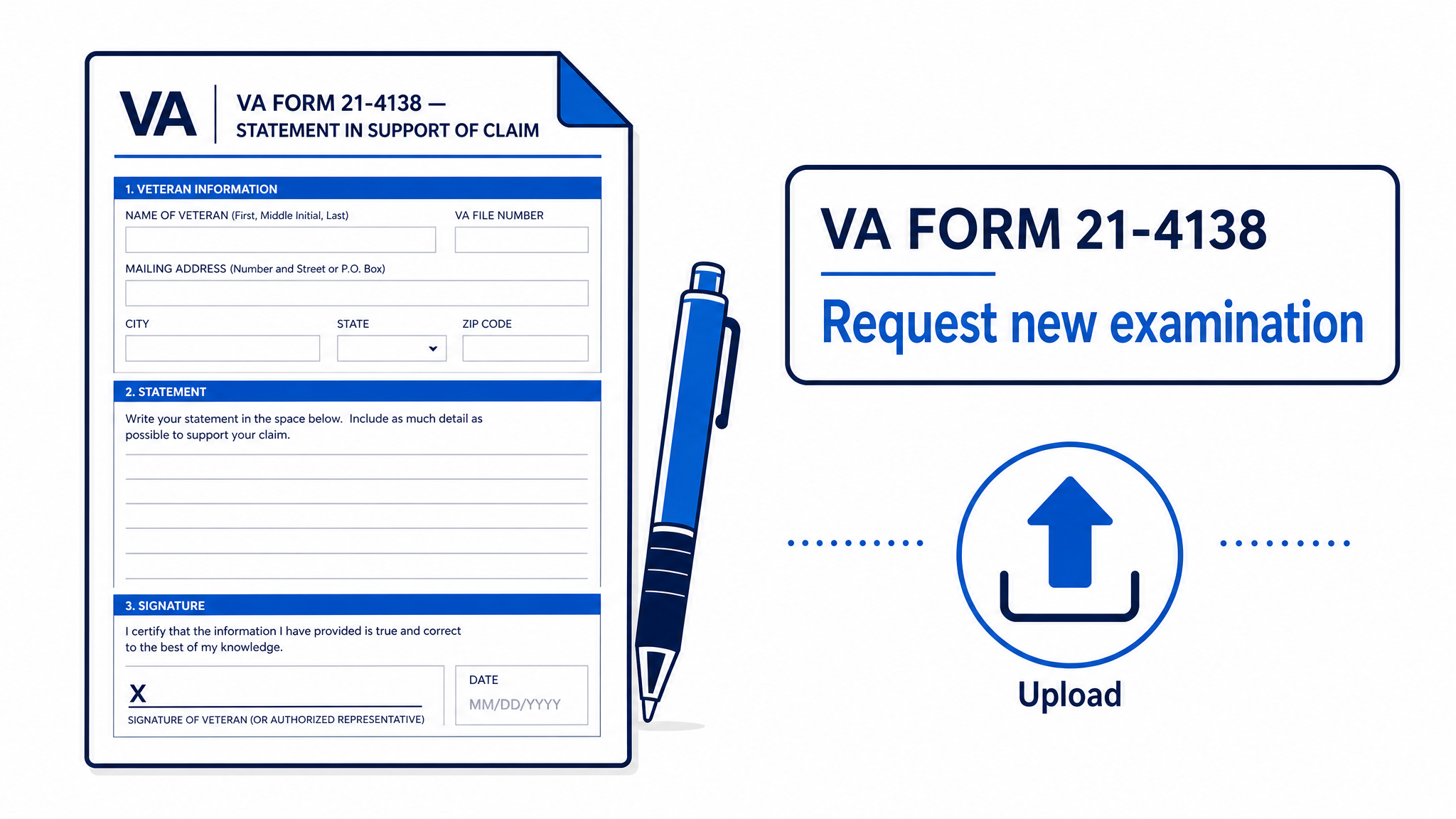
Submit a statement asking for a new examination
VA Form 21-4138, Statement in Support of Claim, filed through VA.gov or mailed to the Evidence Intake Center. State the defect, cite the authority, and request a new or supplemental examination. Do this BEFORE the decision if the claim is still open, it is far easier than undoing a decision afterward.
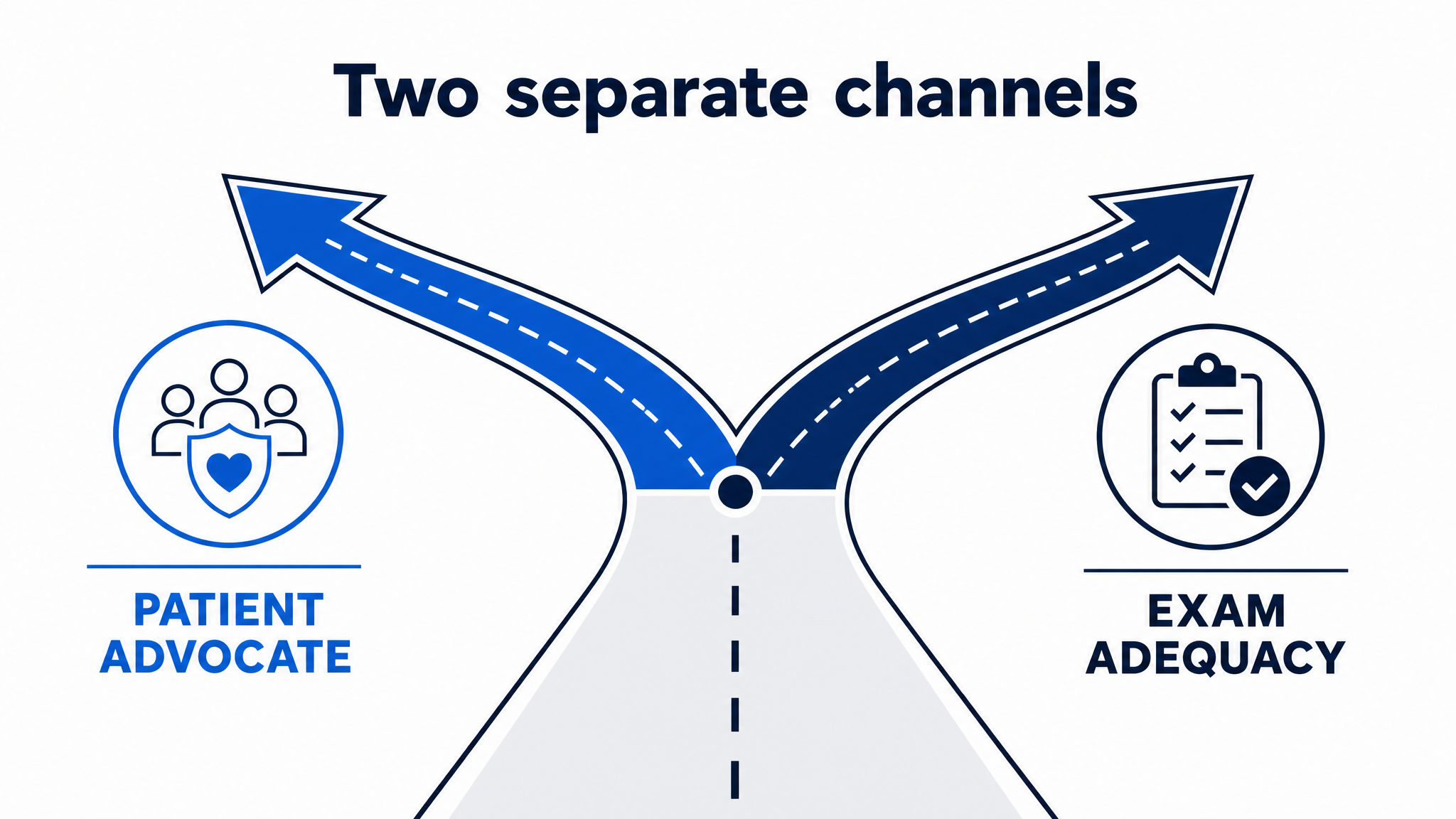
Report examiner conduct separately
If the problem is behavior rather than methodology, you were rushed out, dismissed, never touched, or treated with hostility, file a complaint with the VA facility’s Patient Advocate, or with the vendor directly for a contract exam, and copy the Regional Office. Conduct complaints and adequacy challenges are two different tracks and you can run both.

If a decision has already issued, pick the right lane
A Higher-Level Review (VA Form 20-0996) argues the VA erred on the evidence it had, the right vehicle when the exam was inadequate on its face. A Supplemental Claim (VA Form 20-0995) is the vehicle when you are adding new and relevant evidence, such as your own private range-of-motion examination or a completed DBQ from your treating provider.
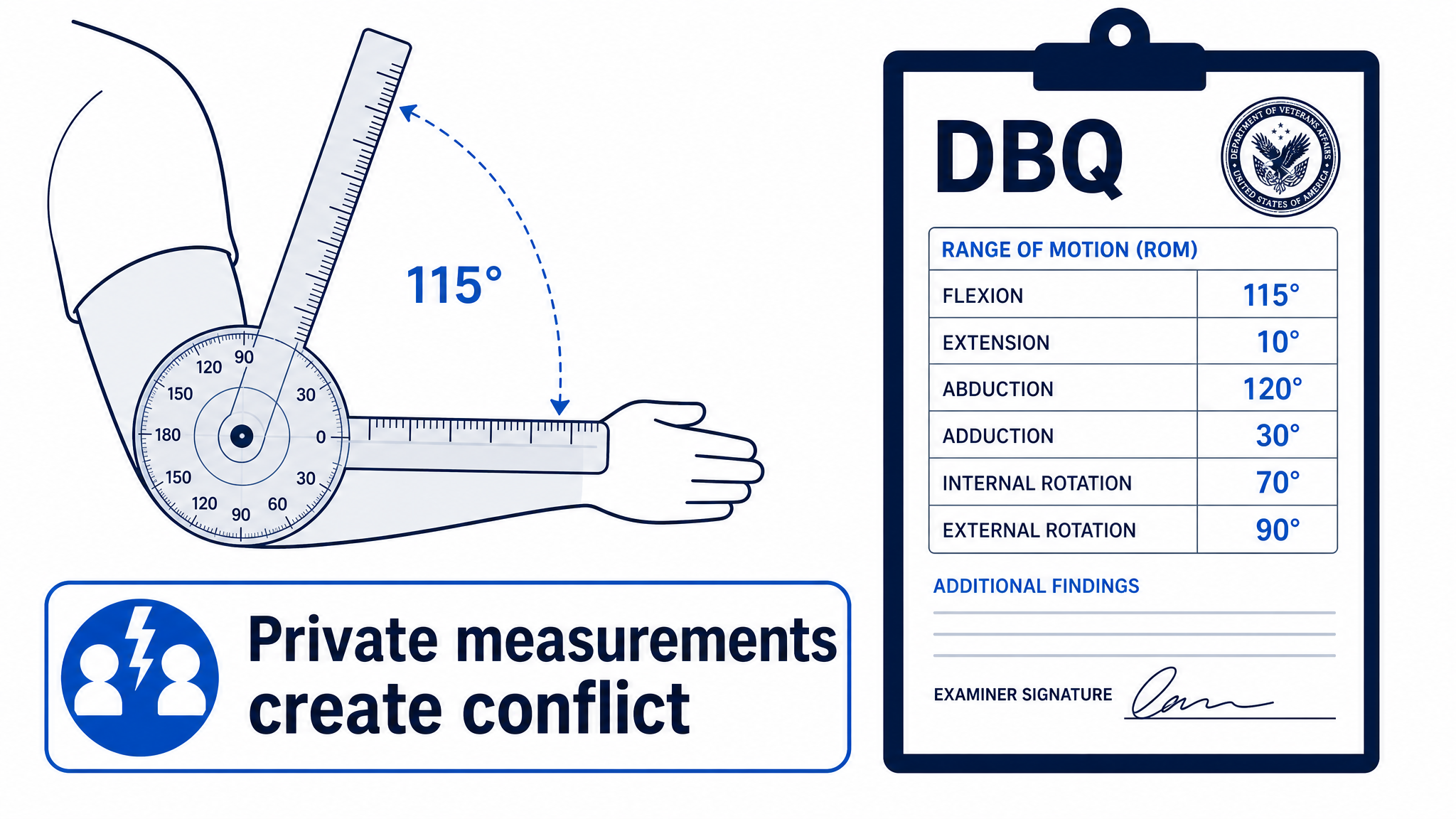
Put your own measurements on the table
A private examination with full goniometric measurements, or a DBQ completed by your own provider, creates a conflict in the evidence that the VA has to resolve, and under 38 CFR §3.102 reasonable doubt is resolved in your favor.
End of clinical section
Chronic kidney disease is rated on renal dysfunction under §4.115a, driven by lab values like creatinine, BUN, and eGFR. It is very commonly secondary to service-connected diabetes or hypertension, and dialysis warrants 100 percent., §4.115a, DC 7530–7541
The Questions Veterans Actually Ask
Chronic kidney disease is rated on renal dysfunction under §4.115a, driven by lab values like creatinine, BUN, and eGFR. It is very commonly secondary to service-connected diabetes or hypertension, and dialysis warrants 100 percent. Claims, Frequently Asked Questions
Straight answers to the questions that decide chronic kidney disease is rated on renal dysfunction under §4.115a, driven by lab values like creatinine, bun, and egfr. it is very commonly secondary to service-connected diabetes or hypertension, and dialysis warrants 100 percent. claims, the ratings, the separate evaluations, and the exam mistakes that cost veterans money. Read every answer with your own file open. If an answer depends on a record you do not have yet, that is the next thing to request, from your doctor, your unit or the VA itself.
Almost entirely on lab values. The renal dysfunction formula in 38 CFR §4.115a is built on creatinine, BUN, eGFR, proteinuria, and blood pressure, not on how you feel. A kidney claim without current bloodwork and urinalysis in the file cannot be rated properly.