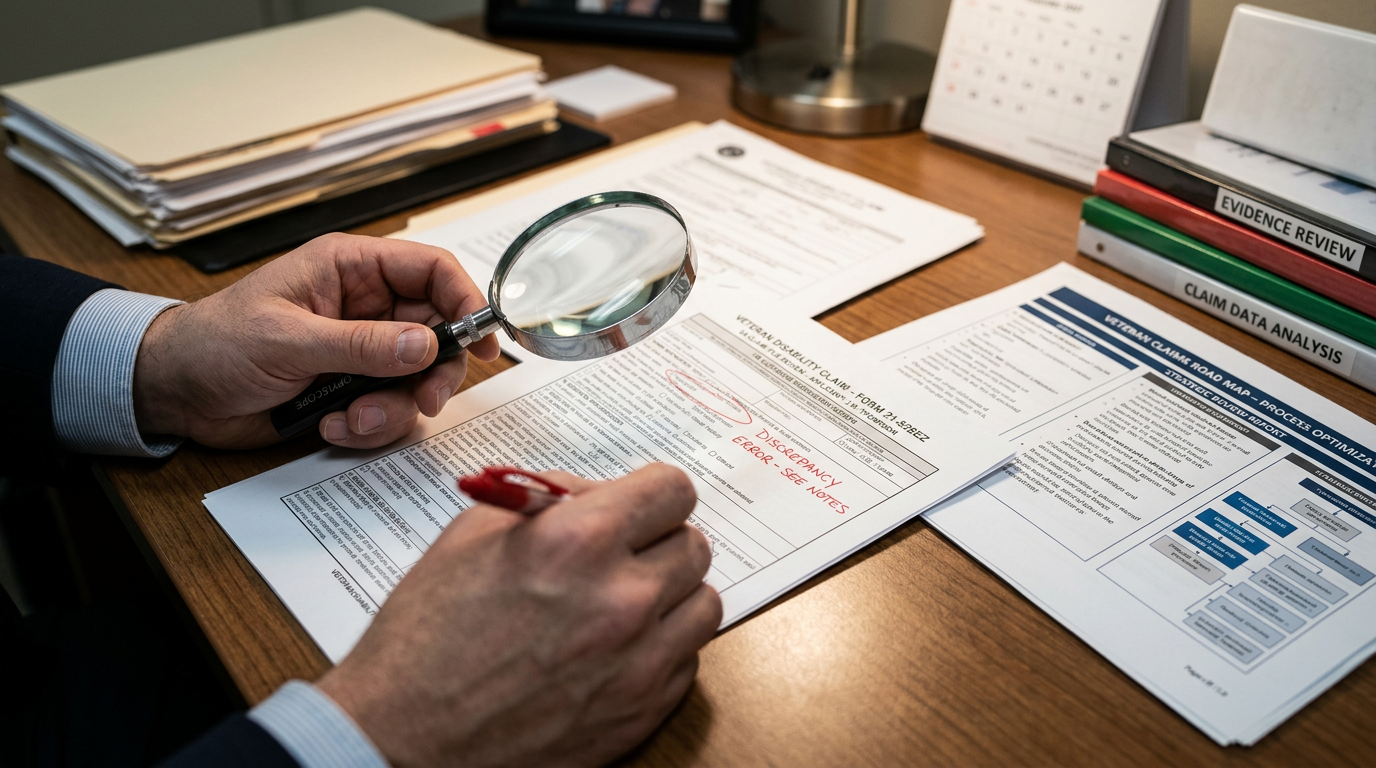
For joint claims, a few degrees on a goniometer can move your rating by tiers. Here is what a proper measurement looks like.
For musculoskeletal claims, your rating often comes down to degrees of motion measured with a goniometer. Under 38 CFR § 4.71a, those numbers map directly to rating tiers, so how the measurement is taken matters enormously.
What a proper exam includes
The examiner should measure active and passive motion, test both the injured and opposite joint for comparison, and repeat the motion to capture loss after repetitive use. Pain that begins during motion should be noted, along with where it starts.
Speak up during the test
Tell the examiner exactly where the pain begins and stop when it is genuine, do not push through silently to look tough, and do not exaggerate. An accurate, honest measurement protects you. If the exam skipped repetitive-use testing or ignored painful motion, that is a defect worth challenging.
A few degrees decide a tier. Make sure the number in your file is the real one.
The adequacy standard for C&P examinations is codified in M21-1, Part III, Subpart iv, Chapter 3 (Obtaining Medical Examinations and Medical Opinions), and the body-system-specific requirements in Chapter 4. When an examiner fails to address functional loss, skips required testing, or provides a "bare conclusion" without a rationale, the exam is legally inadequate under Barr v. Nicholson. Under Sharp v. Shulkin, an examiner who dismisses flare-up impact without a reasoned explanation has produced a deficient opinion. Under Correia v. McDonald, musculoskeletal exams must include active, passive, and weight-bearing versus non-weight-bearing testing, skip any one of those, and the exam is incomplete.